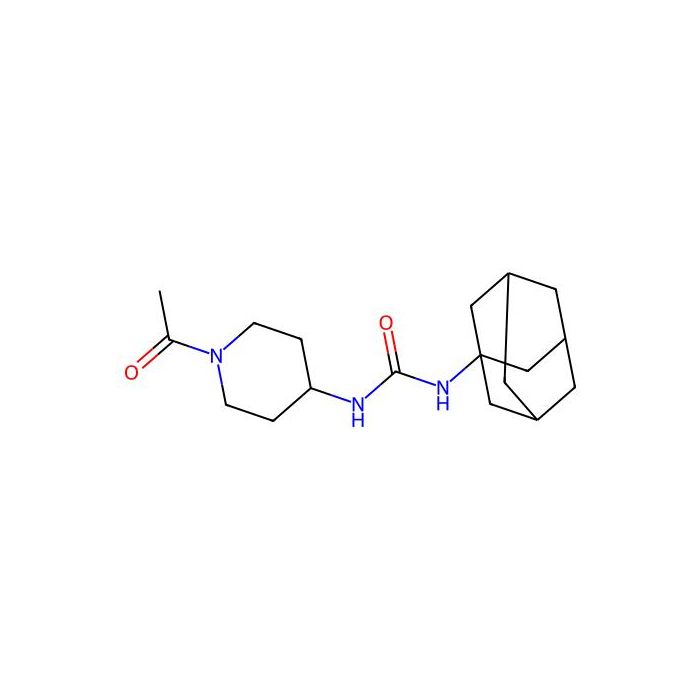
AR9281 (APAU) is a potent, selective and orally active soluble epoxide hydrolase (s-EH) inhibitor. AR-9281 can inhibits human sEH (HsEH) and murine sEH (MsEH) with IC 50 values of 13.8 nM and 1.7 nM, respectively. AR9281 can be used for the research of inflammation, hypertension and type 2 diabetes
In Vitro
AR-9281 (APAU) has inhibitory activity for human sEH (HsEH) and murine sEH (MsEH) with IC 50 values of 13.8 nM and 1.7 nM, respectively. MCE has not independently confirmed the accuracy of these methods. They are for reference only.
In Vivo
AR-9281 (APAU) (oral, 150-200 mg/dL, for 6 weeks) enhances the therapeutic effects of EETs, slows progression of hyperglycemia, protects the myocyte structure, and reduces Ca 2+ dysregulation and SERCA remodeling in hyperglycemic rats. MCE has not independently confirmed the accuracy of these methods. They are for reference only. Animal Model: T2DM rat modelDosage: 150-200 mg/dL Administration: oral(drinking), for 6 weeks Result: Attenuated the progressive increase of blood glucose concentration and preserved mitochondrial structure and myofibril morphology in cardiac myocytes. Protected the intracellular Ca 2+ effector system. Had less downregulation of sarco(endo)plasmic reticulum Ca 2+ ATPase (SERCA) and lowed expression of hypertrophic markers.
IC50& Target:IC50: 13.8 nM (HsEH),1.7 nM (MsEH)
Especificaciones
Especificaciones y pureza
10mM in DMSO
Mecanismos bioquímicos y fisiológicos
AR9281 (APAU) is a potent, selective and orally active soluble epoxide hydrolase (s-EH) inhibitor. AR-9281 can inhibits human sEH (HsEH) and murine sEH (MsEH) with IC 50 values of 13.8 nM and 1.7 nM, respectively. AR9281 can be used for the research of in
Condiciones de almacenamiento de almacenamiento
Store at -80°C
Enviado en
Dry ice packs + Cold packs
Este producto requiere envío en cadena de frío. Los servicios terrestres y otros servicios económicos no están disponibles.
Determine the necessary mass, volume, or concentration for preparing a solution.
Dilution Calculator
Determine the dilution needed to prepare a stock solution.
Reconstitution Calculator
Reseñas
Reseñas de cliente
Application Protocols
No vendor-validated application protocols are specified for this product. The following are general, non-validated handling examples for small-molecule tools; adapt to your system and verify performance empirically.
Example workflow (biochemical or cell-based assay):
Stock preparation: Dissolve compound in anhydrous DMSO to prepare a 10–50 mM stock. Vortex and, if needed, briefly sonicate. Record exact concentration.
Aliquoting: Dispense single-use aliquots (10–50 µL) into low-bind tubes or 96-well source plates. Store at −80°C.
Working dilutions: Prepare serial dilutions in DMSO, then back-dilute into assay buffer or culture medium to achieve the final test concentrations. Keep final DMSO consistent across wells (e.g., ≤1% v/v or as tolerated).
Controls: Include vehicle controls (DMSO only) and, if applicable, a known reference compound. Run in technical triplicates and across at least two independent biological replicates.
Stability check: Inspect for precipitation/turbidity after dilution. For long incubations, verify stability by LC–MS or re-measure activity at the end of the assay.
These steps are provided as general guidance and are not product specifications.
Biological Roles
Item-specific biological data are not included in this listing.
Literature context (for user orientation only; verify for your use case):
AR-9281 has been reported in the peer-reviewed literature as a small-molecule tool compound investigated for inhibition of soluble epoxide hydrolase (sEH). Such references describe its use to modulate epoxide metabolism in preclinical research systems. These literature notes are provided for general background and are not product specifications.
Practical research considerations:
If employing AR-9281 as a literature-referenced tool, confirm target engagement in your system using orthogonal readouts (e.g., biochemical enzyme activity assays, target occupancy, or pathway biomarkers) and include counter-screens to assess off-target effects.
Establish vehicle controls matched for DMSO content and verify compound stability under assay conditions (time, temperature, light, and protein content) to avoid artifactual readouts.
For mechanistic studies, consider concentration ranges that bracket reported literature potencies, but optimize empirically for your assay format and cell line or enzyme source.
No medical, therapeutic, or clinical claims are made. Use strictly for research in appropriately controlled laboratory settings.
Buffer Applications
This product is a small-molecule tool compound rather than a buffering agent. It is not used to set or maintain pH.
Practical handling in buffered systems (general):
Prepare a concentrated DMSO stock, then dilute into assay buffers (e.g., HEPES-, PBS-, or Tris-based) to the desired working concentration while keeping final DMSO low (commonly ≤0.5–1% v/v, as permitted by your assay).
To prevent precipitation, add compound stock slowly to vigorously mixed buffer or pre-mix with serum-containing media if compatible. Perform a small-scale solubility check at intended temperature and protein content.
Filter working solutions (0.22 µm, low-binding) if optical clarity is essential for spectrophotometric or imaging assays.
For any pH-dependent behavior (ionization/solubility), consult computed pKa values from verified structures or conduct a pH–solubility screen.
Green Alternatives
This product is a discrete small-molecule research compound rather than a process solvent or reagent for which greener substitutes are typically evaluated. As such, there are no direct “green alternatives” to the compound itself.
Sustainability considerations for handling and use (general):
Prefer minimal-volume, high-concentration DMSO stocks to reduce solvent waste. Consolidate assay plates to improve throughput per unit solvent.
Choose lower-hazard co-solvents (e.g., ethanol) when compatible with the assay and compound solubility.
Implement microplate formats (384/1536 wells) and acoustic dispensing to reduce DMSO usage and plastic consumables.
Deactivate and segregate organic waste streams to facilitate compliant disposal; avoid unnecessary rinses with halogenated solvents.
If your objective is to replace this tool compound functionally (e.g., within a panel), consult the literature for alternative chemical probes with similar target coverage that may offer improved stability, solubility, or synthetic accessibility. Validate biological equivalence before substitution.
Pharmaceutical Uses
No excipient, compendial, or clinical-use information is provided or implied for this product. It is supplied strictly for research use.
Relevant laboratory and pre-formulation contexts (non-clinical):
Analytical reference: May be used as a reference standard during the development of LC–MS/MS methods that quantify the compound in nonclinical matrices (e.g., microsomes) for in vitro ADME profiling.
Formulation screening (research): Exploratory solubilization in co-solvents, cyclodextrins, or lipid-based systems can be performed to support in vitro studies. These activities are distinct from any clinical formulation work and must remain within research boundaries.
Solid-state characterization: If needed for stability work, assess polymorph/amorphous content by PXRD/DSC/TGA and verify moisture uptake by DVS—none of which are specified for this item and would require in-house testing.
No pharmacopeial monographs or GMP status are claimed for this material.
Physical Properties
Item-specific physicochemical specifications are not provided in this listing. Do not assume values for critical method development.
Appearance: Not specified for this item; refer to CoA/Spec Sheet.
Melting point (MP): Not specified for this item; refer to CoA/Spec Sheet.
Boiling point (BP): Not applicable/rarely reported for solid screening compounds; Not specified for this item; refer to CoA/Spec Sheet.
Density: Not specified for this item; refer to CoA/Spec Sheet.
Refractive index: Not applicable for solids; Not specified for this item; refer to CoA/Spec Sheet.
Solubility: Not specified for this item; refer to CoA/Spec Sheet. Practical note (general): library compounds are commonly prepared as DMSO stocks (e.g., 10–50 mM) and diluted into assay buffers, monitoring final DMSO percentage.
logP/logD, pKa: Not specified for this item; refer to CoA/Spec Sheet.
Literature/computational reminders:
If predictive values (cLogP, TPSA, pKa) are required for screening design, compute from a verified structure (e.g., via PubChem CID 12000797) using cheminformatics tools; treat such values as guidance only unless confirmed experimentally for this batch.
Quality and Grades
Grade/Purity: Not specified for this item; refer to CoA/Spec Sheet.
Context for screening compounds and library-grade materials:
Library-grade or discovery-grade small molecules are typically provided at high chemical purity (often ≥95% by HPLC), but exact thresholds, chromatographic methods, and reporting conventions vary by supplier. For this item, rely on the provided CoA for the definitive assay method (e.g., HPLC/UPLC/ELSD) and any orthogonal verification (NMR, HRMS).
UV profile and residual solvent limits are critical for analytics but are not specified here. Request a current CoA for details such as peak purity, ret. time windows, and detection wavelengths.
Stabilizers/inhibitors: Not specified for this item; refer to CoA/Spec Sheet. If no stabilizer is present, minimize exposure to light, air, and moisture per best practices.
Batch traceability: Use the SKU and lot number on the vial/CoA for internal documentation. If using the compound in plate-based screening, record plate maps and barcodes to maintain sample provenance.
When to request additional quality documentation:
For biophysical assays (SPR, ITC, DSF) and in vitro ADME, trace impurities can confound results. Consider obtaining lot-specific spectral data (1H/13C NMR, LC–MS) and impurity profiles before critical decision-making experiments.
Reaction and Applications
Primary use case (research-only): AR-9281 is typically employed as a reference/tool compound within small-molecule and compound-library workflows. No therapeutic or clinical claims are made or implied.
Common applications in discovery settings (general):
Biochemical and cell-based assays: Evaluate target engagement, pathway modulation, and phenotypic responses. Establish concentration–response curves (e.g., 10-point, half-log dilutions) with appropriate vehicle controls.
Positive control/reference standard: Benchmark assay performance, Z’ factor, and dynamic range when studying the same or related targets reported in the literature.
Analytical standard: Calibrate LC–MS methods for quantitation in microsomal stability, plasma protein binding, or permeability studies (if permitted by your workflow).
Probe development: Serve as a starting point for SAR exploration, analog design, or derivatization for target-ID chemoproteomics (e.g., biotinylation/photoaffinity tags), pending IP and licensing considerations.
Practical notes:
Prepare and store concentrated DMSO aliquots at −80°C to minimize degradation and adsorption losses. Thaw on ice, mix gently, and avoid repeated freeze–thaw cycles.
Confirm identity/purity of the working lot by LC–MS and, if critical, by NMR before mechanistic or high-value studies.
For cross-platform reproducibility, document stock concentration verification by quantitative NMR or UV-Vis (if chromophore present) and standardize dilution schemes across assay runs.
Reaction Conditions
Not typically applicable. AR-9281 is provided as a discrete small-molecule research tool rather than a reagent used to mediate or catalyze transformations.
If derivatization is undertaken in a medicinal chemistry context (general, literature-agnostic guidance):
Confirm structure and functional handles from authoritative sources (CoA, primary literature) before planning reactions.
Choose mild conditions compatible with sensitive heterocycles and urea/amide motifs commonly found in discovery compounds (if present; do not assume without verification).
Employ anhydrous, oxygen-controlled techniques for air/moisture-sensitive transformations and monitor by LC–MS.
No item-specific reaction temperatures, catalysts, or yields are provided or implied for this product.
Safety and Handling
Safety information specific to this item is limited in the current listing. Always consult the SDS for authoritative guidance.
GHS classification: Not specified for this item; refer to SDS.
Signal word / H-statements / pictograms: Not specified for this item; refer to SDS.
Storage conditions (Product Data): Store at −80°C.
General laboratory precautions for small-molecule screening compounds:
PPE: lab coat, safety glasses, and appropriate chemically resistant gloves. Avoid inhalation of dust/aerosols. Work in a fume hood during weighing and initial dissolution.
Incompatibilities: Avoid strong oxidizers and strong acids/bases until compatibility is known. Prevent moisture ingress for hygroscopic or hydrolytically sensitive compounds (use desiccation and anhydrous solvents as needed).
Special risks: Many discovery compounds are of unknown acute/chronic toxicity. Minimize exposure, avoid skin contact, and prevent environmental release. Dispose according to institutional hazardous waste procedures.
First aid (overview; defer to SDS): If inhaled—fresh air; skin/eye contact—rinse with water for 15 minutes; ingestion—seek medical attention. Provide SDS to medical personnel.
Handling tips: Warm sealed vials to room temperature before opening to avoid moisture condensation. If making concentrated DMSO stocks, filter-sterilize if sterility is required and aliquot to minimize freeze–thaw cycles.
Solvent Selection
Given the absence of item-specific solubility data, select solvents based on general best practices for small-molecule tools.
Primary stock solvent (general): Anhydrous DMSO is most common for discovery compounds due to broad solvating power and assay compatibility at low final percentages (typically ≤0.5–1% v/v in assay wells). Verify assay tolerance.
Secondary options: DMF, ethanol, or aqueous buffers with co-solvent and pH adjustment (if ionizable groups are present; verify from structure). Use gentle warming (≤37°C) and sonication to aid dissolution when appropriate.
Aqueous work: To introduce into aqueous buffers, prepare a concentrated DMSO stock, then perform stepwise dilutions to control final DMSO content and prevent precipitation. Include matched DMSO controls.
Filtration: If clarity is required, pass diluted working solutions through low-protein-binding 0.22 µm filters. Avoid filtering highly concentrated DMSO stocks.
Comparison (general guidance):
DMSO: highest solvency, best for small volumes, but hygroscopic—store dry and aliquot.
Ethanol: more volatile, lower solvency breadth; can impact certain assays.
Aqueous buffer only: feasible if compound is sufficiently ionizable/hydrophilic; confirm by small-scale tests.
Always confirm actual solubility/compatibility with a small pilot dissolution test before committing assay resources.
Storage and Reconstitution
Storage (Product Data): Store at −80°C. Maintain the container tightly closed, protected from moisture and light.
Shipping (Product Data): Shipped on dry ice packs + cold packs. Inspect upon receipt; if thawing occurred, assess integrity before use.
Reconstitution: Not specified for this item; refer to CoA/Spec Sheet.
General best practices for small-molecule library compounds:
Reconstitution solvent: Typically anhydrous DMSO. If aqueous stocks are required, use controlled co-solvent addition and verify solubility at working pH.
Aliquoting: Prepare single-use aliquots to avoid repeated freeze–thaw. Label with compound name, lot, concentration, date, and operator.
Freeze–thaw: Minimize cycles. Thaw on ice or at room temperature, mix gently, and promptly return unused aliquots to −80°C.
Light/moisture: Use amber vials or foil wrapping and desiccation if the compound is photosensitive or hygroscopic (not specified for this item).
Stability: No shelf-life or stability data are provided here. For critical studies, confirm integrity over time by LC–MS/HPLC and maintain an internal usage log tied to lot numbers.
Research Use Only: As indicated in the Product Data, this material is for research use only and is not intended for human or veterinary use.
Structure and Identity
Brief ID summary for a small-molecule screening compound supplied for research use.
Product name: AR-9281 (SKU: A655278)
CAS: 913548-29-5
PubChem CID: 12000797 (literature identifier)
Molecular formula: Not specified for this item; refer to CoA/Spec Sheet.
Molecular weight: Not specified for this item; refer to CoA/Spec Sheet.
SMILES: Not specified for this item; refer to CoA/Spec Sheet.
InChIKey: Not specified for this item; refer to CoA/Spec Sheet.
Structural features (general, literature):
AR-9281 is widely referenced in the literature as a small-molecule inhibitor used in biochemical studies; specific ring systems/functional motifs are not provided in this product entry. Do not infer structural details for experimental design without consulting the CoA/SDS or primary literature for this exact CAS.
2D structure description (general guidance):
A 2D structure is not provided here. For cheminformatics tasks (e.g., similarity search, docking input), retrieve structure from trusted databases using CAS 913548-29-5 or PubChem CID 12000797 and verify via CoA.
Synthetic Utility
AR-9281 is supplied as a finished small molecule for use as a research tool. It is not typically employed as a synthetic reagent or building block in general organic synthesis.
Potential roles in medicinal chemistry workflows (general):
SAR starting point: Can be used as a reference structure when designing analogs targeting the same biological pathway. Derivatization strategies (bioisosteres, polarity tuning, vector exploration) should be informed by a verified structure from databases and IP considerations.
Analytical comparator: Useful as a benchmark in LC–MS method development to confirm retention windows and fragmentation behavior for analog series.
Because no functional groups or reactivity patterns are specified in this product entry, no reaction-specific guidance (e.g., protection/deprotection tactics or named reaction handles) can be provided. For any synthetic elaboration or probe attachment, first obtain and confirm the exact structure, then plan transformations consistent with the compound’s stability profile.
Target Specificity
No target specificity data are provided for this item in the product listing. For antibodies and biologicals this section would include clone/epitope/isotype details; these are not applicable to a small-molecule product.
If target information is required for experimental planning, consult the primary literature associated with CAS 913548-29-5 or PubChem CID 12000797 and verify that the referenced data correspond to the same structure and lot.
Preguntas frecuentes
How should this product be stored?
Store at ?80 °C. Ultra-low temperature storage is required to maintain the specified shelf life.
Utilizamos cookies para garantizar el correcto funcionamiento del sitio web y, cuando esté permitido, para mejorar su experiencia. Puede gestionar sus preferencias en cualquier momento en Configuración. Más información en nuestra Política de Cookies.
¿Quieres que te enviemos un mensaje cuando tengamos descuentos disponibles?
Recordármelo más tarde
¡Gracias! Por favor, revisa tu bandeja de entrada de correo electrónico para confirmar.
Products are supplied to verified businesses, institutions, and qualified professionals for research and development use only. Not for use in humans, animals, diagnosis, or therapy.

 I2623753