
Determine the necessary mass, volume, or concentration for preparing a solution.
| Activity Type | Activity Value -log(M) | Mechanism of Action | Activity Reference | Publications (PubMed IDs) |
|---|
Moligand™, 10mM in DMSO Moligand™ for sensitive chromatographic and analytical workflows requiring minimal baseline interference.
Store at -80°C Ships Dry ice packs + Cold packs Check lot-specific COA for exact specifications.
SDS, COA, datasheet, and spec sheet available for download. Lot-specific COA accessible via lot number lookup.
Cited in 1 peer-reviewed publications across chromatography, organic synthesis, and cross-coupling reactions.
Information
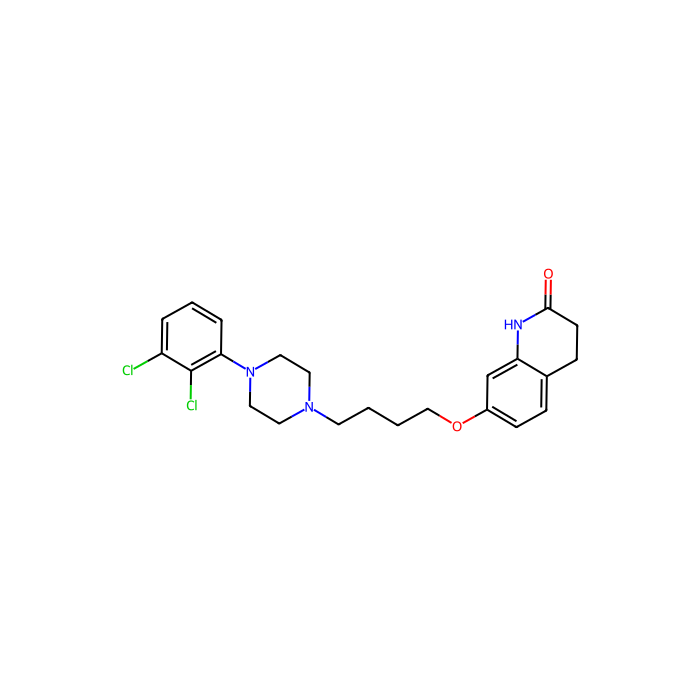
Aripiprazole (OPC-14597) is a novel atypical antipsychotic drug that is reported to be a high-affinity5-HT receptorpartial agonist.
In vitro
Aripiprazole binds with high affinity to both the G protein-coupled and uncoupled states of receptors. Aripiprazole potently activates D2 receptor-mediated inhibition of cAMP accumulation. Aripiprazole has highest affinity for h5-HT(2B)-, hD(2L)-, and hD(3)-dopamine receptors, but also has significant affinity (5-30 nM) for several other 5-HT receptors (5-HT(1A), 5-HT(2A), 5-HT(7)), as well as alpha(1A)-adrenergic and hH(1)-histamine receptors. Aripiprazole has less affinity (30-200 nM) for other G protein-coupled receptors, including the 5-HT(1D), 5-HT(2C), alpha(1B)-, alpha(2A)-, alpha(2B)-, alpha(2C)-, beta(1)-, and beta(2)-adrenergic, and H(3)-histamine receptors. Aripiprazole is an inverse agonist at 5-HT(2B) receptors and displays partial agonist actions at 5-HT(2A), 5-HT(2C), D(3), and D(4) receptors.
In vivo
Aripiprazole reduces extracellular 5-HIAA concentrations in the medial prefrontal cortex and striatum of drug-naive rats, but not in chronic Aripiprazole-pretreated rats. Aripiprazole, 0.1 mg/kg and 0.3 mg/kg, significantly increases dopamine release in the hippocampus of rats. Aripiprazole, 0.3 mg/kg, slightly but significantly increases dopamine release in the medial prefrontal cortex but not in the nucleus accumbens. Aripiprazole, 3.0 mg/kg and 10 mg/kg, significantly decreases dopamine release in the nucleus accumbens but not the medical prefrontal cortex. Aripiprazole, 0.3 mg/kg, transiently potentiates haloperidol (0.1 mg/kg)-induced dopamine release in the medial prefrontal cortex but inhibited that in the nucleus accumbens.
Cell Data
cell lines:
Concentrations:
Incubation Time:
Powder Purity:≥98%
| ALogP | 4.6 |
|---|
| Isomeric SMILES | C1CC(=O)NC2=C1C=CC(=C2)OCCCCN3CCN(CC3)C4=C(C(=CC=C4)Cl)Cl |
|---|---|
| WGK Germany | 3 |
| RTECS | VC8275950 |
| Molecular Weight | 448.39 |
| Reaxy-Rn | 7951706 |
| Reaxys-RN_link_address | https://www.reaxys.com/reaxys/secured/hopinto.do?context=S&query=IDE.XRN=7951706&ln= |
Comprehensive hazard, handling, storage, and regulatory compliance document.
Download SDS →Lot-specific quality data. Enter your lot number to retrieve the exact COA.
Look up COA →Full quality attributes and acceptance criteria for this grade.
View spec sheet →| Activity Type | Activity Value -log(M) | Mechanism of Action | Activity Reference | Publications (PubMed IDs) |
|---|
| Activity Type | Activity Value -log(M) | Mechanism of Action | Activity Reference | Publications (PubMed IDs) |
|---|
| Activity Type | Activity Value -log(M) | Mechanism of Action | Activity Reference | Publications (PubMed IDs) |
|---|
| Activity Type | Activity Value -log(M) | Mechanism of Action | Activity Reference | Publications (PubMed IDs) |
|---|
| Activity Type | Activity Value -log(M) | Mechanism of Action | Activity Reference | Publications (PubMed IDs) |
|---|
| Activity Type | Activity Value -log(M) | Mechanism of Action | Activity Reference | Publications (PubMed IDs) |
|---|
| Activity Type | Activity Value -log(M) | Mechanism of Action | Activity Reference | Publications (PubMed IDs) |
|---|
| Activity Type | Activity Value -log(M) | Mechanism of Action | Activity Reference | Publications (PubMed IDs) |
|---|
| Activity Type | Activity Value -log(M) | Mechanism of Action | Activity Reference | Publications (PubMed IDs) |
|---|
| Activity Type | Activity Value -log(M) | Mechanism of Action | Activity Reference | Publications (PubMed IDs) |
|---|
| Activity Type | Activity Value -log(M) | Mechanism of Action | Activity Reference | Publications (PubMed IDs) |
|---|
| Activity Type | Activity Value -log(M) | Mechanism of Action | Activity Reference | Publications (PubMed IDs) |
|---|
| Activity Type | Activity Value -log(M) | Mechanism of Action | Activity Reference | Publications (PubMed IDs) |
|---|
| Activity Type | Activity Value -log(M) | Mechanism of Action | Activity Reference | Publications (PubMed IDs) |
|---|
| Activity Type | Activity Value -log(M) | Mechanism of Action | Activity Reference | Publications (PubMed IDs) |
|---|
| Activity Type | Activity Value -log(M) | Mechanism of Action | Activity Reference | Publications (PubMed IDs) |
|---|
| Activity Type | Activity Value -log(M) | Mechanism of Action | Activity Reference | Publications (PubMed IDs) |
|---|
| Activity Type | Activity Value -log(M) | Mechanism of Action | Activity Reference | Publications (PubMed IDs) |
|---|
| Activity Type | Activity Value -log(M) | Mechanism of Action | Activity Reference | Publications (PubMed IDs) |
|---|
| Activity Type | Activity Value -log(M) | Mechanism of Action | Activity Reference | Publications (PubMed IDs) |
|---|
| Activity Type | Activity Value -log(M) | Mechanism of Action | Activity Reference | Publications (PubMed IDs) |
|---|
| Solubility | Solubility (25°C) In vitro DMSO: 37 mg/mL (198.65 mM); |
|---|---|
| Melt Point(°C) | 149 °C |
| 1. Huanhuan Yang, Cong Liu, Chuanhong Zhu, Yan Zheng, Juan Li, Qianyun Zhu, Hao Wang, Xiangming Fang, Quan Liu, Man Liang, Zilong Liu. (2023) Determination of ten antipsychotics in blood, hair and nails: Validation of a LC–MS/MS method and forensic application of keratinized matrix analysis. JOURNAL OF PHARMACEUTICAL AND BIOMEDICAL ANALYSIS, [PMID:37406464] [10.1016/j.jpba.2023.115557] |
Our grade selection guide covers purity, stabilizer status, and application suitability for all variants in our catalog.
View Moligand™ grade guide →