CALIDAD & PUREZAMoligand™?Moligand™ — Aladdin's line of ligands and bioactive small molecules. Use for receptor, pathway, and binding studies needing defined small-molecule tools.
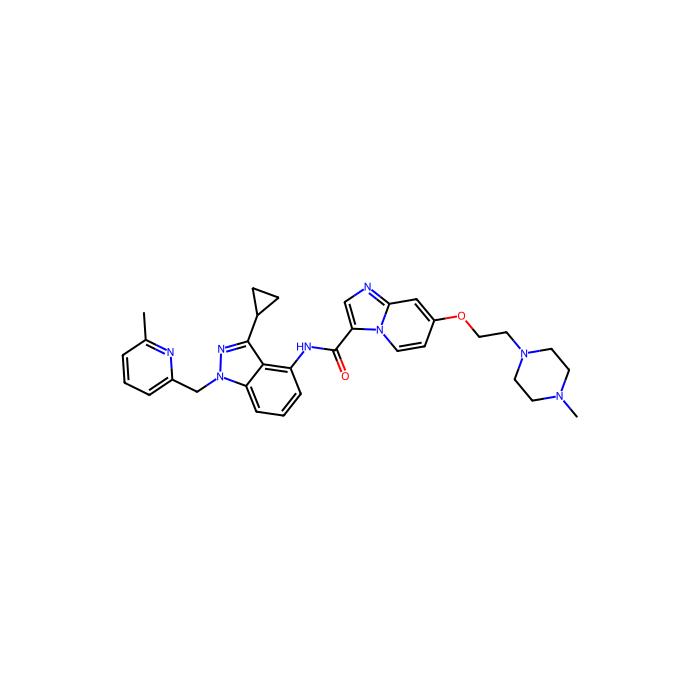
This compound belongs to the class of organic compounds known as imidazopyridines. These are organic polycyclic compounds containing an imidazole ring fused to a pyridine ring. Imidazole is 5-membered ring consisting of three carbon atoms, and two nitrogen centers at the 1- and 3-positions. Pyridine is a 6-membered ring consisting of five carbon atoms and one nitrogen center.
External Descriptors
Not available
1. Djoumbou Feunang Y, Eisner R, Knox C, Chepelev L, Hastings J, Owen G, Fahy E, Steinbeck C, Subramanian S, Bolton E, Greiner R, and Wishart DS. ClassyFire: Automated Chemical Classification With A Comprehensive, Computable Taxonomy. Journal of Cheminformatics, 2016, 8:61.
Determine the necessary mass, volume, or concentration for preparing a solution.
Dilution Calculator
Determine the dilution needed to prepare a stock solution.
Reconstitution Calculator
Reseñas
Reseñas de cliente
Application Protocols
Only application details provided in Product Data may be listed here.
Tested applications, recommended dilutions, or positive controls: Not specified for this catalog item.
General note:
For internal method development, establish dose–response curves (e.g., 10-point serial dilutions) and include vehicle controls matched for DMSO percentage. Record plate maps and lot numbers for reproducibility. This is general guidance, not a validated protocol for this item.
Biological Roles
Context (literature): ARRY-382 is reported in the scientific literature as a small-molecule inhibitor designed to modulate receptor tyrosine kinase signaling, with frequent reference to colony-stimulating factor 1 receptor (CSF1R) pathway studies. The following is general background and should be validated for your system.
Putative target class (literature): Receptor tyrosine kinases involved in macrophage biology (e.g., CSF1R) have been studied using ARRY-382 as a probe compound.
Cellular context: Modulation of macrophage lineage signaling is commonly assessed via phosphorylation state changes, transcriptional outputs, and functional assays (migration, cytokine release) after compound treatment.
Selectivity considerations: Literature often evaluates off-target kinase panels to contextualize on-target effects; users should confirm selectivity under their assay conditions.
Assay endpoints: p-CSF1R/p-ERK readouts, viability, and cytokine profiling are typical assay observables in discovery biology.
Important notes:
No medical or clinical claims are made. This product is for research use only.
Verify the exact target, potency, and selectivity of the specific lot you use by consulting primary references and performing in-house controls, as this catalog entry does not specify these parameters.
Buffer Applications
Not typically applicable. ARRY-382 is a bioactive small molecule and is not used as a pH buffer component.
Practical note:
When dosing into buffered media, ensure compatibility of the co-solvent (commonly DMSO) with the buffer system and maintain consistent final solvent percentages across controls and treatments to avoid pH or solvation artifacts.
Green Alternatives
Green chemistry considerations focus on solvent use, handling, and waste minimization during bioassay workflows with small-molecule probes like ARRY-382.
Opportunities:
Prefer water-compatible protocols: Use minimal DMSO by preparing concentrated stocks and performing high-fold dilutions to reduce solvent burden per assay.
Solvent selection: If ethanol is acceptable in your assay, it may offer lower environmental impact than DMF and similar to DMSO; confirm solubility and biological tolerance.
Miniaturization: Implement 384/1536-well formats and acoustic dispensing to reduce total solvent and compound consumption.
Closed-transfer practices: Reduce volatilization and operator exposure.
Illustrative comparison (general):
DMSO: High solvency, low volatility, widely accepted in screening; moderate environmental impact; readily recyclable in some facilities.
Ethanol: Bio-based and low toxicity comparatively; limited solvency for some heteroaromatics; flammable.
DMF: Strong solvency but reproductive toxin; avoid when possible for screening stocks.
Waste management:
Segregate DMSO/organic waste from aqueous assay waste for optimal treatment.
Use multi-dose aliquots to minimize freeze–thaw cycles and product loss, thereby reducing re-synthesis/re-purchase footprint.
Pharmaceutical Uses
Not applicable as an excipient or processing aid. This listing is supplied for research use only and is not intended for human or veterinary use, drug formulation, or clinical applications.
Context for formulation scientists (general research use):
If exploring preclinical formulations for in vitro or ex vivo studies, typical approaches include DMSO-based concentrates followed by dilution into acceptable vehicles (e.g., buffered saline with co-solvent or surfactant). Such practices must remain within research settings and comply with institutional policies.
Compliance note:
No pharmacopeial monograph or compendial grade is claimed in this catalog entry. Do not use for manufacturing or clinical studies.
Physical Properties
Only general guidance is provided here; do not treat as specifications.
Appearance: Not specified for this item; refer to CoA/Spec Sheet.
Melting point (MP): Not specified for this item; refer to CoA/Spec Sheet.
Boiling point (BP): Not applicable/Not specified (complex organic solids are typically handled below BP); refer to CoA/Spec Sheet.
Density: Not specified for this item; refer to CoA/Spec Sheet.
Refractive index: Not applicable to solids; not specified.
Solubility: Item-specific solubility is not provided. For small-molecule screening compounds, DMSO is commonly used to prepare stock solutions (literature practice). Aqueous solubility often requires co-solvent or surfactant systems; verify experimentally.
LogP/logD, pKa: Not specified for this item; consult primary literature or computational predictions if needed for assay design.
Practical notes (general, literature-based):
Preparing 10–50 mM DMSO stock solutions is common for kinase-focused tool compounds. Filter (0.2 µm PTFE) if particulates are present.
For aqueous assays, pre-dilute DMSO stocks into media/buffer to achieve a low final DMSO fraction (e.g., ≤0.1–0.5%), validating solubility and assay tolerance.
If crystallization/precipitation occurs on dilution, consider serial pre-dilution in DMSO or use solvent blends (e.g., DMSO:EtOH or DMSO:PEG400) compatible with the bioassay.
Quality and Grades
Grade/Purity: Moligand™ (Aladdin). This designation indicates supply as a small-molecule ligand/chemical probe suitable for discovery research and screening workflows.
What Moligand™ typically implies (general expectations; not item-specific specifications):
Identity confirmation by modern analytical methods (e.g., LC–MS, NMR) appropriate for small-molecule probes.
Purity appropriate for biochemical/cellular screening. Exact purity thresholds, counter-ions, salt form, and residual solvents are item-specific and should be verified on the CoA/Spec Sheet.
Packaging intended to reduce moisture/light exposure when relevant, and to support accurate mass recovery for stock preparation.
Item-specific notes for ARRY-382:
Appearance: Not specified for this item; refer to CoA/Spec Sheet.
Stabilizers/antioxidants: Not specified for this item; refer to CoA/Spec Sheet.
UV cutoff/UV profile, metal content, water/peroxide content: Not specified for this item; refer to CoA/Spec Sheet.
Recommendations:
For reproducible screening data, record lot number and retain CoA with any reported purity and analytical traces.
If your workflow requires additional QC (e.g., enantiomeric purity, counter-ion quantitation), consider in-house verification by chiral HPLC, Karl Fischer, or ion chromatography as applicable.
Reaction and Applications
This product is supplied as a bioactive research compound rather than a synthetic reagent. As such, its primary applications are in discovery biology and chemical biology rather than as a substrate, catalyst, or solvent for chemical reactions.
Representative research applications (general, literature-based for small-molecule kinase probes):
Pathway interrogation: Use as a chemical tool to modulate specific signaling nodes in cellular models; evaluate downstream biomarkers by WB/ELISA/transcriptomics.
Phenotypic screening: Inclusion in targeted libraries against macrophage/immune-modulatory pathways for phenotype-based assays; follow with target deconvolution as needed.
Target engagement: Perform CETSA/thermal shift or NanoBRET/kinase panel assays to quantify binding/engagement in cells or lysates (requires appropriate controls and reference standards).
Combination studies: Explore pathway crosstalk with orthogonal inhibitors to assess synthetic lethality or compensatory signaling (strictly research context).
Not typically applicable:
Named synthetic reactions (e.g., Grignard, cross-coupling) are not relevant to end-users for this catalog item. For synthetic methods to prepare analogs, consult medicinal chemistry literature rather than using ARRY-382 itself as a reagent.
Reaction Conditions
Synthetic reaction conditions are not applicable to this finished probe for routine user workflows. Instead, the focus is on solution preparation and dosing conditions for biological assays.
General assay preparation guidance (literature-based best practices):
Stock solutions: Prepare concentrated stocks in anhydrous DMSO (e.g., 10–50 mM) to minimize final DMSO in assays; vortex and, if needed, sonicate gently to ensure complete dissolution.
Working solutions: Serially dilute stocks into assay-compatible media while keeping the final DMSO fraction low (commonly ≤0.1–0.5% v/v). Maintain constant solvent levels across controls and treatments.
Filtration: If particulate is observed, pass through a 0.2 µm PTFE syringe filter; avoid cellulose ester filters that may adsorb hydrophobic analytes.
Light/temperature: Many kinase probes are light- and heat-sensitive to varying degrees; prepare fresh working solutions immediately before use, minimizing bench time.
Adsorption control: Use low-bind plates and polypropylene tubes; pre-wet tips with solution when preparing sub-µM dilutions.
All values above are general literature practices and not specifications for this item. Validate conditions for your specific assay and instrumentation.
Safety and Handling
Safety information is limited in this catalog entry. Always consult the product-specific SDS for authoritative guidance.
GHS Classification: Not specified for this item; refer to SDS.
Signal Word: Not specified for this item; refer to SDS.
Hazard (H) Statements: Not specified for this item; refer to SDS.
Pictograms: Not specified for this item; refer to SDS.
General laboratory precautions (good practice for organic research compounds):
PPE: Wear lab coat, nitrile gloves, and safety glasses; handle powders and DMSO solutions in a fume hood to avoid inhalation/dermal exposure.
Avoid: Inhalation of dust, skin/eye contact, ingestion. Prevent aerosolization during weighing and solution prep.
Incompatibilities: Strong oxidizers and strong acids/bases may cause degradation of many heteroatom-containing organics; segregate until compatibility is known (general guidance).
First aid (overview; defer to SDS): If on skin, wash with soap and water; if in eyes, rinse cautiously with water for several minutes; if inhaled, move to fresh air; if ingested, seek medical attention. Provide SDS to responders.
Waste: Collect solutions/solids as organic hazardous waste. Decontaminate tools/benches per institutional policy.
Special notes:
Many kinase-targeted small molecules are bioactive at low concentrations. Minimize environmental release and surface contamination; wipe down work areas after use.
Solvent Selection
Intended use is as a small-molecule research probe; solvent choice is typically driven by bioassay compatibility rather than synthetic operations.
General guidance (literature practice for discovery compounds):
Primary stock solvent: DMSO is the default due to broad solubilizing power and compatibility with biochemical and cell-based assays.
Alternative organic cosolvents: DMF, ethanol, or methanol can sometimes aid pre-dissolution before buffer dilution. Verify assay compatibility and cytotoxicity.
Aqueous media: Many kinase-oriented molecules have limited intrinsic aqueous solubility. Achieve target concentrations by serial dilution of DMSO stocks into buffer/media while keeping final DMSO low (e.g., ≤0.1–0.5% v/v), or by using acceptable cosolvent blends.
Surfactant aids: Low levels of non-ionic surfactants (e.g., Pluronic F-68) or BSA can reduce adsorption/precipitation in some cell assays; validate case-by-case.
Adsorption minimization: Use polypropylene or low-bind labware; pre-rinse pipette tips with the dosing solution to improve accuracy at low nM–µM levels.
Comparison (context):
DMSO vs ethanol: DMSO offers higher solvating ability for polar/aromatic heterocycles; ethanol may be preferable for microbial assays with strict DMSO limits. Always confirm assay tolerance.
Storage and Reconstitution
Storage Conditions (Product Data): Store at -20°C.
Shipping (Product Data): Shipped in ice chest with ice pads.
General guidance for small-molecule probes (not item-specific specifications):
Protect from moisture and light during storage. Keep container tightly closed. If supplied as a solid, allow vial to equilibrate to room temperature in a desiccator before opening to prevent condensation.
For solution aliquots: If preparing DMSO stocks, dispense into single-use aliquots to avoid repeated freeze–thaw cycles. Store frozen (−20°C) or colder based on your stability data.
Thawing: Warm to room temperature before opening to minimize condensation; vortex after thaw. Inspect for precipitation or discoloration and discard if integrity is questionable.
Reconstitution: Use anhydrous DMSO for initial dissolution. If aqueous working solutions are required, dilute immediately before use to the desired concentration, keeping the final DMSO fraction consistent across samples.
Disclaimer:
Specific stability, solubility, and concentration limits are not specified for this item; refer to the CoA/Spec Sheet and perform internal qualification for your application.
Structure and Identity
Brief: ARRY-382 is a small-molecule research compound supplied as part of Aladdin’s Moligand™ portfolio.
SMILES: Not specified for this item; refer to CoA/Spec Sheet.
Molecular Formula: Not specified for this item; refer to CoA/Spec Sheet.
Molecular Weight: Not specified for this item; refer to CoA/Spec Sheet.
Structural features: Not specified in this listing. ARRY-382 is commonly described in the literature as a kinase-focused small molecule. Specific functional groups, ring systems, and stereochemical details are not provided here and should be confirmed from the CoA/Spec Sheet or primary literature associated with this CAS/CID.
2D structure (verbal): Not specified for this item. No annotated heteroaromatic scaffolds, substituent patterns, or stereocenters are disclosed in this catalog entry.
Notes:
Identity confirmations, if needed for regulated work, should be based on vendor CoA (e.g., LC–MS purity/identity, 1H NMR) and any in-house orthogonal testing.
Synthetic Utility
This product is a finished small-molecule probe, not a synthetic building block. Consequently, it has limited utility as a reagent in routine organic synthesis.
Relevant uses (research/analytical):
Analytical reference: May serve as a reference standard for developing and validating LC–MS or HPLC methods (e.g., retention time, fragmentation pattern) in discovery workflows. Confirm availability of reference spectra on the CoA or generate in-house.
Impurity profiling: Can aid in establishing specificity/selectivity of analytical methods used to characterize related analogs during SAR studies.
Not typically applicable:
Functional group interconversions, coupling strategies, or protecting-group manipulations are not relevant for end-users working with the final probe. For synthetic routes and derivatization, consult medicinal chemistry literature corresponding to this CAS/CID.
Target Specificity
Only information from the Product Data may be listed here.
Target, epitope, clone/isotype, and species reactivity: Not specified for this catalog item.
Note: Although ARRY-382 is discussed in the literature as a kinase-targeted small molecule, no target specificity is provided in this listing. Users should consult primary references and perform in-house profiling under their assay conditions.
¿Necesita ayuda para elegir la calidad?
Nuestra guía de selección de calidades cubre la pureza, el estado del estabilizador y la idoneidad de la aplicación para todas las variantes de nuestro catálogo.
Utilizamos cookies para garantizar el correcto funcionamiento del sitio web y, cuando esté permitido, para mejorar su experiencia. Puede gestionar sus preferencias en cualquier momento en Configuración. Más información en nuestra Política de Cookies.
¿Quieres que te enviemos un mensaje cuando tengamos descuentos disponibles?
Recordármelo más tarde
¡Gracias! Por favor, revisa tu bandeja de entrada de correo electrónico para confirmar.
Products are supplied to verified businesses, institutions, and qualified professionals for research and development use only. Not for use in humans, animals, diagnosis, or therapy.