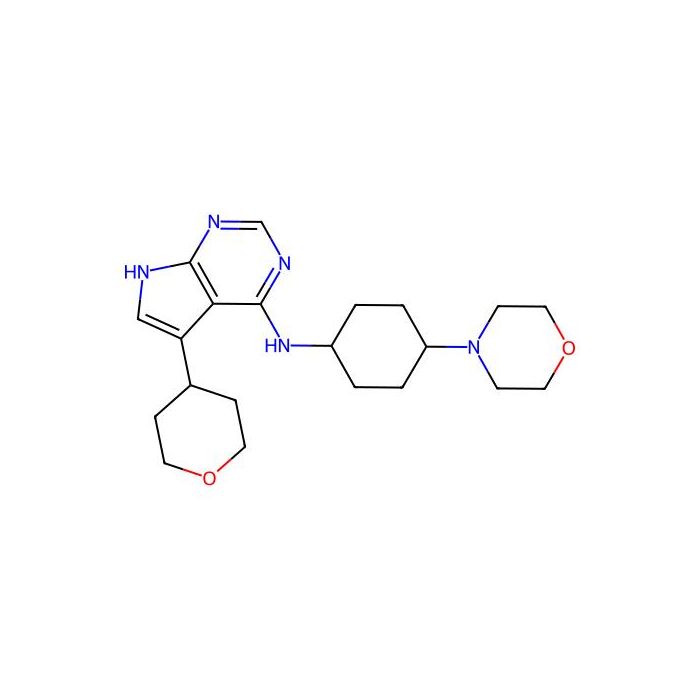
Determine the necessary mass, volume, or concentration for preparing a solution.
AZ1495 - 10mM in DMSO , CAS No.2196204-23-4
Disponible para pedir
CALIDAD & PUREZA 10mM in DMSO
Storage
Store at -80°C
Shipped In
Dry ice packs + Cold packs

AZ1495, a weak base, is a potent orally active interleukin-1 receptor associated kinase 4 (IRAK4) inhibitor. AZ1495 has a favorable physicochemical and kinase selectivity for IRAK4 and IRAK1 with IC 50 values of 0.005 μM and 0.023 μM, respectively. AZ1495 has IRAK4 inhibition with a K d value of 0.0007 μM. AZ1495 can be used for the research of diffuse large B-cell lymphoma (DLBCL)
In Vitro
AZ1495 (compound 28) (10 μM,1 h) has kinase selectivity for IRAK4 with IC 50 values of 0.005 μM (enzyme assay) and 0.052 μM (cellular assay), respectively. AZ1495 (10 μM,1 h) has kinase inhibition for IRAK4 with an IC 50 value of 0.005 μM and K d value of 0.0007 μM. AZ1495 (0.001-100 μM, 72 h) inhibits NF-κB activation and growth of ABC-DLBCL cell lines in a dosedependent manner. AZ1495 (0-3.3 μM, 14 h) completely inhibits NF-κB signaling and induces cell death at lower concentration in combination with a BTK inhibitor in OCI-LY10 cells. MCE has not independently confirmed the accuracy of these methods. They are for reference only. Cell Viability AssayCell Line: OCI-LY10 and SUDHL2 cells Concentration: 0.001-100 μM Incubation Time: 72 h Result: Inhibited growth of OCI-LY10 cells in a dosedependent manner, whereas SUDHL2, a GCB-cell line was not sensitive and no increased cell killing to IRAK4 inhibitor. Increased the cell death in OCI-LY10 cells upon increasing concentrations of compound 28 and BTK ibrutinib. Western Blot AnalysisCell Line: OCI-LY10 cells Concentration: 0-3.3 μM Incubation Time: 14 h Result: Inhibited IκBα phosphorylation with dose-dependentence in OCI-LY10 cells. Showed induction of apoptosis combination with 10 nM ibrutinib by cleavage of caspase 3 in OCI-LY10 cells.
In Vivo
AZ1495 (compound 28) (oral, daily, 12.5 mg/kg) leds to tumor regression combination with ibrutinib in an ABC-DLBCL mouse model (OCI-LY10 cells) . AZ1495 (iv., 2 mg/kg and oral, 5mg/kg) is characterized by high clearance (Cl) in rat (75 mL/min/kg) and moderate predictions based on hepatocyte data (Clint 15 μl/min/106 cells, predicted clearance 42 mL/min/kg) with low bioavailability consistent with a high first pass effect . AZ1495 (iv., 1 mg/kg) has low the amount of active renal secretion occurring in the dog . MCE has not independently confirmed the accuracy of these methods. They are for reference only. Animal Model: CB.17 SCID mice Dosage: 12.5 mg/kg Administration: oral, daily, 12.5 mg/kg Result: Had modest anti-tumor activity as single agents but a combination ofibrutinib led to tumor regression and is well tolerated. Animal Model: rat Dosage: 2 mg/kg, 5mg/kg Administration: iv., 2 mg/kg and oral, 5mg/kg Result: Species Dose (mg/kg) Cl (mL/min/kg) Vss(L/kg) PO halflife (h) IV halflife (h) Fabs (%) F (%) Rat 2,5 75 2.1 2.0 0.8 100 28 Dog 1 29 3.0 - 3.3 - - Animal Model: dog Dosage: 1 mg/kg Administration: iv., 1 mg/kg Result: Species Dose (mg/kg) Cl (mL/min/kg) Vss(L/kg) PO halflife (h) IV halflife (h) Fabs (%) F (%) Rat 2,5 75 2.1 2.0 0.8 100 28 Dog 1 29 3.0 - 3.3 - -
IC50& Target:IRAK4 5 nM (IC 50 ) IRAK1 23 nM (IC 50 ) CLK1 50 nM (IC 50 ) CLK2 5 nM (IC 50 ) CLK4 8 nM (IC 50 ) haspin 4 nM (IC 50 )
No tested applications or recommended dilutions are provided for this item. The following are general, non-item-specific suggestions for handling small-molecule screening compounds:
For validated, item-specific protocols (WB, IHC, IF, FC, enzymatic assay conditions), refer to application notes in the CoA/Spec Sheet if available.
General guidance (not item-specific):
Note: No medical, diagnostic, or therapeutic use is intended or implied. This item is supplied strictly for research use only.
AZ1495 is not a buffer reagent, and no acid/base properties or buffering ranges are provided.
With no item-specific solvent or hazard data provided, greener practice focuses on dissolution media and handling steps common to small-molecule screening compounds.
Trade-offs (general):
Note: If the structure and properties (e.g., polarity, stability) are obtained from the CID/CoA, consider tailoring solvent selection accordingly—favor aqueous-compatible systems where compound solubility allows.
No pharmacopeial status, excipient role, or formulation guidance is provided for this item. It is supplied for research use only.
General R&D context (not item-specific):
Item-specific physicochemical properties are not provided for this entry.
Practical guidance (general, not item-specific):
Interpretation and guidance:
Manufacturer application notes are not provided. Given its listing within a small-molecule/compound library, AZ1495 is typically deployed as a research screening compound rather than a synthetic reagent.
Research use scenarios (general, not item-specific):
Practical tips:
Note: If the compound is to be used synthetically (e.g., as a building block), consult the CoA/Spec Sheet for functional group information; no synthetic reactivity is specified here.
Reaction conditions are not applicable because no synthetic transformations for AZ1495 are specified. This catalog entry is intended for use as a small-molecule screening compound.
If you intend to use the compound in synthesis, first obtain the exact structure and any stability constraints from the CoA or PubChem, then consult literature for reaction precedents tailored to that scaffold. Without item-specific structure and functional group data, providing meaningful conditions would be speculative.
Hazard classification for this specific item has not been provided in the Product Data. Always consult the SDS for your received lot for authoritative safety and regulatory information.
Item-specific solvent compatibility is not provided. The following is general, practical guidance for small-molecule screening compounds like AZ1495 when preparing assay stocks.
Comparison (general):
Item-specific storage and shipping:
Reconstitution and handling (general best practices for small molecules; verify compatibility with your lot):
Research use note: For research use only; not for human or animal therapeutic or diagnostic applications.
Overview: AZ1495 (SKU A654894) is a cataloged small-molecule screening compound supplied for research use. The structural identifiers typically used for unambiguous identification are only partially provided for this item.
Structural features (general note):
Identification guidance (general):
No functional group information or reactivity data are provided for AZ1495; therefore, specific synthetic roles cannot be defined for this item.
General note:
As listed, this item should be regarded primarily as a screening/reference compound rather than a building block or reagent.
No target, enzyme, receptor, or pathway specificity information is provided for AZ1495 in the Product Data.