GRADE & PURITYMoligand™?Moligand™ — Aladdin's line of ligands and bioactive small molecules. Use for receptor, pathway, and binding studies needing defined small-molecule tools.10 mM in DMSO
Moligand™, 10 mM in DMSO Moligand™ for sensitive chromatographic and analytical workflows requiring minimal baseline interference.
🌡
Storage & shipping
Store at -80°C Ships Dry ice packs + Cold packs Check lot-specific COA for exact specifications.
📋
Quality documents
SDS, COA, datasheet, and spec sheet available for download. Lot-specific COA accessible via lot number lookup.
📚
Literature proof
Cited in 0 peer-reviewed publications across chromatography, organic synthesis, and cross-coupling reactions.
Descripción general
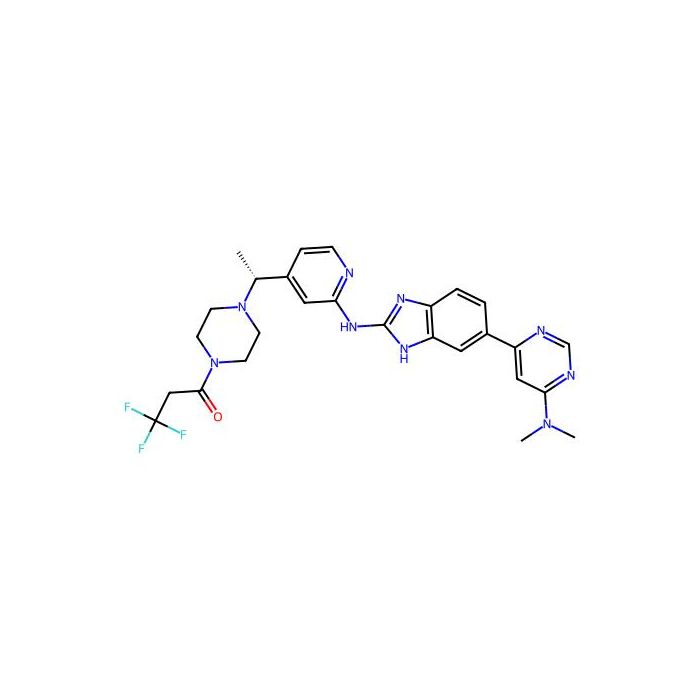
BAY-985 is a highly potent, orally active and selective ATP-competitive dual inhibitor of TBK1 and IKKε with IC 50 s of 2/30 and 2 nM for TBK1 (low/high ATP) and IKKε , respectively. Antitumor efficacy.
Specifications
Especificaciones y pureza
Moligand™, 10 mM in DMSO
Condiciones de almacenamiento de almacenamiento
Store at -80°C
Enviado en
Dry ice packs + Cold packs
Este producto requiere envío en cadena de frío. Los servicios terrestres y otros servicios económicos no están disponibles.
Certificados (CoA, COO, BSE/TSE y tabla de análisis)
C of A & Other Certificates(BSE/TSE, COO):
Analytical Chart:
Calculadoras de soluciones
Molarity Calculator
Determine the necessary mass, volume, or concentration for preparing a solution.
Dilution Calculator
Determine the dilution needed to prepare a stock solution.
Reconstitution Calculator
Reseñas
Reseñas de cliente
Application Protocols
Only product-data-sourced protocols may be listed here.
Tested applications, recommended dilutions, positive controls, and assay setup: Not specified for this item; refer to CoA/Spec Sheet.
Researchers should design protocols based on their assay platform and consult peer-reviewed literature for BAY-985 where available. Validate concentration ranges, exposure times, and vehicle percentages empirically.
Biological Roles
General/literature context (no clinical claims):
BAY-985 is described in the literature as a small-molecule ligand designed to inhibit/antagonize bromodomain-containing reader proteins, which recognize ε-N-acetyl-lysine marks on histones. By perturbing bromodomain–acetyl-lysine interactions, such ligands are used to probe chromatin remodeling and transcriptional regulation pathways.
The bromodomain and plant homeodomain (PHD) finger-containing (BRPF) family and BET family (e.g., BRD2/3/4) are among the commonly studied bromodomain targets in epigenetic research; specific target scope and potency for this catalog item are not provided here and should be verified in primary literature or via CoA/Spec Sheet.
Typical research applications include: mapping epigenetic dependencies, validating target engagement (thermal shift assays, CETSA, BRET), and profiling transcriptional outputs (RNA-seq/ChIP-based assays) following ligand treatment.
Important: All uses are for research only. Biological activity, off-target profile, and selectivity can be context-dependent (cell line, exposure time, vehicle), and should be empirically confirmed under the intended experimental conditions.
Buffer Applications
BAY-985 is not a buffering reagent. However, it is commonly deployed in buffered biological assays. Practical guidance (general):
Stock preparation: Dissolve in DMSO to 10–50 mM. Store aliquots at low temperature to reduce freeze–thaw cycles (see Storage tab for item-specific conditions).
Working solutions: Dilute into assay buffers such as PBS, HEPES, or Tris-based buffers. Maintain final DMSO typically ≤0.1–0.5% v/v to minimize solvent effects; validate tolerance for your system.
Protein/biochemical assays: Include 0.01–0.1% non-ionic surfactant (e.g., Tween-20) if nonspecific adsorption is an issue; add BSA if needed to stabilize proteins—verify that additives do not alter binding readouts.
pH: Use physiologically relevant pH (7.2–7.5) unless the target assay requires otherwise. If the compound is ionizable (not specified here), pH may affect apparent solubility and binding.
Item-specific buffer compatibility and solubility are not provided; consult the CoA/Spec Sheet and pilot tests to establish suitable vehicle and dilution protocols.
Green Alternatives
As a bioactive small molecule used primarily as a research probe, BAY-985 does not have direct “green alternative” substitutes in the way common solvents or bulk reagents do. However, greener practices can be adopted in its handling:
Prefer water-miscible vehicles (e.g., DMSO at minimal feasible percentage) and avoid high-boiling, toxic aprotics (NMP/DMF) unless necessary for solubility.
Minimize organic solvent volumes in assay preparation; prepare concentrated master stocks to reduce waste.
Use microscale formats (96/384-well plates) to lower compound consumption and solvent usage.
Consider benign cosolubilizers (e.g., cyclodextrins) when compatible with the assay.
Comparison (general)
DMSO vs. DMF/NMP: DMSO offers strong solvency with comparatively favorable toxicological/handling profiles; DMF/NMP carry stricter hazard classifications and regulatory scrutiny.
Ethanol/methanol: Greener and volatile but may provide insufficient solubility for many aromatic ligands.
Note: Selection should balance environmental impact with data quality and compound stability.
Pharmaceutical Uses
No pharmaceutical or clinical use is claimed or supported for this item. For research use only.
General context for professionals:
BAY-985 may be used as a reference standard or tool compound in preclinical discovery workflows such as target validation, SAR benchmarking, or comparative profiling versus other epigenetic ligands.
Formulation research (in vitro/in vivo exploratory): Researchers sometimes evaluate vehicles such as aqueous buffers with cosolvents (DMSO/PEG400/ethanol), lipid-based systems, or cyclodextrin complexes to improve exposure in model systems. Any such work remains investigative and outside approved medicinal use.
Pharmacopeial status, excipient listing, and GMP attributes: Not specified for this item; consult CoA/Spec Sheet if documentation is required for regulated environments.
All activities must remain within non-clinical, laboratory research contexts.
Physical Properties
Item-specific physical data
Appearance: Not specified for this item; refer to CoA/Spec Sheet.
Molecular formula: Not specified for this item; refer to CoA/Spec Sheet.
Molecular weight: Not specified for this item; refer to CoA/Spec Sheet.
Melting point: Not specified for this item; refer to CoA/Spec Sheet.
Boiling point: Not applicable for a high-melting solid; exact value not specified for this item; refer to CoA/Spec Sheet.
Density: Not specified for this item; refer to CoA/Spec Sheet.
Refractive index: Not applicable to solids; not specified for this item.
Solubility: Not specified for this item; refer to CoA/Spec Sheet.
Small-molecule bromodomain ligands are commonly handled as solids with limited aqueous solubility; stock solutions are often prepared in DMSO (e.g., 10–50 mM) and diluted into assay buffers to low final DMSO (≤0.1–0.5% v/v).
Aqueous solubility can be enhanced by co-solvents (DMSO, DMF), cyclodextrins, or pH adjustment if ionizable groups are present (ionization state for BAY-985 not specified here).
Always rely on the item’s CoA/Spec Sheet for authoritative specifications.
Quality and Grades
Item-specific information
Grade: Moligand™ (as listed for this item). Specific purity, residual solvents, and analytical limits: Not specified for this item; refer to CoA/Spec Sheet.
What Moligand™ typically signifies (general explanation; not item-specific specifications)
Moligand™ denotes a small-molecule ligand/probe grade intended for discovery, screening, or target-validation workflows. Such materials are generally qualified by orthogonal identity tests (e.g., NMR and/or LC–MS) and an assay-suitable purity level to minimize confounding bioassay readouts. Exact test methods and release criteria vary by item and should be verified on the CoA.
Implications for use
Suitable for in vitro biochemical assays, cell-based target engagement, and profiling studies (research use only). If ultra-low impurity levels or specific counterscreen requirements (e.g., fluorescence background, UV cutoff, metal content) are critical, verify with the current CoA/Spec Sheet before use.
Documentation
For regulatory or publication support, retain the lot-specific CoA and SDS. If required, request additional documentation (e.g., impurity profiling or salt/form information) prior to initiating critical studies.
Reaction and Applications
This product is a small-molecule ligand/probe and is not typically used as a reagent or catalyst in preparative organic reactions. Therefore, classical reaction families (e.g., cross-coupling, reductions, oxidations) and associated setup conditions are not generally applicable.
For BAY-985, relevant applications are in discovery and mechanistic biology contexts (research use only), such as:
Target engagement and binding studies (e.g., thermal shift assays, fluorescence polarization) to characterize bromodomain interactions (literature/general context).
Cellular pathway modulation studies to interrogate epigenetic reader functions and downstream transcriptional consequences (general; verify solubility and cytotoxicity independently).
If you require a synthetic reagent with analogous functional groups for building-block chemistry, consult our catalog under heteroaromatic amides/aza-arenes; BAY-985 itself is not recommended for such transformations.
Reaction Conditions
Not applicable. BAY-985 is supplied as a research ligand/probe and is not intended for use as a reagent or substrate in preparative chemical reactions.
For assay-related handling (general, not item-specific conditions):
Stock solutions: Commonly prepared in DMSO at 10–50 mM.
Working concentrations: Determined empirically from literature or pilot dose–response curves (e.g., nM–μM range for many bromodomain ligands). Exact potencies for this item are not specified here.
Incubation: Time and temperature depend on assay type (biochemical vs. cellular); ensure equilibrium binding is reached before readout.
For any synthetic chemistry involving analogous scaffolds, consult literature for conditions specific to the desired transformations; do not repurpose this catalog item for synthesis.
Safety and Handling
GHS and hazard statements (item-specific)
Signal word: Not specified for this item; refer to SDS.
H-statements: Not specified for this item; refer to SDS.
GHS classification/pictograms: Not specified for this item; refer to SDS.
General laboratory precautions (non-item-specific guidance)
Handle in a fume hood with appropriate PPE: lab coat, nitrile gloves, and safety glasses. Avoid inhalation of dust/aerosols and skin/eye contact.
Prevent environmental release; collect waste in appropriate organic waste streams per institutional policy.
If preparing DMSO stocks, avoid contact as DMSO can facilitate dermal absorption of solutes.
First-aid overview (consult SDS for details)
Inhalation: Move to fresh air; seek medical attention if symptoms occur.
Skin/eye contact: Rinse with water for at least 15 minutes; remove contaminated clothing; seek medical attention if irritation persists.
Ingestion: Rinse mouth; do not induce vomiting; seek medical advice.
Incompatibilities and special risks (general)
Avoid strong oxidizers and strong acids/bases unless compatibility is known.
Thermal decomposition data are not specified; avoid heating above necessary processing temperatures.
Always consult the product-specific SDS for definitive hazard, exposure limits, spill response, and disposal instructions.
Solvent Selection
Item-specific solubility data
Not specified for this item; refer to CoA/Spec Sheet.
General guidance for small-molecule epigenetic ligands (literature/practice)
Primary solvent: DMSO for concentrated stocks (e.g., 10–50 mM) due to broad solvating power for heteroaromatic scaffolds.
Co-solvents/alternatives: DMF and NMP (high solvency; consider cytotoxicity in cellular assays), or ethanol/methanol (lower solvency but easier evaporation). For purely aqueous systems, consider HP-β-cyclodextrin or small amounts of non-ionic surfactants.
Aqueous buffers: Typically poor solubility without co-solvent. When diluting into buffers (e.g., HEPES, PBS), keep final DMSO ≤0.1–0.5% v/v for most cells/enzymes unless otherwise validated.
Polarity/miscibility context (general)
DMSO is polar aprotic (dielectric ~47, miscible with water); ethanol/methanol are protic (dielectric 24–33, fully miscible); DMF is polar aprotic (dielectric ~37, water-miscible). Choice depends on assay compatibility, evaporation needs, and target sensitivity.
Practical tips
Warm gently (25–37°C) and vortex/sonicate to aid dissolution; avoid prolonged heating.
Filter sterilization (0.22 μm PTFE) can clarify particulate suspensions; verify compound stability vs. filter materials.
Document the exact vehicle and final solvent percentage in experimental records.
Storage and Reconstitution
Item-specific conditions (from Product Data)
Storage: Store at -80°C.
Shipping: Shipped on dry ice packs + cold packs.
Not specified for this item; refer to CoA/Spec Sheet
Exact appearance, hydration/solvate form, and container type.
Stability after thaw, permissible freeze–thaw cycles, and long-term stability data.
General handling guidance (non-item-specific)
Upon receipt, keep frozen at -80°C. Allow the container to equilibrate to room temperature in a desiccated environment before opening to minimize moisture condensation.
Prepare single-use DMSO stock aliquots (e.g., 10–50 mM) to avoid repeated freeze–thaw. Store aliquots tightly sealed, protected from light, at the recommended temperature.
Avoid prolonged exposure to ambient humidity and elevated temperatures. If filtration is required, use compatible low-binding membranes (e.g., PTFE) and confirm compound stability.
Always consult the lot-specific CoA and SDS for authoritative guidance on reconstitution, stability, and shelf life.
Structure and Identity
Item-specific identifiers (from Product Data)
Product Name: BAY-985
SKU: B1496245
CAS: 2409479-29-2
PubChem CID: 145925685
Grade: Moligand™
Item-specific identifiers not provided
Molecular formula: Not specified for this item; refer to CoA/Spec Sheet.
Molecular weight: Not specified for this item; refer to CoA/Spec Sheet.
SMILES: Not specified for this item; refer to CoA/Spec Sheet.
InChI / InChIKey: Not specified for this item; refer to CoA/Spec Sheet.
Structural features (general/literature context, not item-specific specs)
BAY-985 is reported in the literature as a small-molecule epigenetic probe candidate designed to interact with bromodomain reader proteins. Such chemotypes typically feature: aromatic/heteroaromatic scaffolds, hydrogen-bond donors/acceptors positioned to engage the conserved Asn in bromodomains, and substituents that occupy ZA/BC channel regions.
2D description (generic): one or more fused/aromatic rings bearing heteroatoms (N/O) and polar functionalities arranged to mimic an acetyl-lysine interaction pattern; no stereochemical assignment provided in Product Data.
Note: For definitive structure (including exact connectivity, functional groups, and stereochemistry) consult the CoA/Spec Sheet or authoritative databases corresponding to the provided CAS/CID.
Synthetic Utility
This product is not intended as a synthetic building block or reagent. Consequently, classic synthetic utilities (e.g., cross-coupling handles, functional group interconversions) are not typically applicable for BAY-985 within a standard synthesis planning context.
If your goal is to explore structure–activity relationships (SAR) around bromodomain-binding chemotypes, consider sourcing structurally simpler scaffolds or annotated intermediates from our catalog that offer: readily functionalizable aryl/heteroaryl cores, orthogonal protecting groups, and cross-coupling handles (e.g., aryl halides/boronates). BAY-985 itself should be reserved for bioactivity studies and assay benchmarking rather than route development.
Target Specificity
Only product-data-sourced details may be listed here.
Specific molecular targets, selectivity profile, binding constants, and off-target screening results: Not specified for this item; refer to CoA/Spec Sheet or primary literature.
Note: While bromodomain interactions are discussed elsewhere as general/literature context, definitive target specificity for this supplied item is not provided in the Product Data.
Need help choosing the grade?
Our grade selection guide covers purity, stabilizer status, and application suitability for all variants in our catalog.
We use cookies to ensure the website functions properly and, where permitted, to improve your experience. You can manage your preferences at any time in Settings. Learn more in our Cookie Policy.
Shall we send you a message when we have discounts available?
Remind me later
Thank you! Please check your email inbox to confirm.
Products are supplied to verified businesses, institutions, and qualified professionals for research and development use only. Not for use in humans, animals, diagnosis, or therapy.