This compound belongs to the class of organic compounds known as alpha amino acids and derivatives. These are amino acids in which the amino group is attached to the carbon atom immediately adjacent to the carboxylate group (alpha carbon), or a derivative thereof.
External Descriptors
Not available
1. Djoumbou Feunang Y, Eisner R, Knox C, Chepelev L, Hastings J, Owen G, Fahy E, Steinbeck C, Subramanian S, Bolton E, Greiner R, and Wishart DS. ClassyFire: Automated Chemical Classification With A Comprehensive, Computable Taxonomy. Journal of Cheminformatics, 2016, 8:61.
Determine the necessary mass, volume, or concentration for preparing a solution.
Dilution Calculator
Determine the dilution needed to prepare a stock solution.
Reconstitution Calculator
Reseñas
Reseñas de cliente
Application Protocols
No vendor‑validated bioassay protocols (e.g., WB, IHC, IF, FC) are applicable to this small‑molecule building block.
Example general workflow for SPPS using Boc‑Lys(Boc)‑OH·DCHA (literature guidance; not item‑specific):
Swell resin in DCM or DMF; wash thoroughly.
Deprotect N‑terminus (if Boc strategy) with TFA; neutralize and wash.
Prepare coupling solution: Boc‑Lys(Boc)‑OH·DCHA (3–5 eq relative to resin loading) + HATU (3–5 eq) + DIPEA (6–10 eq) in DMF (0.1–0.2 M). Stir 10–30 min to pre‑activate if desired.
Add to resin and agitate 30–60 min at rt; monitor with Kaiser test. Repeat coupling if needed for difficult sequences.
Wash resin with DMF and DCM; proceed to next cycle.
After chain assembly, perform global deprotection/cleavage as per resin and protecting group scheme, then precipitate peptide (e.g., cold Et2O) and purify.
For solution‑phase fragment coupling, adapt equivalents and solvent system (DMF/DCM or DMF/EtOAc), and use Oxyma‑assisted carbodiimide activation to minimize racemization.
Consult internal SOPs and the specific CoA/SDS for operational and safety details.
Biological Roles
This product is a protected synthetic derivative of the natural amino acid L‑lysine and is intended for chemical synthesis workflows, not for biological administration.
General context (literature):
L‑Lysine is a proteinogenic, cationic amino acid involved in protein structure, enzyme active sites, and post‑translational modifications such as acetylation, methylation, ubiquitination, and SUMOylation at the ε‑amino group.
In peptides and proteins, lysine side chains participate in electrostatic interactions and can serve as nucleophilic handles for conjugation chemistry.
Relevance of this protected form:
Boc protection of both α- and ε‑amines prevents undesired reactions during stepwise peptide assembly, enabling the installation of lysine residues at precise positions without side‑reactions.
Following synthesis, acidic global deprotection reveals the native lysine functionalities, permitting downstream biological interactions or further bioconjugation of the peptide product.
Biochemical modeling and probes:
Researchers often incorporate lysine via protected derivatives to create peptides for studying lysine‑specific enzymes (e.g., acetyltransferases, deacetylases, methyltransferases) after deprotection.
Note: No in vivo function or clinical claims are made for this product. It is supplied strictly for research and laboratory use in chemical synthesis of peptides and related constructs.
Buffer Applications
This product is not a buffering reagent. As a protected amino acid building block supplied as a dicyclohexylammonium salt, it is not typically used to prepare biological or analytical buffers.
Practical guidance:
For peptide synthesis involving this reagent, standard buffer systems are not used; instead, anhydrous organic solvents (e.g., DMF, NMP) with coupling reagents and organic bases (e.g., DIPEA) are employed.
If aqueous workups are required after solution‑phase reactions, conventional buffers (phosphate, acetate) may be used to adjust pH during extractions, but the protected amino acid itself does not serve as the buffer component.
Refer to the Solvent Selection and Reaction & Applications sections for conditions relevant to its intended use.
Green Alternatives
While DMF/DCM are standard for Boc‑based peptide chemistry, greener solvent and process choices can reduce environmental impact without sacrificing performance.
Greener solvent swaps (literature/general):
Replace DMF with NBP (N‑butylpyrrolidone), PolarClean, or Cyrene for couplings; solubility of Boc‑amino acids is often comparable, though activation kinetics may differ.
Replace DCM with EtOAc or 2‑MeTHF for washes and extractions; these offer lower toxicity and better environmental profiles.
Use ethyl acetate/hexanes or 2‑MeTHF/hexanes in place of DCM/ether for crystallizations where feasible.
Reagent choices:
Prefer DIC + OxymaPure over HBTU/HATU to avoid benzotriazole waste; Oxyma has reduced explosive risk vs HOBt and offers good coupling efficiency.
Employ microwave or rapid mixing to shorten coupling times and reduce solvent use.
Waste minimization:
Concentrate and re‑use mother liquors for multiple dissolutions when purity allows; apply in‑line filtration to extend solvent life in automated SPPS.
Comparative snapshot (general guidance):
DMF vs NBP: similar polarity; NBP has higher boiling point and improved worker safety profile; may require longer coupling times.
DCM vs EtOAc: EtOAc is more biodegradable; partitioning differs—optimize workup.
Evaluate solubility and coupling efficiency with small trials when adopting alternative media with Boc‑Lys(Boc)‑OH·DCHA.
Pharmaceutical Uses
No therapeutic or clinical claims are made for this material. It is intended solely as a research‑grade building block for synthetic chemistry.
Role in pharmaceutical R&D and manufacturing (general):
Protected amino acids like Boc‑Lys(Boc)‑OH·DCHA are used to assemble peptide active pharmaceutical ingredients (APIs) and peptide intermediates via SPPS or solution‑phase segment coupling.
The DCHA salt often improves crystallinity and handling during scale‑up, aiding accurate dispensing and reduced caking in automated synthesizers.
After assembly, global deprotection and purification steps (TFA cleavage, scavengers, preparative chromatography) yield the target peptide, which is then formulated per pharmacopeial guidelines for the API or as part of a conjugate.
Quality considerations:
For GMP contexts, vendors typically provide extended documentation (CoA, TSE/BSE, residual solvents, elemental impurities per ICH Q3D). Such specifications are lot‑specific; consult documentation for the specific batch.
Formulation relevance:
Although the protected amino acid itself is not an excipient, its use impacts impurity profiles (e.g., t‑butyl cations byproducts, DCHA traces) that must be controlled during downstream purification of peptide drug substances.
Always verify suitability and compliance with internal QA/QC and regulatory requirements for any use beyond research.
Physical Properties
Item-specific data from Product Data:
Appearance: Not specified for this item; refer to CoA/Spec Sheet.
Molecular Weight: Not specified for this item; refer to CoA/Spec Sheet.
Molecular Formula: Not specified for this item; refer to CoA/Spec Sheet.
Typical physical characteristics (literature/general for di‑Boc‑Lys DCHA salts; provided as guidance, not item specification):
Physical state: Solid, typically crystalline or free‑flowing powder for the DCHA salt forms.
Solubility profile: Good solubility in polar aprotic organic solvents used for peptide chemistry (e.g., DMF, NMP, DCM, THF, MeOH/EtOH mixtures); limited solubility in water due to dual Boc protection and hydrophobic counterion. The ammonium carboxylate salt may exhibit improved solubility in alcohols compared to the free acid.
Acid/base behavior: Carboxylic acid is present as a carboxylate–ammonium pair with DCHA; Boc groups are stable to mild base and hydrogenation but cleaved rapidly by strong acids (e.g., TFA).
Optical activity: Contains one stereogenic center (L configuration). Specific rotation values vary by solvent and concentration; consult CoA for item-specific [α]D.
Thermal behavior: Boc carbamates can decompose under prolonged heating or strong acid; melting points for DCHA salts are often broad with potential decomposition; refer to CoA for exact MP.
Hygroscopicity: Typically low to moderate; avoid moisture uptake to prevent handling variability.
For authoritative numerical values (mp, density, refractive index, logP/pKa), consult the CoA/Spec Sheet for this specific lot.
Quality and Grades
Item-specific grade/purity: Not specified for this item; refer to CoA/Spec Sheet.
Typical expectations for protected amino acid building blocks (general):
Peptide synthesis grade materials are typically controlled for identity (1H/13C NMR), purity (HPLC/UPLC), and residual solvents. When offered as “peptide grade,” low levels of acidic/basic impurities and free amine content are ensured to minimize epimerization and side reactions.
Counterion content: For DCHA salts, stoichiometry (1:1) and counterion identity are confirmed to ensure reproducible solubility and coupling behavior.
Optical purity: L‑configuration with high enantiomeric excess is essential; many suppliers report [α]D and chiral HPLC.
Water and mineral content: Karl Fischer moisture and ash/metals may be monitored for sensitive couplings; values are lot‑specific and reported on CoA.
Stabilizer/antioxidant use:
Boc‑protected amino acids generally do not require stabilizers; absence/presence of any additive would be listed on the CoA if used.
Why DCHA salt form?
DCHA salts often show improved crystallinity, handling, and reduced caking relative to sticky free acids, and may display enhanced solubility in peptide coupling solvents (literature). This can improve dosing accuracy and flow in automated synthesizers.
For exact specifications (purity %, residual solvents, water, metals, optical rotation, and HPLC conditions), consult the item’s CoA/Spec Sheet.
Reaction and Applications
Primary use: protected amino acid building block for peptide synthesis where ε‑amino and α‑amino functions are simultaneously masked with Boc groups.
Orthogonality: Boc is acid‑labile; global deprotection under TFA/TFA‑based cocktails removes both α‑ and ε‑Boc. The DCHA salt form facilitates weighing and charging solutions with reduced static/caking.
Coupling: Activated with carbodiimides (DIC/EDC) plus Oxyma/HOAt/HOBt surrogates or with uronium/phosphonium reagents (HATU, HBTU, PyBOP) to form amide bonds to resin‑bound or solution‑phase partners.
Side‑chain strategy: Because the ε‑amine is Boc‑protected, incorporation avoids undesired branching; subsequent global deprotection liberates the lysine side chain.
Solution‑phase peptide assembly:
Segment coupling: Useful for fragment condensation where both α/ε protection prevents oligomerization. After coupling, Boc groups can be selectively removed under controlled acid exposure, although both are generally removed together in Boc strategies.
Other transformations:
Chemoselective derivatization post‑coupling at the ε‑position after Boc removal (e.g., acylation, sulfonylation, alkylation) to generate Lys‑modified peptides (ubiquitination mimics, acetyl‑Lys analogs).
Conjugation chemistry: Upon deprotection, ε‑Lys enables dye/biotin linkages with NHS esters or isothiocyanates.
Practical tips:
Dry solvents and handle under inert atmosphere when using moisture‑sensitive activators (e.g., DIC/Oxyma). Avoid strong acids until deprotection is intended. Monitor couplings by Kaiser or chloranil tests when working on resin.
Reaction Conditions
General guidance from peptide synthesis literature for using Boc‑Lys(Boc)‑OH·DCHA (not item‑specific specifications):
Coupling conditions:
Carbodiimide/Oxyma: DIC (1.1–1.5 eq) + OxymaPure (1.1–1.5 eq) in DMF or NMP; add DIPEA (0–2 eq as needed). Typical concentrations 0.1–0.3 M. Reaction time 10–60 min at rt for SPPS; longer for hindered sites.
Uronium/phosphonium: HATU or HBTU (1.0–1.2 eq) + DIPEA (2–4 eq) in DMF; 10–30 min at rt. PyBOP is an alternative. Monitor with colorimetric resin tests.
EDC/HOAt or EDC/Oxyma for solution‑phase couplings in DMF/CH2Cl2 or DMF/EtOAc mixtures.
Temperature and atmosphere:
Ambient temperature is typical; mildly elevated temperature (30–40 °C) or microwave (50–70 °C) can accelerate difficult couplings. Use dry solvents and inert atmosphere when employing moisture‑sensitive activators.
Deprotection (Boc removal):
TFA in DCM or neat TFA (50–100%) for 15–60 min at rt cleaves Boc groups, releasing CO2 and isobutylene. Include scavengers (e.g., water, TIS, anisole) to capture t‑Bu cations if sensitive functionalities are present.
Workup and purification:
For solution‑phase products, quench activations with dilute base, extract into organics, and crystallize or chromatograph as needed. For SPPS, wash resin thoroughly with DMF/DCM after coupling/deprotection cycles.
Expected outcomes:
High conversions (>90%) for non‑hindered couplings are common under these conditions; difficult sequences may require double couplings or extended times.
Adjust equivalents and times based on sequence complexity and resin loading; always validate on small scale.
Safety and Handling
Regulatory and GHS (item-specific):
Signal Word: Not specified for this item; refer to SDS.
Hazard Statements (H‑statements): Not specified for this item; refer to SDS.
GHS Classification and Pictograms: Not specified for this item; refer to SDS.
General safety considerations (literature/general):
Irritation potential: Amino acid derivatives and amine salts can cause skin/eye irritation. Handle powders to avoid inhalation.
Acid sensitivity: Boc groups are acid‑labile; contact with strong acids (e.g., TFA, HCl) releases CO2 and tert‑butyl cations; perform deprotections with adequate ventilation.
Amines: The DCHA counterion is a secondary amine; amines may be corrosive and can form salts with acids. Avoid contact with strong oxidizers and acylating agents unless intended.
PPE and engineering controls:
Wear lab coat, safety glasses, and appropriate chemically resistant gloves (e.g., nitrile). Handle solids in a fume hood; use local exhaust during weighing and during TFA deprotection steps.
Storage incompatibilities and notes:
Store tightly closed, desiccated, protected from acids and moisture. Avoid prolonged exposure to elevated temperatures that may compromise Boc groups.
Keep away from strong oxidizers and strong acids.
First‑aid overview (consult SDS for details):
Skin/eyes: Rinse with water for 15 minutes; remove contaminated clothing; seek medical attention if irritation persists.
Inhalation: Move to fresh air; seek attention for symptoms.
Ingestion: Rinse mouth; do not induce vomiting; seek medical advice.
Always defer to the product‑specific SDS for authoritative hazard, exposure limits, and emergency measures.
Solvent Selection
As a di‑Boc‑protected lysine DCHA salt, this reagent behaves as a neutral organic salt with good compatibility with common peptide synthesis solvents.
Polarity and miscibility (literature/general):
Preferred solvents for dissolution: DMF, NMP, DCM, THF, MeOH/EtOH, and mixtures thereof. DMF/NMP provide high solubility and are standard for SPPS and solution‑phase couplings.
Limited solubility: In pure water and very nonpolar hydrocarbons due to hydrophobic Boc groups and DCHA counterion.
Practical selection guidance:
Coupling solutions: DMF or NMP offer optimal solubility for preparing 0.1–0.4 M stock solutions for activation with HATU, HBTU, TBTU, COMU, or EDCI/DIC + Oxyma.
Workups/crystallizations: EtOAc/hexanes or acetone/Et2O systems often provide phase separation and precipitation control for protected amino acids (check small‑scale first).
Greener substitutions: NBP (N‑butylpyrrolidone) or Cyrene can sometimes replace DMF; EtOAc or 2‑MeTHF may replace DCM in washes or crystallizations (see Green Alternatives tab for tradeoffs).
Additives:
Bases: DIPEA, NMM, or collidine are commonly used in activation; their miscibility with DMF/NMP supports homogeneous reaction media.
Salts: The presence of DCHA typically does not impede dissolution; mild warming and sonication can accelerate dissolution in DMF/NMP.
Tip: Filter solutions through 0.2 µm PTFE to remove particulates that can clog SPPS resin frits.
Storage and Reconstitution
Item-specific conditions (from Product Data):
Storage Conditions: Store at 2–8 °C.
Shipped In: Wet ice.
General storage guidance (literature/general):
Store in the original, tightly closed container, protected from moisture and strong acids. Consider desiccant use to maintain low humidity.
Avoid repeated warming/cooling cycles; if frequent access is required, aliquot under dry conditions to minimize exposure.
Solid materials do not require “reconstitution,” but for preparing stock solutions, dissolve in dry DMF, NMP, DCM/DMF mixtures, or alcohols as appropriate. Gentle warming (≤40 °C) and sonication can aid dissolution.
Filter solutions (0.2 µm PTFE) before use in automated synthesizers to prevent clogging.
For longer‑term solution storage, keep under inert gas at 2–8 °C, and verify stability prior to use; Boc groups are generally stable in neutral/Basic aprotic media but will hydrolyze/cleave under acidic conditions.
Stability notes:
Avoid exposure to strong acids (including TFA vapors) unless deprotection is intended.
Keep away from oxidizers; maintain dry conditions to prevent variability in coupling performance.
Refer to the CoA and SDS for lot‑specific stability and handling recommendations.
Structure and Identity
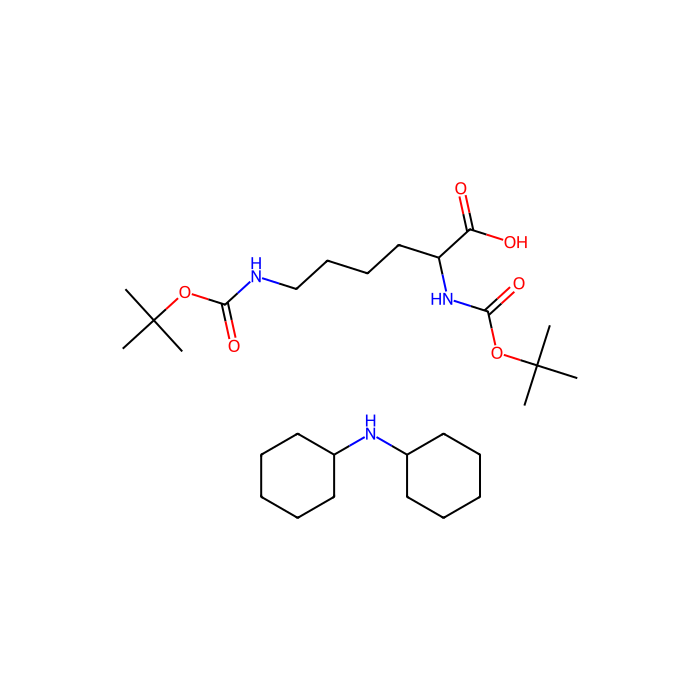
Boc-Lys(Boc)-OH·DCHA is a protected amino acid building block: the L-lysine backbone bearing Boc protection at both the α- and ε-amino groups, isolated as the dicyclohexylammonium (DCHA) salt of the carboxylic acid.
Item-specific identifiers (from Product Data):
Product Name: Boc-Lys(Boc)-OH.DCHA (SKU: B101562)
CAS: 15098-69-8
PubChem CID: 12017189
InChIKey: 129060 (as provided)
SMILES: Not specified for this item; refer to CoA/Spec Sheet.
Molecular Formula: Not specified for this item; refer to CoA/Spec Sheet.
Molecular Weight: Not specified for this item; refer to CoA/Spec Sheet.
Structural features (general/literature description):
Core scaffold: L-lysine (one stereocenter at the α-carbon; L-configuration, i.e., S at the α-C in the standard CIP convention for L-amino acids).
Protecting groups: Two tert‑butoxycarbonyl (Boc) carbamates: one on the α-amino, one on the ε-amino side chain. These are acid‑labile, base/neutral-stable carbamate protections.
Acid–base form: The α‑carboxylate is paired as a 1:1 carboxylate–ammonium salt with dicyclohexylamine (secondary amine), enhancing crystallinity and handling (literature).
Functional groups present: Carboxylate (as salt), two carbamates (urethane), aliphatic primary chain, secondary ammonium counterion.
2D structure in words (general): A central chiral α‑carbon bearing a Boc‑carbamate nitrogen, a carboxylate (salted with DCHA), a methylene side chain of four carbons terminating in an ε‑amino protected as Boc; counterion is protonated dicyclohexylamine (two cyclohexyl rings bound to N–H).
Synthetic Utility
Boc‑Lys(Boc)‑OH·DCHA provides orthogonal protection for lysine, enabling precise control over both the α‑ and ε‑amine functionalities during amide bond formation.
Functional group strategy (literature/general):
α‑CO2H (as DCHA salt): Readily activated with DIC/EDC + Oxyma/HOAt/HOBt or uronium/phosphonium reagents to couple to amines on resin or in solution.
α‑ and ε‑Boc: Acid‑labile carbamates stable to bases commonly used during couplings (DIPEA, NMM) and to hydrogenation; both can be removed under TFA conditions post‑assembly.
Orthogonality uses:
Protecting both amines prevents cyclization or branching during fragment condensation and facilitates synthesis of Lys‑rich sequences with minimized side reactions.
Retrosynthetic value:
Serves as a convergent building block for peptides, peptidomimetics, and Lys‑modified scaffolds. After global deprotection, ε‑amine becomes a handle for late‑stage diversification (acylation, carbamylation, sulfonylation, click‑handle installation via NHS esters).
Typical transformations:
Amide coupling to carboxylic acids (peptide elongation), followed by TFA‑mediated Boc cleavage to unveil reactive amines for further derivatization.
Practical advantages of DCHA salt form:
Increased crystallinity, improved handling, and predictable dissolution behavior in DMF/NMP aids batch‑to‑batch reproducibility and dosing precision.
Include base scavengers and optimize equivalents to suppress diketopiperazine formation at sensitive dipeptide junctions when using Boc strategies.
Target Specificity
Not applicable. This product is a small‑molecule protected amino acid building block, not an antibody, probe, or biologic with target specificity. For its intended use, see Reaction & Applications and Synthetic Utility.
We use cookies to ensure the website functions properly and, where permitted, to improve your experience. You can manage your preferences at any time in Settings. Learn more in our Cookie Policy.
Shall we send you a message when we have discounts available?
Remind me later
Thank you! Please check your email inbox to confirm.
Products are supplied to verified businesses, institutions, and qualified professionals for research and development use only. Not for use in humans, animals, diagnosis, or therapy.

 I2603033