This compound belongs to the class of organic compounds known as nitrophenyl ethers. These are aromatic compounds containing a nitrobenzene moiety that carries an ether group on the benzene ring.
External Descriptors
Not available
1. Djoumbou Feunang Y, Eisner R, Knox C, Chepelev L, Hastings J, Owen G, Fahy E, Steinbeck C, Subramanian S, Bolton E, Greiner R, and Wishart DS. ClassyFire: Automated Chemical Classification With A Comprehensive, Computable Taxonomy. Journal of Cheminformatics, 2016, 8:61.
Soluble in Chloroform, Dichloromethane, Ethyl Acetate and Methanol
Punto de ebullición (°C)
170°C/0.5mmHg
Punto de fusión (°C)
63.0-67.0℃
Peso molecular
246.060 g/mol
XLogP3
2.900
Hydrogen Bond Donor Count
0
Hydrogen Bond Acceptor Count
3
Rotatable Bond Count
3
Exact Mass
244.969 Da
Monoisotopic Mass
244.969 Da
Topological Polar Surface Area
55.100 Ų
Heavy Atom Count
13
Formal Charge
0
Complexity
163.000
Isotope Atom Count
0
Defined Atom Stereocenter Count
0
Undefined Atom Stereocenter Count
0
Defined Bond Stereocenter Count
0
Undefined Bond Stereocenter Count
0
The total count of all stereochemical bonds
0
Covalently-Bonded Unit Count
1
Calculadoras de soluciones
Molarity Calculator
Determine the necessary mass, volume, or concentration for preparing a solution.
Dilution Calculator
Determine the dilution needed to prepare a stock solution.
Reconstitution Calculator
Reseñas
Reseñas de cliente
Application Protocols
Not applicable as an assay reagent in immuno/cell-based techniques. There are no validated protocols (e.g., WB, IHC, IF, FC) for this small-molecule intermediate.
Synthetic usage notes (general)
For SN2 substitutions, pre-generate the nucleophile (e.g., phenoxide, thiolate) under anhydrous conditions and add β-Bromo-4-nitrophenetole dropwise to control exotherm.
Monitor by TLC/HPLC using the strong UV response of the nitroaryl group; confirm completion by disappearance of the –CH2Br signal in 1H NMR.
For scale-up, assess heat release and gas evolution if using hydrogenation to reduce the nitro group in subsequent steps.
For detailed, reaction-specific procedures, consult the primary literature or develop internal SOPs under your lab’s safety management system.
Biological Roles
Scope: β-Bromo-4-nitrophenetole is a synthetic organic intermediate. It is not a natural metabolite or cofactor, and it is sold for research use only.
General biochemical considerations (literature/general)
Reactivity toward biomolecules: As a primary alkyl bromide, it can alkylate nucleophilic residues (thiols, amines) in proteins or small molecules. This is a hazard consideration rather than a designed biological function.
Nitroaryl chromophore: The para-nitro group confers strong UV absorbance, which can be useful for monitoring conjugations or tracing incorporation in model systems, but it does not indicate any specific biological role.
Metabolic fate (conceptual): In vivo, alkyl bromides are typically detoxified by nucleophilic substitution (e.g., glutathione conjugation). Nitro groups can undergo reduction under certain enzymatic or reductive conditions to anilines. These pathways are referenced for context only and not intended for any in vivo application.
Use context
This compound is most appropriate for chemical synthesis of small molecules, linkers, or materials that may later be evaluated in biochemical assays after thorough purification. Any biological testing should follow institutional approvals and safety protocols.
No medical or clinical claims are made or implied. For all hazard and exposure details, consult the SDS and institutional biosafety guidance.
Buffer Applications
Not typically applicable. β-Bromo-4-nitrophenetole is a non-ionic, hydrophobic organic reagent used in synthetic chemistry and does not serve as a buffering agent.
Practical note
If reactions are run biphasically (organic/aqueous), aqueous phases should employ standard buffers suited to the nucleophile or catalyst system (e.g., carbonate for phenoxide generation in PTC conditions). Selection depends on the reaction and is not intrinsic to this reagent.
Avoid strongly basic aqueous buffers in storage/handling of the neat compound to prevent undesired hydrolysis or substitution.
Green Alternatives
Greenness considerations (general)
The substrate is a halogenated electrophile (alkyl bromide). While effective for SN2, brominated reagents raise EHS concerns (corrosive HBr byproducts; persistence). Process choices can mitigate impact.
Alternative leaving groups: Mesylates/tosylates from the corresponding 2-hydroxyethyl p-nitrophenyl ether can reduce halogenated waste, though they may be less reactive than bromides.
Solvent selection: Favor MeCN, 2-MeTHF, CPME, or acetone over DMF/DMSO where feasible to improve LCA metrics and ease of workup.
Catalysis/activation: Phase-transfer catalysis (PTC) in biphasic green media (e.g., toluene or 2-MeTHF/water with quats) can lower temperature and time.
Illustrative comparison (general guidance)
Route A (this item, –CH2CH2Br): High SN2 rate; generates bromide salt; often lower reaction temperature.
Route B (–CH2CH2–OTs/OMs): Milder waste profile; may need higher temperature/longer time or stronger base.
Practical tips
Employ minimal excess reagent; titrate base to stoichiometry to limit salt waste.
Use solvent recycling (MeCN, 2-MeTHF) and aqueous bromide scrubbing where appropriate.
If large-scale, evaluate inherent safety: bromides can be lachrymatory and pose greater aquatic toxicity—closed transfers and contained quench reduce emissions.
Note: Selection balances E-factor, hazard, and performance; pilot both options to confirm productivity and quality.
Pharmaceutical Uses
Formulation/excipient role: None specified for this item; the compound is intended for laboratory research and synthetic use only.
Relevance to pharmaceutical R&D (general)
Intermediate: Can function as a building block to introduce a 2-(4-nitrophenoxy)ethyl fragment into small molecules or materials that may later be elaborated (e.g., nitro-to-amino reduction to access an anilide handle) during medicinal chemistry campaigns.
Analytical handle: The nitroaryl chromophore offers UV detectability, facilitating HPLC monitoring of intermediates.
Regulatory/pharmacopeial status
Not listed as a pharmacopeial excipient to our knowledge. No compendial monograph is implied by this listing.
Manufacturing considerations
If used to make GMP-relevant intermediates, ensure removal of residual alkyl bromide and nitroaromatic impurities to acceptable limits; apply appropriate impurity qualification per ICH guidelines. This listing provides no GMP or clinical suitability claims.
All uses are for research and development only; not for human or veterinary use.
Physical Properties
Item-specific specifications
Appearance: Not specified for this item; refer to CoA/Spec Sheet.
Molecular formula: Not specified for this item; refer to CoA/Spec Sheet.
Molecular weight: Not specified for this item; refer to CoA/Spec Sheet.
Literature/general reference values for β-Bromo-4-nitrophenetole (1-bromo-2-(4-nitrophenoxy)ethane)
Formula (literature): C8H8BrNO3
Formula mass (literature): ~246.06 g/mol
Physical state: Typically a pale yellow liquid or low-melting solid for analogous 2-bromoethyl aryl ethers; exact state depends on purity and temperature (literature/general observation).
Solubility (general): Low in water; miscible with common organic solvents such as dichloromethane, chloroform, ethyl acetate, acetone, acetonitrile, THF, DMF, and DMSO (literature/general for aryl 2-bromoethyl ethers).
Partitioning: Expected moderate hydrophobicity due to aryl ring with polar functionality (ether, nitro); logP not widely tabulated for this exact compound (literature: not readily available).
UV-vis: Para-nitroaryl chromophore typically shows strong absorption in near-UV; specific maxima depend on solvent and are not provided here (literature/general trend).
Boiling point / melting point / density / refractive index: Not specified for this item; consult primary literature or measure under your lab conditions.
Notes for practitioners
The presence of a primary bromoethyl group suggests volatility and density comparable to other bromoethyl aryl ethers; verify by in-house measurement prior to scale-up.
For analytical methods, GC or HPLC with UV detection (nitro chromophore) are generally effective; exact wavelengths and response factors should be empirically determined.
Quality and Grades
Item-specific grade/purity information
Grade/Purity: Not specified for this item; refer to CoA/Spec Sheet.
Guidance on interpreting grades (general)
Research grade: Suitable for most synthetic and method-development work. Impurity profiles (e.g., residual halides, hydrolyzed alcohols, unreacted phenols) can influence reaction selectivity/yield for sensitive nucleophiles or catalytic systems.
HPLC grade/UV grade (if applicable): Emphasizes low UV-absorbing impurities, which is relevant here because the para-nitro chromophore absorbs strongly. If using for analytical calibrants, verify baseline cleanliness at your detection wavelength.
Purification notes: For alkyl bromides, trace moisture and adventitious acid/base can promote decomposition (hydrolysis to 2-hydroxyethyl aryl ether or elimination). If higher purity is required, consider short-path distillation under reduced pressure or flash chromatography using neutral alumina/silica (minimize basic sites to avoid SN1/E1 side processes).
Stabilizers: None specified for this item. If your workflow is base- or nucleophile-sensitive, avoid stabilizers containing amines/alcohols.
Recommendations
Verify identity/purity via 1H/13C NMR and GC/HPLC prior to scale-up, looking especially for signals of p-nitrophenol/phenetol byproducts and 2-bromoethanol-derived impurities.
For exact acceptance criteria (water content, halide assay, UV cutoff, metal content), this listing provides no item-specific specs—consult the product’s CoA/Spec Sheet.
Reaction and Applications
Overview: The molecule functions primarily as a benzylic-adjacent primary alkyl bromide tethered to a para-nitrophenyl ether, making it a versatile electrophile for SN2 substitution to install a 2-(4-nitrophenoxy)ethyl fragment onto O-, N-, S-, or C-nucleophiles.
Representative applications (literature/general)
Nucleophilic substitutions (SN2): Reaction with alcoholates, phenolates, thiolates, azolates, secondary amines, and malonate/enolate derivatives to furnish 2-(4-nitrophenoxy)ethyl ethers, thioethers, amines, and C-alkylated adducts.
Protecting/linker chemistry: Installation of a 2-(p-nitrophenoxy)ethyl moiety as a cleavable spacer; the para-nitro group allows spectroscopic tracking and can be transformed (e.g., reduced to anilines) for further diversification.
Post-functionalization: Reduction of the nitro group (e.g., catalytic hydrogenation, Fe/HCl, SnCl2) affords 4-aminophenoxyethyl derivatives that engage in diazotization, acylation, urea/amide formation, or coupling to electrophiles.
Polymer/surface modification: Alkylation of nucleophilic sites on polymers (e.g., hydroxylated resins) to append chromophoric nitroaryl groups for analytical tracing.
Two-step handles: SN2 substitution with azide (NaN3) to give the corresponding 2-azidoethyl ether, enabling CuAAC “click” diversification after reduction to amine.
Practical tips
Order of reactivity (typical): S- > N- > O- > C-nucleophiles under comparable conditions.
Bases: K2CO3/Cs2CO3 for O-alkylations; DIPEA/triethylamine for N-alkylations; NaH or strong bases for less nucleophilic substrates (ensure anhydrous conditions).
Competing processes: Trace hydrolysis to the corresponding 2-hydroxyethyl ether; elimination to vinyl ether is generally minor under SN2-favorable conditions.
Monitoring: Nitro chromophore enables UV monitoring by TLC/HPLC; 1H NMR (disappearance of –CH2Br ~3.4–3.5 ppm in many solvents) is informative.
Reaction Conditions
General literature guidance (optimize per substrate)
O-alkylation (phenols/alcohols)
Solvent: MeCN or acetone (green(er) choice); DMF for difficult cases.
Base: K2CO3 (2–3 equiv) or Cs2CO3 (1.2–1.5 equiv for more reactive phenoxides).
Temperature/time: 25–60 °C, 2–16 h; monitor by TLC/HPLC (nitro UV response).
Additives: Catalytic KI (10 mol%) can enhance rate via in situ iodide exchange (Finkelstein-type).
N-alkylation (secondary amines/azoles)
Solvent: MeCN, DMF, or DCM (with non-nucleophilic base such as DIPEA).
Stoichiometry: 1.05–1.2 equiv of electrophile to minimize dialkylation; for quaternization, use excess.
Temperature: 0–25 °C initially (exotherm control), then to 40–50 °C if needed.
S-alkylation (thiols)
Solvent: MeCN or THF; weak base (NaHCO3/K2CO3) or preformed thiolate.
Temperature: 0–25 °C; typically rapid (0.5–4 h).
Azide displacement
Reagents: NaN3 (1.2–1.5 equiv) in DMF or DMSO.
Temperature: 25–60 °C; caution with azides; ensure proper ventilation.
Workup/purification
Quench with water; extract with EtOAc or DCM. Wash organic phase with brine and bicarbonate as needed. Dry (Na2SO4/MgSO4) and concentrate.
Purify by flash chromatography on silica/alumina; use neutral media to minimize side reactions. Nitro chromophore aids UV detection.
Yields
O/N/S-alkylations commonly furnish moderate to high yields (literature: substrate-dependent). Establish substrate-specific conditions through small-scale scouting.
Safety and Handling
Item-specific safety data
GHS classification, pictograms, signal word, and H-statements: Not specified for this item; refer to the SDS.
Storage: Room temperature (as provided). Ship at ambient temperature.
General safety considerations (literature/general for aryl 2-bromoethyl ethers and nitroarenes)
Hazard profile: Primary alkyl bromides are potent electrophiles and may be irritants/skin sensitizers; nitroaromatics can be harmful if ingested or inhaled and may cause methemoglobinemia at sufficient exposure. Treat as harmful and irritant unless SDS indicates otherwise.
Peroxide formation: Not a dialkyl ether; peroxide formation risk is much lower than for ethers like THF or diethyl ether. Routine peroxide testing is typically unnecessary for this structure.
Incompatibilities: Avoid strong bases with active nucleophiles if uncontrolled alkylation is a concern; avoid strong reducing agents that could reduce the nitro group. Incompatible with strong nucleophiles in storage containers (e.g., amines) that might attack the bromoethyl moiety.
PPE: Lab coat, nitrile gloves, splash goggles as minimum. Consider double-gloving or laminate gloves for extended handling of alkylating agents. Use in a fume hood to avoid inhalation of vapors/aerosols.
First aid (overview; defer to SDS): Skin/eye contact—immediately flush with water for ≥15 min; remove contaminated clothing. Inhalation—move to fresh air. Ingestion—rinse mouth; do not induce vomiting; seek medical attention.
Spill response: Contain with inert absorbent; avoid contact; collect for halogenated organic waste.
Fire safety: Combustible organic; use CO2, dry chemical, or foam. Combustion may release HBr, NOx.
Always consult the product SDS for authoritative hazard classification and response procedures.
Solvent Selection
Applicability: As a moderately polar, halogenated aryl–alkyl ether with a primary bromoethyl group, β-Bromo-4-nitrophenetole dissolves well in many organic solvents and is generally insoluble in water.
General solvent behavior (literature/general)
Polarity class: Moderately polar, non-protic; capable of dipole–dipole interactions via nitro and ether groups.
Expected miscibility: Good solubility in dichloromethane (DCM), chloroform, toluene, THF, ethyl acetate, acetone, acetonitrile (MeCN), DMF, and DMSO; poor in alkanes at room temperature unless warmed.
For SN2 applications: Polar aprotic solvents (MeCN, DMF, DMSO) tend to accelerate substitution at the primary bromide relative to protic/less polar media.
Choosing a medium by reaction type
O-alkylation (alcohol/phenol as nucleophile): MeCN or acetone with K2CO3 or Cs2CO3; DMF for less reactive substrates. Add catalytic KI for halide exchange acceleration if compatible.
S-alkylation (thiols/thiolates): MeCN or THF; mild base (NaHCO3, K2CO3) often sufficient due to higher nucleophilicity of sulfur.
N-alkylation (amines/azoles): MeCN, DMF, or DCM with base scavengers (e.g., DIPEA). Monitor for over-alkylation.
Avoid highly nucleophilic solvent systems (e.g., neat amines) if selectivity is a concern.
Quick comparison (general)
DMF/DMSO: Highest SN2 rates; more challenging workup and greenness concerns.
MeCN: Balanced rate and ease of removal; good choice for many substrates.
Acetone/2-MeTHF: Greener options with moderate rates; may require heating or phase-transfer catalysis.
Storage and Reconstitution
Item-specific guidance
Storage conditions: Room temperature (per Product Data). Store tightly closed in a dry, well-ventilated place, protected from moisture and strong bases/nucleophiles.
Shipping: Normal ambient conditions.
Reconstitution: Not applicable; product is supplied as a neat organic compound (no reconstitution buffer required).
General best practices
Moisture control: While hydrolysis is slower than for acid halides, trace moisture can lead to gradual formation of 2-hydroxyethyl derivatives; include a desiccant in the storage cabinet if humidity is high.
Container compatibility: Use amber glass where possible to minimize photolysis of nitroaryl chromophores; PTFE-lined caps recommended.
After opening: Consider blanketing headspace with inert gas for long-term storage, especially if partial bottles will be kept for extended periods.
Stability checks: Periodically verify by TLC/NMR for any signs of decomposition (appearance of p-nitrophenol/phenetol signals or loss of –CH2Br).
Disposal
Collect residues and washings as halogenated organic waste. Follow institutional and local regulations.
Note: For definitive shelf-life and impurity limits, refer to the product’s CoA and SDS; this listing provides no item-specific stability data beyond storage temperature.
Structure and Identity
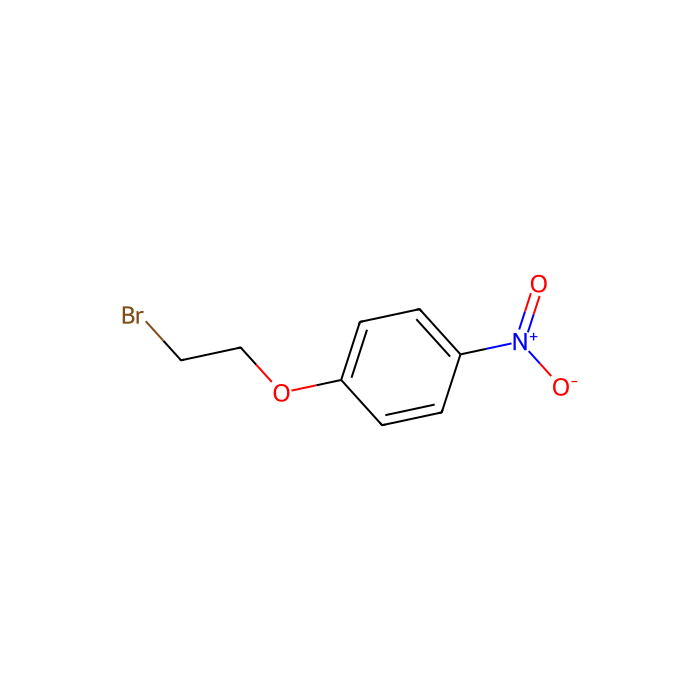
Brief overview: β-Bromo-4-nitrophenetole is an aryl–alkyl ether bearing a para-nitro group on the phenyl ring and a 2-bromoethyl substituent on the ether side chain, making it a useful benzylic-like alkylating electrophile for SN2 reactions.
2D description in words: A benzene ring bearing a nitro group at the para position relative to the phenoxy oxygen; the phenoxy oxygen is connected to a two-carbon chain terminating in bromine (–O–CH2–CH2–Br).
Computed/literature identifiers (for reference; not item specifications)
Tentative molecular formula (literature): C8H8BrNO3
Approximate formula mass (literature): ~246.06 g/mol
Note: When exact identity matters, rely on the item’s CoA/SDS and the provided CAS number for unambiguous sourcing.
Synthetic Utility
Key reactivity (literature/general)
Primary alkyl bromide: High SN2 reactivity with a wide range of nucleophiles allows modular installation of a 2-carbon spacer terminating in a para-nitrophenoxy unit.
Nitro group as a synthetic handle: Subsequent reduction to an aniline unlocks diazotization, coupling (e.g., to phenols, anilines), urea/amide formation, and cross-couplings after converting the aniline to aryl halides or triflates.
Ether linkage: The phenoxy oxygen stabilizes the aryl ring electronically; the para-nitro group enhances chromophoric properties useful for monitoring.
S-alkylation: Thiols → thioethers under mild conditions (often room temperature, MeCN or THF, weak base).
Azide displacement: Formation of 2-azidoethyl ether → reduction or CuAAC diversification.
Nitro reduction: Hydrogenation (Pd/C, H2) or SnCl2/Fe reductions to give 4-aminophenoxyethyl derivatives for further coupling.
Strategic value in synthesis
Serves as a bifunctional module: an SN2-active terminus (–CH2CH2Br) and a transformable aryl nitro motif on the other end.
Useful in linker design for conjugates and materials where a UV-active tag facilitates tracking during process development.
Notes
Avoid strong bases that may induce elimination or side reactions on sensitive substrates.
The reagent’s benzylic-adjacent carbon is not directly activated for SN1; SN2 pathway predominates under typical conditions.
Target Specificity
Not applicable. This product is a small-molecule chemical reagent, not a biological targeting agent or antibody. No antigen, epitope, species reactivity, clone, or isotype information applies.
We use cookies to ensure the website functions properly and, where permitted, to improve your experience. You can manage your preferences at any time in Settings. Learn more in our Cookie Policy.
Shall we send you a message when we have discounts available?
Remind me later
Thank you! Please check your email inbox to confirm.
Products are supplied to verified businesses, institutions, and qualified professionals for research and development use only. Not for use in humans, animals, diagnosis, or therapy.

 I2623192