Tetraalkylammonium salt - Organopnictogen compound - Hydrocarbon derivative - Organic bromide salt - Organic salt - Amine - Aliphatic acyclic compound
Descripción
This compound belongs to the class of organic compounds known as tetraalkylammonium salts. These are organonitrogen compounds containing a quaternary ammonium substituted with four alkyl chains.
External Descriptors
quaternary ammonium salt - bromide salt
1. Djoumbou Feunang Y, Eisner R, Knox C, Chepelev L, Hastings J, Owen G, Fahy E, Steinbeck C, Subramanian S, Bolton E, Greiner R, and Wishart DS. ClassyFire: Automated Chemical Classification With A Comprehensive, Computable Taxonomy. Journal of Cheminformatics, 2016, 8:61.
Determine the necessary mass, volume, or concentration for preparing a solution.
Dilution Calculator
Determine the dilution needed to prepare a stock solution.
Reconstitution Calculator
Reseñas
Reseñas de cliente
Application Protocols
Item-specific, tested application details are not provided for this product.
General starting points (literature; not item specifications)
Micellar catalysis: prepare an aqueous DeTAB solution above its CMC; add substrates with stirring; optionally include 5–15% v/v ethanol to aid dissolution; monitor by TLC/GC.
PTC: combine organic substrate phase and aqueous nucleophile/base; add DeTAB (1–10 mol%); stir vigorously; quench and separate layers; wash organic phase to remove surfactant.
Colloid/nanomaterial synthesis: prepare DeTAB in water (fixed bromide molarity); add metal precursor; reduce under controlled temperature; age until color/UV–vis indicates target morphology.
Biochemical solubilization: add DeTAB to buffer to desired concentration; gently invert to mix; avoid foam; verify clarity; adjust salt/pH to prevent precipitation with anionic components.
Always validate and optimize locally. For regulatory or safety-critical work, consult the SDS and internal SOPs.
Biological Roles
Applicability
Decyltrimethylammonium bromide is a synthetic cationic surfactant. It does not have an endogenous biological role.
General/literature context (not item specifications; no clinical claims)
Membrane interactions: cationic headgroups bind strongly to negatively charged phospholipids and biomacromolecules, disrupting lipid packing; shorter alkyl chains (C10) are typically less denaturing than longer-chain homologues at equal molarity.
Nucleic acids and polysaccharides: cationic surfactants can precipitate polyanions via ion pairing; conditions can be tuned for selective fractionation or extraction.
Protein solubilization: useful for solubilizing acidic proteins and protein–lipid complexes; may unfold proteins at sufficient concentration.
Antimicrobial activity: many quaternary ammonium compounds exhibit biocidal effects by membrane disruption; potency rises with alkyl chain length. Any such use must be assessed under appropriate regulatory frameworks—this product is designated for research use only.
Buffer Applications
Relevance
DeTAB is not a buffer. It may be included as a cationic surfactant in buffer formulations to modulate solubilization, micelle-mediated separations, or surface interactions.
Practical guidance (literature; not item specifications)
Typical working ranges: low millimolar to low weight‑percent, often above the CMC to ensure consistent micellar environment. Optimize empirically for your analyte or assay.
Compatible buffer systems: phosphate, Tris, HEPES, and acetate are commonly used; maintain ionic strength (e.g., 50–150 mM salt) to control electrostatics and micelle size.
Electrophoresis/chromatography: cationic surfactants can be used in micellar electrokinetic chromatography (MEKC) and in specialized cationic PAGE systems; choose concentrations to balance conductivity and Joule heating.
Additive strategy: when formulating mixed surfactant systems (e.g., nonionic + cationic), screen for precipitation with any anionic components; adjust pH and salt gradually while monitoring clarity and conductivity.
Green Alternatives
Context
DeTAB enables aqueous or water-rich reaction media via micellar catalysis, potentially replacing chlorinated solvents or high-VOC systems. However, cationic surfactants can be persistent and exhibit aquatic toxicity.
Options and tradeoffs (literature; not item specifications)
Alternative surfactants:
Alkyl polyglucosides (APGs): renewable, readily biodegradable; nonionic headgroups reduce aquatic toxicity but may lack strong templating seen with quats.
Zwitterionic betaines (e.g., cocoamidopropyl betaine): milder ecotoxicity; compatible with salts; different micellar microenvironments.
Short-chain alcohols/green co-solvents (e.g., ethanol, propylene carbonate) to assist solubilization without dedicated surfactants—less interfacial control.
Within the quaternary ammonium family:
Using shorter chains (C10 vs C16) raises CMC and can improve rinsability/recovery, lowering residuals in waste streams, but typically increases the total mass of surfactant required.
Compact comparison (qualitative)
DeTAB (C10 quat): high CMC; good removability; useful for transient micelles.
Dodecyltrimethylammonium bromide (C12): moderate CMC; balance of efficacy/removal.
CTAB (C16): low CMC; strong templating; more persistent; harder to remove.
Best practices
Run at the minimal effective concentration above CMC.
Implement phase separation or adsorptive polishing (activated carbon/resins) to reduce quaternary ammonium residues in effluent.
Pharmaceutical Uses
Item-specific regulatory status
Not specified for this item; refer to CoA/Spec Sheet. No pharmacopeial monograph is indicated in the provided data.
General formulation context (no therapeutic claims)
Potential roles in research-stage formulations: cationic excipient for enhancing dispersion of hydrophobic actives in aqueous media; surface charge modifier for colloids and nanocarriers; penetration or adhesion modifier in topical prototypes. Decyl (C10) provides comparatively higher CMC and easier removal post-processing than longer-chain homologues.
Compatibility: avoid anionic excipients (e.g., sulfates, carboxylates) that can form insoluble ion pairs; evaluate osmolality and irritancy in pre-formulation screens.
Analytics: quantify residual quaternary ammonium by ion chromatography, NMR integration, or LC–MS (cation scan) as part of extractables/leachables and excipient profiling.
Manufacturing notes: control water activity and temperature to prevent caking; consider milling/sieving for consistent blend performance if used as a solid excipient.
Physical Properties
Item-specific specifications
Not specified for this item; refer to CoA/Spec Sheet.
General/literature characteristics (for context; not item specifications)
Physical state/appearance: typically a crystalline solid; hygroscopic tendencies are common for quaternary ammonium salts.
Charge state: permanently cationic (quaternary ammonium); no acid–base pKa relevant to protonation.
Solubility: readily soluble in water; also soluble in polar organic solvents (e.g., methanol, ethanol) and water/alcohol mixtures; very limited solubility in nonpolar hydrocarbons.
Partitioning: classical logP is not meaningful for the salt; as an ion pair, hydrotropy and micellization dominate behavior.
Surfactant behavior: forms micelles above a characteristic critical micelle concentration (CMC); as a C10 homologue, DeTAB typically exhibits a higher CMC than the longer-chain dodecyl (C12) and cetyl (C16) analogues.
Thermal transitions: quaternary ammonium bromides often show high melting points with possible solid–solid (gel–crystal) transitions in hydrated states; specific values vary by hydration and are not listed here.
Quality and Grades
Item-specific grade/purity
Grade/Purity: Not specified for this item; refer to CoA/Spec Sheet.
Context and implications
Surfactant-grade considerations: For colloid and nanomaterials work, low inorganic residue and controlled halide content help reproducibility (e.g., in seed-mediated metal nanoparticle growth). For biochemical work, low bioburden/endotoxin and low UV-absorbing impurities may be desired.
If HPLC-grade or LC-MS-grade is offered (not specified here), that typically implies low non-volatile and UV-active contaminants suitable for analytical use. AR/ACS grades emphasize assay and inorganic impurity limits.
Counterion/stabilizer: No stabilizer is listed for this item. If stabilizers or anti-caking agents are present in other lots, they can affect micelle size/charge and should be disclosed on the CoA.
Batch-to-batch consistency: For surfactants, chain length distribution and residual alkylhalide/amine are key. Check CoA for assay by titration or NMR, halide content, water content (Karl Fischer), and color/appearance.
Reaction and Applications
Use domains (literature; not item specifications)
Cationic surfactant for colloids and interfaces: forms micelles, vesicles, and mixed micelles; useful in emulsification, solubilization of hydrophobic organics into aqueous media, and interfacial tension reduction.
Micellar catalysis: enhances rates/selectivities of reactions conducted in water by concentrating substrates within micellar cores; relevant to SN1/SN2, nucleophilic substitutions, and certain pericyclic or radical processes under aqueous conditions.
Phase-transfer catalysis (PTC): as a quaternary ammonium salt, can shuttle anions across phase boundaries for substitution, alkylation, and condensation reactions; shorter-chain C10 can be advantageous when faster desorption or easier removal is needed compared to C16 analogues.
Templating/directing agent in nanomaterials: cationic headgroup and bromide counterion interact with metal halide complexes; though cetyltrimethylammonium bromide (CTAB) is classic for gold nanorods, DeTAB can modulate aspect ratios or reduce cytotoxicity in screening studies.
Electrophoretic and extraction aids: cationic detergents can precipitate/analyze nucleic acids and polysaccharides in specialized protocols (e.g., CTAB-like precipitation); DeTAB’s shorter chain can adjust selectivity/solubility.
Practical notes
Water quality (ionic strength, halide identity) and temperature affect CMC and aggregation number; standardize these to ensure reproducibility.
For PTC, begin with 1–10 mol% relative to substrate and adjust based on phase ratio and agitation efficiency.
Avoid anionic surfactants in the same medium unless designing catanionic systems—insoluble ion pairs may form.
Reaction Conditions
General guidance (literature; not item specifications)
Phase-transfer catalysis (PTC):
Solvent: toluene, chlorobenzene, dichloromethane, or neat; aqueous phase with base (e.g., 50% NaOH) or salts provides nucleophile source.
Loading: 1–10 mol% DeTAB relative to limiting substrate; vigorous stirring to maximize interfacial area.
Temperature: 20–80 °C depending on substrate reactivity; monitor for emulsion formation and adjust stirring rate/antifoam accordingly.
Micellar catalysis in water:
Medium: deionized water or buffered saline; optional co-solvent (≤10–20% v/v ethanol or isopropanol) to aid solubilization.
Concentration: typically above CMC to ensure micelle formation; salt (NaBr/NaCl) can lower CMC and influence aggregation number.
Temperature: ambient to 60 °C; higher temperatures may reduce micelle stability for shorter-chain surfactants—optimize empirically.
Nanoparticle templating:
Aqueous metal salt with halide (e.g., Au(III)–halide complexes); maintain precise bromide concentration; introduce reducers (ascorbate, borohydride) under controlled addition.
Additives (Ag+, seed particles) profoundly affect anisotropy; DeTAB vs CTAB choice tunes growth kinetics and final shape.
Expected outcomes
SN2/PTC reactions often show substantial rate enhancements vs neat biphasic systems.
Micellar conditions can enable high conversions with reduced organic solvent usage; isolated yields are substrate-dependent.
Safety and Handling
Item-specific hazard data
Signal word, H-statements, GHS classification, pictograms: Not specified for this item; refer to SDS.
General safety guidance for quaternary ammonium surfactants (informational only; consult the SDS for authoritative data)
Likely hazards: may cause skin and eye irritation; harmful if swallowed; toxic to aquatic life with long lasting effects (common for cationic surfactants). Avoid aerosol generation.
PPE: lab coat, safety glasses or face shield, and appropriate impermeable gloves (e.g., nitrile). Use in a fume hood to minimize dust/aerosol exposure.
Handling: minimize dust formation; keep containers tightly closed under inert gas as supplied. Avoid contact with oxidizers and strong bases that can increase aerosolization; bromide salts are generally compatible but observe standard incompatibility lists per SDS.
First aid overview: if on skin/eyes, rinse immediately with water for ≥15 min; remove contaminated clothing. If inhaled, move to fresh air. If ingested, rinse mouth; do not induce vomiting; seek medical attention. Provide SDS to responders.
Environmental precautions: prevent release to waterways; collect spills with inert absorbent and dispose of as hazardous waste.
Special risks: cationic surfactants can strongly adsorb to surfaces and biological membranes; cleanup should ensure thorough detergent/water rinses to remove residues.
Solvent Selection
Applicability
As an ionic, amphiphilic solid, DeTAB is used as a solute/surfactant rather than as a solvent.
General guidance (literature; not item specifications)
Polarity/miscibility: highly soluble in water; soluble in short-chain alcohols (MeOH, EtOH, i‑PrOH) and water/alcohol mixtures; poor solubility in nonpolar solvents (hexanes, toluene).
Dielectric considerations: aqueous media (ε ≈ 78 at 25 °C) facilitate electrostatic stabilization of the quaternary ammonium cation; alcohols reduce CMC and can modify micelle shape.
Selection tips:
For micellar catalysis or extractions, use water or water/alcohol with ionic strength control (NaBr, NaCl) to tune aggregation.
For nanoparticle templating, bromide concentration and co-solvents materially affect shape control; avoid competing surfactants unless intentionally blending.
For biological sample prep, buffered saline (e.g., 10–100 mM) with low % alcohol can improve solubilization while moderating denaturation.
Comparison to analogues:
Decyl (C10) vs dodecyl (C12) vs cetyl (C16): increasing chain length lowers CMC and increases micelle hydrophobic core size; the C10 homologue offers higher critical concentration but improved rinsability and lower foaming persistence.
Rationale: quaternary ammonium bromides can be hygroscopic and may cake on moisture uptake; desiccation preserves flow and assay. An inert headspace helps minimize oxidative discoloration or adventitious microbiological contamination during long storage.
Container: keep tightly sealed in glass or compatible HDPE with desiccant. Reseal promptly after each use; purge with inert gas if matching original condition.
Shelf life: Not specified for this item; refer to CoA/Spec Sheet.
Reconstitution and working solutions (general; not item specifications)
Aqueous stocks: dissolve the required mass directly in ultrapure water or buffer with gentle stirring. Warm slightly (≤40 °C) if needed to accelerate dissolution; avoid vigorous shaking to limit foam.
Organic stocks: prepare in methanol or ethanol if water-free conditions are needed; confirm compatibility with your process.
Sterilization: for cell-related workflows, filter through 0.22 µm membranes; avoid heat sterilization that may promote decomposition or discoloration.
Storage of solutions: ideally prepare fresh. If necessary, store refrigerated in clean, sealed containers; label with concentration and date; monitor for microbial growth or precipitation.
Freeze–thaw: typically unnecessary; if freezing solutions, verify no phase separation or concentration drift on thawing.
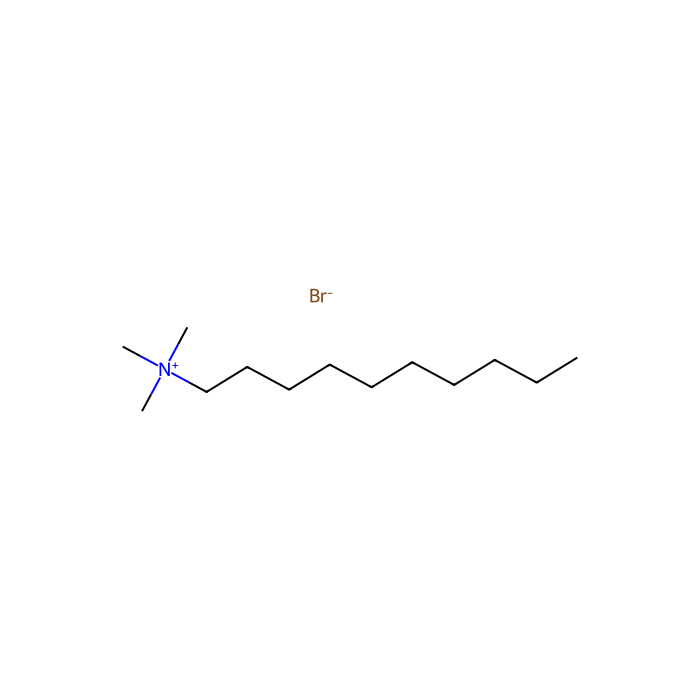
Structural features: a permanently charged quaternary ammonium center bearing a single n-decyl (C10) substituent and three methyl groups; paired with bromide as counter-anion.
2D structure in words: a linear 10‑carbon alkyl chain bonded to a tetraalkylammonium nitrogen (N+(CH3)3), with Br− as the counterion; no stereocenters, no rings; ionic, amphiphilic surfactant.
Synthetic Utility
Functional features
Persistent cation (R4N+): excellent phase-transfer capability for bringing anions (e.g., CN−, N3−, HS−, halides) into organic phases; facilitates nucleophilic substitutions and condensations under biphasic conditions.
Amphiphilicity: enables micellar catalysis in water, concentrating hydrophobes and accelerating reactions while reducing or eliminating organic solvents.
Representative applications (literature; not item specifications)
SN2 alkylations and benzylations under biphasic toluene/water or solvent-free conditions with inorganic bases; DeTAB used at catalytic loadings to shuttle anionic nucleophiles.
Oxidations/reductions in micellar media (e.g., NaBH4 reductions of carbonyls; TEMPO or bleach oxidations of alcohols) where the surfactant organizes substrates and reagents.
Heterogeneous catalysis: cationic surfactants stabilize colloidal metal particles; DeTAB can tune particle size relative to C12/C16 analogues for hydrogenations or cross-couplings.
Material synthesis: directs mesophase assembly in sol–gel routes (silicas, organosilicas); C10 length yields distinct pore sizes/morphologies compared to CTAB-templated materials.
Practical tips
Start with 1–10 mol% for PTC or 1–3× CMC for micellar catalysis; adjust based on phase ratio and agitation.
Maintain halide balance: exchanging Br− for other counterions (Cl−, PF6−) alters solubility and micelle structure; keep consistent across experiments.
Target Specificity
Not applicable. This product is a small-molecule surfactant, not a biological targeting reagent (e.g., antibody, ligand with defined biomolecular target). No antigen/epitope/isotype or species reactivity information is relevant.
We use cookies to ensure the website functions properly and, where permitted, to improve your experience. You can manage your preferences at any time in Settings. Learn more in our Cookie Policy.
Shall we send you a message when we have discounts available?
Remind me later
Thank you! Please check your email inbox to confirm.
Products are supplied to verified businesses, institutions, and qualified professionals for research and development use only. Not for use in humans, animals, diagnosis, or therapy.

 I2609590