GRADE & PURITYPrimorTrace™?PrimorTrace™ — Aladdin's trace-metal-analysis line with ultra-low metal background. Use for ICP/AAS trace-metal work where contamination must be minimal.≥99.99% metals basis
PrimorTrace™, ≥99.99% metals basis PrimorTrace™ for sensitive chromatographic and analytical workflows requiring minimal baseline interference.
🌡
Storage & shipping
Room temperature Ships FedEx DG Service Check lot-specific COA for exact specifications.
📋
Quality documents
SDS, COA, datasheet, and spec sheet available for download. Lot-specific COA accessible via lot number lookup.
📚
Literature proof
Cited in 123 peer-reviewed publications across chromatography, organic synthesis, and cross-coupling reactions.
Descripción general
Cadmium sulfate is water soluble, toxic cadmium salt which is one of the main source of cadmium in the environment. Cadmium is an environmental pollutant and a suspected carcinogen.The role of cadmium sulfate in inducing aneuploidy and modulation of genomic DNA-methylation status has been studied in a pig Robertsonian translocation model.
Application: Cadmium sulfate was used in the synthesis of two-dimensional cadmium-thiocyanate coordination solids with checkerboard or herringbone structures. It may be used as cadmium source in the synthesis of the following: cadmium sulfide (CdS) thin films cadmium carbonate (CdCO3) microcrystal cadmium sulfide-montmorillonite nanocomposites cadmium sulfate phases cadmium sulfide (CdS) quantum dots
Transition metal sulfate - Inorganic cadmium salt - Inorganic oxide - Inorganic salt
Descripción
This compound belongs to the class of inorganic compounds known as transition metal sulfates. These are inorganic compounds in which the largest oxoanion is sulfate, and in which the heaviest atom not in an oxoanion is a transition metal.
External Descriptors
cadmium salt
1. Djoumbou Feunang Y, Eisner R, Knox C, Chepelev L, Hastings J, Owen G, Fahy E, Steinbeck C, Subramanian S, Bolton E, Greiner R, and Wishart DS. ClassyFire: Automated Chemical Classification With A Comprehensive, Computable Taxonomy. Journal of Cheminformatics, 2016, 8:61.
Determine the necessary mass, volume, or concentration for preparing a solution.
Dilution Calculator
Determine the dilution needed to prepare a stock solution.
Reconstitution Calculator
Reseñas
Reseñas de cliente
Application Protocols
No vendor-validated bioassay protocols are provided for this inorganic salt. Typical laboratory uses include:
Preparing aqueous stock solutions of known cadmium content for materials synthesis or elemental analysis.
Conducting precipitation reactions to form cadmium chalcogenides (CdS, CdSe) under controlled conditions.
Formulating electrolytes for cadmium electrodeposition studies.
For detailed, application-specific protocols, consult the primary literature and your institution’s safety procedures. This product is for research use only.
Biological Roles
This product is for research use only. Cadmium has no known beneficial biological role and is widely recognized as a toxic metal.
General/literature context
Cd2+ can interfere with biochemical processes by mimicking and displacing essential divalent cations such as Zn2+ and Ca2+ in metalloproteins and signaling pathways, leading to enzyme inhibition and oxidative stress.
Cellular handling: Induces metallothionein expression; accumulates in lysosomes and kidneys, with long biological half-life.
Laboratory relevance
Used in toxicology studies, metal–protein binding competition assays, and as a standard for evaluating metal uptake/efflux systems in cells and microbes (strict containment and approvals required).
No clinical or therapeutic uses are implied; this information is provided strictly for biochemical context.
Buffer Applications
Cadmium sulfate is not a buffering agent and is not typically used to prepare pH buffer systems.
Practical note
If used in aqueous solutions, select an appropriate buffer that does not precipitate cadmium (avoid phosphate and carbonate at neutral–basic pH). Weakly acidic buffers (e.g., acetate, citrate) may be compatible depending on concentration and complexation behavior (literature).
Green Alternatives
Given cadmium’s high toxicity and persistence, substitution is strongly encouraged where functionally feasible.
Potential substitutes (general/literature)
For chalcogenide materials research: Consider zinc sulfate (ZnSO4) for ZnS systems or indium-free alternatives when optical/electronic properties permit.
For corrosion/coating studies: Evaluate zinc- or tin-based systems instead of cadmium plating where performance criteria allow.
For Lewis-acidic salt needs: Benign divalent salts (e.g., MgSO4, ZnSO4) may replace CdSO4 for non-cadmium-specific roles.
Comparison highlights
Toxicological profile: CdSO4 (very high toxicity, strict disposal) vs Zn/Mg salts (significantly lower toxicity, simpler waste handling).
Performance trade-offs: Optical gaps and charge transport properties of Cd chalcogenides are difficult to match; substitution must be justified by application requirements.
Green chemistry practices when CdSO4 is unavoidable
Minimize scale; use closed systems and recycle process water when compatible.
Implement rigorous waste segregation for heavy metals and verify treatment via licensed hazardous waste vendors.
Design experiments to limit excess sulfide and acid to reduce secondary hazards.
Pharmaceutical Uses
Cadmium salts are not used as pharmaceutical excipients due to toxicity and regulatory restrictions.
Manufacturing/formulation context
In the pharmaceutical analytical lab, cadmium sulfate may appear only as a reference material for instrument calibration or as part of research into impurity profiling and metal–ligand interactions, under strict controls.
Regulatory status
No pharmacopeial excipient monograph use is expected for CdSO4; handling falls under hazardous substance controls rather than excipient quality frameworks.
No therapeutic or clinical claims are made; for research use only.
Physical Properties
Item-specific specifications
Molecular formula: Not specified for this item; refer to CoA/Spec Sheet.
Molecular weight: Not specified for this item; refer to CoA/Spec Sheet.
Appearance: Not specified for this item; refer to CoA/Spec Sheet.
General/literature values (for reference; may vary by hydration state)
Physical form: Ionic inorganic solid; commonly encountered as colorless to white crystals.
Solubility: Highly soluble in water; sparingly soluble to insoluble in most nonpolar organic solvents (literature).
Thermal behavior: No true boiling point; dehydrates and decomposes on strong heating (literature).
Density: Hydration-state dependent (literature).
Hygroscopicity: Hydrated forms may lose/gain water depending on ambient conditions (literature).
Practical implications
Solutions are acidic due to the sulfate counterion and potential hydrolysis of Cd2+ (literature).
For precise massing, confirm hydration state on the product CoA before stoichiometric calculations.
Quality and Grades
Item-specific
Grade: PrimorTrace™ (as provided). No additional numeric specifications are listed for this item; refer to the CoA/Spec Sheet for exact impurity limits.
What PrimorTrace™ generally implies (general description)
Designed for trace- and ultra-trace–level applications where background elemental contaminants must be minimized (e.g., ICP-OES/ICP-MS calibration matrices, semiconductor or materials analysis workflows).
Emphasis on low particulate burden and high lot-to-lot consistency to reduce analytical noise and drift.
Practical considerations for CdSO4 in trace analysis
Cadmium sulfate solutions are frequently used to prepare cadmium-containing matrices or standards; consistent hydration state and assay are critical for accurate concentration calculations.
Use high-purity water and acid-cleaned labware to avoid adventitious metal contamination.
Documentation
For assay, hydration state, insolubles, and trace metal profiles: Not specified for this item; refer to CoA/Spec Sheet.
Reaction and Applications
Materials synthesis (literature/general)
Precursor to cadmium chalcogenides (e.g., CdS, CdSe) for pigments, thin films, and semiconductor nanomaterials. CdSO4 is converted to CdS via sulfide sources (Na2S, H2S, thioureas) in aqueous media.
Electroplating/electrodeposition: Employed as a cadmium ion source in aqueous plating baths (often with boric acid buffers and complexants) for corrosion-resistant coatings in specialized industrial research contexts.
Analytical chemistry
Source material for preparing calibration solutions or matrices for elemental analysis (AAS/ICP), where traceable cadmium content is required.
Catalysis and mechanistic studies
Cd2+ used as a Lewis-acidic probe and as a toxicant standard in environmental partitioning and sorption studies.
Practical tips (general)
Confirm hydration state prior to stoichiometric calculations.
Minimize carbonate/alkali carryover to avoid precipitation of basic cadmium salts.
For CdS formation, control nucleation by adjusting sulfide addition rate, temperature, and the presence of stabilizing ligands (e.g., citrate, thiols, amines) to tune particle size (literature).
Reaction Conditions
General, literature-based guidance for common laboratory uses of cadmium sulfate (parameters may vary by setup; optimize empirically and consult primary sources):
Precipitation of CdS (pigment/nanomaterial precursor)
Reagents: Aqueous CdSO4 mixed with aqueous Na2S or bubbled H2S under controlled addition.
Temperature: 20–80 °C depending on desired particle size/crystallinity.
Atmosphere: Ambient; inert atmosphere beneficial when sensitive ligands are used.
Notes: Maintain slight excess of chalcogenide for complete precipitation; wash precipitate thoroughly to remove sulfate.
Electrodeposition (research scale)
Electrolyte: Aqueous CdSO4 with supporting electrolytes and additives (e.g., boric acid buffer, surfactants).
pH: Mildly acidic to neutral to keep Cd2+ soluble; avoid carbonate contamination.
Temperature: Ambient to 50 °C for bath stability.
Notes: Control current density to tune grain size and deposit morphology; strict fume control and waste capture are mandatory.
Preparation of analytical standards
Medium: ASTM Type I water or dilute HNO3 to mitigate adsorption.
Containers: Pre-cleaned, acid-washed HDPE or PFA bottles; pre-rinse with standard solution.
Calculation: Confirm hydration state and assay from CoA to compute exact cadmium concentration.
Safety and Handling
Item-specific hazard fields
Signal word, H-statements, GHS classification, pictograms: Not specified for this item; refer to the product SDS.
General cadmium-compound hazards (literature/typical)
Cadmium salts are highly toxic, suspected/known carcinogens, and reproductive toxins; strong acute and chronic toxicity by inhalation and ingestion. Very toxic to aquatic life.
Avoid generating dust; use wet methods and closed transfer where possible.
Storage incompatibilities and precautions (general)
Store tightly sealed at room temperature (per Product Data), segregated in a designated toxic metal cabinet.
Keep away from strong bases (may enhance cadmium mobility), strong acids (aerosol formation), and sulfide sources unless intentionally reacting (H2S generation risk with acid + sulfide).
Prevent release to the environment; collect waste in dedicated heavy-metal containers for hazardous disposal.
First-aid overview (consult SDS for full guidance)
Inhalation: Move to fresh air, seek medical attention.
Skin/eye contact: Immediate decontamination with copious water for ≥15 min; remove contaminated clothing.
Ingestion: Do not induce vomiting; seek urgent medical attention.
Always defer to the product SDS and institutional EHS policies for authoritative safety guidance.
Solvent Selection
Cadmium sulfate is an inorganic ionic salt; solvent considerations primarily concern dissolution for processing or analysis.
Polarity and miscibility (general/literature)
Highly soluble in water; insoluble or only sparingly soluble in most organic solvents (alcohols may dissolve small amounts depending on water content).
Typical working medium: deionized water; for ICP applications, dilute nitric acid or weakly acidic aqueous media are often employed to maintain stability and reduce adsorption to surfaces.
Practical guidance
For stock solutions, use ASTM Type I water; pre-rinse volumetrics with the working solution to minimize adsorption losses.
Avoid high-pH media that can precipitate Cd(OH)2 or basic cadmium salts.
Comparison (general)
Water (preferred): maximum solubility, conductivity considerations manageable.
Alcohols (MeOH/EtOH): limited use; generally inferior for bulk dissolution; may be used as cosolvents in analytical workflows.
Nonpolar solvents (hexanes, toluene): not applicable.
Storage and Reconstitution
Item-specific storage and shipping
Storage conditions: Room temperature (as provided).
Shipped in: FedEx DG Service (as provided) due to hazardous classification.
General handling and solution preparation
Store in a tightly sealed container, in a dry area, segregated as a toxic heavy-metal reagent.
To prepare solutions, dissolve the measured solid in ASTM Type I water. Gentle stirring at ambient temperature is typically sufficient.
If a defined molarity of Cd2+ is required, verify and use the product’s hydration state/assay from the CoA to calculate the exact mass needed.
Stability
Solid: Stable at room temperature when kept dry and sealed (literature).
Solutions: Stable in water under mildly acidic to neutral conditions; avoid alkaline media to prevent precipitation of cadmium hydroxides/basic salts (literature).
Freeze–thaw and aliquoting
Not generally relevant for inorganic salts; for long-term standard solutions, store in acidified water (e.g., trace nitric acid) in clean HDPE/PFA containers and minimize headspace.
Always consult the product CoA and SDS for definitive guidance specific to the supplied lot.
Structure and Identity
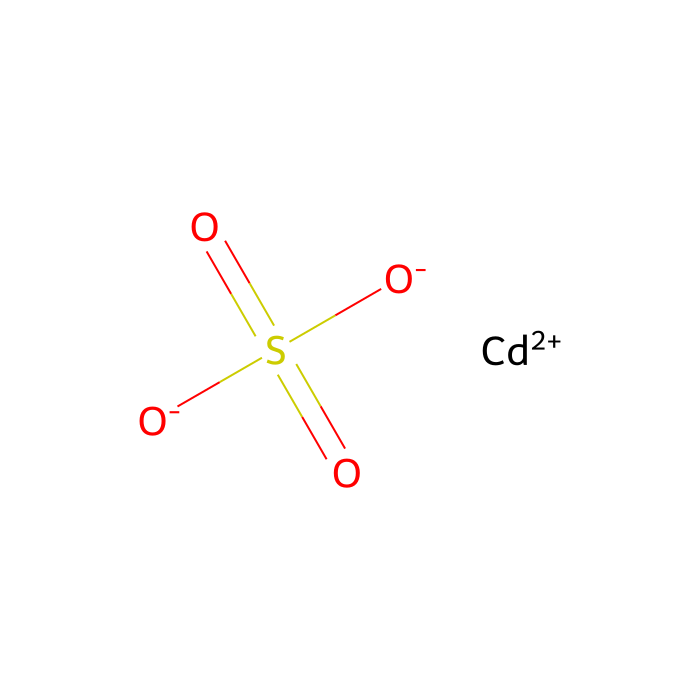
Brief overview: Cadmium sulfate is an inorganic cadmium(II) salt of sulfuric acid, widely used in materials science, electroplating, and as a cadmium source for sulfide/chalcogenide materials.
Item-specific (from Product Data)
SKU: C357813
Product name: Cadmium sulfate
CAS: 10124-36-4
CID: 24962
InChIKey: 293525 (as provided)
Grade: PrimorTrace™
Structure (general/literature)
Composition: Cd2+ counterion with sulfate anion SO4^2−.
InChIKey (literature for CdSO4): commonly recorded as non-proprietary identifiers in public databases; note the provided InChIKey above appears non-standard format.
Structural features: tetrahedral sulfate (S(VI), four S–O bonds) electrostatically associated with octahedrally coordinated Cd(II) centers in the solid state; hydrate forms incorporate water into the lattice.
Notes on forms (general/literature)
Cadmium sulfate exists as anhydrous CdSO4 and several hydrates (e.g., monohydrate, higher hydrates). Exact hydration state for this item is not specified; refer to CoA/Spec Sheet.
Synthetic Utility
Functional role (general/literature)
Inorganic salt providing Cd2+ for precipitation, ion-exchange, coordination chemistry, and electrochemical deposition.
Representative transformations and uses
Formation of CdS/CdSe: Reaction of aqueous CdSO4 with sulfide/selenide sources to generate chalcogenide solids and nanocrystals; sulfate remains in the mother liquor as spectator anion.
Coordination complexes: Cd2+ complexes with N/O/S-donor ligands; used to build MOF-like coordination polymers for materials studies.
Electrochemistry: Source of cadmium ions in electrolytes for electrodeposition studies and corrosion research.
Retrosynthetic/value considerations
Ready availability, water solubility, and relatively inert sulfate anion make CdSO4 a convenient, predictable cadmium source compared with halides where complexation or volatility might complicate systems.
Limitations
Severe EHS footprint and disposal burden; precipitation of insoluble cadmium species under basic conditions limits its use in alkaline media.
Target Specificity
Not applicable. This product is an inorganic salt, not a biological targeting reagent (e.g., antibody, enzyme inhibitor). No antigen/epitope specificity information applies.
Utilizamos cookies para garantizar el correcto funcionamiento del sitio web y, cuando esté permitido, para mejorar su experiencia. Puede gestionar sus preferencias en cualquier momento en Configuración. Más información en nuestra Política de Cookies.
¿Quieres que te enviemos un mensaje cuando tengamos descuentos disponibles?
Recordármelo más tarde
¡Gracias! Por favor, revisa tu bandeja de entrada de correo electrónico para confirmar.
Products are supplied to verified businesses, institutions, and qualified professionals for research and development use only. Not for use in humans, animals, diagnosis, or therapy.

 J2331045