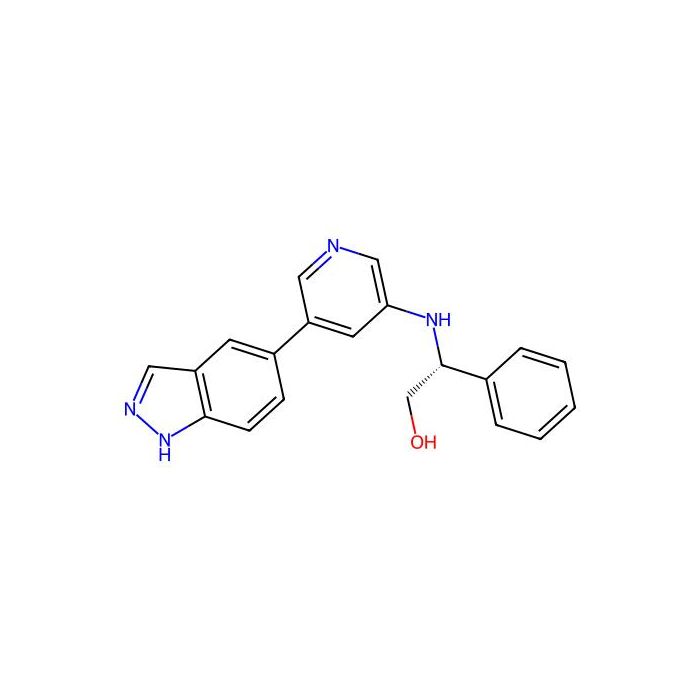
GRADE & PURITYMoligand™?Moligand™ — Aladdin's line of ligands and bioactive small molecules. Use for receptor, pathway, and binding studies needing defined small-molecule tools.10 mM in DMSO
Treat cells with a range of concentrations for 1–2 h; measure BRET displacement or thermal stabilization shifts to infer binding.
Transcriptomic profiling:
Dose cells with vehicle vs. multiple concentrations; harvest RNA at 2–6 h to capture acute transcriptional effects; analyze by RNA-seq/RT-qPCR.
Controls and QC:
Include vehicle controls and an orthogonal reference inhibitor where available.
Confirm stock concentration/integrity by LC–MS or quantitative NMR for critical experiments.
Note: Adjust exposure time, cell density, and media composition to the biological system. Observe institutional safety and waste protocols.
Biological Roles
Context (general biology; not a clinical claim):
CDK8 (Cyclin-Dependent Kinase 8) is part of the Mediator kinase module (CDK8/19–Cyclin C–MED12–MED13) that regulates RNA polymerase II–mediated transcription. CDK8/19 modulate transcription factor activity and mediator complex function via phosphorylation events, influencing gene expression dynamics, stress responses, and developmental programs.
Chemical inhibition of CDK8 is used in research to dissect signal-dependent transcription (e.g., pathways involving STATs, SMADs, and other transcription factors) and to probe context-specific gene regulation.
Use of small-molecule ligands like CDK8-IN-4 (general guidance):
Serves as a chemical probe candidate to transiently modulate kinase activity, enabling temporal control compared with genetic perturbations (knockdown/knockout). This can reveal acute versus adaptive responses in transcriptomic and proteomic readouts.
In pathway mapping, pairing a CDK8 inhibitor with rescue experiments (e.g., overexpression of phosphorylation-resistant mutants) strengthens causal inference.
Assay considerations:
Confirm on-target effects through orthogonal assays (biochemical IC50/Ki, cellular target engagement) and selectivity panels when available from literature or internal testing.
Monitor global transcriptional and phosphoproteomic changes to understand both primary and compensatory network effects.
Note: Potency, selectivity, and exact mode-of-binding for CDK8-IN-4 are not specified for this item; consult primary literature or request additional data where needed.
Buffer Applications
This product is a small-molecule ligand, not a buffering reagent. However, buffer composition critically affects its performance in biochemical and cellular assays.
General buffer guidance for kinase assays (not item-specific):
Base buffer: HEPES or Tris (25–50 mM) at pH 7.4–7.5, with NaCl (50–150 mM) for ionic strength, MgCl2 or MnCl2 (1–10 mM) for ATP-dependent reactions, and DTT/TCEP (0.5–2 mM) to maintain reducing conditions.
Add 0.01–0.05% Tween-20 to reduce nonspecific adsorption/aggregation, if compatible with detection.
Maintain final DMSO ≤0.5–1% v/v across all wells (include vehicle controls).
Assay-specific notes:
For fluorescence-based readouts, confirm that the ligand and vehicle do not interfere with excitation/emission settings; consider time-resolved or luminescent formats if needed.
In cell-based assays, use serum-containing media appropriate to the cell line and confirm compound stability in the chosen medium over the dosing period (carryover of DMSO ideally ≤0.1–0.2% v/v where tolerated).
Preparation tips:
Pre-dissolve in DMSO to a concentrated stock, then serially dilute into assay buffer while mixing to avoid precipitation.
Filter buffers (0.22 μm) and degas if using oxygen-sensitive detection chemistries.
Green Alternatives
As a bioactive ligand, CDK8-IN-4 itself does not have a direct “green” substitute. However, sustainability considerations arise in the choice of dissolution vehicles and lab practices.
Prioritize aqueous buffers whenever feasible after initial dissolution, minimizing final DMSO fraction.
Consider propylene carbonate (PC) or ethylene carbonate as alternative high-permittivity vehicles in certain screening contexts if compatibility and solubility are validated (note: these may be more viscous and require assay re-optimization).
Avoid DMF and NMP where possible due to reproductive toxicity classifications; if used, implement strict exposure controls.
Comparison (general; not item-specific):
DMSO: Broad solubility; moderate EHS profile; widely accepted in screening; hygroscopic → may require desiccation.
Aqueous buffer: Best EHS profile; risk of precipitation without co-solvent.
Operational green practices:
Prepare small, single-use aliquots to reduce waste and maintain compound integrity.
Use miniaturized assay formats (e.g., 384/1536-well) to lower solvent consumption.
Implement closed-source dispensing to minimize volatilization and operator exposure.
Bottom line: Maintain performance with the least hazardous vehicle compatible with solubility and assay fidelity; document any solvent changes to ensure data comparability.
Pharmaceutical Uses
This product is supplied strictly for research use and is not intended for human or veterinary applications.
Small-molecule kinase inhibitors like CDK8-IN-4 can function as reference standards or tool compounds during early discovery to evaluate target tractability, develop structure–activity relationships (SAR), and benchmark screening cascades.
In preformulation research, such compounds help assess solubility, permeability, and stability properties that guide medicinal chemistry optimization (e.g., salt selection, prodrug hypotheses). No pharmacopeial monograph is implied or provided for this item.
Formulation-type activities suitable for research only:
Preparation of DMSO concentrates for in vitro testing; short-term aqueous dilutions into assay media.
Exploratory enabling formulations (e.g., cyclodextrin inclusion, lipid-based vehicles) may be studied to understand exposure in non-clinical models; any in vivo use must follow institutional approvals and is outside Aladdin’s intended use claims.
Regulatory note:
No claims are made regarding therapeutic suitability, GMP status, or clinical safety/efficacy. For GLP or regulated workflows, request a detailed CoA/Spec Sheet and consider custom qualification.
Physical Properties
Appearance: Not specified for this item; refer to CoA/Spec Sheet.
Molecular weight: Not specified for this item; refer to CoA/Spec Sheet.
Melting point, boiling point, density, refractive index: Not specified for this item; refer to CoA/Spec Sheet.
Aqueous solubility, logP/logD, pKa: Not specified for this item; refer to CoA/Spec Sheet.
General handling guidance for kinase inhibitors (literature/practice; not item-specific specifications):
Many kinase inhibitors are handled as DMSO stock solutions (commonly 10–50 mM). If solid, allow to warm to room temperature in a desiccator before opening to avoid moisture condensation.
Typical working concentrations in biochemical assays range from 1 nM to 30 μM depending on target and assay design (optimize empirically).
For aqueous use, pre-dissolve in DMSO, then dilute into assay buffer with constant mixing to minimize precipitation. Final DMSO content is often kept at ≤0.5–1% v/v to maintain biological compatibility (check assay tolerance).
Solubility and stability can be sensitive to pH and ionic strength; validate by visual inspection and, where critical, by LC/UV to confirm no precipitation or rapid degradation during assay timeframes.
Note: For batch-specific physical data (e.g., solid-state form, water content, residual solvents), consult the CoA/Spec Sheet. Avoid assuming interchangeability with other CDK8 ligands as substituent patterns can significantly alter physicochemical behavior.
Quality and Grades
Grade/Purity: Moligand™.
What Moligand™ implies (general description of grade intent; not a specification):
Moligand™ designates a catalog class optimized for ligand discovery and screening workflows. Lots are prepared to high chemical purity suitable for biochemical assays, HTS, and chemical biology studies. UV-absorbing impurities, residual solvents, and moisture are controlled to support reliable assay performance, but exact numerical specifications are batch-dependent.
Item-specific notes:
Exact purity (%), residual solvents, water content (Karl Fischer), metal content, and stabilizers are Not specified for this item; refer to CoA/Spec Sheet.
Each batch should be traceable by lot number; obtain a CoA for confirmation of identity and purity prior to use in regulated or data-critical campaigns.
Best practices for assay-grade small molecules:
Verify identity/purity by LC–MS/UPLC upon receipt when results will inform structure–activity relationships.
Prepare single-use aliquots to avoid freeze–thaw and headspace oxidative degradation, consistent with the specified argon storage.
Document solvent and concentration for each stock solution; use calibrated balances/pipettes.
If you require special grades (e.g., formulated for crystallography, salt form selection, or quantitative reference standard with assigned purity), contact us for custom services and an augmented specification sheet.
Reaction and Applications
Scope: CDK8-IN-4 is supplied as a bioactive small molecule for target modulation and discovery workflows, not primarily as a synthetic reagent. The following focuses on research applications rather than preparative chemistry.
Assay and screening applications (general, non-clinical):
Use as a tool compound in biochemical kinase assays to explore CDK8/mediator kinase module function. Suitable for establishing assay windows, validating detection methods, and benchmarking inhibitor responses.
Apply in cell-based pathway studies to probe CDK8-dependent transcriptional regulation. Include appropriate DMSO vehicle controls and, ideally, an orthogonal CDK8/19 inhibitor to control for off-targets.
Employ in SAR and chemoproteomic workflows as a reference ligand for affinity profiling, CETSA, or NanoBRET target engagement, where compatible.
Experimental tips:
Titrate across at least 8–12 half-log concentrations; ensure top concentration below solubility/aggregation limits (monitor by light scattering or visual inspection).
For enzyme assays, pre-incubate inhibitor with enzyme (e.g., 10–30 min) to approximate steady-state binding for slow-onset ligands; verify reversibility where relevant.
Control for ATP competition by testing at multiple ATP concentrations to distinguish ATP-competitive versus allosteric behavior (as appropriate to your assay design).
Data integrity:
Confirm chemical integrity by LC–MS before critical studies, especially after prolonged storage or multiple freeze–thaw cycles.
Reaction Conditions
Not typically applicable: CDK8-IN-4 is a bioactive ligand, not a reagent for effecting chemical transformations. Therefore, canonical synthetic reaction conditions (solvent/temperature/catalyst/yield) are not relevant to routine use of this item.
Stock preparation: Dissolve in anhydrous DMSO to a validated concentration (e.g., 10–50 mM). Vortex and sonicate briefly if needed; avoid prolonged heating.
Working solutions: Dilute into assay buffer or cell culture medium with gentle mixing. Keep final DMSO ≤0.5–1% v/v (biochemical) or at tolerable levels for cells (often ≤0.1–0.2%).
Incubation parameters: For enzyme inhibition, pre-incubate inhibitor with enzyme (10–30 min, room temperature) if slow-binding is suspected. For cellular assays, dose over time windows appropriate to target biology (e.g., 2–24 h) while monitoring compound stability.
Controls: Include vehicle controls, and when available, a positive control inhibitor with known activity on CDK8/19 to benchmark assay performance.
Analytical verification: Where outcomes are critical, confirm concentration by UV or quantitative NMR and verify integrity by LC–MS at start/end of assay.
Note: No item-specific kinetic parameters, potency values, or solvent stability data are provided here; consult literature or internal validation data.
Safety and Handling
GHS classification, signal word, pictograms, and H-statements: Not specified for this item; refer to SDS.
Research use: For research use only. Not for human or veterinary use.
Practical PPE and engineering controls (general laboratory guidance):
Wear appropriate PPE: lab coat, safety glasses, and nitrile gloves. Handle powders or concentrated DMSO stocks in a fume hood to reduce exposure.
Avoid inhalation of dust/aerosols and contact with skin/eyes. Prevent environmental release. Use secondary containment for solutions.
First-aid overview (consult SDS for authoritative instructions):
Skin/eye contact: Rinse thoroughly with water for at least 15 minutes; remove contaminated clothing; seek medical attention if irritation persists.
Inhalation: Move to fresh air; seek medical attention if symptoms develop.
Ingestion: Rinse mouth; do not induce vomiting; seek medical attention.
Storage incompatibilities and special risks:
Product is shipped cold and specified to be stored protected from light, under argon, at −80°C. Minimize oxygen and moisture exposure; recap vials promptly.
Many heteroaromatic inhibitors can adsorb to plastics at low concentration; use low-bind plastics or glass for critical assays.
DMSO solutions can facilitate dermal absorption; avoid skin contact.
Waste disposal:
Dispose of residues and solutions as organic hazardous waste in accordance with institutional and local regulations. Decontaminate work areas after use.
Solvent Selection
Applicability: CDK8-IN-4 is a small-molecule ligand intended for biochemical/cellular assay use rather than as a bulk solvent. This section focuses on selecting dissolution solvents and vehicles.
Common vehicles (general guidance; not item-specific specs):
DMSO (anhydrous): Primary choice for preparing concentrated stocks (e.g., 10–50 mM). Offers broad solubilization for heteroaromatic inhibitors; miscible with water for serial dilutions.
DMF or NMP: Alternative aprotic vehicles when DMSO is contraindicated; consider cytotoxicity and assay interference.
Aqueous buffers: Direct dissolution is often limited; generally pre-dissolve in an aprotic solvent and dilute into buffer while mixing.
Buffer/Co-solvent considerations:
Maintain final DMSO ≤0.5–1% v/v in biochemical assays (tolerance varies by enzyme/cell type). Include vehicle controls.
Add small amounts of nonionic surfactant (e.g., 0.01% Tween-20) only if assay chemistry tolerates it and precipitation is observed.
Stability concerns:
Protect solutions from light and oxygen (amber vials, argon headspace), consistent with product storage guidance.
Adsorption losses may occur at low μM/nM levels; prefer glass or low-bind plastics; pre-rinse vessels with working solution if necessary.
Reconstitution guidance (general best practice; not item-specific specifications):
Allow the sealed vial to equilibrate to room temperature in a desiccator before opening to prevent moisture condensation.
Open under inert atmosphere (argon or nitrogen) if possible to maintain the argon blanket and minimize oxidative degradation.
Prepare concentrated DMSO stock solutions (e.g., 10–50 mM) using anhydrous solvent. Vortex to dissolve; brief bath sonication may help. Avoid heating unless stability is documented.
Dispense into single-use aliquots in amber vials or low-bind tubes; backfill headspace with argon; label with concentration and date.
In-use stability (guidance):
Keep working solutions protected from light. Limit bench-time for thawed aliquots; discard if precipitation or discoloration occurs.
Minimize freeze–thaw cycles; thaw on ice and refreeze only once if unavoidable.
Specifications not provided for this item:
Exact solubility limits, aqueous stability half-life, and long-term solution stability are Not specified for this item; refer to CoA/Spec Sheet. Validate storage and handling conditions within your laboratory context prior to critical studies.
Structure and Identity
Product name: CDK8-IN-4 (SKU: C1494505)
CAS: 1613638-82-6
PubChem CID: 75202254
InChIKey: Not specified for this item; refer to CoA/Spec Sheet.
SMILES: Not specified for this item; refer to CoA/Spec Sheet.
Molecular formula: Not specified for this item; refer to CoA/Spec Sheet.
Molecular weight: Not specified for this item; refer to CoA/Spec Sheet.
General structural notes (literature/context; not item-specific):
CDK8-IN series compounds are small-molecule kinase ligands typically designed to target the ATP-binding site of Cyclin-Dependent Kinase 8 (CDK8) and often display features common to ATP-competitive kinase inhibitors (e.g., heteroaromatic hinges, H-bond donors/acceptors, planar cores).
Without the exact SMILES, specific ring systems, stereochemistry, and functional-group inventory for CDK8-IN-4 cannot be enumerated for this catalog item. Users should consult the item’s CoA/Spec Sheet for definitive identifiers prior to registration in ELNs/LIMS.
Identity best practices:
Cross-verify CAS (1613638-82-6) and CID (75202254) with your internal databases prior to procurement.
For regulated or GLP contexts, request and retain the batch-specific CoA including exact structural identifiers (SMILES/InChI, NMR/HRMS data if available).
Synthetic Utility
CDK8-IN-4 is provided as a finished bioactive small molecule rather than a synthetic building block or catalyst; it is not typically employed as a reagent in organic synthesis.
That said, general insights relevant to chemical biology and medicinal chemistry workflows include:
Functional-group tolerance: Kinase inhibitors commonly contain heteroaromatic cores, amide/urea linkages, and H-bonding motifs optimized for ATP-site interactions. While these motifs confer potency, they may reduce aqueous solubility and influence microspecies distribution across physiological pH.
Derivatization strategies (general): Parallel synthesis to explore hinge-binding heterocycles, solubilizing basic side chains, or bioisosteric replacements can tune potency/selectivity versus CDK8/19. If pursuing analog synthesis, obtain or deduce the exact CDK8-IN-4 structure (SMILES/InChI) from the CoA or literature before planning routes.
Analytical support: For SAR, ensure high-throughput LC–MS purity checks, orthogonal NMR for identity, and stability-indicating methods to monitor oxidative or hydrolytic liabilities.
Conclusion: Treat CDK8-IN-4 as a reference ligand or probe candidate. For synthetic derivatization or conjugation (e.g., PROTAC warhead development), structural confirmation is essential; absent item-specific identifiers in this listing, consult the CoA/Spec Sheet.
Target Specificity
Antibody/biologic-style specificity data (antigen, epitope, species reactivity, clone, isotype) do not apply to this small-molecule product.
General research context (not item-specific claims):
CDK8-IN-4 is named to indicate intended activity toward CDK8 (and potentially the closely related CDK19). However, for this catalog item, no potency, selectivity panel, or mode-of-action data are provided.
What users should verify:
Obtain or generate quantitative data (e.g., biochemical IC50/Ki, cellular target engagement, kinase selectivity profiling) to confirm suitability for your system.
Consider orthogonal assays and counter-screens to rule out off-target effects and assay interference (fluorescence quenching, colloidal aggregation).
Item-specific target data: Not specified for this item; refer to CoA/Spec Sheet or request technical support.
Need help choosing the grade?
Our grade selection guide covers purity, stabilizer status, and application suitability for all variants in our catalog.
We use cookies to ensure the website functions properly and, where permitted, to improve your experience. You can manage your preferences at any time in Settings. Learn more in our Cookie Policy.
Shall we send you a message when we have discounts available?
Remind me later
Thank you! Please check your email inbox to confirm.
Products are supplied to verified businesses, institutions, and qualified professionals for research and development use only. Not for use in humans, animals, diagnosis, or therapy.