GRADE & PURITYMoligand™?Moligand™ — Aladdin's line of ligands and bioactive small molecules. Use for receptor, pathway, and binding studies needing defined small-molecule tools.10mM in DMSO
Synonyms
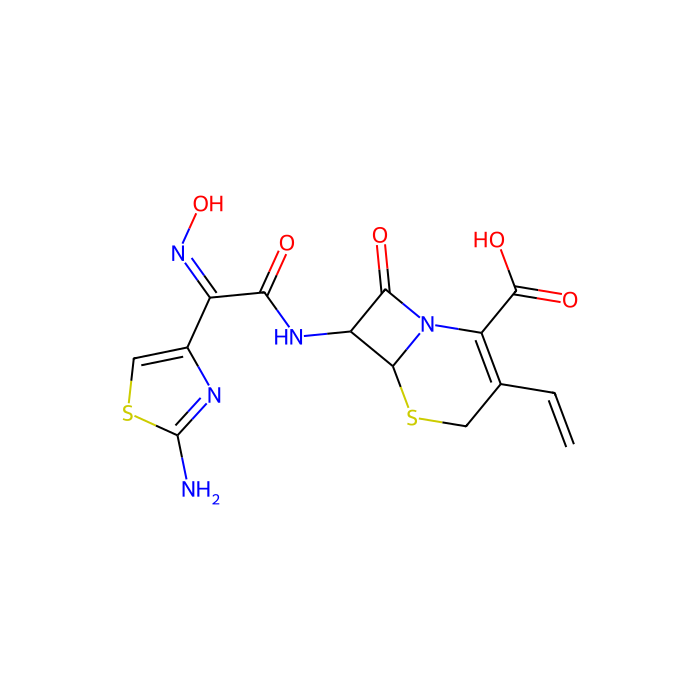
FK 482, PD 134393, CI-983 | (6R,7R)-7-[[(2Z)-2-(2-amino-4-thiazolyl)-2-(hydroxyimino)acetyl]amino]-3-ethenyl-8-oxo-5-thia-1-azabicyclo[4.2.0]oct-2-ene-2-carboxylic acid
Moligand™, 10mM in DMSO Moligand™ for sensitive chromatographic and analytical workflows requiring minimal baseline interference.
🌡
Storage & shipping
Store at -80°C Ships Dry ice packs + Cold packs Check lot-specific COA for exact specifications.
📋
Quality documents
SDS, COA, datasheet, and spec sheet available for download. Lot-specific COA accessible via lot number lookup.
📚
Literature proof
Cited in 1 peer-reviewed publications across chromatography, organic synthesis, and cross-coupling reactions.
Descripción general
Information
Cefdinir (FK 482, PD 134393, CI-983) is an oral cephalosporin antibiotic, used to treat bacterial infections in many different parts of the body. In vitro
Cefdinir, a new oral 2-amino-5-thiazolyl cephalosporin, inhibits the luminol-amplified chemiluminescence (LACL) response of human neutrophils stimulated by PMA but not opsonized zymosan, in a concentration-dependent but not time-dependent manner. Cefdinir inhibits LACL generation in cell-free systems consisting of H2O2, NaI, and either horseradish peroxidase or amyeloperoxidase-containing neutrophil extract. Cefdinir impairs LACL response induced by the calcium ionophore A23187 and FMLP, and this impairment is increased in cytochalasin B-treated neutrophils. Cefdinir directly inhibits the activity of myeloperoxidase-containing neutrophil extract released into the extracellular medium during neutrophil stimulation by soluble mediators, but has no effect on that released into the phagolysosome during phagocytosis. Cefdinir demonstrates excellent activity against a wide range of gram-positive and gram-negative bacteria. Cefdinir is resistant to a broad variety of β-lactamases and exhibits a β-lactam stability profile generally better than those observed with cefaclor and cefuroxime. Cefdinir elimination is primarily mediated by the kidney. Cefdinir interacts with the dipeptide transporters PEPT1 and PEPT2. Cefdinir tubular reabsorption is substantial, that Cefdinir tubular secretion is inhibitable by probenecid, and that this secretion is probably mediated by the renal organic anion secretory pathway.
In vivo
Cell Data
cell lines:
Concentrations:
Incubation Time:
Powder Purity:≥99%
Specifications
Sinónimos
FK 482, PD 134393, CI-983 | (6R,7R)-7-[[(2Z)-2-(2-amino-4-thiazolyl)-2-(hydroxyimino)acetyl]amino]-3-ethenyl-8-oxo-5-thia-1-azabicyclo[4.2.0]oct-2-ene-2-carboxylic acid
Especificaciones y pureza
Moligand™, 10mM in DMSO
Mecanismos bioquímicos y fisiológicos
Cefdinir (FK 482, PD 134393, CI-983) is an oral cephalosporin antibiotic, used to treat bacterial infections in many different parts of the body.
Condiciones de almacenamiento de almacenamiento
Store at -80°C
Enviado en
Dry ice packs + Cold packs
Este producto requiere envío en cadena de frío. Los servicios terrestres y otros servicios económicos no están disponibles.
1.Guanxing Chen, Haohuai He, Lu Zhao, Qiujie Lv, Calvin Yu-Chian Chen. (2023) GINCM-DTA: A graph isomorphic network with protein contact map representation for potential use against COVID-19 and Omicron subvariants BQ.1, BQ.1.1, XBB.1.5, XBB.1.16. EXPERT SYSTEMS WITH APPLICATIONS, [PMID:][10.1016/j.eswa.2023.121274]
Calculadoras de soluciones
Molarity Calculator
Determine the necessary mass, volume, or concentration for preparing a solution.
Dilution Calculator
Determine the dilution needed to prepare a stock solution.
We use cookies to ensure the website functions properly and, where permitted, to improve your experience. You can manage your preferences at any time in Settings. Learn more in our Cookie Policy.
Shall we send you a message when we have discounts available?
Remind me later
Thank you! Please check your email inbox to confirm.
Products are supplied to verified businesses, institutions, and qualified professionals for research and development use only. Not for use in humans, animals, diagnosis, or therapy.