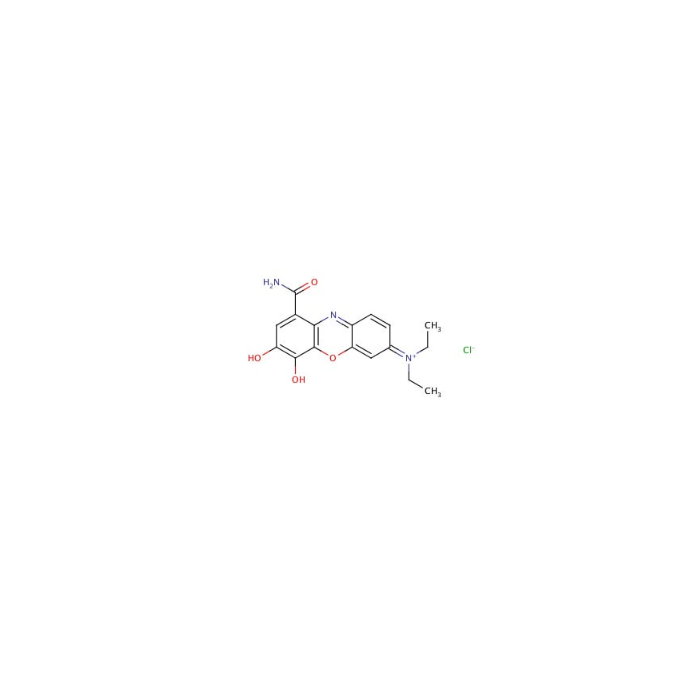
cis-13-Docosenoate | CELESTINEBLUE | COM-998 | 7-(diethylylidene)-3,4-dihydroxyphenoxazinecarboxamide, chloride | Celestin blue B | CELESTINE BLUE | Celestine Blue B | Coelestin blue | COREIN 2R | [7-(diethylamino)-3,4-dioxo-10H-phenoxazine-1-carbonyl]azanium;chloride | Phenoxazin-5-ium, 1-(aminocarbonyl)-7-(diethylamino)-3,4-dihydroxy-, Show more
Especificaciones y pureza
Dye content 80 %
Mecanismos bioquímicos y fisiológicos
Celestine blue (CB) is an oxazine dye and is used in combination with the alum hematoxylin, as a nuclear stain. It gives good nuclear definition and is resistant to strong acid dyes. Celestine blue is commonly used for routine staining of fixed sections.It has been used as a new electroactive indicator in DNA biosensors.
This compound belongs to the class of organic compounds known as phenoxazines. These are polycyclic aromatic compounds containing a phenoxazine moiety, which is a linear tricyclic system that consists of a two benzene rings joined by a 1,4-oxazine ring.
External Descriptors
Not available
1. Djoumbou Feunang Y, Eisner R, Knox C, Chepelev L, Hastings J, Owen G, Fahy E, Steinbeck C, Subramanian S, Bolton E, Greiner R, and Wishart DS. ClassyFire: Automated Chemical Classification With A Comprehensive, Computable Taxonomy. Journal of Cheminformatics, 2016, 8:61.
Determine the necessary mass, volume, or concentration for preparing a solution.
Dilution Calculator
Determine the dilution needed to prepare a stock solution.
Reconstitution Calculator
Reseñas
Reseñas de cliente
Application Protocols
No manufacturer-validated protocols are provided for this SKU. The following is general, literature-based guidance for histological staining; users should optimize conditions for their samples.
Example workflow: Celestine blue iron–mordant nuclear stain
Section prep: Deparaffinize and rehydrate tissue sections through graded alcohols to water.
Mordant: Immerse in 2–5% ferric ammonium sulfate solution for 2–5 min; rinse in water.
Stain: Apply celestine blue solution (e.g., 0.1–0.5% w/v in water or 70% ethanol with 0.5–1% acetic acid) for 1–5 min. Protect from light.
Rinse: Wash in running tap water or distilled water for 1–3 min.
Differentiate (optional): Brief dips in dilute acid alcohol to sharpen nuclear detail; rinse promptly.
Counterstain: Proceed with compatible counterstains if desired.
Dehydrate and mount: Through graded alcohols, clear, and coverslip with a suitable mountant.
Quality tips:
Filter all solutions (0.22–0.45 µm) before use.
Record pH, temperature, and times for reproducibility.
Validate each lot on control sections to confirm hue and contrast.
Note: Parameters are general guidance, not item specifications.
Biological Roles
Celestine blue is a synthetic dye and does not have a native biological role. The following points describe general, literature-based interactions of basic (cationic) dyes with biological materials in research contexts.
Binding preference: Cationic dyes electrostatically associate with anionic biomacromolecules (DNA/RNA phosphate backbone, acidic glycosaminoglycans, and certain acidic proteins). Aromatic planarity can enable intercalative or groove-binding interactions with nucleic acids, influencing color intensity and shade.
Mordant-assisted staining: In the presence of multivalent metal ions (e.g., Fe3+), dye–metal complexes (“lakes”) can form and bind robustly to nuclear chromatin, granting resistance to subsequent differentiation and dehydration steps in histological workflows.
pH dependence: Protonation state of the dye and ionization of tissue components modulate binding and metachromasia; mildly acidic conditions frequently enhance nuclear staining specificity for many cationic dyes.
Photostability: Many dyes are susceptible to photofading, especially in thin films and in oxygenated media. Protect stained specimens and working solutions from light to preserve color.
Compatibility: Fixatives (formalin, alcohols), section thickness, and dehydration/clearing regimens shift dye uptake; hence protocol-specific validation is essential for reproducible results.
Note: The above are general research observations. No clinical/diagnostic claims are made. For regulated applications, validate methods under appropriate quality systems.
Buffer Applications
Celestine blue is not a buffering agent. However, it is commonly used in buffered or mildly acidic staining baths. Below are general, literature-based suggestions for preparing staining solutions; adjust empirically to your substrates.
Common media: Water, aqueous ethanol (50–80%), or buffered aqueous solutions (e.g., acetate buffer) to maintain mildly acidic pH.
pH range (general for cationic dyes): Approx. pH 2.5–5.5 often yields strong nuclear staining with reduced background; exact optimum is method-dependent.
Example (literature-style) staining bath concept:
Ferric mordant: 2–5% ferric ammonium sulfate in water, optionally with a small amount of acetic acid; brief incubation of sections.
Dye bath: Celestine blue in water or 70% ethanol, acidified slightly (e.g., 0.5–1% acetic acid). Filter before use.
Rinse/differentiate: Water wash; if needed, brief dip in dilute acid alcohol to sharpen contrast.
Ionic strength: Moderate salt can reduce nonspecific interactions; test 0–100 mM NaCl in trial runs.
Because item-specific solubility and assay are not provided, start at low dye concentrations (e.g., 0.05–0.5% w/v) and titrate for optimal contrast. Always record pH and solvent composition for reproducibility.
Green Alternatives
While Celestine blue is a specialized histological dye, greener practice focuses on solvent systems, waste minimization, and alternative dyes with improved safety profiles.
Potential greener considerations (general):
Solvent system:
Prefer water or aqueous ethanol over methanol or higher-toxicity organics when feasible.
Use minimal acid concentrations necessary for staining; avoid strong mineral acids when weaker acids (e.g., acetic acid) suffice.
Alternative dyes (contextual comparison; literature-based):
Methylene blue: Broadly available, good water solubility; may offer lower hazard classifications in some jurisdictions but with different metachromatic behavior.
Toluidine blue O: Effective basic dye with strong nucleic acid affinity; well-characterized in buffered aqueous systems.
Hematoxylin/iron mordant systems: Naturally derived chromogen; often used as the primary nuclear stain, potentially reducing reliance on synthetic cationic dyes depending on the workflow.
Small comparison (general):
Celestine blue: Distinct chromophore; excellent contrast in iron–dye lakes; specialized supply chain; handle with light protection.
Methylene blue/Toluidine blue: Readily available, robust aqueous protocols; different hue/metachromasia; may simplify waste handling.
Greening the workflow:
Scale solutions to immediate need, extend bath life with filtration and covered containers, segregate dye wastes for appropriate disposal, and document minimal effective concentrations to reduce total dye load.
Pharmaceutical Uses
This product is supplied strictly for research use only (per Product Data) and is not intended for human or veterinary use.
Contextual, non-clinical information:
Role: Synthetic dye used in laboratory staining and visualization; not an approved excipient or coloring agent for pharmaceutical formulations unless explicitly supported by pharmacopeial monographs (none cited here).
Manufacturing/QC laboratories: May be used in research assays or training environments for visualization standards or process simulations; not for incorporation into drug product.
Regulatory note: If considering any GMP-adjacent use (e.g., analytical visualization), qualify the lot under your quality system and ensure that no prohibition exists for the intended context.
No therapeutic, diagnostic, or clinical claims are made for this material.
Physical Properties
Item-specific physical property data have not been provided for this SKU.
Appearance: Not specified for this item; refer to CoA/Spec Sheet.
Melting point: Not specified for this item; refer to CoA/Spec Sheet. (Many basic dyes decompose rather than distill; mp values can vary by salt form.)
Boiling point: Not applicable for ionic organic dyes (decompose before boiling) (general literature guidance).
Density: Not specified for this item; refer to CoA/Spec Sheet.
Solubility (general, literature-based for cationic dyes like Celestine blue):
Often soluble in water and lower alcohols; solubility can depend on counterion and hydration state.
Solutions are typically intensely colored; filtration through 0.22–0.45 µm is recommended for microscopy work.
pKa/logP: Not specified for this item; refer to CoA/Spec Sheet. (Basic dyes commonly exhibit pKa values reflecting protonated amine nitrogens; distribution depends on medium polarity.)
UV-Vis (general, literature-based): Exhibits strong visible absorption bands characteristic of the chromophore; exact λmax depends on solvent, pH, and complexation (e.g., with Fe3+). Not specified for this item; refer to CoA/Spec Sheet.
Refractive index: Not applicable to solids; Not specified for this item.
Practical notes (general):
Prepare fresh solutions to minimize photofading; protect solutions from light per storage guidance. Adjust ionic strength and pH to optimize staining contrast and specificity.
Quality and Grades
Grade/Purity: Not specified for this item; refer to CoA/Spec Sheet.
Interpretation and guidance:
Without a declared grade (e.g., biological stain grade, analytical grade), users should verify assay/purity, counterion identity, residual salts, moisture, and spectral characteristics on the CoA/Spec Sheet to ensure suitability for microscopy, imaging, or analytical applications.
Dye performance is often governed more by chromophore integrity, counterion content, and trace metal levels than by a simple purity percentage. For histological applications, low particulate burden and consistent λmax/ε are critical for reproducible coloration.
Stabilizers: None are listed for this item. If stabilizers or anti-caking agents are present, they will be shown on the CoA; these can influence staining background and should be considered during method development.
Batch-to-batch consistency: For staining protocols (e.g., iron–celestine blue lakes), small spectral shifts can affect contrast. It is good practice to qualify each lot by a quick performance check (test tissue section or reference substrate) before large studies.
Documentation: Request or download the CoA/Spec Sheet and SDS for:
Identity tests (e.g., UV-Vis profile)
Assay and impurity profile
Moisture/LOD
Inorganic residue (ash) and counterion content
Recommended applications and any special handling notes.
Reaction and Applications
This compound is primarily a biological/histological stain rather than a synthetic reagent. No manufacturer application details were provided for this SKU.
Research and laboratory applications (general, literature-based):
Histology: Celestine blue has been used as a nuclear stain in iron–dye complexes ("celestine blue–hematoxylin" methods), where ferric salts act as a mordant to form a stable dye lake with nuclear components, offering crisp chromatin contrast.
Microscopy: As a cationic dye, it binds preferentially to anionic biopolymers (e.g., nucleic acids, acidic mucins), often delivering blue to blue-violet coloration. Performance depends on fixation, pH, and mordant.
Analytical staining: Potential utility in paper or thin-layer chromatography as a visualization reagent for anionic species, subject to compatibility.
Teaching and QC: Useful for color standards, filter calibration, and general dye behavior demonstrations.
Practical tips:
Prepare fresh solutions; protect from light to minimize photobleaching.
For iron-mordanted staining, pre-treat sections with ferric ammonium sulfate under controlled acidity, then expose to celestine blue solution; rinse and proceed to counterstains as needed.
Control pH (often mildly acidic) for consistent hue and intensity; excessive acidity may alter shade or reduce binding.
Rinse thoroughly to lower nonspecific background; brief differentiation steps (acid alcohol) can sharpen contrast.
Note: Optimization is substrate- and protocol-specific; validate conditions with trial slides.
Reaction Conditions
Conventional reaction-condition guidance is not broadly applicable, as Celestine blue is used as a stain rather than as a reactant. For laboratory preparation and use of staining solutions, the following general, literature-based conditions are relevant:
Solvent: Water or aqueous ethanol (50–80%). Acidify slightly with acetic acid for improved nuclear staining.
Mordanting: Pre-treat sections with ferric ammonium sulfate (e.g., 2–5%) for iron–dye lake formation; rinse before dye exposure.
Dye concentration: Start low (0.05–0.5% w/v) and titrate. Higher concentrations can raise background.
Temperature/time: Room temperature staining for 1–10 minutes is typical in histology workflows; exact timing depends on tissue, fixation, and concentration.
Light protection: Use amberware or cover vessels to limit photofading during staining.
Rinsing/differentiation: Thorough water rinse; brief differentiation in dilute acid alcohol can enhance nuclear/cytoplasmic contrast when required.
Expected outcomes (general):
Blue to blue-violet nuclear coloration with good contrast after iron mordanting; stability through dehydration/clearing depends on protocol specifics.
Note: Values above are general literature guidance and not item-specific specifications. Optimize for your specimen type and lab conditions.
Safety and Handling
Authoritative safety data should be obtained from the product SDS. Item-specific classifications were not provided in the Product Data.
GHS classification: Not specified for this item; refer to SDS.
Signal word / H-statements / pictograms: Not specified for this item; refer to SDS.
General laboratory precautions for cationic dyes:
Hazards: Basic dyes can cause skin/eye staining and irritation. Avoid inhalation of dusts and contact with skin/eyes. Some dyes may be harmful if swallowed or cause respiratory irritation; evaluate SDS before use.
PPE: Lab coat, safety glasses or splash goggles, and nitrile gloves. Use a dust mask or handle in a fume hood when weighing powders.
Engineering controls: Work in well-ventilated areas or fume hood to minimize aerosolization of fine particulates. Employ spill trays and lint-free tissues to contain staining.
Storage incompatibilities: Avoid strong oxidizers and strong acids/bases unless required by protocol. Keep away from photosensitizing conditions to limit fading or decomposition.
Photostability: Product Data specifies “Protected from light” — minimize exposure by using amber glassware and covering flasks.
Inerting: Product is “Argon charged” — maintain containers tightly closed; purge headspace with inert gas after opening when feasible to limit oxidative degradation.
First aid (overview; consult SDS):
Skin: Wash with soap and water; remove stained clothing.
Eyes: Rinse cautiously with water for several minutes; seek medical attention if irritation persists.
Inhalation: Move to fresh air.
Ingestion: Rinse mouth; seek medical advice.
Solvent Selection
Celestine blue is a basic (cationic) dye typically supplied as a salt. Solvent behavior depends on salt form and hydration; item-specific solubility is not provided for this SKU.
General, literature-based guidance:
Polarity class: Polar/ionic; favors protic or polar aprotic media.
Common solvents: Water (often soluble), ethanol/methanol (frequently soluble), and aqueous alcohols. Solubility in nonpolar solvents is generally poor.
pH effects: Protonation state and color intensity can vary with pH; mildly acidic aqueous media often enhance dye solubility and stability. For iron “lake” formation, acidic conditions with ferric salts are used in histology.
Additives: Small amounts of acetic acid or buffer salts can improve solution stability and staining performance.
Filtration: 0.22–0.45 µm membrane filtration removes particulates that can cause background in microscopy.
When to choose alternatives:
If water-fastness or specific metachromasia is required, compare with other cationic dyes (e.g., methylene blue, toluidine blue) or oxazine dyes with documented behavior for your tissue/cell type.
Comparison (general):
Water: maximal ionization, strong color, compatible with ferric mordants.
Ethanol: useful for dehydrated sections; may reduce background but can affect shade.
Aqueous ethanol (50–80%): balances penetration and color strength for many staining workflows.
Storage and Reconstitution
Storage conditions (from Product Data):
Protect from light.
Argon charged (maintain container tightly closed; consider re-purging headspace with inert gas after opening to limit oxidative degradation).
Shipped at: Normal conditions.
Long-term storage: Store in a cool, dry place away from strong oxidizers and moisture. Use amber bottles or secondary light protection.
Reconstitution (general guidance; item-specific solubility not provided):
Solvent: Start with water or 50–70% ethanol; slight acidification (e.g., 0.5–1% acetic acid) may improve dissolution and stability. If high purity water does not readily dissolve the material, gently warm (≤30–40°C) and stir; avoid prolonged heating or strong light.
Concentration: Prepare a small test batch (e.g., 1–5 mg/mL) to assess solubility and performance; adjust as needed for your protocol.
Filtration: Sterile-filter (0.22 µm) for microscopy/cell-associated applications to remove particulates.
Aliquoting: Divide into single-use amber vials to minimize air/light exposure and repeated opening.
Stability: Use freshly prepared solutions when possible. If storage of solutions is necessary, keep refrigerated and protected from light; monitor for color change or precipitate.
Research use only: Not for human or veterinary use. Consult the CoA/Spec Sheet and SDS for any additional, item-specific instructions.
Structure and Identity
Product name: Celestine blue (commonly known as a basic/cationic histological dye; also encountered as “Celestine blue B” in literature)
CAS: 1562-90-9
CID: 135403650
InChIKey: Not specified for this item; refer to CoA/Spec Sheet. (Note: provided string “314369” is not a standard InChIKey format.)
SMILES: Not specified for this item; refer to CoA/Spec Sheet.
Molecular formula: Not specified for this item; refer to CoA/Spec Sheet.
Molecular weight: Not specified for this item; refer to CoA/Spec Sheet.
Structural features (general, literature-based):
Celestine blue dyes are classically categorized among basic (cationic) dyes used in histology; many references assign them to the oxazine family of aromatic nitrogen heterocycles. They typically exist as salt forms (e.g., chloride), conferring water solubility.
Key functional motifs (literature): extended, conjugated, polycyclic aromatic system enabling strong visible-light absorption; one or more tertiary amine nitrogens responsible for cationic character under physiological conditions.
2D description (general): a fused multi-ring chromophore with heteroatoms (usually N, sometimes O) bearing a delocalized positive charge across the dye scaffold; counterion present for charge balance. This architecture supports metachromatic staining and complexation (e.g., iron-dye “lake” formation) in histological protocols.
Identity notes:
Without item-specific structural identifiers (SMILES/InChIKey/formula), users should verify exact structure and counterion on the Certificate of Analysis (CoA) for spectral matching, method validation, and regulatory documentation.
Synthetic Utility
Celestine blue functions as a chromophoric stain and is not typically employed as a reagent or intermediate in organic synthesis. Accordingly, classic synthetic-chemistry “utility” (e.g., nucleophile/electrophile reactivity, protective group chemistry) is limited or non-applicable.
Potential niche laboratory utilities (general):
Tracer/colorant: Can be used as a visual tracer in method development (e.g., monitoring column fractions, flow paths) where a strongly colored, water-compatible tracer is useful.
Indicator behavior: Some basic dyes display pH- or coordination-sensitive spectral shifts; while not a standardized indicator, celestine blue–metal interactions may be explored in teaching labs to illustrate complexation phenomena.
If your goal is synthetic transformations (e.g., dye modification, salt exchange):
Transformations usually target the counterion (ion exchange resins) or functionalization of peripheral amine substituents on the chromophore. Such chemistry is specialized and requires structural confirmation of the starting material (SMILES/InChI), which are not specified for this item.
Target Specificity
This product is not an antibody or affinity reagent; target specificity in the immunological sense does not apply.
Contextual note (general, literature-based): In histology, celestine blue exhibits preferential binding to anionic nuclear components (DNA/RNA) especially when used with ferric mordants, yielding pronounced nuclear staining. This is driven by electrostatic interactions and dye–metal “lake” formation rather than epitope recognition.
Preguntas frecuentes
How should this product be stored?
Store protected from light under argon. It is supplied under an argon blanket; reseal under inert gas after each use.
How is this product shipped?
This product ships under standard ambient conditions. No temperature-controlled packaging is required.
What are the CAS number, molecular formula and molecular weight?
The CAS Number is 1562-90-9, the molecular formula is C17H18ClN3O4, and the molecular weight is 363.80 g/mol. InChIKey REPMZEQSQQAHJR-UHFFFAOYSA-N.
What documentation is provided?
Available product documentation, including Certificates of Analysis (COA), Safety Data Sheets (SDS), and specification sheets, is shown in the product document area. Document availability and access follow the current site policy.
Utilizamos cookies para garantizar el correcto funcionamiento del sitio web y, cuando esté permitido, para mejorar su experiencia. Puede gestionar sus preferencias en cualquier momento en Configuración. Más información en nuestra Política de Cookies.
¿Quieres que te enviemos un mensaje cuando tengamos descuentos disponibles?
Recordármelo más tarde
¡Gracias! Por favor, revisa tu bandeja de entrada de correo electrónico para confirmar.
Products are supplied to verified businesses, institutions, and qualified professionals for research and development use only. Not for use in humans, animals, diagnosis, or therapy.

 C2321469