Determine the necessary mass, volume, or concentration for preparing a solution.
| Activity Type | Relation | Activity value | Units | Action Type | Journal | PubMed Id | doi | Assay Aladdin ID |
|---|

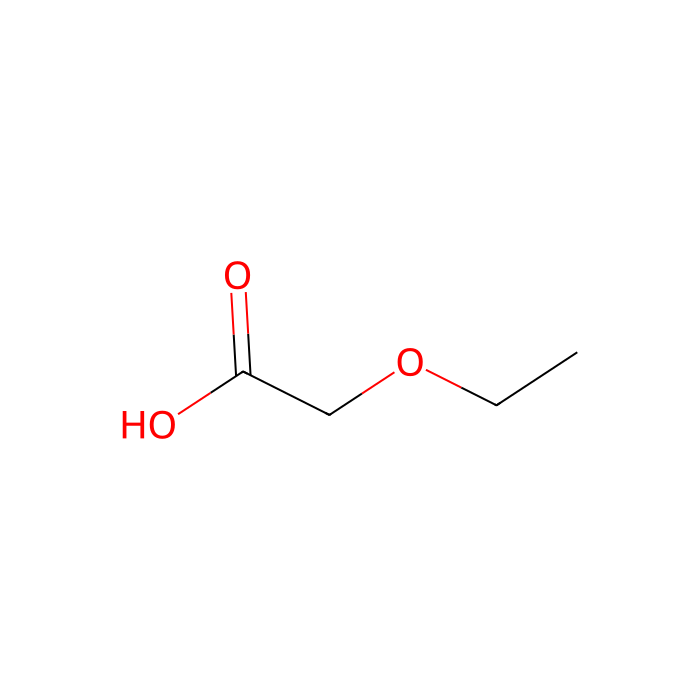
El ácido etoxiacético es un biomarcador de la exposición a productos químicos industriales ampliamente utilizados, como los glicoles de etileno sustituidos por alquilos y otros éteres alifáticos
El ácido etoxiacético es un metabolito del éter de glicol alcoxiácido y se utilizó para evaluar su toxicidad en el ensayo de células madre embrionarias en ratón[3]. Se utilizó en la prueba de embriotoxicidad del pez cebra para estudiar la toxicidad química tras la exposición del embrión vertebrado completo durante la embriogénesis in ovo[4].
aplicación:
El ácido etoxiacético se utiliza para evaluar la toxicidad en la prueba de células madre embrionarias en ratones. Encuentra aplicación como biomarcador de exposición a etilenglicoles alquil-sustituidos y otros éteres alifáticos. Se utiliza como precursor para preparar el éster etoxiacético del ácido etoxiacético.
Taxonomy Tree
| Kingdom | Organic compounds |
|---|---|
| Superclass | Organic acids and derivatives |
| Clase | Carboxylic acids and derivatives |
| Subclass | Carboxylic acids |
| Intermediate Tree Nodes | Not available |
| Direct Parent | Carboxylic acids |
| Alternative Parents | Monocarboxylic acids and derivatives Dialkyl ethers Organic oxides Hydrocarbon derivatives Carbonyl compounds |
| Molecular Framework | Aliphatic acyclic compounds |
| Substituents | Monocarboxylic acid or derivatives - Ether - Dialkyl ether - Carboxylic acid - Organic oxygen compound - Organic oxide - Hydrocarbon derivative - Organooxygen compound - Carbonyl group - Aliphatic acyclic compound |
| Descripción | This compound belongs to the class of organic compounds known as carboxylic acids. These are compounds containing a carboxylic acid group with the formula -C(=O)OH. |
| External Descriptors | Not available |
| Activity Type | Relation | Activity value | Units | Action Type | Journal | PubMed Id | doi | Assay Aladdin ID |
|---|
Find and download the COA for your product by matching the lot number on the packaging.
| Lot Number | Certificate Type | Fecha | Articulo |
|---|---|---|---|
 K2118398 | Certificate of Analysis | Sep 04, 2025 | E156174 |
| K2118399 | Certificate of Analysis | Sep 04, 2025 | E156174 |
| H2114139 | Certificate of Analysis | May 12, 2025 | E156174 |
| H2402146 | Certificate of Analysis | Apr 15, 2024 | E156174 |
| H2412147 | Certificate of Analysis | Apr 15, 2024 | E156174 |
| H2412148 | Certificate of Analysis | Apr 15, 2024 | E156174 |
| L2322174 | Certificate of Analysis | Dec 01, 2023 | E156174 |
| B2309116 | Certificate of Analysis | Mar 21, 2022 | E156174 |
| F2224389 | Certificate of Analysis | Mar 21, 2022 | E156174 |
| F2224390 | Certificate of Analysis | Mar 21, 2022 | E156174 |
| F2224488 | Certificate of Analysis | Mar 21, 2022 | E156174 |
| Solubilidad | Chloroform (Slightly), Methanol (Slightly) |
|---|---|
| Índice de refracción | 1.4170 to 1.4200 |
| Punto de inflamación (°F) | 206.6 °F |
| Punto de inflamación (°C) | 97°C |
| Punto de ebullición (°C) | 207°C |
| Peso molecular | 104.1 |
| XLogP3 | 0.000 |
| Hydrogen Bond Donor Count | 1 |
| Hydrogen Bond Acceptor Count | 3 |
| Rotatable Bond Count | 3 |
| Exact Mass | 104.047 Da |
| Monoisotopic Mass | 104.047 Da |
| Topological Polar Surface Area | 46.500 Ų |
| Heavy Atom Count | 7 |
| Formal Charge | 0 |
| Complexity | 60.000 |
| Isotope Atom Count | 0 |
| Defined Atom Stereocenter Count | 0 |
| Undefined Atom Stereocenter Count | 0 |
| Defined Bond Stereocenter Count | 0 |
| Undefined Bond Stereocenter Count | 0 |
| The total count of all stereochemical bonds | 0 |
| Covalently-Bonded Unit Count | 1 |
H314:Causes severe skin burns and eye damage
H315:Causes skin irritation
H319:Causes serious eye irritation
H335:May cause respiratory irritation
P260:Do not breathe dust/fume/gas/mist/vapors/spray.
P261:Avoid breathing dust/fume/gas/mist/vapors/spray.
P264:Wash hands [and …] thoroughly after handling.
P271:Use only outdoors or in a well-ventilated area.
P280:Wear protective gloves/protective clothing/eye protection/face protection.
P321:Specific treatment (see ... on this label).
P363:Wash contaminated clothing before reuse.
P301+P330+P331:IF SWALLOWED: Rinse mouth. Do NOT induce vomiting.
P302+P352:IF ON SKIN: wash with plenty of water.
P304+P340:IF INHALED: Remove person to fresh air and keep comfortable for breathing.
P305+P351+P338:IF IN EYES: Rinse cautiously with water for several minutes. Remove contact lenses if present and easy to do - continue rinsing.
P362+P364:Take off contaminated clothing and wash it before reuse.
P405:Store locked up.
P403+P233:Store in a well-ventilated place. Keep container tightly closed.
P501:Dispose of contents/container to an approved waste disposal plant.
P264+P265:Wash hands [and …] thoroughly after handling. Do not touch eyes.
P305+P354+P338:IF IN EYES: Immediately rinse with water for several minutes. Remove contact lenses if present and easy to do. Continue rinsing.
P337+P317:If eye irritation persists: Get medical help.
P332+P317:If skin irritation occurs: Get medical help.
P302+P361+P354:IF ON SKIN: Take off Immediately all contaminated clothing. Immediately rinse with water for several minutes.
P316:Get emergency medical help immediately.
P319:Get medical help if you feel unwell.