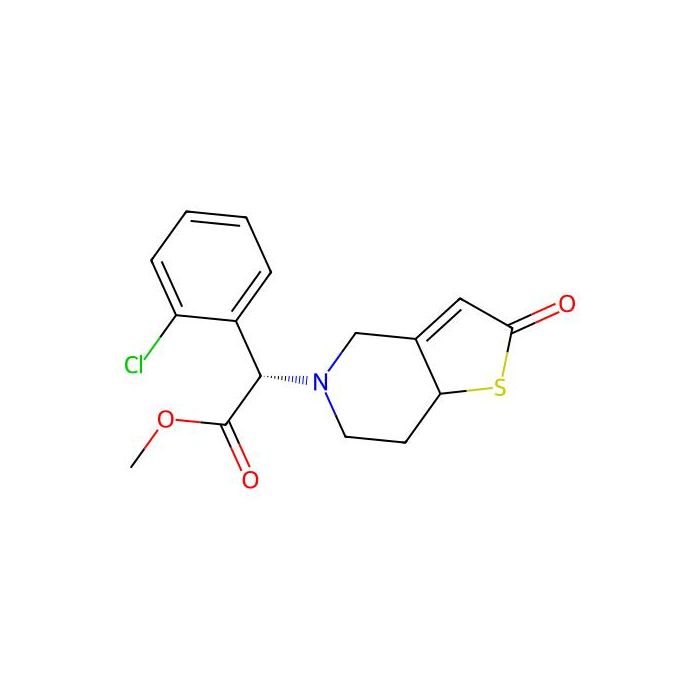
Clopidogrel thiolactone is an active metabolites containing thiols resulting from thionolactone transformation of clopidogrel . Clopidogrel thiolactone is a P2Y12 receptor inhibitor, is a potent antiplatelet agent
In Vivo
Clopidogrel thiolactone (8 μm/kg; i.v.; Sprague-Dawley male rats) has good biological availability and pharmacokinetic parameters . MCE has not independently confirmed the accuracy of these methods. They are for reference only. Animal Model: Sprague-Dawley male rats Dosage: 8 μm/kg; orally clopidogrel (24 μm/kg) Administration: Intravenous injection; collected blood at 0 h (before dosing) and 0.083, 0.167, 0.5, 1, 2, 4, 6, 8, 24 h postdose. Result: 1.19 Parameter Clopidogrel C max (μg/L) 6.93 T max (h) 0.583 t 1/2 (h) 2.48 AUC 0-∞ (μg*h/L) 32.2
IC50& Target:P2Y12 Receptor
Especificaciones
Especificaciones y pureza
10mM in DMSO
Mecanismos bioquímicos y fisiológicos
Clopidogrel thiolactone is an active metabolites containing thiols resulting from thionolactone transformation of clopidogrel ( HY-15283 ). Clopidogrel thiolactone is a P2Y12 receptor inhibitor, is a potent antiplatelet agent.
Condiciones de almacenamiento de almacenamiento
Store at -80°C
Enviado en
Dry ice packs + Cold packs
Este producto requiere envío en cadena de frío. Los servicios terrestres y otros servicios económicos no están disponibles.
Tipo de acción
INHIBITOR
Nombres e identificadores
Isómeros SMILES
COC(=O)[C@H](C1=CC=CC=C1Cl)N2CCC3C(=CC(=O)S3)C2
PubChem CID
56848893
Peso molecular
337.82
Datos avanzados
Certificados (CoA, COO, BSE/TSE y tabla de análisis)
C of A & Other Certificates(BSE/TSE, COO):
Analytical Chart:
Calculadoras de soluciones
Molarity Calculator
Determine the necessary mass, volume, or concentration for preparing a solution.
Dilution Calculator
Determine the dilution needed to prepare a stock solution.
Reconstitution Calculator
Reseñas
Reseñas de cliente
Application Protocols
Below are example research workflows for clopidogrel thiolactone as an analytical reference standard or reactive intermediate. These are general suggestions; adjust to your instrumentation and SOPs.
LC–MS/MS calibration standard (general):
Equilibrate vial to room temperature in a desiccator. Open only after condensation risk is eliminated.
Prepare a 10 mM primary stock in anhydrous MeCN or DMSO. Vortex until fully dissolved.
Aliquot into low-bind microvials (50–100 µL) and store at −80 °C.
On assay day, thaw a single aliquot on ice; dilute serially in mobile phase (e.g., MeCN/H2O with 2–10 mM ammonium formate, pH 3–4). Discard any unused thawed aliquot.
Reactivity assay with nucleophiles (aminolysis/thiolysis):
In a dry vial under N2, dissolve the compound in anhydrous MeCN (0.01–0.05 M).
Add nucleophile (1.1–2.0 equiv). Optionally include DIPEA (0–0.2 equiv) for activation.
Stir at 0–25 °C, monitor by LC–MS. Quench with dilute acid, extract with EtOAc, and analyze.
Stability screening (forced degradation panel):
Expose small aliquots to 0.1 M HCl, neutral buffer, and 0.1 M NaOH at ambient temperature for defined intervals; analyze by LC–MS to map degradation routes. Expect faster degradation under basic conditions.
All protocols are for research use only. Validate internally before routine deployment.
Biological Roles
Clopidogrel thiolactone is recognized in the literature as an intermediate within the broader bioactivation landscape of clopidogrel. It is primarily relevant as a chemical entity to study metabolism, reactivity, and analytical detection, not as a functional biological molecule.
Context within clopidogrel metabolism (literature/general):
Clopidogrel undergoes enzyme-mediated transformations that include oxidative steps by cytochrome P450 isozymes (notably CYP2C19 and CYP3A family) and competing hydrolytic pathways via esterases. Thiolactone formation is observed along these pathways as an intermediate en route to reactive thiol species.
The thiolactone can undergo ring opening to produce thiol-containing metabolites, which are reactive toward nucleophiles (e.g., cysteine residues) in vitro. The thiolactone itself is less nucleophilic/reactive than the resultant thiol but is a useful proxy for studying chemical selectivity.
Research utility:
Serves as a calibration and identification standard for bioanalytical assays (LC–MS/MS) quantifying clopidogrel-related species in in vitro systems.
Useful for mechanistic experiments that probe covalent adduct formation propensity under controlled conditions, without making clinical or pharmacodynamic claims.
Caution:
Do not infer therapeutic or physiological activity from the thiolactone per se. All uses should be confined to controlled laboratory research and method development.
Buffer Applications
This compound is a neutral, hydrophobic thiolactone and is not typically used as a buffering agent or buffer component.
Practical note:
If aqueous buffers are required for biological assays, introduce the compound via a minimal percentage of a water-miscible organic co-solvent (e.g., DMSO or MeCN at ≤1–2% v/v) to avoid precipitation. Maintain neutral to mildly acidic pH to reduce hydrolytic ring opening.
For stability studies, pair with volatile, MS-compatible buffers (e.g., ammonium formate/acetate at low millimolar concentrations) to facilitate LC–MS analysis.
Refer to Solvent Selection and Reaction Conditions for recommendations more relevant to handling and use.
Green Alternatives
When working with clopidogrel thiolactone, greener solvent choices can reduce environmental impact without sacrificing performance. Selection must still respect the compound’s hydrolytic sensitivity.
Preferred greener options (general):
Ethyl acetate: effective for extractions and some reactions; readily biodegradable, low toxicity.
2-Methyltetrahydrofuran (2-MeTHF): bio-based alternative to THF; good for many aprotic reactions, immiscible with water to aid separations.
Cyclopentyl methyl ether (CPME): hydrophobic ether with low peroxide formation tendency; good for moisture-sensitive chemistry.
Acetonitrile: not “green” per se, but often superior to halogenated solvents for LC/MS and reactions; high recoverability by distillation.
Tradeoffs:
DCM/CHCl3: excellent solvency but high environmental/health costs—use only if necessary and recover via solvent recycling.
DMSO: benign from a volatility/toxicity standpoint but oxidizing impurities/moisture can affect sensitive thiolactones; ensure high purity/low water.
Quick comparison (general guidance):
| Solvent | Green profile | Suitability |
| --- | --- | --- |
| EtOAc | Favorable | Workups, extractions, some ring-opening reactions |
| 2-MeTHF | Favorable | Anhydrous reactions; replaces THF/MTBE |
| CPME | Favorable | Water-intolerant steps; stable and recyclable |
| MeCN | Moderate | LC/MS and synthesis; recover/recycle |
| DCM | Unfavorable | Use only if needed for solubility/selectivity |
Adopt closed-loop solvent recovery and minimize aqueous basic waste streams to limit thiolactone hydrolysis byproducts.
Pharmaceutical Uses
No excipient or formulation roles are assigned to this material for clinical use. For research use only.
Research/manufacturing context (general):
Analytical reference standard:
Employed in development and validation of QC/QA methods (e.g., LC–MS/MS, UHPLC) to track clopidogrel-related species in synthetic routes or in vitro metabolism studies.
Process chemistry and impurity profiling:
Useful as a marker/benchmark to understand potential formation and fate of thiolactone intermediates during synthetic optimization and stability testing.
Stability-indicating methods:
Included in forced-degradation panels (acid/base, oxidative, thermal, photolytic) to ensure chromatographic methods can resolve thiolactone vs. parent and downstream products.
Notes:
This listing does not imply compliance with pharmacopeial monographs (USP/EP/JP) for the thiolactone; check CoA/Spec Sheet for any applicable internal specifications.
Avoid clinical or diagnostic application; limit use to non-human, non-clinical research workflows.
Physical Properties
Item-specific physicochemical specifications (mp, bp, density, refractive index, water content, residual solvents, UV cutoff) are Not specified for this item; refer to CoA/Spec Sheet.
General/literature-based guidance for clopidogrel thiolactone-type structures:
Physical state: typically a solid or semi-solid organic intermediate; may be amorphous or low-melting depending on counterions/solvate state (literature, varies by batch and preparation).
Solubility (qualitative, literature/general):
Good solubility in polar aprotic organic solvents such as DMSO, DMF, acetonitrile, ethyl acetate, and dichloromethane.
Low to very low solubility in water at neutral pH due to overall neutral, lipophilic framework.
Polarity and partitioning (literature/general):
Moderately lipophilic; logP expected to be similar to clopidogrel derivatives bearing a neutral thienopyridine core. Exact logP for this precise thiolactone species is not widely standardized.
pKa: No strongly ionizable groups in the neutral thiolactone; protonation can occur on ring nitrogens under strong acid, but practical pKa values are not widely tabulated.
Stability considerations (practical):
Hydrolytically sensitive toward strong bases and nucleophiles (aminolysis/thiolysis) and under extended aqueous exposure.
Susceptible to slow ring opening in moist conditions; keep dry, cold, and protected from prolonged light and air when possible.
Always verify lot-specific data from the CoA if you require numerical specifications for method development or QA.
Quality and Grades
Grade/purity: Not specified for this item; refer to CoA/Spec Sheet for assay, impurity profile, and chiral purity (if applicable).
Appearance: Not specified for this item; refer to CoA/Spec Sheet.
How to interpret grades (general guidance):
Research-grade small molecules typically emphasize chemical purity (assay by HPLC/UPLC/GC), identity (NMR/HRMS), and, where relevant, enantiomeric excess (chiral HPLC).
If a stabilizer or counterion is used (e.g., acid addition salts or antioxidant), it will be declared on the CoA. Absence of declaration implies none was intentionally added, but trace adventitious stabilizers/solvents can be present; confirm by CoA.
For LC/MS reference-standard use, look for: high assay purity, well-resolved related substances, and a documented residual solvent panel.
What is specific to this item:
Storage at −80 °C and cold-chain shipment (dry ice + cold packs) indicate a compound with limited ambient stability (e.g., hydrolysis or ring-opening risk). This is consistent with thiolactone sensitivity. Minimize freeze–thaw and moisture exposure.
Documentation you should request/consult:
CoA: assay, ID spectra (1H/13C NMR, MS), chiral purity (if relevant), water content, residual solvents.
Spec Sheet/SDS: handling, hazard codes, and any stabilizers or form (free base vs. salt).
Reaction and Applications
This thiolactone is a pivotal intermediate in clopidogrel-derived chemistry and is widely used as an analytical and synthetic handle.
Applications (research/analytical):
Reference material for studying clopidogrel bioactivation pathways; benchmarking LC–MS/MS methods distinguishing parent, thiolactone, and downstream thiol metabolites.
Reactivity probe toward nucleophiles (amines, thiols) to model protein adduct formation or to generate labeled derivatives for mechanistic studies.
Synthetic transformations (general):
Nucleophilic ring opening (aminolysis, thiolysis, alcoholysis) to furnish thioesters, amides, or the free thiol metabolite after suitable reduction/oxidation sequences.
Oxidation of sulfur (controlled) to sulfoxide/sulfone variants for SAR exploration.
Cross-coupling on the 2-chlorophenyl motif (if retained and accessible) using Pd-catalyzed methods, enabling derivatization.
Practical tips:
Maintain anhydrous, neutral to mildly acidic conditions during manipulations to preserve the thiolactone.
Avoid strong bases and prolonged aqueous workups; quench and extract promptly.
If chirality is critical, conduct low-temperature reactions and verify enantiopurity by chiral HPLC.
Workflows:
Bioanalytical sample prep: prepare primary stock in MeCN or DMSO (e.g., 1–10 mM), serially dilute in mobile phase, and store aliquots at −20 to −80 °C.
Synthesis of thiol metabolite analogs: ring-open with a protected thiol nucleophile, then deprotect to access the free thiol; handle under inert atmosphere to prevent disulfide formation.
All conditions above are general literature practices for thiolactones and clopidogrel-related intermediates; adjust per your route and analytical goals.
Reaction Conditions
The conditions below are general literature practices for thiolactones and clopidogrel-related intermediates. They are provided as non-binding guidance; optimize for your specific system.
Nucleophilic ring opening (aminolysis/thiolysis):
Solvents: anhydrous MeCN, THF, DCM, or DMF.
Bases: weak, non-nucleophilic bases (e.g., DIPEA) in catalytic or substoichiometric amounts, if needed, to activate nucleophiles; avoid strong bases that promote side reactions.
Temperature: 0–25 °C to preserve stereochemistry and limit competing hydrolysis.
Oxidants: m-CPBA (controlled equivalents at −20 to 0 °C) or Oxone; monitor closely by TLC/LC–MS to avoid over-oxidation or ring opening.
Solvent: DCM, MeCN, or EtOAc under cooling.
LC–MS reference standard preparation:
Stock solutions: 1–10 mM in anhydrous MeCN or DMSO; filter through 0.2 µm PTFE if needed.
Dilution: mobile phase or 50:50 MeCN:H2O (volatile buffer, pH ~3–5) immediately before injection.
Stability: store aliquots at −20 to −80 °C; minimize light and air exposure; use within defined study windows validated in-house.
Expected outcomes (general):
Ring-opening reactions typically proceed in good conversions under mild conditions; yields vary with nucleophile and substitution pattern. Validate by NMR and LC–MS.
Safety and Handling
GHS and hazard classifications for this specific item are Not specified for this item; refer to SDS.
General laboratory safety guidance for thiolactone, thienopyridine-containing research chemicals:
Potential hazards (general):
May cause skin/eye irritation; dust or aerosols may irritate respiratory tract. Some thioesters and heteroaromatics may cause sensitization in susceptible individuals.
Not intended for human or veterinary use. For research use only.
Recommended PPE:
Laboratory coat, nitrile gloves (change regularly), and safety glasses with side shields.
Work in a certified fume hood to avoid inhalation exposure and to minimize odors.
Handling practices:
Avoid contact with strong bases, strong nucleophiles, and reducing sulfur nucleophiles unless intended; thiolactones are susceptible to ring-opening.
Keep material dry; minimize exposure to ambient moisture. Use anhydrous solvents and inert atmosphere for sensitive operations.
Storage incompatibilities (general):
Separate from oxidizing agents and strong bases. Store tightly sealed, moisture-protected containers.
Skin/eye: Rinse with water for at least 15 minutes; remove contaminated clothing.
Inhalation: Move to fresh air; seek medical attention if symptoms persist.
Ingestion: Rinse mouth, do not induce vomiting; seek medical attention.
Fire safety:
Use CO2, dry chemical, or foam. Combustion may produce COx, NOx, SOx, and HCl.
For authoritative risk phrases, exposure limits, and spill/fire procedures, defer to the product SDS.
Solvent Selection
Clopidogrel thiolactone is a neutral, moderately lipophilic heteroaromatic thioester. Solvent choice should balance solubility, stability, and downstream analytical compatibility.
Recommended solvents (general/literature):
DMSO: excellent solvency; ideal for stock solutions for bioanalytical assays. Dry, oxygen-reduced DMSO preferred for longer-term solutions.
Acetonitrile: good solvency; LC/MS friendly; lower viscosity and easier removal vs. DMSO.
DMF and ethyl acetate: strong solvency for synthesis and workups.
Dichloromethane or toluene: suitable for nonpolar operations; monitor stability.
Aqueous media:
Limited solubility at neutral pH. Use co-solvent strategies (e.g., DMSO ≤1–2% v/v into buffer) or prepare immediate-use dispersions.
Stability considerations:
Avoid strong basic aqueous media which accelerate ring opening (aminolysis/hydrolysis). Prefer neutral to mildly acidic conditions for short exposures.
Quick comparison (general):
DMSO: highest solubility; may complicate some bioassays at >1%.
EtOAc: good for extractions, workups; limited for aqueous dosing.
Selection tips:
For analytical reference standards: MeCN or DMSO stocks, then dilute with mobile phase.
For synthetic transformations: dry aprotic media (MeCN, DCM, THF) under inert atmosphere to limit hydrolysis.
For storage in solution: prefer anhydrous DMSO or MeCN at low temperature; aliquot to avoid freeze–thaw.
Storage and Reconstitution
Item-specific storage: Store at −80 °C. Shipped on dry ice packs + cold packs to maintain cold chain.
Long-term storage:
Keep tightly sealed in original container under dry, inert atmosphere if possible. Include desiccant. Limit headspace and freeze–thaw cycles by aliquoting upon first opening.
Protect from moisture and prolonged light exposure to minimize hydrolysis and ring opening.
Short-term handling:
When removing from −80 °C, allow the sealed container to equilibrate to room temperature in a desiccator to prevent condensation.
Withdraw material quickly in a dry box or under an inert gas purge; promptly re-seal and return to −80 °C.
Reconstitution/preparation of solutions (general):
Solvents: anhydrous acetonitrile or DMSO are preferred for stock solutions. Typical working stocks are 1–10 mM for LC–MS or reactivity assays (concentration not specified for this item; adjust to your method).
Filtration: If needed, filter through 0.2 µm PTFE under dry conditions.
Aqueous use: Dilute immediately before use into aqueous media with minimal organic co-solvent (≤1–2% v/v), keeping pH neutral to slightly acidic to mitigate hydrolysis.
Stability in solution:
Solution stability is method- and matrix-dependent; establish in-house stability indicating methods. For prolonged storage, freeze small aliquots of anhydrous solutions at −80 °C and avoid repeated thawing.
For any unspecified parameters (appearance, purity, stabilizers), consult the CoA/Spec Sheet.
Structure and Identity
Clopidogrel thiolactone is a heteroaromatic, sulfur-containing cyclic thioester derived from the thieno[3,2-c]pyridine scaffold of clopidogrel. It is commonly referenced as a key intermediate in the metabolic activation pathway of clopidogrel and as a useful analytical standard.
Item-specific identifiers:
CAS: 1147350-75-1
InChIKey: Not specified for this item; refer to CoA/Spec Sheet.
SMILES: Not specified for this item; refer to CoA/Spec Sheet.
Molecular formula: Not specified for this item; refer to CoA/Spec Sheet.
Molecular weight: Not specified for this item; refer to CoA/Spec Sheet.
Structural features (general/literature description):
Core system: fused thieno[3,2-c]pyridine ring bearing a 2-chlorophenyl substituent (as in clopidogrel lineage).
Functional group: intramolecular cyclic thioester (thiolactone) bridging a sulfur and carbonyl, which is prone to nucleophilic ring opening.
Stereochemistry: clopidogrel-derived materials are typically chiral at the benzylic center; thiolactone formation preserves configuration in carefully controlled conditions (literature). The absolute configuration for this specific item is Not specified for this item; refer to CoA/Spec Sheet.
2D description: a bicyclic thienopyridine fused system substituted with 2-chlorophenyl, incorporating a five-membered (commonly) or related-size thiolactone ring where the sulfur of the thienopyridine participates in a cyclic thioester linkage to a pendant carbonyl.
Notes:
This compound is distinct from the active thiol metabolite; it is the thiolactone precursor that can undergo ring-opening to generate the reactive thiol species under suitable conditions.
Synthetic Utility
Clopidogrel thiolactone offers a versatile entry point into clopidogrel-derived chemical space, enabling targeted transformations on both the thienopyridine core and the thiolactone moiety.
Key reactive elements:
Thiolactone (cyclic thioester): undergoes nucleophilic acyl substitution leading to ring opening (aminolysis/thiolysis/alcoholysis).
Aryl chloride (2-chlorophenyl, clopidogrel lineage): potential site for Pd-catalyzed cross-coupling (e.g., Suzuki, Buchwald–Hartwig) given appropriate activation and protection strategies.
Heteroaromatic nitrogen and sulfur: amenable to oxidation (S-oxidation), N-oxidation, and electrophilic functionalization under controlled conditions.
Access to thiol metabolite analogs via ring opening with a thiol nucleophile; subsequent oxidation affords disulfides or sulfoxides for SAR.
Formation of amide derivatives by aminolysis, enabling conjugation to reporter tags or linkers (e.g., biotinylation) for target-adduct studies.
Late-stage diversification through cross-coupling on the aryl chloride (if structurally accessible in the specific derivative).
Practical guidance:
Preserve stereochemical integrity by performing reactions at low temperature and neutral pH; verify enantiopurity by chiral HPLC as required.
Use dry, oxygen-poor solvents and inert atmosphere; exclude strong bases to mitigate racemization and hydrolysis.
Rapid aqueous workups with mildly acidic washes help maintain the thiolactone and remove basic residues.
Target Specificity
Not applicable to this small-molecule intermediate. No antigen, epitope, clone, or isotype information pertains to this product.
For functional selectivity regarding biological macromolecules, see Biological Roles for a qualitative discussion of reactivity pathways studied in vitro.
Utilizamos cookies para garantizar el correcto funcionamiento del sitio web y, cuando esté permitido, para mejorar su experiencia. Puede gestionar sus preferencias en cualquier momento en Configuración. Más información en nuestra Política de Cookies.
¿Quieres que te enviemos un mensaje cuando tengamos descuentos disponibles?
Recordármelo más tarde
¡Gracias! Por favor, revisa tu bandeja de entrada de correo electrónico para confirmar.
Products are supplied to verified businesses, institutions, and qualified professionals for research and development use only. Not for use in humans, animals, diagnosis, or therapy.