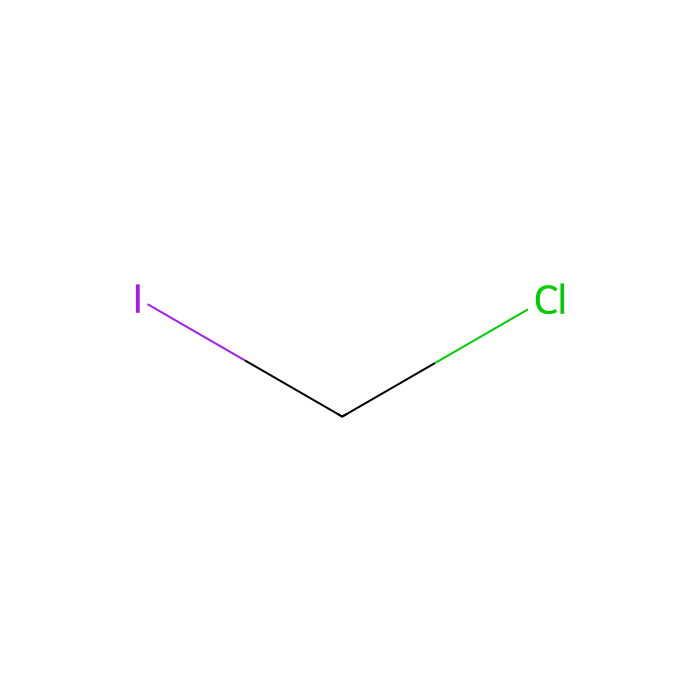
Determine the necessary mass, volume, or concentration for preparing a solution.
Taxonomy Tree
| Kingdom | Organic compounds |
|---|---|
| Superclass | Organohalogen compounds |
| Clase | Alkyl halides |
| Subclass | Halomethanes |
| Intermediate Tree Nodes | Not available |
| Direct Parent | Halomethanes |
| Alternative Parents | Organoiodides Organochlorides Hydrocarbon derivatives Alkyl iodides Alkyl chlorides |
| Molecular Framework | Aliphatic acyclic compounds |
| Substituents | Halomethane - Hydrocarbon derivative - Organoiodide - Organochloride - Alkyl iodide - Alkyl chloride - Aliphatic acyclic compound |
| Descripción | This compound belongs to the class of organic compounds known as halomethanes. These are organic compounds in which at least one of the four hydrogen atoms of methane (CH4) are replaced by halogen atoms. |
| External Descriptors | Not available |
Find and download the COA for your product by matching the lot number on the packaging.
| Lot Number | Certificate Type | Fecha | Articulo |
|---|---|---|---|
| Certificate of Analysis | Oct 29, 2025 | C106574 | |
| Certificate of Analysis | Oct 29, 2025 | C106574 | |
| Certificate of Analysis | Oct 29, 2025 | C106574 | |
| Certificate of Analysis | Jul 09, 2025 | C106574 | |
| Certificate of Analysis | Jul 09, 2025 | C106574 | |
| Certificate of Analysis | Jul 09, 2025 | C106574 | |
| Certificate of Analysis | Jul 09, 2025 | C106574 | |
| Certificate of Analysis | Jul 09, 2025 | C106574 | |
| Certificate of Analysis | Jul 09, 2025 | C106574 | |
| Certificate of Analysis | Jun 16, 2025 | C106574 | |
| Certificate of Analysis | Dec 16, 2024 | C106574 | |
| Certificate of Analysis | Sep 05, 2024 | C106574 | |
| Certificate of Analysis | Apr 03, 2024 | C106574 | |
| Certificate of Analysis | Jun 15, 2023 | C106574 | |
| Certificate of Analysis | Mar 10, 2023 | C106574 | |
| Certificate of Analysis | Jan 21, 2022 | C106574 |
| Solubilidad | Miscible with acetone, benzene, diethyl ether and alcohol. |
|---|---|
| Sensibilidad | Light Sensitive |
| Índice de refracción | 1.5812-1.5832 |
| Punto de ebullición (°C) | 108-109°C |
| Peso molecular | 176.38 |
| XLogP3 | 1.600 |
| Hydrogen Bond Donor Count | 0 |
| Hydrogen Bond Acceptor Count | 0 |
| Rotatable Bond Count | 0 |
| Exact Mass | 175.889 Da |
| Monoisotopic Mass | 175.889 Da |
| Topological Polar Surface Area | 0.000 Ų |
| Heavy Atom Count | 3 |
| Formal Charge | 0 |
| Complexity | 4.800 |
| Isotope Atom Count | 0 |
| Defined Atom Stereocenter Count | 0 |
| Undefined Atom Stereocenter Count | 0 |
| Defined Bond Stereocenter Count | 0 |
| Undefined Bond Stereocenter Count | 0 |
| The total count of all stereochemical bonds | 0 |
| Covalently-Bonded Unit Count | 1 |
H315:Causes skin irritation
H319:Causes serious eye irritation
H335:May cause respiratory irritation
P261:Avoid breathing dust/fume/gas/mist/vapors/spray.
P264:Wash hands [and …] thoroughly after handling.
P271:Use only outdoors or in a well-ventilated area.
P280:Wear protective gloves/protective clothing/eye protection/face protection.
P321:Specific treatment (see ... on this label).
P302+P352:IF ON SKIN: wash with plenty of water.
P304+P340:IF INHALED: Remove person to fresh air and keep comfortable for breathing.
P305+P351+P338:IF IN EYES: Rinse cautiously with water for several minutes. Remove contact lenses if present and easy to do - continue rinsing.
P362+P364:Take off contaminated clothing and wash it before reuse.
P405:Store locked up.
P403+P233:Store in a well-ventilated place. Keep container tightly closed.
P501:Dispose of contents/container to an approved waste disposal plant.
P264+P265:Wash hands [and …] thoroughly after handling. Do not touch eyes.
P337+P317:If eye irritation persists: Get medical help.
P332+P317:If skin irritation occurs: Get medical help.
P319:Get medical help if you feel unwell.
No biological assay protocols apply to this reagent. For chemical applications, consider the general procedures outlined under Reaction Conditions and Synthetic Utility. Always tailor stoichiometry, solvent, and temperature to your substrate and catalyst system. Consult the SDS and primary literature before scaling.
Chloroiodomethane is a synthetic, non-natural organohalide with no known physiological role.
For life-science experiments: Use only as a synthetic intermediate or reagent upstream of biological testing. No claims are made for cellular compatibility or bioactivity. Always remove residual reagent thoroughly and verify absence by appropriate analytical methods before any bioassay work.
Not typically applicable. Chloroiodomethane is a hydrophobic halomethane reagent and is not used to prepare aqueous buffers or to control pH. For work involving this reagent, focus on the solvent and reaction sections for guidance on compatible organic media and handling.
When selecting a methylene source or halomethylating agent, consider both hazard and lifecycle impacts.
Greener choices and trade-offs (literature/general):
Comparison snapshot (general):
Conclusion: While chloroiodomethane is not a “green” reagent, thoughtful solvent selection, stoichiometry control, and waste minimization can materially reduce environmental burden.
Chloroiodomethane is not used as a pharmaceutical excipient or additive.
Note: This product is for research use only, as indicated in the Product Data. It is not intended for human or veterinary use, clinical diagnostics, or household applications.
Only general/literature values are provided here for context. They are NOT specifications for this item.
Notes
Item-specific details
Guidance on typical grades (general information):
Practical QA/QC considerations for chloroiodomethane (general):
Chloroiodomethane (CH2ClI) is a versatile geminal dihalide valued for its differentiated leaving groups.
Key application families (literature/general):
Practical tips:
General literature guidance (optimize for your substrate; not item specifications):
SN2 chloromethylation using CH2ClI:
Halide exchange to CH2I2 (Finkelstein-type):
Carbenoid generation (Simmons–Smith–type):
Radical halomethylation:
Yields vary with substrate class; consult primary literature for substrate-specific outcomes and further optimization.
Safety information below is general for chloroiodomethane and does not replace the SDS. Always consult the product-specific SDS before use.
Chloroiodomethane is typically a reagent rather than a bulk solvent. When used, it is often added neat to a reaction or dissolved in a compatible medium.
Note: This section gives general guidance; optimize solvent choice empirically for your substrate and catalyst system.
Chloroiodomethane is a geminal dihalomethane bearing both chlorine and iodine on the same methylene carbon.
Functional group logic (literature/general):
Named/related methodologies:
Retrosynthetic value:
Practical considerations:
Not applicable. This product is a small-molecule chemical reagent and is not an antibody, enzyme, or biological probe with defined biomolecular targets. No antigen/epitope or species reactivity applies.