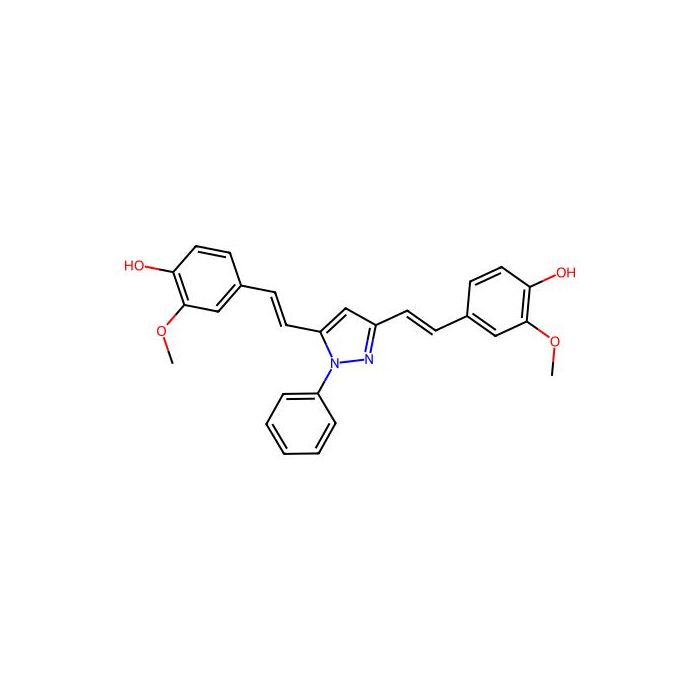
Determine the necessary mass, volume, or concentration for preparing a solution.
Cnb-001 , CAS No.828911-76-8
Disponible para pedir
Storage
Store at 2-8°C,Argon charged,Desiccated
Shipped In
Wet ice

for sensitive chromatographic and analytical workflows requiring minimal baseline interference.
Store at 2-8°C,Argon charged,Desiccated Ships Wet ice Check lot-specific COA for exact specifications.
SDS, COA, datasheet, and spec sheet available for download. Lot-specific COA accessible via lot number lookup.
Cited in 0 peer-reviewed publications across chromatography, organic synthesis, and cross-coupling reactions.
| Sonrisas canónicas | COC1=C(C=CC(=C1)C=CC2=CC(=NN2C3=CC=CC=C3)C=CC4=CC(=C(C=C4)O)OC)O |
|---|---|
| IUPAC Name | 4-[(E)-2-[5-[(E)-2-(4-hydroxy-3-methoxyphenyl)ethenyl]-2-phenylpyrazol-3-yl]ethenyl]-2-methoxyphenol |
| InChIKey | QUOCIDQIFWYHLB-QHKWOANTSA-N |
| INCHI | 1S/C27H24N2O4/c1-32-26-16-19(10-14-24(26)30)8-12-21-18-23(29(28-21)22-6-4-3-5-7-22)13-9-20-11-15-25(31)27(17-20)33-2/h3-18,30-31H,1-2H3/b12-8+,13-9+ |
| Isómeros SMILES | COC1=C(C=CC(=C1)/C=C/C2=CC(=NN2C3=CC=CC=C3)/C=C/C4=CC(=C(C=C4)O)OC)O |
| PubChem CID | 135440402 |
| Peso molecular | 440.5 |
Comprehensive hazard, handling, storage, and regulatory compliance document.
Download SDS →Lot-specific quality data. Enter your lot number to retrieve the exact COA.
Look up COA →Full quality attributes and acceptance criteria for this grade.
View spec sheet →Taxonomy Tree
| Kingdom | Organic compounds |
|---|---|
| Superclass | Phenylpropanoids and polyketides |
| Clase | Diarylheptanoids |
| Subclass | Linear diarylheptanoids |
| Intermediate Tree Nodes | Not available |
| Direct Parent | Linear diarylheptanoids |
| Alternative Parents | Phenylpyrazoles Methoxyphenols Styrenes Phenoxy compounds Methoxybenzenes Anisoles Alkyl aryl ethers 1-hydroxy-2-unsubstituted benzenoids Heteroaromatic compounds Azacyclic compounds Organonitrogen compounds Hydrocarbon derivatives |
| Molecular Framework | Aromatic heteromonocyclic compounds |
| Substituents | Linear 1,7-diphenylheptane skeleton - Phenylpyrazole - Methoxyphenol - Phenoxy compound - Anisole - Methoxybenzene - Styrene - Phenol ether - 1-hydroxy-2-unsubstituted benzenoid - Alkyl aryl ether - Phenol - Monocyclic benzene moiety - Benzenoid - Heteroaromatic compound - Azole - Pyrazole - Azacycle - Organoheterocyclic compound - Ether - Hydrocarbon derivative - Organic oxygen compound - Organic nitrogen compound - Organooxygen compound - Organonitrogen compound - Aromatic heteromonocyclic compound |
| Descripción | This compound belongs to the class of organic compounds known as linear diarylheptanoids. These are diarylheptanoids with an open heptane chain. The two aromatic rings are linked only by the heptane chain. |
| External Descriptors | Not available |
| Peso molecular | 440.500 g/mol |
|---|---|
| XLogP3 | 5.700 |
| Hydrogen Bond Donor Count | 2 |
| Hydrogen Bond Acceptor Count | 5 |
| Rotatable Bond Count | 7 |
| Exact Mass | 440.174 Da |
| Monoisotopic Mass | 440.174 Da |
| Topological Polar Surface Area | 76.700 Ų |
| Heavy Atom Count | 33 |
| Formal Charge | 0 |
| Complexity | 650.000 |
| Isotope Atom Count | 0 |
| Defined Atom Stereocenter Count | 0 |
| Undefined Atom Stereocenter Count | 0 |
| Defined Bond Stereocenter Count | 2 |
| Undefined Bond Stereocenter Count | 0 |
| The total count of all stereochemical bonds | 2 |
| Covalently-Bonded Unit Count | 1 |
No tested application protocols are provided for this item in the Product Data. The compound is not an antibody or biologic; therefore, no immunoassay-specific parameters (e.g., WB/IHC/IF dilutions) apply.
General protocol framework for small-molecule use in vitro (adapt as needed):
For analytical method development:
Note: These are general templates and not item-validated protocols. Consult the SDS and CoA for any restrictions.
Item-specific biological function and targets are not provided in the current listing. The compound is supplied strictly for research use only, with no medical or clinical claims.
General considerations for small-molecule research probes:
Documentation:
Note: Any literature-reported roles for compounds sharing the trade name “CNB-001” must be verified against the exact structure and lot-specific analytical data from this product’s CoA before extrapolating biological expectations.
This product is a small-molecule research compound and is not a buffering agent. No item-specific pKa or buffer-capable functional groups are provided.
Practical guidance if used in buffered systems:
If your application requires a buffering function, select dedicated buffers with defined pKa ranges (e.g., HEPES pKa ~7.5, MOPS pKa ~7.2, Tris pKa ~8.1 at 25 °C) and validated recipes. This item is not intended for buffer formulation.
Because the exact structure and use-case of this item are not specified, “greener” choices should be considered in the context of your intended application (analytical, assay, or synthesis). The following guidance focuses on solvent and process choices rather than replacing the molecule itself.
Greener solvent considerations (general):
Illustrative comparison (general guidance):
Process-intensity reductions:
Trade-offs:
Note: This section provides general sustainability guidance; it does not alter any item-specific storage requirement (2–8 °C, argon, desiccated).
No pharmacopeial status, excipient role, or formulation designation is provided for this item. It is supplied strictly for research use only and not for human or veterinary use.
General R&D formulation considerations (non-clinical):
Compliance and limitations:
Documentation:
Item-specific physical data are not provided in the current listing. Do not treat literature values as product specifications.
Item-specific (from Product Data):
General/literature guidance (non-spec, for planning only):
Practical recommendations:
Item-specific quality grade and purity are not listed in the current Product Data.
How to interpret grades (general guidance):
Analytical confirmation (recommended best practices):
Stabilizers/additives:
This product is positioned as a research-use small molecule rather than a general-purpose synthetic reagent. No manufacturer application notes are provided in the listing.
Potential laboratory uses (general, non-item-specific):
Practical tips:
Important: No specific reaction classes (e.g., cross-coupling, nucleophilic substitutions) are endorsed for this item without a confirmed structure. Consult the CoA/SDS and primary literature for structure-dependent reactivity before planning synthetic transformations.
Item-specific reactivity and optimal reaction conditions are not available because the verified structure and functional groups have not been provided. Accordingly, no named-reaction conditions are recommended for this product.
If you plan to employ this compound in chemical reactions (general guidance only):
Expected yields: Not applicable—insufficient structural information. Establish feasibility via micro-scale experiments and stability-indicating analytics before considering any scale-up.
Safety summary (item-specific):
General laboratory precautions (always defer to SDS for authoritative guidance):
Special risks to consider:
Item-specific solubility data are not provided. The storage guidance (argon, desiccated) suggests using dry, oxygen-free solvents for solution preparation and storage.
General solvent strategy for small-molecule research probes:
Polarity/miscibility considerations (general):
Method development suggestions:
Note: Do not treat any of the above as product specifications; verify experimentally under your conditions.
Item-specific storage conditions:
General handling to maintain quality:
Reconstitution guidance (non-spec, verify experimentally):
Do not freeze–thaw repeatedly. Aliquot stock solutions to single-use vials to maintain consistency across experiments.
Specifications not provided (refer to CoA/SDS): grade/purity, stabilizers, water/metal/peroxide content, exact solubility, and analytical reference spectra.
Brief overview: CNB-001 (SKU C1065853) is a small-molecule research chemical. Limited item-specific identifiers are provided in the current listing; consult CoA/Spec Sheet for definitive structure data.
Structural features (general notes):
Data integrity guidance:
No structure or functional group details are provided in the item data; therefore, specific synthetic transformations cannot be responsibly recommended for this compound.
General guidance for using small molecules in synthesis when structure is known (for planning only):
Risk management:
Conclusion: Treat this item as a finished research probe unless and until the exact functional group map is verified from the CoA/Spec Sheet.
No target, pathway, or binding specificity information is provided in the Product Data for this item. As such, no claims are made regarding biochemical targets, selectivity profiles, or potency.
Guidance for researchers (general):
Note: Any literature-referenced specificity associated with the trade name “CNB-001” must not be imputed to this item without confirming structural identity and purity from the Aladdin CoA.