CALIDAD & PUREZAMoligand™?Moligand™ — Aladdin's line of ligands and bioactive small molecules. Use for receptor, pathway, and binding studies needing defined small-molecule tools.Isomer mixture?Isomer mixture — contains more than one structural/stereo isomer rather than a single pure form. Use when the mixed-isomer product fits your purpose or cost.≥80%
This compound belongs to the class of organic compounds known as lineolic acids and derivatives. These are derivatives of lineolic acid. Lineolic acid is a polyunsaturated omega-6 18 carbon long fatty acid, with two CC double bonds at the 9- and 12-positions.
External Descriptors
Unsaturated fatty acids
1. Djoumbou Feunang Y, Eisner R, Knox C, Chepelev L, Hastings J, Owen G, Fahy E, Steinbeck C, Subramanian S, Bolton E, Greiner R, and Wishart DS. ClassyFire: Automated Chemical Classification With A Comprehensive, Computable Taxonomy. Journal of Cheminformatics, 2016, 8:61.
Determine the necessary mass, volume, or concentration for preparing a solution.
Dilution Calculator
Determine the dilution needed to prepare a stock solution.
Reconstitution Calculator
Reseñas
Reseñas de cliente
Application Protocols
Item-specific, validated protocols are not provided in the Product Data. The following general, literature-based procedures can guide research use; adjust to your system and perform internal qualification.
Preparation of stock solutions (cell-based assays):
Dissolve CLA at 50–100 mM in absolute ethanol or DMSO under inert gas. Store aliquots at 2–8°C or −20°C, protected from light. For working solutions, add stock slowly to pre-warmed culture medium containing 0.1–1% fatty acid–free BSA with vigorous mixing to reach 1–100 µM final CLA and ≤0.1% co-solvent.
Liposome incorporation:
Prepare a chloroform or chloroform/MeOH solution of phospholipids and CLA (e.g., 80:20 mol%). Evaporate to a thin film under reduced pressure, dry under vacuum ≥2 h, hydrate with buffer (e.g., HEPES 10 mM, NaCl 150 mM, pH 7.4), and extrude to desired size. Work under inert gas and low light.
FAME derivatization for GC:
Dissolve CLA in dry methanol with catalytic H2SO4 (1–2% v/v) and heat at 60–65°C for 1–2 h under nitrogen. Quench with saturated NaHCO3, extract with hexane, wash, dry, and analyze by GC-FID/MS. Use Ag+ columns or adjusted ramps to resolve isomers.
Amide coupling (analytical probe synthesis):
Activate CLA with HATU/DIPEA in DMF at 0–25°C, add amine-bearing probe, stir 2–6 h, and purify by silica gel chromatography (hexanes/EtOAc). Verify structure by NMR and HRMS.
Note: Specific performance characteristics for this SKU are not established here; consult CoA/Spec Sheet and perform pilot experiments.
Biological Roles
The following describes general, literature-based biochemical roles of conjugated linoleic acid (CLA) isomers; it is not specific to this SKU and does not imply clinical use. For research use only.
Endogenous relevance: CLA is not a major endogenous human fatty acid but can arise via microbial biohydrogenation and is present in ruminant-derived foods. In cells, CLA is activated to CLA–CoA thioesters and incorporated into complex lipids (phospholipids, triglycerides) or undergoes β-oxidation.
Molecular interactions: CLA isomers are reported ligands for lipid-binding and nuclear receptor proteins (e.g., PPARs), influencing transcriptional programs in lipid metabolism pathways. Isomer specificity is significant—c9,t11 and t10,c12 can exhibit distinct affinities and downstream signaling profiles.
Membranes and biophysics: Incorporation of conjugated double bonds affects membrane fluidity, order parameters, and susceptibility to lipid peroxidation. This can be probed via fluorescence polarization, EPR spin labeling, or calorimetry in model membranes.
Metabolic handling: As a carboxylic acid, CLA can be transported by fatty acid transport proteins (FATPs) and bound by serum albumin in extracellular environments. Oxidative metabolites (e.g., epoxides, hydroxy-derivatives) may form enzymatically (CYPs, LOXs) or non-enzymatically.
Assay considerations: Because isomer mixtures may activate different pathways to varying degrees, define the isomer composition for reproducibility. Use carrier proteins (e.g., BSA) in aqueous buffers to solubilize and deliver CLA to cells or enzymes, and protect solutions from air/light to limit artifactual oxidation that can confound bioassay readouts.
Buffer Applications
Conjugated linoleic acid is not a buffering agent and does not form classical buffer systems. It is a hydrophobic carboxylic acid used as a ligand or lipid component.
Practical notes for aqueous work (literature/general):
Dispersion: Prepare concentrated stocks in ethanol or DMSO and dilute into buffered media with carrier proteins (e.g., 0.1–1% fatty acid–free BSA) or nonionic surfactants, maintaining final co-solvent below assay tolerance.
pH considerations: The carboxyl group (pKa ~4.8–5.0, literature) can be deprotonated to form soaps in basic buffers, which may drastically change aggregation and bioavailability. Avoid strong base unless saponification is intended.
Vehicles: Cyclodextrin inclusion complexes or liposomes can be used to introduce CLA into aqueous buffers for biophysical assays.
For buffer preparation guidance, refer instead to established buffer systems (e.g., PBS, HEPES) and use the Solvent Selection and Application Protocols sections for handling of hydrophobic ligands.
Green Alternatives
Sustainability considerations around CLA focus on solvent choices and oxidation control rather than the substrate itself (a bio-derived fatty acid). Selection of greener solvents and processes can reduce environmental impact without compromising performance.
Greener solvent options (literature/general):
Replace chlorinated solvents (CH2Cl2, CHCl3) with ethyl acetate, 2-MeTHF, CPME, or toluene where feasible for extractions and reaction media.
Use bio-based ethanol or isopropanol for stock solutions and precipitations when compatible with the application.
Prefer heptane/cyclohexane over hexane for reduced toxicity (where chromatographic resolution permits).
Process suggestions:
Conduct reactions under inert gas to reduce oxidative byproducts, minimizing waste from degradation and repurification.
Employ catalytic methods (e.g., enzyme-catalyzed esterification using lipases in green solvents or solvent-free) rather than stoichiometric coupling reagents when possible.
Utilize room-temperature photochemical or radical additions with LED sources to reduce energy consumption.
Comparison snapshot (general):
CH2Cl2 vs EtOAc: EtOAc is biodegradable with lower toxicity; may require adjusted reaction times/temperatures.
THF vs 2-MeTHF/CPME: 2-MeTHF/CPME offer higher hydrophobicity and lower peroxide formation rates than THF; they are partially bio-based (2-MeTHF) and facilitate phase separation.
Hexane vs Heptane: Heptane presents a safer profile with similar chromatographic behavior; minor elution strength differences should be calibrated.
Trade-offs: Greener solvents can alter solubility and selectivity (e.g., amidation kinetics); verify with small-scale trials and control for water content to avoid saponification.
Pharmaceutical Uses
No therapeutic claims are made. The following are general, literature-based formulation roles for long-chain fatty acids that may guide research and development; item-specific pharmacopeial status is not provided.
Excipient roles (literature/general):
Lipid component in self-emulsifying drug delivery systems (SEDDS/SMEDDS), nanoemulsions, and liposomes to solubilize hydrophobic APIs and modulate release.
Precursor for ester/amide derivatives serving as permeation enhancers or pro-moieties in lipid–drug conjugates.
Hydrophobic matrix component in solid lipid nanoparticles (SLNs) or nanostructured lipid carriers (NLCs) when partially hydrogenated/derivatized.
Regulatory/compendial status: Not specified for this item; refer to CoA/Spec Sheet and relevant pharmacopeias.
Quality considerations: Isomer composition and peroxide/acid values critically affect stability, odor, and compatibility in formulations; these parameters are not specified here and should be established during excipient qualification.
Processing: Handle under inert gas and reduced light; incorporate antioxidants (e.g., tocopherols) as permitted for experimental formulations, verifying compatibility and analytical removal where necessary for research endpoints.
Researchers should validate excipient suitability, residual solvent profiles, impurity limits, and endotoxin/bioburden (if applicable) per internal standards; this SKU is for research use only.
Physical Properties
Item-specific specifications are not provided in the Product Data. The following values are typical literature/general references for conjugated linoleic acid (isomer mixtures) and should not be construed as product specifications.
Aggregate state/appearance: Typically a colorless to pale yellow oily liquid at ambient temperature (literature); item-specific appearance: Not specified for this item; refer to CoA/Spec Sheet.
Molecular formula: C18H32O2 (literature for CLA isomers)
Molecular weight: ~280.45 g/mol (literature)
Density: ~0.90–0.92 g/mL at 25°C (literature, isomer- and purity-dependent)
Boiling point: ~230–235°C at ~10 mmHg (literature, reduced pressure; thermal decomposition may occur); atmospheric bp not practical (decomposes) (literature)
Melting point/pour point: typically below 0°C (literature; varies with isomer ratio)
Refractive index n20 D: ~1.46–1.47 (literature)
pKa (carboxyl): ~4.8–5.0 in water (literature; effective pKa depends on medium/ionic strength)
LogP (octanol/water): ~7–8 (literature estimate for C18:2 FA)
Item-specific numerical specs (water content, residual solvents, peroxide value, UV cutoff, metal limits, stabilizers): Not specified for this item; refer to CoA/Spec Sheet.
Interpretation and implications (general guidance):
Moligand™ (brand context): While a formal definition is not provided in the Product Data, this designation typically indicates suitability as a small-molecule ligand/biochemical tool or building block in molecular sciences workflows. Users should confirm fitness-for-purpose (e.g., biochemistry, chemical biology, surface functionalization) based on their application.
Isomer mixture: Conjugated linoleic acid is supplied as a mixture of positional/geometric isomers (e.g., c9,t11; t10,c12, etc.). The exact isomeric composition, trans/cis ratio, and any stabilizers/antioxidants are not specified for this SKU and should be verified on the certificate of analysis (CoA) if critical to your method (e.g., bioassays sensitive to PPAR isomer selectivity, or synthetic routes where geometry influences outcome).
What this means for your work:
Chromatography/analytical: If isomer resolution is required, plan for GC-FID/MS of methyl esters (FAME), Ag+ HPLC, or 1H/13C NMR with NOE/2D methods to estimate isomer ratios.
Reactivity: Isomer distribution can change oxidation/epoxidation kinetics; maintain inert atmosphere and consider adding a small amount of an approved antioxidant in-process if compatible (verify with QC).
UV/fluorescence background: Not specified for this item; refer to CoA/Spec Sheet.
Trace impurities (peroxide value, acid value, metals, residual solvents): Not specified for this item; refer to CoA/Spec Sheet.
Always consult the CoA/Spec Sheet for item-specific acceptance criteria and test methods.
Reaction and Applications
Conjugated linoleic acid (CLA) is a versatile fatty-acid building block and biochemical tool owing to its terminal carboxyl group and conjugated diene.
Applications (literature/general):
Biochemical ligand studies: CLA isomers are widely used as small-molecule ligands in nuclear receptor research (e.g., PPAR family) and lipid–protein interaction assays. The isomer mixture nature should be accounted for when interpreting binding/activation data.
Lipid formulation: Incorporation into liposomes, micelles, or nanoparticles to modulate membrane properties and hydrophobic cargo loading. The conjugation can influence packing and oxidation sensitivity.
Derivatization for analytics: Conversion to methyl esters (FAME) for GC-FID/MS profiling; formation of 2,4-dinitrophenylhydrazones is not applicable to acids but epoxide/oxidation products may be derivatized for analysis.
Chemical transformations: Epoxidation of the double bonds (e.g., mCPBA) to give mono/di-epoxides; hydrogenation to yield monoenes or stearic derivatives; thiol–ene/ene–ene additions under radical or photochemical conditions; Diels–Alder reactions with suitable dienophiles (geometry-dependent).
Conjugation chemistry: Amide coupling to amines (EDC/HOBt, HATU, PyBOP) to produce bioactive amides; esterification to glycerol or PEG derivatives for surfactants.
Practical considerations:
Maintain inert atmosphere and protect from light during reactions to minimize auto-oxidation and isomerization.
If stereochemical integrity matters, start from or enrich specific isomers (e.g., c9,t11 vs t10,c12) via Ag+ chromatography before transformation.
Use antioxidant stabilizers (e.g., BHT) only if compatible with downstream use and remove by purification post-reaction.
Reaction Conditions
Representative, literature-based conditions for common transformations of conjugated linoleic acid (CLA). Adjust for scale and substrate.
Esterification (Fischer): CLA (1.0 equiv), ROH (5–20 equiv), catalytic H2SO4 or p-TsOH (1–5 mol%), reflux (e.g., MeOH 65°C, EtOH 78°C) 4–16 h; remove water (Dean–Stark for higher alcohols). Neutralize, extract, and purify. Alternative: Steglich (DCC, DMAP, 0–25°C, CH2Cl2) 2–12 h for base-sensitive partners.
Amide coupling: CLA (1.0 equiv), amine (1.1–1.5 equiv), HATU (1.1–1.2 equiv), DIPEA (2–3 equiv), DMF or CH2Cl2, 0–25°C, 1–6 h; or EDC·HCl (1.1–1.5 equiv) with HOBt/HOAt additives. Monitor by TLC/LC–MS. Typical isolated yields: 70–90% (literature, substrate-dependent).
Acid chloride route: Oxalyl chloride (1.2–1.5 equiv) with DMF catalytic (0.1 equiv) in CH2Cl2, 0–25°C, 1–2 h to form acyl chloride; follow with amine in base (pyridine/Et3N) 0–25°C. Protect from moisture/air.
Epoxidation: mCPBA (1.0–2.2 equiv per C=C), CH2Cl2, 0°C to RT, 1–6 h; buffer with NaHCO3 to control acidity. Alternatively, peracetic acid in EtOAc. Control equivalents to bias mono- vs di-epoxidation. Work under inert gas and low light.
Hydrogenation: 5–10 wt% Pd/C (1–5 mol% Pd), H2 1–5 bar, RT–50°C, 1–6 h in EtOAc, EtOH, or hexanes; monitor to target partial or full saturation. Filter through celite to remove catalyst; test peroxide value if relevant.
Thiol–ene: Photoinitiation (365–400 nm LEDs) with 1–2 mol% photoinitiator (e.g., DMPA) in toluene or neat, RT, 0.5–4 h; inert atmosphere to suppress oxygen inhibition.
General practices: Degas solvents, maintain inert gas blanket (argon/nitrogen), and protect from light. Include antioxidant (e.g., BHT 50–200 ppm) only if compatible and removable. Item-specific conditions are not specified; consult CoA/Spec Sheet as needed.
Safety and Handling
GHS classification, signal word, H‑statements, and pictograms are not provided in the Product Data for this item. Always consult the product SDS for authoritative safety information.
General safety considerations for conjugated polyunsaturated fatty acids (literature/general):
Hazards: Typically classified as combustible liquids/oils. May cause skin and eye irritation on contact; ingestion/aspiration hazards similar to other oils. Unsaturated fatty acids are prone to auto-oxidation, forming peroxides and aldehydic byproducts, especially upon exposure to air, heat, and light.
Special risks: Conjugated dienes are more oxidation-prone than nonconjugated analogs. Oxidation can lead to rancidity, off-odors, and reactive species. Storage under inert gas (argon/nitrogen) and reduced light is recommended; this item is supplied argon charged per Product Data.
Incompatibilities: Strong oxidizers (e.g., peroxides, nitric acid), strong bases (will form soaps; can accelerate oxidation), strong reducing agents (for oxidized contaminants). Avoid heating in the presence of air and metals that catalyze oxidation (e.g., Cu, Fe).
PPE: Lab coat, safety glasses or chemical goggles, and appropriate chemical-resistant gloves (nitrile recommended). Use in a well-ventilated area or fume hood if aerosol/mist could form.
First aid (general):
Skin: Wash with soap and water; remove contaminated clothing.
Eyes: Rinse cautiously with water for several minutes; remove contact lenses if present and easy to do; continue rinsing.
Inhalation: Move to fresh air if aerosols/mists were generated.
Ingestion: Rinse mouth; do not induce vomiting; seek medical attention per SDS guidance.
Fire fighting: Use CO2, dry chemical, or foam. Water spray may be used to cool containers.
Defer to the SDS for spill response, disposal, and transport classification.
Solvent Selection
Conjugated linoleic acid is a hydrophobic, long-chain carboxylic acid. Solvent choice should balance dissolution, chemical stability (minimizing oxidation/isomerization), and downstream compatibility.
Polarity/miscibility (literature/general):
Water: essentially insoluble; forms micelles/soaps only after neutralization.
Alcohols (ethanol, isopropanol): good solubility; convenient for biochemical stock solutions; avoid prolonged air exposure.
Polar aprotics (DMSO, DMF): excellent solvents for concentrated stocks; minimize exposure to air/light; purge headspace with inert gas.
Halogenated organics (CH2Cl2, CHCl3): very good solubility; useful for extractions and thin-film deposition; remove promptly under reduced pressure.
Ethers (THF, MTBE): good solubility; THF subject to peroxide formation; use fresh, anhydrous solvent.
Hydrocarbons (hexanes, heptane, toluene): soluble; preferred for nonpolar workflows and normal-phase chromatography.
Practical tips:
For biological assays, prepare 10–100 mM stocks in ethanol or DMSO, then dilute into buffered media with carrier proteins (e.g., BSA) to aid dispersion; verify compatibility with your system.
For synthetic operations (esterification/amidation), use dry chlorinated solvents, toluene, or DMF with standard coupling reagents; exclude air and moisture.
For chromatographic purification of derivatives, normal phase (hexanes/EtOAc) or silver-loaded silica can resolve CLA isomers.
Comparison (general):
DMSO vs ethanol: DMSO enables higher concentration stocks but can complicate bioassays; ethanol is more biocompatible but has lower solubility limits.
Hexanes vs toluene: hexanes maximize nonpolarity for NP chromatography; toluene offers higher boiling point and better solvency for heated reactions.
Storage and Reconstitution
Item-specific storage and shipping (from Product Data):
Storage Conditions: Store at 2–8°C, Argon charged.
Shipped In: Wet ice.
Appearance: Not specified for this item; refer to CoA/Spec Sheet.
Stability considerations (literature/general):
Conjugated dienes are susceptible to air/light-induced oxidation and isomerization. Maintain containers tightly sealed under inert gas (argon preferred) and minimize headspace. Protect from light (amber vials or foil wrap). Avoid repeated warming/cooling cycles.
Reconstitution and handling (general guidance):
Allow the container to reach room temperature before opening to avoid moisture condensation. If viscous, gently warm to ~25–30°C to facilitate transfer.
Prepare concentrated stocks in anhydrous solvents (e.g., ethanol, DMSO, CH2Cl2, hexane) inside a glove box or under a dry inert gas purge. After aliquoting, re-blanket with argon and cap tightly.
Working concentrations, pH, and vehicle composition: Not specified for this item; define per application. For aqueous use, employ co-solvents and carriers (e.g., fatty acid–free BSA) to aid dispersion.
Shelf life/quality checks:
Item-specific shelf life: Not specified for this item; refer to CoA/Spec Sheet.
Monitor for signs of oxidation (odor, color darkening, increased peroxide value, new peaks in LC/GC). If critical, assay peroxide/acid values prior to sensitive experiments.
For research use only. Always refer to the CoA and SDS for definitive, lot-specific instructions.
Structure and Identity
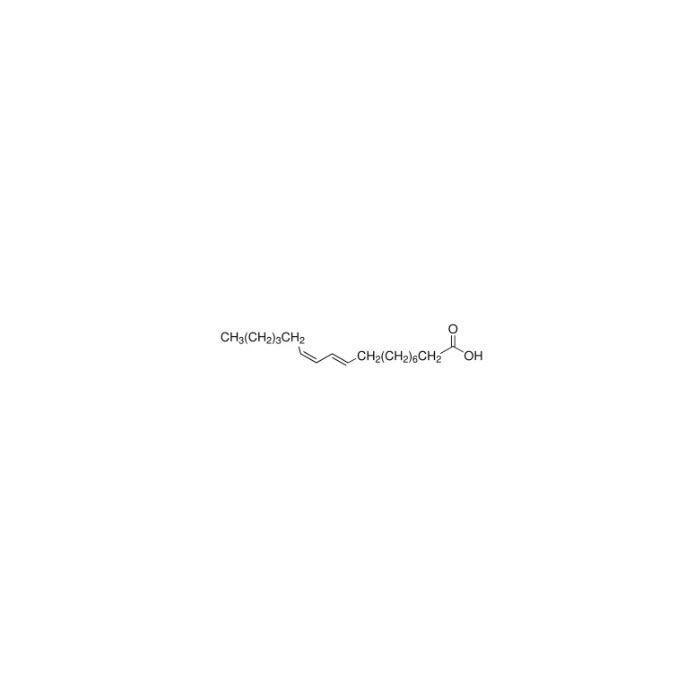
Conjugated linoleic acid (CLA) is a C18 polyunsaturated fatty acid comprising isomeric octadecadienoic acids with conjugated double bonds and a terminal carboxylic acid.
Item-specific identifiers (from Product Data):
SKU: C768874
CAS: 2420-56-6
InChIKey: 104362 (as provided)
Grade/Purity: Moligand™, Isomer mixture
Structural description (literature/general):
Typical molecular formula: C18H32O2 (literature for CLA isomers)
Core features: a linear C18 aliphatic chain bearing a terminal carboxylic acid (–CO2H) and two carbon–carbon double bonds in conjugation (–CH=CH–CH=CH–) at various positional and geometric (E/Z) isomers; common isomers include cis-9,trans-11 and trans-10,cis-12.
Functional groups: carboxylic acid (acidic, enables salt/ester/amide formation); conjugated diene (susceptible to addition, oxidation, and polymerization).
Stereochemistry: mixture of geometric isomers (cis/trans) and positional isomers; no stereogenic centers.
SMILES/InChI (item-specific): Not specified for this item; refer to CoA/Spec Sheet.
2D structure in words (literature/general): a straight-chain octadecenoic backbone ending with a carboxyl group at C1; two double bonds separated by a single bond (conjugation), located at variant positions (commonly Δ9 and Δ11 or Δ10 and Δ12) with mixed E/Z geometry depending on isomer.
Note: Exact isomer distribution and micro-identity for this SKU are not specified; consult the CoA for definitive identity and any chromatographic isomer ratios.
Synthetic Utility
CLA’s synthetic value stems from its bifunctionality: a carboxylic acid terminus enabling classical acyl-transfer chemistry, and a conjugated diene enabling diverse pericyclic and radical transformations.
Carboxyl chemistry (literature/general):
Esterification: Fischer conditions (ROH/H+, Dean–Stark) or Steglich/DCC/DMAP for mild conditions; enzymatic (lipase-catalyzed) routes in green solvents for selectivity.
Amide coupling: EDC/HOBt, HATU/DIPEA, PyBOP, or CDI to furnish amides for probe molecules or surface functionalization. Convert to acid chlorides with SOCl2/Oxalyl chloride for direct acylation when substrates tolerate.
Activation: Formation of N-hydroxysuccinimide (NHS) esters for bioconjugation.
Diene transformations:
Epoxidation: mCPBA or peracetic acid to mono/di-epoxides; stereochemical outcomes depend on isomer geometry.
Hydrogenation: Pd/C or Ni catalysts to monoenes or saturated C18 acids under 1–5 bar H2 at RT–50°C; monitor to avoid over-reduction if partial saturation desired.
Radical additions: Thiol–ene and atom-transfer processes across double bonds under photoredox or thermal initiation to install functional handles.
Diels–Alder: As a diene, can undergo cycloadditions with activated dienophiles, albeit with geometry/steric constraints; intramolecular or tethered designs improve efficiency.
Protection/compatibility:
Protect the acid as a methyl/benzyl/tert-butyl ester when performing non-acyl transformations; deprotect under standard conditions (saponification, hydrogenolysis, acidolysis).
Work under inert atmosphere with light protection to minimize isomerization and oxidation. Include antioxidant scavengers if consistent with goals and purify promptly.
Analytical: Track isomer integrity via 1H NMR (allylic vinylic patterns), UV–vis (conjugated diene band ~233 nm, literature), and GC of FAME derivatives.
Target Specificity
Not applicable. This product is a small-molecule fatty acid, not an antibody, enzyme, or affinity reagent with defined biological target specificity. For ligand-binding studies (e.g., nuclear receptors), consult primary literature for isomer-specific interactions and characterize the isomer composition of this SKU via CoA/Spec Sheet before interpreting specificity.
¿Necesita ayuda para elegir la calidad?
Nuestra guía de selección de calidades cubre la pureza, el estado del estabilizador y la idoneidad de la aplicación para todas las variantes de nuestro catálogo.
Utilizamos cookies para garantizar el correcto funcionamiento del sitio web y, cuando esté permitido, para mejorar su experiencia. Puede gestionar sus preferencias en cualquier momento en Configuración. Más información en nuestra Política de Cookies.
¿Quieres que te enviemos un mensaje cuando tengamos descuentos disponibles?
Recordármelo más tarde
¡Gracias! Por favor, revisa tu bandeja de entrada de correo electrónico para confirmar.
Products are supplied to verified businesses, institutions, and qualified professionals for research and development use only. Not for use in humans, animals, diagnosis, or therapy.

 J2522318