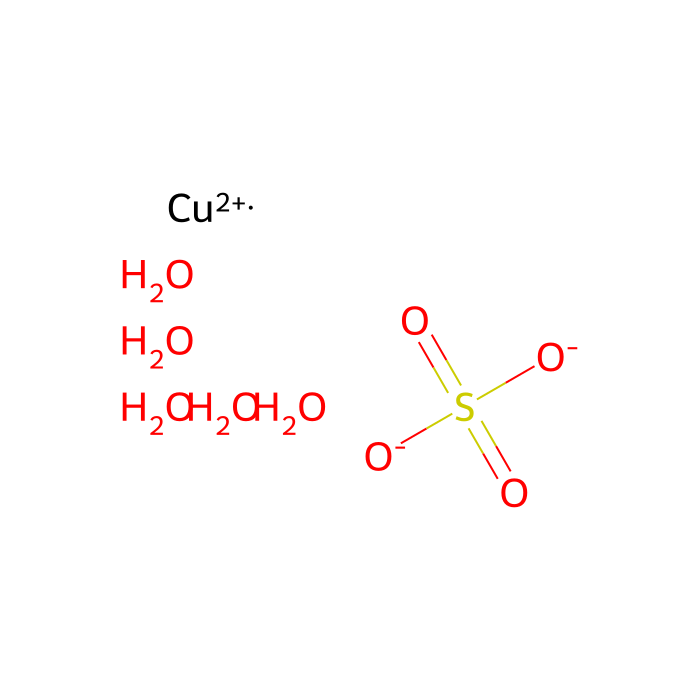
Copper sulfate pentahydrate - suitable for plant cell culture, ≥98% , CAS No.7758-99-8

CAS: 7758-99-8 Cat. No.: C112412 Fórmula: CuSO4 · 5H2O Peso molecular: 249.69 Número EC: 616-477-9
Disponible para pedir
GRADE & PURITY Suitable for plant cell culture ? Plant cell-culture grade — formulated for plant tissue and cell cultures. Use in plant biotechnology, callus, and suspension culture work. ≥98%
Synonyms
Calcanthite | Copper(II) sulfate pentahydrate | Copper(II)sulfatepentahydrate | COPPERFINE-ZINC | Copper(2+) sulfate (1:1) pentahydrate | Cupric sulfate (pentahydrate) | copper(II)sulfate pentahydrate | copper;sulfate;pentahydrate | COPPER SULFATE PENTAHY
Storage
Room temperature,Argon charged
Shipped In
Normal
★
Size
Alemania (EU)
USA*
Price
Qty
250g
C112412-250g
—
3 Disponible
36,36€
Enter a quantity for the sizes you want to add.
🧪
Why this grade

suitable for plant cell culture, ≥98% Apto para el cultivo de células vegetales for sensitive chromatographic and analytical workflows requiring minimal baseline interference.

🌡

Storage & shipping

Room temperature,Argon charged Ships Normal Check lot-specific COA for exact specifications.

📋

Quality documents

SDS, COA, datasheet, and spec sheet available for download. Lot-specific COA accessible via lot number lookup.

📚

Literature proof

Cited in 1023 peer-reviewed publications across chromatography, organic synthesis, and cross-coupling reactions.

Specifications

Sinónimos
Calcanthite | Copper(II) sulfate pentahydrate | Copper(II)sulfatepentahydrate | COPPERFINE-ZINC | Copper(2+) sulfate (1:1) pentahydrate | Cupric sulfate (pentahydrate) | copper(II)sulfate pentahydrate | copper;sulfate;pentahydrate | COPPER SULFATE PENTAHY
Especificaciones y pureza
suitable for plant cell culture, ≥98%
Condiciones de almacenamiento de almacenamiento
Room temperature,Argon charged
Enviado en
Normal
Grado
Apto para el cultivo de células vegetales
Pureza
≥98%
Nombres e identificadores
Pubchem Sid
Pubchem Sid Url
https://pubchem.ncbi.nlm.nih.gov/substance/488182890
Sonrisas canónicas
O.O.O.O.O.[O-]S(=O)(=O)[O-].[Cu+2]
IUPAC Name
copper;sulfate;pentahydrate
InChIKey
JZCCFEFSEZPSOG-UHFFFAOYSA-L
INCHI
1S/Cu.H2O4S.5H2O/c;1-5(2,3)4;;;;;/h;(H2,1,2,3,4);5*1H2/q+2;;;;;;/p-2
Isómeros SMILES
O.O.O.O.O.[O-]S(=O)(=O)[O-].[Cu+2]
WGK Alemania
3
RTECS
GL8900000
CAS alternativo
10257-54-2
Número ONU
UN 3077
Grupo de embalaje
III
Peso molecular
249.69
Reaxy-Rn
13154734
Reaxys-RN_link_address
https://www.reaxys.com/reaxys/secured/hopinto.do?context=S&query=IDE.XRN=13154734&ln=

Documentation

📋 Safety Data Sheet (SDS)

Comprehensive hazard, handling, storage, and regulatory compliance document.

Download SDS →

✅ Certificate of Analysis (COA)

Lot-specific quality data. Enter your lot number to retrieve the exact COA.

Look up COA →

📊 Datasheet

Quick-reference summary of product specifications and applications.

View datasheet →

🔬 Specification Sheet

Full quality attributes and acceptance criteria for this grade.

View spec sheet →

Advanced Data

Taxonomic Classification

Taxonomy Tree

KingdomInorganic compounds
SuperclassMixed metal/non-metal compounds
ClaseTransition metal oxoanionic compounds
SubclassTransition metal sulfates
Intermediate Tree Nodes Not available
Direct ParentTransition metal sulfates
Alternative Parents Inorganic oxides  Inorganic copper salts  
Molecular FrameworkNot available
Substituents Transition metal sulfate - Inorganic copper salt - Inorganic oxide - Inorganic salt
DescripciónThis compound belongs to the class of inorganic compounds known as transition metal sulfates. These are inorganic compounds in which the largest oxoanion is sulfate, and in which the heaviest atom not in an oxoanion is a transition metal.
External Descriptors hydrate - metal sulfate
Estructura 3D
Modelo de Estructura Química Interactiva


Certificados (CoA, COO, BSE/TSE y tabla de análisis)
C of A & Other Certificates(BSE/TSE, COO):
Analytical Chart:

Find and download the COA for your product by matching the lot number on the packaging.

11 results found

Lot NumberCertificate TypeFechaArticulo
D2620235Certificate of AnalysisMar 11, 2026 C112412
D2620236Certificate of AnalysisMar 11, 2026 C112412
D2620237Certificate of AnalysisMar 11, 2026 C112412
F2117110Certificate of AnalysisApr 03, 2025 C112412
F2118045Certificate of AnalysisApr 03, 2025 C112412
G1925028Certificate of AnalysisMay 15, 2023 C112412
C23181052Certificate of AnalysisFeb 02, 2023 C112412
C2318860Certificate of AnalysisFeb 02, 2023 C112412
C2318861Certificate of AnalysisFeb 02, 2023 C112412
G2222383Certificate of AnalysisApr 21, 2021 C112412
I2214182Certificate of AnalysisApr 21, 2021 C112412
Propiedades químicas y físicas
SensibilidadMoisture sensitive;Hygroscopic;Air sensitive
Punto de fusión (°C)147 °C
Peso molecular249.690 g/mol
XLogP3
Hydrogen Bond Donor Count5
Hydrogen Bond Acceptor Count9
Rotatable Bond Count0
Exact Mass248.934 Da
Monoisotopic Mass248.934 Da
Topological Polar Surface Area93.600 Ų
Heavy Atom Count11
Formal Charge0
Complexity62.200
Isotope Atom Count0
Defined Atom Stereocenter Count0
Undefined Atom Stereocenter Count0
Defined Bond Stereocenter Count0
Undefined Bond Stereocenter Count0
The total count of all stereochemical bonds0
Covalently-Bonded Unit Count7
Preguntas frecuentes y artículos
Phytohormones commonly used in tissue culture and their functions
For Cell Culture
Structural and Catalytic Roles of Metal Ions in Protein Enzyme Activity
Suitable for Plant Cell Culture
11 Common Methods for Protein Concentration Determination
Fundamentals and Applications of Etching Solutions: Using Metallic Copper / PCB Etching as an Example
A Practical Guide to Small-Molecule Chemical Probes: Concept Clarification, Causal Validation, and Experimental Selection (with Product Navigation and Tables A–D)
OSF/ASF Dual-Channel Toolbox: Divergent Reactions of Four-Membered Ring Sulfonyl Fluorides, Condition “Knobs,” and Selection Navigation
Practical Guide to Sodium Carboxymethyl Cellulose (CMC-Na): Thickening/Stabilizing Mechanisms, Key Controls for Solution Preparation, and Selection Navigation (including Table 1 and Tables A–C)
Transition-Metal Salts/Precursor Selection Guide: How “Different Salts of the Same Metal” Start from Different Chemical Realities—and How to Reproduce Results (including a Selection Navigator and Product Tables 1–5)
Flavones: Structural Features, Physicochemical Properties, and Key Points for Research and Applications
Invertebrate Oxygen Carrier Proteins in Immunology and Vaccine Research
Analytical Basis, Methodological Systems, and Quality Control for Vitamin C Content Determination
Experimental Decision-Making for Introducing Aminoalkyl Side Chains Using N-Haloalkyl Phthalimides: Chain Length, Leaving Group, and Deprotection Choice
How to Determine Whether a Protein Is Suitable for Targeted Degradation: From Degradation Pathway and Molecular Design to Mechanism Validation
Designing Hydrogel Scaffolds as Programmable Cell Microenvironments: From Click-Chemistry Functionalization to 3D Cell Culture Experimental Design
Capable of Swelling, Adsorption, and Cation Exchange: What Makes Montmorillonite Clay Different?
How Should Montmorillonite Be Rationally Modified? Organic Modification, Inorganic Modification, and Application-Oriented Selection and Validation
Structural Features, Property Modulation, and Typical Applications of Triazole Compounds
Synthetic Application Logic of Triazoles and Related Compounds: Structural Introduction, Reactive Sites, and Target Molecule Construction
Common Chromogenic Reagents and Method Selection for Copper Ion Content Determination
Comparison of Reducing Sugar Detection Methods: Selection of Fehling’s Reagent, Benedict’s Method, DNS Method, and HPLC
Aladdin® Plant Research Related Products
Skin Anti-Aging Mechanisms of Carnosine and Decarboxy Carnosine: Active Carbonyl Scavenging, Oxidative-Stress Buffering, and Inhibition of Collagen Glycation Cross-Linking
Acetyl Tetrapeptide-2 and Elastic Fiber Formation: Research on Fibulin-5, LOXL1, and Skin Firmness
How Palmitoyl Pentapeptide-4 Acts on the Skin: From the KTTKS Sequence and Skin Delivery to Collagen Matrix Responses
Reactions and Applications of 3,3-Difluoroallyl Sulfonium Salts (DFASs): Small-Molecule gem-Difluoroallylation, Selective Peptide Modification, and Subsequent Functionalization
The Combination Logic of Palmitoyl Tripeptide-1 and Palmitoyl Pentapeptide-4: Skin Delivery, Matrix Signaling, and Regulation of Collagen Homeostasis
How Arbutin Regulates Melanin Production: α/β Anomeric Configuration and Tyrosinase Action
Structural Characteristics of Ergothioneine, OCTN1-Mediated Uptake by Skin Cells, and Antioxidant Mechanisms
Copper Tripeptide GHK-Cu and Skin Repair: From Copper Coordination Chemistry to Extracellular Matrix Remodeling
Why Do Skincare Oligopeptides Have Different Effects? — Molecular Structure, Skin Delivery, and Mechanisms of Action
Citations of This Product
Calculadoras de soluciones
Reseñas

Reseñas de cliente

Shall we send you a message when we have discounts available?

Remind me later

Thank you! Please check your email inbox to confirm.

Oops! Notifications are disabled.