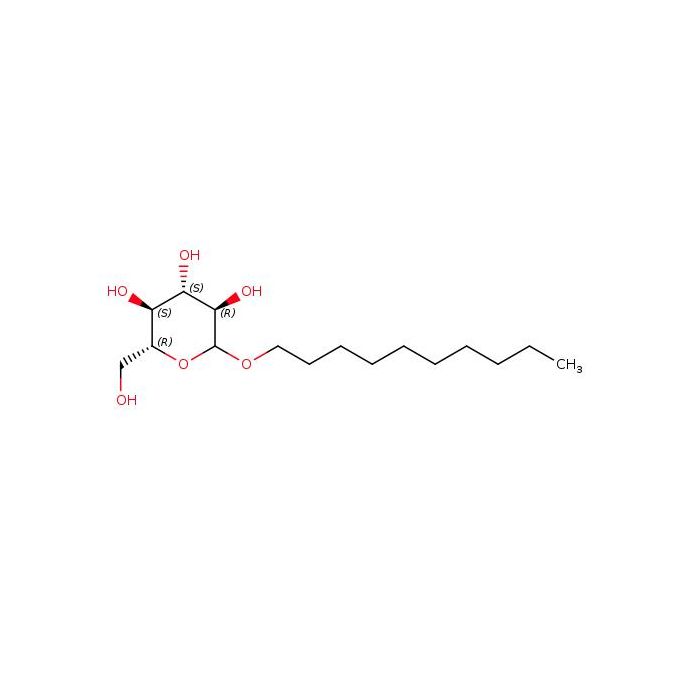
Decyl glucoside (APG) - Moligand™, 60% in H2O , CAS No.68515-73-1

CAS: 68515-73-1 Cat. No.: T476404 Molecular Weight: 320.22 EC Number: 500-220-1
AVAILABLE TO ORDER
GRADE & PURITY Moligand™ ? Moligand™ — Aladdin's line of ligands and bioactive small molecules. Use for receptor, pathway, and binding studies needing defined small-molecule tools. 60% in H2O
Synonyms
C16H32O6 | A867031 | W-203522 | (3R,4S,5S,6R)-2-(Decyloxy)-6-(hydroxymethyl)-tetrahydro-2H-Pyran-3,4,5-triol | (3R,4S,5S,6R)-2-(Decyloxy)-6-(hydroxymethyl)tetrahydro-2H-Pyran-3,4,5-triol | D-Glucopyranoside, decyl | decyl glucopyranoside | DS-3841 | (3R,4
Storage
Room temperature,Argon charged
Shipped In
Normal
 ·  off list, applied to all prices below.
Size
Status
Price
Qty
100ml
T476404-100ml
5
$44.90
500ml
T476404-500ml
8-12 wks(?) Production requires sourcing of materials. We appreciate your patience and understanding.
$55.90
Enter a quantity for the sizes you want to add.
🧪

Why this grade

Moligand™, 60% in H2O Moligand™ for sensitive chromatographic and analytical workflows requiring minimal baseline interference.

🌡

Storage & shipping

Room temperature,Argon charged Ships Normal Check lot-specific COA for exact specifications.

📋

Quality documents

SDS, COA, datasheet, and spec sheet available for download. Lot-specific COA accessible via lot number lookup.

📚

Literature proof

Cited in 4 peer-reviewed publications across chromatography, organic synthesis, and cross-coupling reactions.

Overview

APG 0810 is a mixture of 58.0-62.0% D-glucopyranose, oligomeric, decyl octyl glycoside and 38.0-42.0% water. Contains less than 2% decanol and less than 1.0% octanol.

Specifications

Synonyms
C16H32O6 | A867031 | W-203522 | (3R, 4S, 5S, 6R)-2-(Decyloxy)-6-(hydroxymethyl)-tetrahydro-2H-Pyran-3, 4, 5-triol | (3R, 4S, 5S, 6R)-2-(Decyloxy)-6-(hydroxymethyl)tetrahydro-2H-Pyran-3, 4, 5-triol | D-Glucopyranoside, decyl | decyl glucopyranoside | DS-3841 | (3R, 4
Specifications & Purity
Moligand™, 60% in H2O
Storage
Room temperature, Argon charged
Shipped In
Normal
Grade
Moligand™
Names and Identifiers
Canonical SmilesCCCCCCCCCCOC1C(C(C(C(O1)CO)O)O)O
IUPAC Name(3R,4S,5S,6R)-2-decoxy-6-(hydroxymethyl)oxane-3,4,5-triol
InChIKeyJDRSMPFHFNXQRB-IWQYDBTJSA-N
INCHI1S/C16H32O6/c1-2-3-4-5-6-7-8-9-10-21-16-15(20)14(19)13(18)12(11-17)22-16/h12-20H,2-11H2,1H3/t12-,13-,14+,15-,16?/m1/s1
Isomeric SMILES CCCCCCCCCCOC1[C@@H]([C@H]([C@@H]([C@H](O1)CO)O)O)O
Molecular Weight 320.22
Reaxy-Rn 35664303
Reaxys-RN_link_address https://www.reaxys.com/reaxys/secured/hopinto.do?context=S&query=IDE.XRN=35664303&ln=

Documentation

📋 Safety Data Sheet (SDS)

Comprehensive hazard, handling, storage, and regulatory compliance document.

Download SDS →

✅ Certificate of Analysis (COA)

Lot-specific quality data. Enter your lot number to retrieve the exact COA.

Look up COA →

📊 Datasheet

Quick-reference summary of product specifications and applications.

View datasheet →

🔬 Specification Sheet

Full quality attributes and acceptance criteria for this grade.

View spec sheet →

Advanced Data

Taxonomic Classification

Taxonomy Tree

KingdomOrganic compounds
SuperclassLipids and lipid-like molecules
ClassFatty Acyls
SubclassFatty acyl glycosides
Intermediate Tree Nodes Not available
Direct ParentFatty acyl glycosides of mono- and disaccharides
Alternative Parents Hexoses  Alkyl glycosides  O-glycosyl compounds  Oxanes  Secondary alcohols  Polyols  Oxacyclic compounds  Acetals  Primary alcohols  Hydrocarbon derivatives  
Molecular FrameworkAliphatic heteromonocyclic compounds
Substituents Fatty acyl glycoside of mono- or disaccharide - Alkyl glycoside - Hexose monosaccharide - Glycosyl compound - O-glycosyl compound - Monosaccharide - Oxane - Secondary alcohol - Acetal - Organoheterocyclic compound - Oxacycle - Polyol - Organooxygen compound - Primary alcohol - Hydrocarbon derivative - Organic oxygen compound - Alcohol - Aliphatic heteromonocyclic compound
DescriptionThis compound belongs to the class of organic compounds known as fatty acyl glycosides of mono- and disaccharides. These are compounds composed of a mono- or disaccharide moiety linked to one hydroxyl group of a fatty alcohol or of a phosphorylated alcohol (phosphoprenols), a hydroxy fatty acid or to one carboxyl group of a fatty acid (ester linkage) or to an amino alcohol.
External Descriptors Not available
3D Structure
Interactive Chemical Structure Model


Certificates(CoA,COO,BSE/TSE and Analysis Chart)
C of A & Other Certificates(BSE/TSE, COO):
Analytical Chart:

Find and download the COA for your product by matching the lot number on the packaging.

21 results found

Lot NumberCertificate TypeDateItem
F2611442Certificate of AnalysisMay 15, 2026 T476404
F2611441Certificate of AnalysisMay 15, 2026 T476404
F2611440Certificate of AnalysisMay 15, 2026 T476404
F23061892Certificate of AnalysisMar 18, 2026 T476404
A2627668Certificate of AnalysisJan 08, 2026 T476404
E2607080Certificate of AnalysisJan 08, 2026 T476404
A2627669Certificate of AnalysisJan 08, 2026 T476404
A2627507Certificate of AnalysisJan 08, 2026 T476404
E2528478Certificate of AnalysisMay 13, 2025 T476404
E2528591Certificate of AnalysisMay 13, 2025 T476404
E2528592Certificate of AnalysisMay 13, 2025 T476404
J2422795Certificate of AnalysisSep 21, 2024 T476404
J2422797Certificate of AnalysisSep 21, 2024 T476404
J2422798Certificate of AnalysisSep 21, 2024 T476404
F23061905Certificate of AnalysisApr 20, 2023 T476404
F23061908Certificate of AnalysisApr 20, 2023 T476404
F23061986Certificate of AnalysisApr 20, 2023 T476404
H2422105Certificate of AnalysisApr 20, 2023 T476404
D2310135Certificate of AnalysisMar 10, 2023 T476404
D2310121Certificate of AnalysisMar 10, 2023 T476404
D2310110Certificate of AnalysisMar 10, 2023 T476404

Show more ⌵

Chemical and Physical Properties
Solubility water: freely soluble at20°C (visual)
Molecular Weight320.420 g/mol
XLogP32.400
Hydrogen Bond Donor Count4
Hydrogen Bond Acceptor Count6
Rotatable Bond Count11
Exact Mass320.22 Da
Monoisotopic Mass320.22 Da
Topological Polar Surface Area99.400 Ų
Heavy Atom Count22
Formal Charge0
Complexity275.000
Isotope Atom Count0
Defined Atom Stereocenter Count4
Undefined Atom Stereocenter Count1
Defined Bond Stereocenter Count0
Undefined Bond Stereocenter Count0
The total count of all stereochemical bonds0
Covalently-Bonded Unit Count1
Documents & Articles
Bio-based Chemicals: From Platform Molecules to Application Scenarios — Trend Insights and Aladdin’s Product Portfolio
A Practical Guide to Fragrance Compositions: Turning a Black-Box Formula into an Engineerable System—Compatibility, Stability, Controlled Release, Traceability, and Selection
A Panoramic Guide to Surfactants: Definitions & Mechanisms, Key Metrics, Application Scenarios, and Selection Navigation (Tables 1–3)
Potassium Fatty Acid Soaps: Structure and Formulation Applications—Production Processes, Alkalinity, Foam Control, and Low-Foam Cleaning
Why LABSA (Sulfonic Acid) Is Commonly Used in Household Cleaning Formulations: Neutralization Mechanism, Detergency Action, and Formulation Application Points
Application of Fatty Acid Methyl Ester Sulfonate (MES) in Household Detergent and Cleaning Formulations: Detergency, Hard-Water Tolerance, and Selection Criteria
How Alkyl Polyglucosides (APG) Differ from Cocamidopropyl Betaine (CAPB): Structure, Foam Performance, and Applications in Personal Care and Household-Care Formulations
Solvents, Co-solvents, and Solubilization Systems in Home and Personal Care Formulations: Classification, Functions, and Selection Guide
K12 (Sodium Lauryl Sulfate/SLS) Is More Than a Foaming Agent: Structure, Properties, and Applications in Personal Care and Household Care Formulations
What Is the Difference Between Triethanolamine and Diethanolamine: Understanding Their Formulation Functions, Application Differences, and Selection Logic from a Molecular-Structure Perspective
Thickening, Suspension, Auxiliary Stabilization, and Agglomeration Mechanisms of Xanthan Gum in Personal Care Formulations: From Molecular Structure to Processing Applications
Why Can 6501 (Cocamide DEA) Stabilize Foam and Build Viscosity? Structural Mechanism, 1:1/1:1.5 Differences, and Application Selection
Role of Alkyl Glucosides APG in Cleaning Formulations: Structural Features, Core Performance, and Selection Considerations
Xiao Fang Bai, Da Fang Bai, PnB and DPnB: Mechanisms and Selection of Butyl Glycol Ethers in Hard-Surface Cleaning Formulations
Why Limonene Can Soften Greasy Soils Yet Is Difficult to Dissolve in Water: Understanding the Cleaning Mechanism and Formulation Applications of Naturally Derived Solvents from Molecular Structure
Degreasing Agents from a Molecular-Structure Perspective: How AEO, APG, and Related Surfactants Can Replace Nonylphenol Ethoxylates (NPE)
Understanding CAPB from Its Structure: How Cocamidopropyl Betaine Improves Foam, Enhances Mildness, and Supports Thickening
Interfacial Mechanism and Formulation Applications of AEO-9 (Fatty Alcohol Polyoxyethylene Ether): An Analysis of Emulsification, Wetting, Oil Soil Removal, and Co-Formulation Compatibility
More Than a pH Adjuster: Mechanisms, Selection Logic, and Alternative Acid Source Analysis of Citric Acid in Home-Care Cleaning
Wetting and Penetration Mechanisms of Penetrating Agents in Household and Personal Care Cleaning Systems: Representative Structural Analysis Using JFC, OEP-70, and DOSS as Examples
From Structure to Selection: Mechanisms and Application Assessment of Low-Foam Oil and Wax Removal with Fatty Acid Methyl Ester Ethoxylates (FMEE)
Analysis of the Foaming Performance Differences Between K12 and AOS: Structure, Acid–Base Stability, and Formulation Selection
Citations of This Product
References
1. Zhongjie He, Weirui Zhang, Jing Zhang, Jinliang Xie, Fangfang Su, Yuchen Li, Dongdong Yao, Yudeng Wang, Yaping Zheng.  (2024)  Enhancing the electromagnetic interference shielding of epoxy resin composites with hierarchically structured MXene/graphene aerogel.  COMPOSITES PART B-ENGINEERING,      [PMID:] [10.1016/j.compositesb.2024.111230]
2. Liangliang Ren, Lixia Zhang, Tie Geng, Jiayu Sun, Xuejian Liu, Botao Xu, Huaike Li, Lei Guo, Zhenyuan Yin.  (2025)  Impacts of Stirring Rate on CO2-in-H2O Emulsion Synthesis and Stability for Enhanced CO2 Hydrate Formation Kinetics.  ENERGY & FUELS,      [PMID:] [10.1021/acs.energyfuels.5c04813]
3. Jihao Kang, Pengyue Yu, Zhi Huang, Zhenglong Tong, Ruimin Chang, Zhiyan Xie, Shiyu Gui, Ying Huang.  (2025)  Synergistic Toxicity Reduction of Cadmium in Rice Grains by Foliar Co-Application of Nano-Silica and Surfactants.  Toxics,  13  (12): (1047).  [PMID:41441268] [10.3390/toxics13121047]
4. Liangliang Ren, Lixia Zhang, Tie Geng, Xuejian Liu, Jiayu Sun, Dnyaneshwar R. Bhawangirkar, Botao Xu, Huaike Li, Lei Guo, Zhenyuan Yin.  (2025)  Formulating liquid CO2-in-water emulsion using non-ionic surfactant alkyl polyglucoside for ultra-rapid CO2 hydrate formation.  FUEL,      [PMID:] [10.1016/j.fuel.2025.137597]
Solution Calculators
Reviews

Customer Reviews

Need help choosing the grade?

Our grade selection guide covers purity, stabilizer status, and application suitability for all variants in our catalog.

View Moligand™ grade guide →

Shall we send you a message when we have discounts available?

Remind me later

Thank you! Please check your email inbox to confirm.

Oops! Notifications are disabled.