This compound belongs to the class of organic compounds known as benzene and substituted derivatives. These are aromatic compounds containing one monocyclic ring system consisting of benzene.
External Descriptors
Not available
1. Djoumbou Feunang Y, Eisner R, Knox C, Chepelev L, Hastings J, Owen G, Fahy E, Steinbeck C, Subramanian S, Bolton E, Greiner R, and Wishart DS. ClassyFire: Automated Chemical Classification With A Comprehensive, Computable Taxonomy. Journal of Cheminformatics, 2016, 8:61.
Determine the necessary mass, volume, or concentration for preparing a solution.
Dilution Calculator
Determine the dilution needed to prepare a stock solution.
Reconstitution Calculator
Reseñas
Reseñas de cliente
Application Protocols
No biological assay protocols (WB, IHC, IF, FC) apply to this small-molecule ligand. For laboratory use, see Reaction Conditions for representative catalytic setup guidance. If you require a detailed, stepwise protocol for forming a specific metal–ligand complex with this phosphine, contact technical support with your metal source and transformation of interest.
Biological Roles
This compound is a synthetic organophosphorus ligand intended for chemical synthesis and catalysis. It does not have established endogenous biological roles.
Not a metabolite, cofactor, or structural biopolymer component (general knowledge).
Organophosphines can exhibit toxicity and strong odor; no biological buffering capacity or enzymatic role is anticipated.
Any use in bio-conjugation or chemical biology would be strictly as a synthetic reagent/ligand to assemble small molecules or metal complexes and not as a biomolecule itself.
Research use note (item-specific)
For research use only (as provided). Not for human or animal use in diagnostic or therapeutic contexts.
Buffer Applications
Not typically applicable. Dicyclohexylphenylphosphine is a neutral, hydrophobic ligand and does not form aqueous buffer systems. For practical guidance, see Reaction & Applications and Solvent Selection for its use in organic media.
Green Alternatives
While the ligand itself is not readily substituted by a “green” equivalent without impacting reactivity, several greener choices can be made around its use.
Greener process levers (literature, general)
Solvent selection: favor 2-MeTHF, CPME, heptane, or bio-derived esters over DMF/DMAc/NMP or chlorinated solvents when compatible with the catalytic system.
Lower catalyst loading: the relatively electron-rich, bulky nature can permit reduced metal and ligand loadings in some couplings, diminishing metal waste.
Air-stable precatalysts: use of air-stable Pd(II) or Ni(II) precatalysts can reduce glovebox dependence and waste from failed air-exposed runs.
Ligand recovery: where practical, oxidation to the corresponding phosphine oxide followed by separation and catalytic reduction back to PR3 has been explored, but practicality varies by scale.
Illustrative comparison (qualitative)
Traditional setup: Pd2(dba)3/PCy2Ph in toluene, 90–110 C, inorganic base.
Greener variant: Pd or Ni precatalyst with PCy2Ph in 2-MeTHF or CPME, water-tolerant base (K3PO4), at the lowest effective temperature.
Trade-offs
Greener solvents can alter metal–ligand speciation and rate; re-optimization is often required.
Air-stable ligands (e.g., certain dialkylbiarylphosphines) may be easier to handle but are not inherently “greener” and can be more resource-intensive to make.
Pharmaceutical Uses
No excipient or direct formulation role is expected for this compound. In pharmaceutical process chemistry (literature, general):
Role in manufacturing: used as a coordinating ligand in homogeneous metal catalysis (e.g., Pd/Ni-mediated cross-couplings) during small-molecule API intermediate synthesis.
Selection rationale: steric/electronic profile can enable couplings of deactivated or hindered substrates, potentially reducing steps or protecting-group needs.
Regulatory note: when used in manufacturing, residual ligand levels in APIs are controlled per ICH guidelines; appropriate purge and analytical methods (e.g., 31P NMR, LC–MS for phosphine oxide) should be validated.
No therapeutic claims are made. This product is offered strictly for research and development use.
Physical Properties
Item-specific specifications
Appearance: Not specified for this item; refer to CoA/Spec Sheet.
Grade/Purity: Not specified for this item; refer to CoA/Spec Sheet.
General/literature properties (for orientation; not item-specific)
State near ambient conditions: typically a low-melting solid or viscous liquid depending on lot and temperature, reflecting bulky tertiary phosphine character.
Solubility: high in nonpolar and moderately polar organic solvents (e.g., toluene, hexanes, ethers, chlorinated solvents); very low in water.
Volatility: low; can be handled as a solid/liquid with minimal vapor loss but should be protected from air/oxidants to avoid formation of the phosphine oxide.
Refractive behavior: expected high refractivity due to P center and aromatic ring (qualitative; literature expectation).
Acid–base: tertiary phosphine; basic/nucleophilic at phosphorus. Conjugate acid (phosphonium) pKaH lies between those of PPh3 and PCy3 (literature, qualitative comparison).
Do not treat the above as specifications. For exact MP/BP/density/UV cutoff/trace limits for a given lot, consult the CoA/Spec Sheet.
Quality and Grades
Item-specific details
Grade/Purity: Not specified for this item; refer to CoA/Spec Sheet.
Context for this compound class
Tertiary phosphines used as ligands are commonly offered in research grade with tight control of oxidation state (free phosphine vs. phosphine oxide) and low metal content. For air-sensitive ligands, packaging under inert gas (argon) and in moisture-barrier containers helps preserve assay.
Key quality attributes you may expect to see on the CoA/Spec Sheet (not provided here):
Assay (by titration or quantitative 31P NMR vs. an internal standard).
Impurities: phosphine oxide content, related phosphines.
Residual solvents and water (Karl Fischer) for catalysis-critical applications.
Metal content (ICP-MS) when used in metal-catalyzed reactions where background metals can affect outcomes.
Appearance and melting range for lot verification.
Stabilization: This item is supplied argon charged (item-specific). No stabilizer is specified. If present in other products, amine bases or antioxidants are sometimes used, but none are indicated here.
Guidance
For air-sensitive ligand work (e.g., Pd/Ni catalysis), request a recent CoA and store the container under inert gas between uses. If UV-background or trace-metal constraints are critical (e.g., photoredox or ppb-level catalysis), confirm specifications with our technical team prior to scale-up.
Reaction and Applications
Dicyclohexylphenylphosphine is a sterically demanding, moderately electron-rich ligand that tunes activity and selectivity of late-transition-metal catalysts.
Representative application areas (literature)
Cross-coupling catalysis (Pd, Ni): effective in Suzuki–Miyaura, Stille, Negishi, and Kumada couplings, especially for challenging electrophiles (e.g., hindered aryl halides) where increased steric bulk promotes reductive elimination.
Buchwald–Hartwig amination: can support amination of aryl halides as a monodentate ligand, with activity between PPh3 and PCy3 depending on substrate and base.
Heck and related arylation: bulky monodentate ligands can improve turnover and suppress β-hydride elimination pathways for certain substrates.
Hydrofunctionalizations (Ni, Cu, Rh): serves as a tunable donor to modulate migratory insertion vs. β-H elimination, though specialized ligands may outperform it in many modern protocols.
Catalyst stabilization: forms well-defined L–M complexes; steric bulk can prevent oligomerization or off-cycle species.
Practical guidance
Dry, oxygen-free techniques extend catalyst life. Pre-complexation of ligand to the metal precursor (e.g., Pd2(dba)3 or Ni(cod)2) often improves reproducibility.
Ligand loadings: 1–2 equiv per metal center are typical; catalytic systems often use 2–10 mol% ligand relative to substrate (literature, general guidance).
Bases: K3PO4, K2CO3, Cs2CO3, NaOtBu, and KOtBu are common in C–N/C–C couplings; pairing with solvent is critical.
Sterics/electronics: Positioned between PPh3 (less bulky, less donating) and PCy3 (more bulky, more donating), PCy2Ph can balance oxidative addition and reductive elimination steps.
Reaction Conditions
General guidance from literature (not item-specific; optimize per substrate):
Catalyst systems: Pd2(dba)3, Pd(OAc)2 (reduced in situ), or Ni(cod)2/Ni(II) salts combined with dicyclohexylphenylphosphine (1–2 equiv per metal center).
Loadings: 0.5–5 mol% Pd or Ni; 1–10 mol% ligand relative to limiting substrate, adjusting with substrate class/reactivity.
Bases (for couplings): K3PO4, K2CO3, Cs2CO3, NaOtBu/KOtBu, or aqueous bases in biphasic systems; choose to balance solubility and rate.
Temperatures: typically 50–120 C for aryl halide couplings; lower for activated substrates.
Atmosphere: inert (argon or nitrogen); rigorously degassed solvents and substrates recommended.
Additives: halide salts or phase-transfer agents may help with insoluble bases; water (1–10%) can accelerate some Suzuki reactions.
Monitoring: TLC, GC, or LC; 31P NMR can verify ligand integrity and detect oxide formation.
Expected outcomes: with appropriate optimization, high conversions and selectivities are achievable for many aryl/heteroaryl substrates; more challenging aryl chlorides or hindered partners may require higher temperatures or stronger bases.
Note: Always validate on small scale; subtle changes in ligand purity or oxidation state can significantly affect rate and selectivity.
Safety and Handling
Authoritative safety information must be taken from the SDS. The following is a general overview for tertiary organophosphines like dicyclohexylphenylphosphine.
GHS classification, signal word, pictograms, H-statements: Not specified for this item; refer to SDS.
Anticipated hazards (general): combustible; harmful if swallowed or on skin; causes skin/eye irritation; may be harmful if inhaled. Air oxidation to the corresponding phosphine oxide is expected; avoid peroxides/oxidizers.
Incompatibilities: strong oxidizing agents, strong acids, halogens. Can reduce metal salts; handle away from bleach, peroxides, nitric acid. Avoid prolonged air/oxygen exposure to limit oxidation.
Special risks: tertiary phosphines are malodorous and can undergo exothermic oxidation. Though not a classical peroxide-forming solvent, prudent periodic checks for oxidation products are recommended.
PPE: lab coat, nitrile gloves (change regularly), splash goggles. Use in a fume hood to control odor and any vapors/aerosols.
Handling: minimize air exposure; dispense under inert atmosphere (argon/nitrogen). Use dry glassware and anhydrous solvents for catalysis.
First aid (overview; defer to SDS): skin—wash with soap/water. Eyes—rinse cautiously with water for several minutes, remove contact lenses. Inhalation—move to fresh air, seek medical attention if symptoms persist. Ingestion—rinse mouth, do not induce vomiting, seek medical attention.
Fire-fighting: use CO2, dry chemical, or foam. Combustion may produce phosphorus oxides.
Storage and shipping (item-specific)
Storage: Room temperature, Argon charged (item-specific). Keep tightly sealed under inert gas, protected from air/moisture and light.
Shipped in: Normal (item-specific).
Solvent Selection
This product is a lipophilic, neutral ligand rather than a solvent. However, solvent choice strongly affects its performance in catalysis.
Polarity and miscibility (literature, general): highly soluble in nonpolar to moderately polar organic solvents such as toluene, xylene, hexanes/heptane, MTBE/THF/2-MeTHF, diethyl ether, DCM/DCE, and chlorobenzene. Essentially insoluble in water.
Typical media for cross-couplings: toluene, xylene, dioxane, THF/2-MeTHF, CPME, DMF/DMAc/NMP, or alcohols depending on substrate/base system. Hydrocarbon or ether solvents are often favored to balance solubility and reduce competitive coordination.
When to choose hydrocarbons: for hydrophobic aryl halides and to limit coordinating solvent effects on metal–ligand speciation.
When to choose ethers: to improve solubility/handling at lower temperatures and facilitate base suspension (e.g., K3PO4, Cs2CO3).
When to avoid strong donor solvents: very strong donors (e.g., DMSO) can displace or attenuate binding of PR3 ligands in some catalytic systems.
Small comparison (literature, qualitative)
Toluene vs. dioxane: toluene offers lower coordinating ability and better compatibility with moisture-sensitive bases; dioxane can better dissolve polar substrates but may coordinate to metals.
THF vs. 2-MeTHF: 2-MeTHF is greener and often similar in performance, with higher boiling point and better phase separation from water.
Practical tips
Degas and dry solvents to prevent ligand oxidation and catalyst deactivation.
If preparing stock solutions of the ligand, use dry toluene, THF, or 2-MeTHF under inert gas and store in sealed septum vials.
Storage and Reconstitution
Item-specific storage
Storage Conditions: Room temperature, Argon charged (as provided). Keep tightly closed in the original container under inert gas to limit oxidation. Protect from air, moisture, and light.
Shipped In: Normal (as provided).
General handling/reconstitution (literature guidance)
Opening/dispensing: if available, handle in a glovebox; otherwise, use Schlenk techniques. Backfill headspace with argon after each use.
Stock solutions: prepare under inert atmosphere in dry, oxygen-free solvents such as toluene, THF, or 2-MeTHF. Typical concentrations: 0.05–0.5 M. Store in sealed, argon-purged vials at room temperature or refrigerated if compatible with your solvent.
Stability: tertiary phosphines gradually oxidize in air; monitor by 31P NMR if critical. If significant oxide is detected, purify (e.g., via recrystallization or by passing through a short silica plug under inert conditions) or use fresh material.
Freeze–thaw: not applicable to solids; for solutions, avoid repeated freeze–thaw. Aliquot into small vials to minimize air exposure.
Research use note
For research use only (as provided).
Structure and Identity
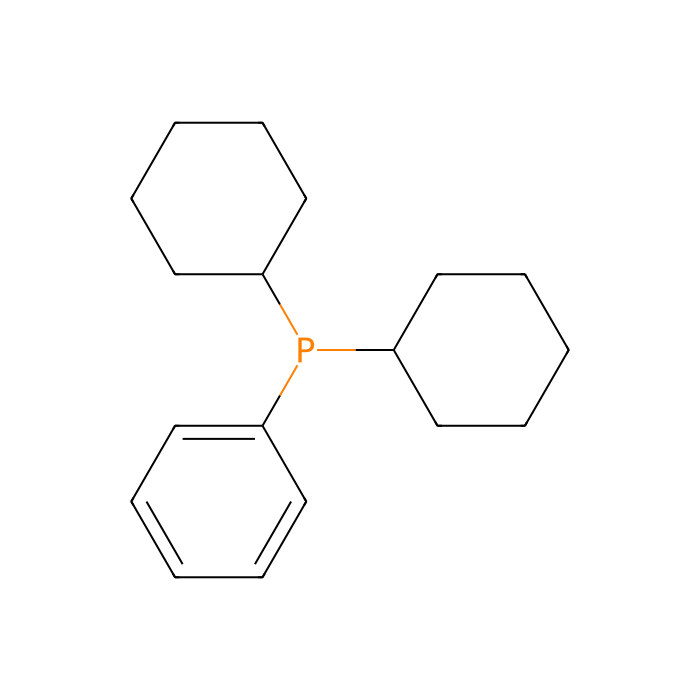
Dicyclohexylphenylphosphine (often abbreviated as PCy2Ph) is a bulky, tertiary aryl–alkyl phosphine widely used as a coordinating ligand in homogeneous catalysis.
SKU: D154319
CAS: 6476-37-5 (item-specific)
CID (PubChem): 80970 (item-specific)
InChIKey: 385002 (item-specific; as provided for this item)
Contains a trivalent phosphorus center (tertiary phosphine, PR3) bearing one phenyl group and two cyclohexyl groups.
Sterically demanding ligand: two saturated cyclohexyl rings create a broad cone angle; electronic properties are intermediate between trialkyl- and triarylphosphines (literature, comparative statement).
2D description: a central P atom singly bonded to an sp2 phenyl ring (planar aromatic) and to two chair-like cyclohexyl rings (sp3, saturated). No defined stereogenic centers at P under typical conditions (rapid inversion), no additional heteroatoms.
Notes
Item-specific identifiers above (CAS, CID, InChIKey) are taken directly from Product Data.
Structural identifiers marked “literature” are provided for researcher convenience and are not item-specific specifications.
Synthetic Utility
Functional role and reactivity (literature)
Monodentate tertiary phosphine ligand that modulates oxidative addition, transmetalation, and reductive elimination steps in cross-coupling cycles. Its bulk can suppress off-cycle dimerization and favor C–C or C–N bond-forming reductive elimination.
Electronic effects: more σ-donating than PPh3 but less than PCy3, often enhancing oxidative addition to aryl chlorides while retaining good selectivity.
Named/representative transformations
Suzuki–Miyaura, Negishi, Stille, Kumada, and Heck couplings (Pd/Ni).
Buchwald–Hartwig amination and related C–N couplings.
Hydrosilylation/hydroboration variants where monodentate phosphines are preferred.
Practical synthetic considerations
Ligand-to-metal ratio: often 2:1 for Pd(0) sources; 1–2 equiv per metal for in situ reduction from Pd(II).
Pre-formation of L–M complexes (e.g., PCy2Ph–Pd(dba)2) can improve reproducibility and reduce induction periods.
Competing reactions: air oxidation to phosphine oxide reduces effective ligand concentration—mitigate with inert atmosphere and dry solvents.
Workup: phosphine oxide byproducts are more polar; silica gel often retains the oxide, aiding purification of organic products.
Retrosynthetic value
Facilitates bond constructions that might otherwise require higher temperatures, exotic bases, or protected substrates, enabling shorter routes under milder conditions.
Target Specificity
Not applicable. This product is a small-molecule ligand, not a biological reagent (e.g., antibody/oligonucleotide). No antigen/epitope specificity, clone, isotype, or species reactivity applies.
We use cookies to ensure the website functions properly and, where permitted, to improve your experience. You can manage your preferences at any time in Settings. Learn more in our Cookie Policy.
Shall we send you a message when we have discounts available?
Remind me later
Thank you! Please check your email inbox to confirm.
Products are supplied to verified businesses, institutions, and qualified professionals for research and development use only. Not for use in humans, animals, diagnosis, or therapy.

 K2520798