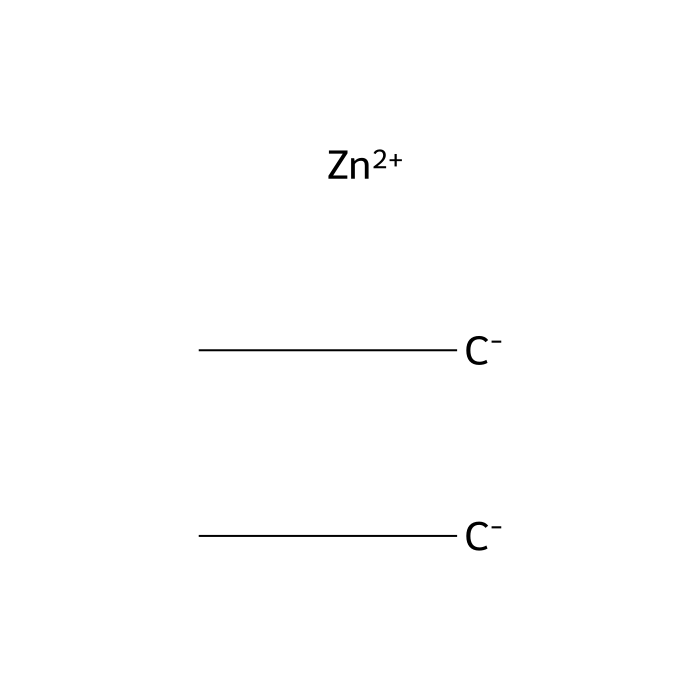
Diethylzinc solution - 1.0 M in heptane , CAS No.557-20-0

CAS: 557-20-0 Cat. No.: D432908 Fórmula: C4H10Zn Peso molecular: 123.51 Beilstein Registry Number: 3587207 Número EC: 209-161-3
Disponible para pedir
CALIDAD & PUREZA 1.0 M in heptane
Synonyms
Zinkdiethyl|Zinc diethyl|Diethylzinc, elec. gr.|zinc;ethane|Zinc, diethyl-|Diethylzink|Zinc ethide|Diethylzinc, >=52 wt. % Zn basis|Zinc ethyl|DIETHYL ZINC|diethyl zinc(II)|Diethylzinc|Diethylzinc [UN1366] [Spontaneously combustible]
Storage
Room temperature
Shipped In
FedEx DG Service
★
Talla
Alemania (EU)
USA*
Precio
Cantidad
100ml
D432908-100ml
Fabricado bajo pedido · 8–12 semanas

248,09€

290,61€
Guardar 42,52 € (14.63%)
Enter a quantity for the sizes you want to add.

Descripción general

Application

Diethylzinc solution can be used in the synthesis of: Bis(pyridylpyrrolyl)zinc luminescent complexes. A versatile building block, 5-(ketoaryl)thiazole. Zn x Cd 1-x Se nanocrystals having high luminescence properties.

Especificaciones

Sinónimos
Zinkdiethyl | Zinc diethyl | Diethylzinc, elec. gr. | zinc;ethane | Zinc, diethyl- | Diethylzink | Zinc ethide | Diethylzinc, >=52 wt. % Zn basis | Zinc ethyl | DIETHYL ZINC | diethyl zinc(II) | Diethylzinc | Diethylzinc [UN1366] [Spontaneously combustible]
Especificaciones y pureza
1.0 M in heptane
Condiciones de almacenamiento de almacenamiento
Room temperature
Enviado en
FedEx DG Service
Nombres e identificadores
Sonrisas canónicas
C[CH2-].C[CH2-].[Zn+2]
IUPAC Name
zinc;ethane
InChIKey
IPSRAFUHLHIWAR-UHFFFAOYSA-N
INCHI
1S/2C2H5.Zn/c2*1-2;/h2*1H2,2H3;/q2*-1;+2
Isómeros SMILES
C[CH2-].C[CH2-].[Zn+2]
WGK Alemania
2
Número ONU
UN 3394
Peso molecular
123.51
Beilstein
3587207
Reaxy-Rn
16917908
Reaxys-RN_link_address
https://www.reaxys.com/reaxys/secured/hopinto.do?context=S&query=IDE.XRN=16917908&ln=

Datos avanzados

Taxonomic Classification

Taxonomy Tree

KingdomOrganic compounds
SuperclassHydrocarbon derivatives
ClaseNot available
SubclassNot available
Intermediate Tree Nodes Not available
Direct ParentHydrocarbon derivatives
Alternative Parents Organic salts  Saturated hydrocarbons  
Molecular FrameworkNot available
Substituents Hydrocarbon derivative - Organic salt - Saturated hydrocarbon - Hydrocarbon - Aliphatic acyclic compound
DescripciónThis compound belongs to the class of organic compounds known as hydrocarbon derivatives. These are derivatives of hydrocarbons obtained by substituting one or more carbon atoms by an heteroatom. They contain at least one carbon atom and heteroatom.
External Descriptors Not available
Estructura 3D
Modelo de Estructura Química Interactiva


Certificados (CoA, COO, BSE/TSE y tabla de análisis)
C of A & Other Certificates(BSE/TSE, COO):
Analytical Chart:
Propiedades químicas y físicas
Índice de refracción1.5
Punto de inflamación (°F)-9.4 °F
Punto de inflamación (°C)-18 °C
Punto de ebullición (°C)124°
Punto de fusión (°C)-28°
Peso molecular123.500 g/mol
XLogP3
Hydrogen Bond Donor Count0
Hydrogen Bond Acceptor Count2
Rotatable Bond Count0
Exact Mass122.007 Da
Monoisotopic Mass122.007 Da
Topological Polar Surface Area0.000 Ų
Heavy Atom Count5
Formal Charge0
Complexity3.600
Isotope Atom Count0
Defined Atom Stereocenter Count0
Undefined Atom Stereocenter Count0
Defined Bond Stereocenter Count0
Undefined Bond Stereocenter Count0
The total count of all stereochemical bonds0
Covalently-Bonded Unit Count3
Preguntas frecuentes y artículos
Understanding ALD Precursor Chemistry: Element Map, Ligand-Based Taxonomy, Typical Pairings, and Troubleshooting (with a Co-Reactant/Precursor List)
ALD and CVD Beginner’s Complete Guide: Mechanisms, Process Branches, Application Scenarios, and a Selection Decision Tree
A Practical Guide to Organozinc Reagents for Synthesis (Organozinc Reagents): Structural Features, Key Reactions, and a Practical Selection Navigation (Including Aladdin Product Tables)
The Preparation Logic of Nearly Monodisperse Colloidal Quantum Dots: Precursor Conversion, Nucleation–Growth Control, Surface Chemistry, and Process Control in Scale-Up
Experimental Selection Logic for C-C Bond Construction: Understanding Fragment Coupling, Carbonyl Chain Extension, Olefination, and Late-Stage Bond-Forming Pathways by Bond-Forming Task
Experimental Decision-Making for Cross-Coupling Reactions: Target Bond Type, Substrate Combination, and Catalytic System Selection
Reactions and Applications of 3,3-Difluoroallyl Sulfonium Salts (DFASs): Small-Molecule gem-Difluoroallylation, Selective Peptide Modification, and Subsequent Functionalization
Build the Three-Membered Ring First, or Form the Carbon–Nitrogen Bond First?—Retrosynthetic Strategies, Route Selection, and Stereochemical Control in Cyclopropylamine Synthesis
The Piperidine Bioisosteric Potential of 4-Azaspiro[2.3]hexane: Geometry, Physicochemical Properties, and Synthetic Accessibility
Regioselectivity of Pyridine-Diimine (PDI)–Cobalt-Catalyzed Simmons–Smith-Type Cyclopropanation: Alkene Substitution Patterns and the Methylene-Transfer Mechanism
Citations of This Product
Calculadoras de soluciones
Reseñas

Reseñas de cliente

¿Quieres que te enviemos un mensaje cuando tengamos descuentos disponibles?

Recordármelo más tarde

¡Gracias! Por favor, revisa tu bandeja de entrada de correo electrónico para confirmar.

¡Vaya! Las notificaciones están desactivadas.