CALIDAD & PUREZAMoligand™?Moligand™ — Aladdin's line of ligands and bioactive small molecules. Use for receptor, pathway, and binding studies needing defined small-molecule tools.≥98%
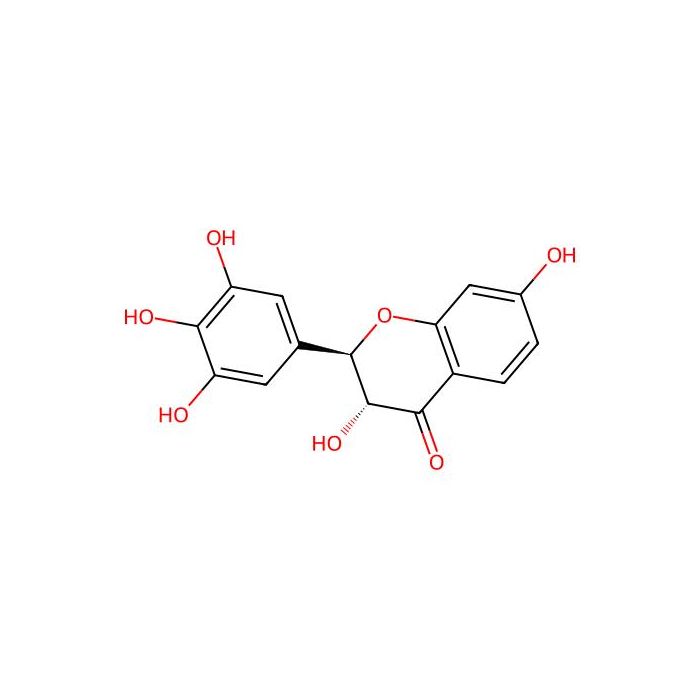
Dihydrorobinetin ((+)-Dihydrorobinetin) is a compound extracted from Robinia pseudoacacia. It is a marker of vinegar aging in Robinia pseudoacacia wood. It has antioxidant activity and is often added to skin care products.
Especificaciones
Sinónimos
(+)-Dihydrorobinetin
Especificaciones y pureza
Moligand™,≥98%
Condiciones de almacenamiento de almacenamiento
Store at -20°C
Enviado en
Ice chest + Ice pads
Este producto requiere envío en cadena de frío. Los servicios terrestres y otros servicios económicos no están disponibles.
This compound belongs to the class of organic compounds known as flavanonols. These are compounds containing a flavan-3-one moiety, with a structure characterized by a 2-phenyl-3,4-dihydro-2H-1-benzopyran bearing a hydroxyl group and a ketone at the carbon C2 and C3, respectively.
External Descriptors
Not available
1. Djoumbou Feunang Y, Eisner R, Knox C, Chepelev L, Hastings J, Owen G, Fahy E, Steinbeck C, Subramanian S, Bolton E, Greiner R, and Wishart DS. ClassyFire: Automated Chemical Classification With A Comprehensive, Computable Taxonomy. Journal of Cheminformatics, 2016, 8:61.
Determine the necessary mass, volume, or concentration for preparing a solution.
Dilution Calculator
Determine the dilution needed to prepare a stock solution.
Reconstitution Calculator
Reseñas
Reseñas de cliente
Application Protocols
No validated bioassay or analytical protocols are provided for this specific catalog item.
General guidance (research use only)
Stock preparation: dissolve in anhydrous DMSO to 10–50 mM; vortex and sonicate gently if needed. Filter (0.22 μm PTFE) for sterile applications. Record exact concentration gravimetrically.
Antioxidant capacity assays: prepare fresh dilutions in assay buffer or ethanol; run blanks for vehicle and account for intrinsic absorbance at assay wavelengths.
LC-MS method development: start with reversed-phase C18, 5–40% MeCN in water (0.1% formic acid), 0.3–0.5 mL/min (analytical scale); monitor multiple wavelengths (e.g., 210–400 nm) and MS in negative ESI.
Metal–phenolic complexation tests: mix ethanolic solution with aqueous metal salt under controlled pH (buffered) and track spectral shifts (UV-Vis) to profile binding.
Always tailor conditions to your system; confirm compatibility and stability experimentally.
Biological Roles
Scope note: No biological activity or mechanism is specified for this item. The following are general, literature-based notes on dihydroflavonols and related polyphenols; they are not product specifications and do not constitute medical claims.
Plant/biochemical context (literature/general)
Dihydroflavonols are intermediates in flavonoid biosynthesis (e.g., precursors to leucoanthocyanidins and anthocyanidins via dihydroflavonol 4-reductase). Their multiple phenolic groups enable interactions with proteins and metal ions, influencing enzyme modulation and redox homeostasis in planta.
Polyphenols can act as antioxidants by hydrogen atom transfer (HAT) and single-electron transfer (SET) mechanisms; substitution patterns (e.g., catechol moieties) modulate redox potential and radical-stabilization.
Binding/complexation: phenolic arrays chelate Fe3+, Cu2+, Al3+, among others; such complexes can alter ROS generation and are often studied in the context of metal–polyphenol networks and coatings.
Supramolecular effects: engage in π–π stacking and hydrogen bonding with nucleic acids and proteins, affecting aggregation or stabilization of biomolecular assemblies in vitro.
Experimental caveats
Polyphenols can adsorb to plastic labware and denature proteins at higher concentrations; run appropriate controls for nonspecific effects.
Autoxidation products may differ in biological behavior; prepare fresh solutions, minimize light/air exposure, and verify integrity by LC-MS/UV before sensitive assays.
Use appropriate vehicles (e.g., DMSO) at low final percentages to limit perturbation of cells/enzymes in research settings.
Buffer Applications
This compound is not a buffering reagent and does not define a conventional buffer system.
Practical guidance
For aqueous work, dissolve first in a miscible organic co-solvent (e.g., DMSO, EtOH), then dilute into the desired buffer while monitoring for precipitation.
If transient solubilization in basic buffer is required (phenolate formation), limit exposure time and protect from air to minimize oxidation.
For spectroscopic assays, choose buffers with low UV background (e.g., phosphate, HEPES) and avoid strong nucleophiles that could react with activated derivatives.
Green Alternatives
Context
While Dihydrorobinetin is a solid analyte/reagent rather than a solvent, greener choices pertain to the solvents and auxiliaries used for its dissolution, extraction, and transformation.
Greener solvent options (literature/general)
Replace DMF/DMSO where possible with bio-based ethers/esters or greener alcohols, recognizing solubility tradeoffs for polyphenols.
| Use case | Conventional | Greener alternative | Trade-offs |
|---|---|---|---|
| Stock solutions for screening | DMSO (high solvency) | GBL, Cyrene, propylene carbonate | Higher viscosity; assay compatibility must be verified |
| O-alkylation/acylation | DMF, DMSO | 2-MeTHF, CPME, MeCN | May reduce solubility; longer reaction times |
| Extraction/sample prep | MeCN, MeOH | EtOH/H2O, isopropanol/H2O | Higher boiling points; potential matrix effects |
| Normal-phase purification | CH2Cl2/hexanes | EtOAc/heptane or CPME/heptane | Selectivity changes; method redevelopment |
Additional green practices
Employ solid-phase extraction (SPE) to minimize solvent volumes.
Use buffered aqueous workups rather than repeated organic washes when compatible with stability.
Optimize crystallizations from ethanol/water systems instead of chlorinated solvents.
Implement micro-scale HTE for derivatization screening to reduce solvent and material use.
Pharmaceutical Uses
Item-specific: No pharmacopeial grade or excipient status is provided for this item; Grade is Moligand™. For research use only.
General, non-clinical context
Polyphenolic flavonoids are studied as formulation stress markers and as model antioxidants in pre-formulation research. They may be used to probe oxidative degradation pathways in drug substances or to evaluate metal-catalyzed oxidation mitigation.
In delivery research, phenolic-rich compounds are explored for metal–phenolic network coatings and as crosslinkers/tannic analogues to tune release or surface properties (materials research only).
Analytical standards: can serve as reference materials for method development in LC-UV/LC-MS when investigating flavonoid-containing botanicals or complex mixtures.
Compliance and documentation
Not intended for use in humans or as an API/excipient. No USP/EP/JP monograph applicability is implied.
For any GMP-adjacent exploratory work, qualify the material internally (identity/purity, residual solvents, elemental impurities) and document solution stability under intended handling conditions.
Physical Properties
Item-specific specs
Appearance: Not specified for this item; refer to CoA/Spec Sheet.
Molecular weight: Not specified for this item; refer to CoA/Spec Sheet.
Molecular formula: Not specified for this item; refer to CoA/Spec Sheet.
Melting point, boiling point, density, refractive index, UV cutoff, metals/impurity limits: Not specified for this item; refer to CoA/Spec Sheet.
Literature/general properties for dihydroflavonols (non-specification)
Physical state: typically yellowish to tan crystalline solid powders due to extended aromatic systems and phenolic chromophores.
Solubility profile: sparingly soluble in water at neutral pH; increased solubility in polar organic solvents such as DMSO, DMF, acetone, and lower alcohols (MeOH, EtOH). Aqueous solubility improves in basic media due to phenolate formation, but this may accelerate oxidation.
Acid–base behavior: multiple phenolic OH groups (pKa values for analogous polyhydroxyflavanonols commonly in the range ~7–10 for the most acidic phenols; literature, varies with substitution and solvent).
Spectroscopy: strong UV absorbance bands typical of flavonoids (Band I and Band II) with hypsochromic shifts relative to fully conjugated flavonols because of C2–C3 saturation; exact λmax depends on substitution and solvent (literature).
Stability considerations: phenolic compounds can undergo air/heat/light-induced oxidation and slow polymerization; antioxidant additives are generally not used for research-grade polyphenols, so minimize exposure to air, light, and elevated temperature.
Hygroscopicity: generally low to moderate; however, fine powders may adsorb moisture—store under dry conditions to preserve assay integrity.
Quality and Grades
Item-specific grade
Grade/Purity: Moligand™ (as provided). No additional assay, stabilizer, or impurity limits are specified for this item; refer to CoA/Spec Sheet for lot-specific details.
Interpretation and implications (general)
Moligand™ is used at Aladdin Scientific to denote research-grade materials curated for molecular recognition, ligand screening, and structure–activity exploration. While not a pharmacopeial grade, the material is appropriate for discovery chemistry, biophysical assays, and synthesis where high chemical identity and reasonable purity are required.
Without a stated stabilizer: handle as an unstabilized polyphenolic solid; minimize exposure to air/light to preserve purity.
Documentation: For quantitative work (e.g., binding constants, redox assays), verify exact purity and water content on the Certificate of Analysis (CoA) and consider performing your own QC (HPLC/UPLC, NMR, MS) prior to critical experiments.
Chromatographic considerations: Polyphenols can show tailing in normal-phase systems and strong retention in reversed-phase due to multiple H-bond donors/acceptors; choosing low-UV-absorbing solvents (HPLC-grade MeOH/MeCN with formic acid or ammonium formate) and endcapped C18 columns commonly improves peak shape.
Batch-to-batch: natural-product-like scaffolds can vary in impurity profile (minor oxidized congeners). If your application is sensitive, pre-screen new lots for UV/Vis signatures and LC-MS profile consistency.
Reaction and Applications
Research/manufacturer applications
Research Use Note: For research use only (as provided). No specific application claims are provided for this item.
General applications for dihydroflavonols/polyphenols (literature/general)
Redox/antioxidant chemistry: multiple phenolic OH groups enable radical scavenging and metal-chelation; used as standards or probes in antioxidant capacity assays (e.g., DPPH, ABTS, FRAP) and for studying polyphenol–protein/metal interactions.
Derivatization chemistry: serves as a scaffold for O-acylation, O-alkylation, and ether/ester protection strategies (e.g., methyl/benzyl protection with base and alkyl halide; acylation with acyl chlorides/anhydrides). Selective protection of catechol-like moieties can direct subsequent transformations.
Oxidation/reduction: dihydroflavonols can be oxidized to the corresponding flavonols (e.g., aerobic oxidation or DDQ/IBX variants) and participate in oxidative coupling to form dimers/oligomers under specific conditions.
Conjugation: preparation of glycosides via Koenigs–Knorr or trichloroacetimidate glycosylation after suitable protection/deprotection sequences to control regioselectivity; carbamate/carbonate formation for pro-moiety studies.
Practical tips
Maintain anhydrous and oxygen-limited conditions when prolonged basic treatments are required; add antioxidant scavengers (e.g., trace ascorbate) only if compatible with your downstream analysis.
Monitor reactions by LC-MS or UHPLC with diode-array detection to distinguish closely related oxidation states.
Use stoichiometric base carefully; strong base can cause rearrangements or over-oxidation. Carbonate or Cs2CO3 in polar aprotic solvents often balance reactivity and stability.
Reaction Conditions
The following are general, literature-based conditions for transformations of dihydroflavonol scaffolds. They are not specifications for this item.
Representative conditions
O-Acylation: acyl chloride or anhydride (1.1–3.0 equiv), base (pyridine or Et3N), solvent (DCM, MeCN), 0 °C to rt, 1–12 h. For regioselectivity, pre-protect more reactive catechol OHs.
O-Alkylation: alkyl halide (1.2–2.0 equiv), base (K2CO3/Cs2CO3), solvent (acetone, DMF), 25–60 °C, 2–24 h. Avoid strong base to minimize side reactions.
Oxidation to flavonol: DDQ (1.1–1.5 equiv) or IBX (1.5–2.0 equiv) in DMSO/MeCN, 0–25 °C, 1–6 h; or air/O2 with catalytic base/transition metal under controlled conditions. Monitor for dimerization.
Metal–phenolic network formation: mix ethanolic solution with metal salts (e.g., Fe3+, Al3+) in water/EtOH at pH 4–7; immediate complexation/coacervation can occur—optimize stoichiometry and pH.
Glycosylation (after protection): donor (e.g., trichloroacetimidate), Lewis acid (TMSOTf, BF3·Et2O), –40 to 0 °C, anhydrous DCM/Et2O; subsequent global deprotection under hydrogenolysis or acidic conditions.
Analytical control
Use UPLC-DAD at multiple wavelengths to distinguish oxidation states; HRMS to confirm mass; 2D NMR for regioisomer assignment following protection/functionalization.
Yields
Reported yields vary widely (30–85%) depending on substitution and protection strategy; optimization of base, temperature, and protecting groups is critical.
Safety and Handling
Item-specific hazards (from Product Data):
GHS classification, signal word, pictograms, H-statements: Not specified for this item; refer to SDS.
General laboratory safety guidance for polyphenolic flavonoids (non-authoritative; defer to SDS)
Likely hazards: may cause skin/eye irritation and respiratory irritation as a nuisance dust. Phenolic compounds can cause local irritation upon contact.
PPE: lab coat, safety glasses or splash goggles, and suitable chemically resistant gloves (e.g., nitrile). Handle powders in a fume hood or ventilated enclosure to minimize inhalation exposure.
Handling: avoid dust generation; protect from light and heat. Use clean, dry tools; close containers promptly after opening. Consider working under inert gas for prolonged manipulations to limit oxidation.
Incompatibilities: strong oxidizing agents (may promote degradation); strong bases can induce rapid phenolate formation and oxidation; strong acids may cause hydrolysis of sensitive glycosidic derivatives (if present) but aglycones are generally acid-tolerant at room temperature.
First aid (overview; consult SDS):
Inhalation: move to fresh air; seek medical attention if symptoms persist.
Skin: wash with soap and water; remove contaminated clothing.
Eyes: rinse cautiously with water for several minutes; remove contact lenses if present; obtain medical advice if irritation continues.
Ingestion: rinse mouth; do not induce vomiting; seek medical attention.
Fire safety: organic solid; combustible. Use CO2, dry chemical, or foam. Thermal decomposition may produce irritating fumes.
Waste: collect in properly labeled organic waste per institutional and regulatory requirements.
Solvent Selection
Polarity and miscibility (general for dihydroflavonols)
Dihydrorobinetin is expected to be sparingly soluble in water at neutral pH and significantly more soluble in polar aprotic and protic organic solvents (DMSO, DMF, acetone, methanol, ethanol). Solubility typically increases on gentle warming and with sonication.
Alkaline aqueous media (carbonate/borate buffers) can deprotonate phenolic OH groups and enhance apparent solubility, but may accelerate oxidative degradation; use only for short exposures.
Practical solvent choices by application
Stock solutions for bioassays: anhydrous DMSO is generally preferred due to high solvating power and compatibility with assay dilution into aqueous buffers (final DMSO ≤1–2% v/v is common). Filter sterilize through 0.22 μm if required.
Synthesis/derivatization: dry DMF, DMSO, acetone, or MeCN for O-alkylation/acylation; MeOH/EtOH for transesterifications or protection steps; CPME/2-MeTHF as greener alternatives when feasible (see Green Alternatives).
Extraction/cleanup: MeOH/H2O or MeCN/H2O mixtures (0.1–1% formic acid) for LC-MS sample prep; avoid prolonged basic conditions.
Comparison notes (literature-informed)
DMSO vs MeOH: DMSO affords higher solubility and stability for phenolics; MeOH is volatile and LC-compatible but can promote acetal/ester exchange under acidic/basic conditions.
MeCN vs acetone: MeCN has lower proticity and UV background (useful in UV detection), while acetone can participate in base-catalyzed aldol or Michael side chemistry with strong bases.
Aqueous buffers: use minimal organic co-solvent to avoid precipitation upon dilution; pre-wet by serial dilution from concentrated DMSO stocks.
Storage and Reconstitution
Item-specific storage and shipping
Storage conditions: Store at -20°C (as provided). Keep container tightly closed in a dry, well-ventilated place. Protect from light.
Shipped in: Ice chest + Ice pads (as provided) to maintain a cool chain and limit thermal exposure.
Handling and in-use stability (general guidance)
Allow container to equilibrate to room temperature before opening to prevent moisture condensation. Reseal promptly; consider aliquoting under inert gas to minimize headspace oxygen.
Short-term bench stability: polyphenolic solids are generally stable for typical weighing times; avoid prolonged exposure to ambient humidity and light.
Reconstitution (general, non-specification)
Preferred solvents: anhydrous DMSO for concentrated stocks (e.g., 10–50 mM). Alternative solvents include ethanol or methanol; ensure complete dissolution by vortexing/sonication.
Aqueous use: dilute DMSO stocks into buffer slowly with vigorous mixing to prevent precipitation. Typical final DMSO content ≤1–2% v/v for many biochemical assays.
Filtration: for sterile applications, filter through a compatible 0.22 μm membrane (PTFE for organic solutions, PES/RC for aqueous mixtures containing ≤10% DMSO/EtOH).
Stability after reconstitution (guidance)
Prepare fresh solutions when possible. Store aliquots at ≤–20°C protected from light; avoid repeated freeze–thaw. Monitor for color change or precipitation; verify integrity by LC-UV/LC-MS as needed.
Documentation
For exact shelf life and lot-specific stability, refer to the product’s CoA/Spec Sheet and SDS.
Structure and Identity
Item-specific (Product Data)
SKU: D693705
Product name: Dihydrorobinetin
CAS: 4382-33-6
PubChem CID: 6708707
InChIKey: 387155 (as provided)
SMILES: Not specified for this item; refer to CoA/Spec Sheet.
Molecular formula: Not specified for this item; refer to CoA/Spec Sheet.
Molecular weight: Not specified for this item; refer to CoA/Spec Sheet.
Dihydrorobinetin is the dihydro (flavanonol) analogue of the polyhydroxyflavonol robinetin. Flavanonols possess the characteristic C6–C3–C6 framework of flavonoids with a saturated C2–C3 bond relative to flavonols and a carbonyl at C4.
Typical structural features: multiple phenolic hydroxyl groups distributed across the A- and B-rings, a heteroaryl C-ring (chromanone-type), and conjugation localized primarily within each aromatic ring rather than across the C2–C3 bond (which is saturated in dihydroflavonoids).
2D structural description (words): two substituted phenyl rings connected through a three-carbon heterocycle containing a ketone at the 4-position; several hydroxy substituents at ring positions corresponding to the robinetin substitution pattern.
Stereochemistry: dihydroflavonols can display a stereogenic center at C2; commercial materials may be racemic unless otherwise specified (no stereochemical specification provided for this item).
Synthetic Utility
Functional group landscape
Multiple phenolic OH groups (H-bond donors/acceptors) enable rich derivatization chemistry: O-alkylation, O-acylation, carbonate/carbamate formation, and selective protection strategies (e.g., MOM, Bn, SEM, silyl ethers). A 4-ketone within the heterocyclic C-ring permits transformations typical of aryl ketones.
Transformations (literature/general)
Oxidation to flavonols: dihydroflavonols can be oxidized to the corresponding flavonols under aerobic or reagent-mediated conditions (DDQ, MnO2, IBX) with attention to site-selective oxidation versus over-oxidation/coupling.
Electrophilic substitution on aromatic rings: directed by phenolic activation; regioselectivity controlled via temporary protection.
Crosslinking/complexation: formation of metal–phenolic coordination complexes for materials assembly or as handles for catalysis/affinity.
Glycosylation: after strategic protection, introduction of O-glycosides via trichloroacetimidate or thioglycoside donors enables solubility tuning and biological probe synthesis.
Retrosynthetic value
Serves as a dense polyfunctional core for late-stage diversification; enables library synthesis exploring substitution effects on redox, chelation, and binding properties.
Practical notes
Use mild bases (K2CO3, Cs2CO3) in polar aprotic media for O-alkylations to minimize degradation; exclude oxygen for prolonged reactions.
Monitor by LC-MS and 1H/13C NMR; phenolic exchange and tautomerism can broaden signals—acquire spectra promptly after dissolution in dry, deoxygenated solvents.
Target Specificity
Not applicable to this product type. Dihydrorobinetin is a small-molecule polyphenolic compound and not an antibody or targeted biologic.
No antigen/epitope/clone/isotype information is associated with this item.
¿Necesita ayuda para elegir la calidad?
Nuestra guía de selección de calidades cubre la pureza, el estado del estabilizador y la idoneidad de la aplicación para todas las variantes de nuestro catálogo.
Utilizamos cookies para garantizar el correcto funcionamiento del sitio web y, cuando esté permitido, para mejorar su experiencia. Puede gestionar sus preferencias en cualquier momento en Configuración. Más información en nuestra Política de Cookies.
¿Quieres que te enviemos un mensaje cuando tengamos descuentos disponibles?
Recordármelo más tarde
¡Gracias! Por favor, revisa tu bandeja de entrada de correo electrónico para confirmar.
Products are supplied to verified businesses, institutions, and qualified professionals for research and development use only. Not for use in humans, animals, diagnosis, or therapy.
 H2625477

