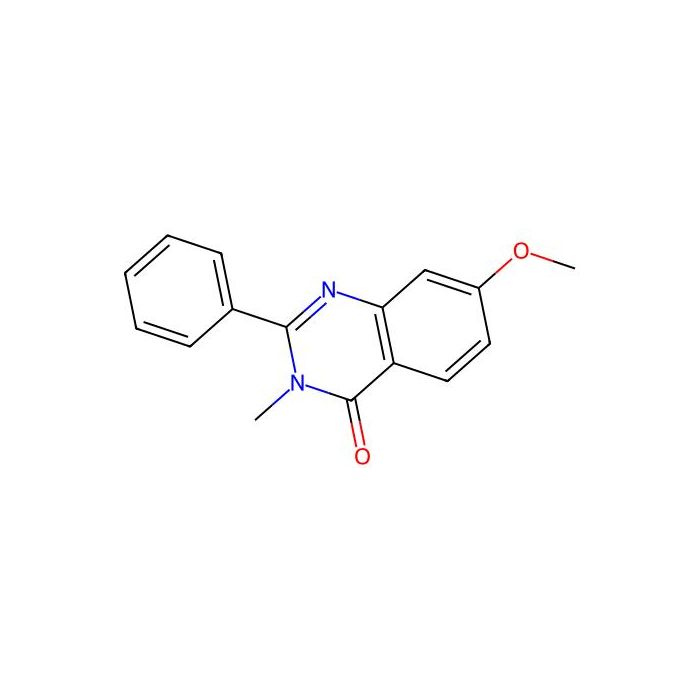
DK3 is a potent and selective estrogen-related receptor alpha (ERRα) agonist.
Form:Solid
Especificaciones
Especificaciones y pureza
≥98%
Mecanismos bioquímicos y fisiológicos
DK3 is a potent and selective estrogen-related receptor alpha (ERRα) agonist.
Condiciones de almacenamiento de almacenamiento
Store at -20°C
Enviado en
Ice chest + Ice pads
Este producto requiere envío en cadena de frío. Los servicios terrestres y otros servicios económicos no están disponibles.
Tipo de acción
AGONIST
Pureza
≥98%
Nombres e identificadores
Isómeros SMILES
CN1C(=NC2=C(C1=O)C=CC(=C2)OC)C3=CC=CC=C3
PubChem CID
44240656
Peso molecular
266.29
Datos avanzados
Certificados (CoA, COO, BSE/TSE y tabla de análisis)
C of A & Other Certificates(BSE/TSE, COO):
Analytical Chart:
Propiedades químicas y físicas
Solubilidad
DMSO : 12.5 mg/mL (46.94 mM; ultrasonic and warming and heat to 60°C)
Peso molecular
266.29
XLogP3
2.500
Hydrogen Bond Donor Count
0
Hydrogen Bond Acceptor Count
3
Rotatable Bond Count
2
Exact Mass
266.106 Da
Monoisotopic Mass
266.106 Da
Topological Polar Surface Area
41.900 Ų
Heavy Atom Count
20
Formal Charge
0
Complexity
401.000
Isotope Atom Count
0
Defined Atom Stereocenter Count
0
Undefined Atom Stereocenter Count
0
Defined Bond Stereocenter Count
0
Undefined Bond Stereocenter Count
0
The total count of all stereochemical bonds
0
Covalently-Bonded Unit Count
1
Calculadoras de soluciones
Molarity Calculator
Determine the necessary mass, volume, or concentration for preparing a solution.
Dilution Calculator
Determine the dilution needed to prepare a stock solution.
Reconstitution Calculator
Reseñas
Reseñas de cliente
Application Protocols
Item-specific validated application protocols are not provided for DK3.
General protocol guidance for small-molecule screening (not product-specific):
Stock preparation: Prepare 10 mM stock in anhydrous DMSO; vortex and sonicate briefly if needed. Confirm clarity and absence of precipitate after 15–30 minutes at room temperature.
Plate handling: Use low-bind polypropylene tubes/plates. Backfill DMSO to maintain constant final solvent across wells. Seal plates to minimize evaporation.
Dilution: Perform serial dilutions in assay buffer maintaining constant DMSO (≤0.5–1% v/v typical). Mix thoroughly, avoiding bubbles.
Controls: Include solvent-only controls and positive/negative reference controls appropriate to the assay.
Please adapt to your assay requirements and consult the CoA/SDS for any compound-specific constraints.
Biological Roles
Item-specific biological role/target information is not provided for DK3. Without target annotation or structure, mechanistic or pathway assignments cannot be made.
General considerations for small-molecule library members (not product-specific and not clinical):
Such compounds are screened to discover modulators of enzymes, receptors, transporters, or protein–protein interactions. Any proposed role must be validated experimentally (biochemical/biophysical assays, orthogonal readouts).
Post-screen, target deconvolution may involve affinity capture, thermal shift, chemoproteomics, or genetics to ascribe mechanism.
Please consult the CoA/Spec Sheet or contact technical support if target, scaffold class, or mechanism notes are available for this particular CAS (1187568-16-6).
Buffer Applications
This product is a small organic compound and is not a buffering reagent. No item-specific buffer capacity, pKa, or formulation role is provided.
Practical notes (general):
When using DK3 in biochemical assays, select a buffer system appropriate to your target (e.g., phosphate, HEPES, Tris) and verify that the final co-solvent level (e.g., DMSO ≤0.5–1% v/v) does not perturb pH or assay readouts.
If the compound is ionizable (unknown here), buffer pH may influence solubility and apparent activity; perform pH compatibility checks during method development.
Green Alternatives
Green chemistry considerations cannot be tailored to this item without structural and process context. Nevertheless, general guidance for handling small-molecule screening compounds is provided below.
Solvent choices (general greener direction):
Prefer water, ethanol, ethyl acetate, 2-MeTHF, CPME, or propylene carbonate when compatible with solubility and assay constraints. DMSO, while widely used, has favorable worker exposure characteristics but remains a petroleum-derived solvent.
Comparison snapshot (general, not product-specific):
DMSO vs 2-MeTHF: DMSO excels in polar solubility and assay compatibility; 2-MeTHF is more suitable for synthesis and extractions with improved environmental profile compared to THF.
Ethanol vs methanol: ethanol is generally less toxic and preferred where solubility allows.
Operational practices:
Minimize solvent volumes (microplate-based workflows), adopt sealed storage to reduce emissions, and use energy-efficient cooling for −20°C storage.
Consolidate shipments on cold packs to reduce packaging waste where possible.
For process-scale green optimization or substitution, structural information and usage details are needed.
Pharmaceutical Uses
No pharmacopeial status, excipient role, or formulation guidance is provided for DK3. This product is supplied strictly for research use only, not for human or veterinary use, clinical diagnostics, or as a drug substance/excipient.
General considerations for research-stage small molecules (not product-specific):
Early formulation for in vivo research typically explores cosolvent systems (e.g., PEG400/saline, Captisol, or DMSO/cremophor blends). Any such use requires compound-specific solubility, stability, and safety data, which are not provided here.
Please refer to the CoA/Spec Sheet for any available additional characterization; no medical or clinical claims are made or implied.
Physical Properties
Item-specific values:
Appearance: Not specified for this item; refer to CoA/Spec Sheet.
Molecular Weight: Not specified for this item; refer to CoA/Spec Sheet.
Molecular Formula: Not specified for this item; refer to CoA/Spec Sheet.
Melting/Boiling Point: Not specified for this item; refer to CoA/Spec Sheet.
Density, refractive index, pKa, logP/logD, UV cutoff: Not specified for this item; refer to CoA/Spec Sheet.
Solubility: Not specified for this item; refer to CoA/Spec Sheet.
Literature/general guidance for library compounds (not product-specific):
Many drug-like small molecules are routinely prepared as 10–50 mM DMSO stock solutions due to broad solubility and assay compatibility (literature practice).
For aqueous work, co-solvents such as DMSO (1–2%), ethanol, or minimal surfactant are commonly employed to aid dissolution (general guidance).
Practical notes (general, non-spec):
If the compound is a weak base/acid, solubility may improve by adjusting pH within assay-compatible limits; however, do not modify pH without knowing the compound’s stability profile.
Always verify solubility empirically on receipt; begin with small-scale trials (e.g., 1–5 mg) to establish a robust dissolution protocol.
Quality and Grades
Item-specific quality data:
Grade/Purity: Not specified for this item; refer to CoA/Spec Sheet.
How to interpret grades (general guidance):
Research grade indicates suitability for laboratory R&D; analytical data (e.g., HPLC/UPLC purity, NMR) typically supplied on the CoA. If you require a specific minimum purity, impurity profile, residual solvent limits, or elemental analysis, please request the current CoA/Spec Sheet for this lot.
Screening collection compounds are usually provided at high chemical purity (often ≥95% by HPLC, literature norm) to enable reproducible bioassay outcomes; however, exact thresholds vary by supplier and lot and must be verified in the CoA.
Stabilizers and form:
Stabilizer/antioxidant content: Not specified for this item; refer to CoA/Spec Sheet.
Salt form/solvate/hydrate state: Not specified for this item; refer to CoA/Spec Sheet.
What is specific to this listing:
Catalog category: small molecule/compound library member, intended for research screening and discovery workflows.
Storage requirement is specified at −20°C (see Storage & Reconstitution) to help maintain integrity over time.
Recommendations:
On receipt, document lot number and request CoA to confirm identity (CAS 1187568-16-6, CID 44240656) and purity method.
If using in quantitative studies (e.g., IC50 determination), consider in-house QC confirmation (HPLC assay, MS) before deployment.
Reaction and Applications
This product is offered as a defined small molecule for research screening/discovery. No item-specific reactivity or synthetic application data are provided.
Item-specific applications (from catalog): Not specified beyond inclusion in a small-molecule/compound library.
General note:
Without known functional groups or reactivity patterns (no SMILES/InChI available), recommending specific reactions (e.g., cross-coupling, condensations) would be speculative. If you intend to use DK3 as a synthetic intermediate, please request structural data and stability information from the CoA/Spec Sheet.
Practical laboratory applications (general for library members):
High-throughput screening (HTS) and hit validation.
Mechanistic probes in biochemical pathways after target deconvolution.
Reference material for analytical method development once structure is known.
For detailed reaction planning, obtain the compound’s structure and any available stability/reactivity notes prior to use.
Reaction Conditions
No item-specific reaction condition data are available for DK3. Without structural information, proposing temperatures, catalysts, or solvent systems would be speculative and not recommended.
General guidance (not product-specific):
For analytical sample preparation, dissolution in HPLC-grade solvents (acetonitrile, methanol, DMSO) is typical; filter through 0.22 µm prior to LC/GC as compatible.
If conducting stability studies, profile DK3 under a standardized panel (acidic, basic, oxidative, thermal, photolytic) to establish handling windows before any synthetic or assay use.
Please consult the CoA/Spec Sheet for any specific notes (e.g., sensitivity to moisture, light, or oxidants) if available.
Safety and Handling
Item-specific hazard data:
Signal Word: Not specified for this item; refer to SDS.
H-Statements: Not specified for this item; refer to SDS.
GHS Classification/Pictograms: Not specified for this item; refer to SDS.
General laboratory safety guidance (not product-specific; defer to SDS):
Handle all research chemicals in a fume hood with appropriate PPE: lab coat, nitrile gloves, and safety glasses. Escalate to chemical splash goggles and double-gloving if handling larger quantities or concentrated solutions.
Avoid inhalation, ingestion, and skin/eye contact. Prevent aerosol formation during weighing and solution preparation.
Incompatibilities are structure-dependent; in the absence of structural data, avoid strong oxidizers/reductants, strong acids/bases, and reactive metals. Segregate from foodstuffs and incompatible waste streams.
First aid (overview; consult SDS):
Skin/eye contact: Rinse with water for at least 15 minutes; remove contaminated clothing; seek medical attention if irritation persists.
Inhalation: Move to fresh air; monitor respiration; obtain medical attention if symptoms occur.
Ingestion: Rinse mouth; do not induce vomiting; seek medical attention.
Spill/leak response: Absorb with inert material, collect in chemically compatible container for disposal per institutional and regulatory requirements.
Waste disposal: Treat as hazardous organic waste unless otherwise characterized; follow local regulations.
Always consult the product-specific SDS for authoritative hazards, exposure limits, and response procedures.
Solvent Selection
Item-specific solubility data are not provided for DK3. The following are general best practices for small-molecule library members.
Primary solvent for stocks:
DMSO is the default choice for preparing assay stocks (e.g., 10–50 mM) due to its broad solvating power and compatibility with most biochemical and cell-based assays at ≤0.5–1% final v/v (general practice). Start at 10 mM and adjust as needed.
Alternative solvents/co-solvents (general):
DMF, ethanol, methanol for analytical sample prep or when DMSO is unsuitable.
Aqueous vehicles often require 1–2% DMSO or ethanol as a co-solvent; gentle heating (≤40°C) and sonication can assist dissolution if the compound is thermally stable.
Polarity/miscibility notes:
Without structural data, predicting polarity class and dielectric behavior is not feasible. Verify empirically by a small solvent panel (e.g., DMSO, MeOH, MeCN, EtOH, isopropanol, PBS + 1% DMSO).
Practical tips:
Filter stock solutions (0.22 µm PTFE for organic, 0.22 µm PES/nylon for aqueous-compatible) to remove particulates if compatible.
Avoid repeated freeze–thaw of DMSO solutions; aliquot to single-use vials.
Record exact solvent composition with each lot to ensure reproducibility across screening campaigns.
Storage and Reconstitution
Item-specific storage and shipping:
Storage Conditions: Store at −20°C (from Product Data).
General best practices for small-molecule library compounds (not product-specific):
Solid form (if received as solid; appearance not specified): Store tightly capped in a desiccated environment at −20°C, protected from light. Equilibrate to room temperature in a desiccator before opening to prevent moisture condensation.
Solution stocks: Prepare in anhydrous DMSO at a convenient concentration (e.g., 10–50 mM). Dispense into single-use aliquots (amber vials or plates) and store at −20°C to minimize freeze–thaw cycles. Record preparation date and solvent lot.
Thawing: Thaw on ice or at room temperature; mix thoroughly. Avoid repeated freeze–thaw; discard aliquots showing precipitation, discoloration, or degradation.
Stability: Not specified for this item; refer to CoA/Spec Sheet. If unknown, verify by LC/MS or HPLC after storage to ensure integrity.
Reconstitution solvent recommendation: Not specified for this item; DMSO is commonly used for small-molecule stocks as a general practice. Confirm compatibility with your assay system.
Disposal: Follow institutional and local regulations for organic chemical waste. For any uncertainty on stability or light/moisture sensitivity, consult the product’s CoA and SDS.
Structure and Identity
Brief overview: DK3 is listed in our small-molecule/compound library category. Structure-specific identifiers are largely not provided for this catalog entry; therefore, only the verified registry information is given below.
Item-specific (from Product Data):
Product Name: DK3 (SKU: D649772)
CAS: 1187568-16-6
PubChem CID: 44240656
InChIKey: Not specified for this item; refer to CoA/Spec Sheet.
SMILES: Not specified for this item; refer to CoA/Spec Sheet.
Molecular Formula: Not specified for this item; refer to CoA/Spec Sheet.
Molecular Weight: Not specified for this item; refer to CoA/Spec Sheet.
Structural features (general note):
Without a provided structure (SMILES/InChI), functional groups, ring systems, and stereochemistry cannot be detailed for this item.
2D structure description (general statement):
Not available for this item due to missing line notation; consult the product’s CoA/Spec Sheet or contact technical support for structural details if required for method development or cheminformatics ingestion.
Synthetic Utility
Item-specific synthetic reactivity and functional-group information are not available for DK3 due to missing structural data (SMILES/InChI not provided).
General note:
If DK3 is intended as a building block or intermediate, please obtain the full structural information to assess reactive handles (e.g., halides for cross-coupling, carbonyls for condensations, amines/acids for amide coupling). Stability to base/acid, redox conditions, and temperature must be confirmed prior to route design.
Recommendation:
Request the CoA/Spec Sheet and, if needed, a structure disclosure under CDA, to evaluate synthetic applicability and compatibility with your planned transformations.
Target Specificity
Item-specific target, pathway, or selectivity data are not provided for DK3.
No tested targets, binding constants, or selectivity panels are available in this listing.
If you possess prior screening data for CAS 1187568-16-6 or CID 44240656, we recommend confirming identity and purity (via CoA) to ensure data portability across lots.
For detailed target annotations, please contact technical support; if available, we can share any non-confidential mechanistic notes associated with this catalog number.
Utilizamos cookies para garantizar el correcto funcionamiento del sitio web y, cuando esté permitido, para mejorar su experiencia. Puede gestionar sus preferencias en cualquier momento en Configuración. Más información en nuestra Política de Cookies.
¿Quieres que te enviemos un mensaje cuando tengamos descuentos disponibles?
Recordármelo más tarde
¡Gracias! Por favor, revisa tu bandeja de entrada de correo electrónico para confirmar.
Products are supplied to verified businesses, institutions, and qualified professionals for research and development use only. Not for use in humans, animals, diagnosis, or therapy.