GRADE & PURITYMoligand™?Moligand™ — Aladdin's line of ligands and bioactive small molecules. Use for receptor, pathway, and binding studies needing defined small-molecule tools.10mM in DMSO
Moligand™, 10mM in DMSO Moligand™ for sensitive chromatographic and analytical workflows requiring minimal baseline interference.
🌡
Storage & shipping
Store at -80°C Ships Dry ice packs + Cold packs Check lot-specific COA for exact specifications.
📋
Quality documents
SDS, COA, datasheet, and spec sheet available for download. Lot-specific COA accessible via lot number lookup.
📚
Literature proof
Cited in 2 peer-reviewed publications across chromatography, organic synthesis, and cross-coupling reactions.
Descripción general
Information
Empagliflozin (BI-10773) is a potent and selectiveSGLT-2inhibitor withIC50of 3.1 nM, exhibits >300-fold selectivity over SGLT-1, 4, 5 and 6. Phase 3. In vitro
Empagliflozin shows >2500-fold selectivity for hSGLT-2 over hSGLT-1 (IC50 8300 nM) and >3500-fold selectivity over hSGLT-4, it exhibits >350-fold selectivity over hSGLT-5 (IC50=1100 nM) and >600-fold selectivity over hSGLT-6. No relevant inhibition of GLUT1 is observed up to 10 μM Empagliflozin. In a kinetic binding experiments, [3H]-empagliflozin displays a high affinity for SGLT-2 with a mean Kd of 57 nM in the absence of glucose, and shows a half-life of [3H]-empagliflozin-binding to SGLT-2 of 59 min in the absence of glucose.Its binding to SGLT-2 is competitive with glucose.
Empagliflozin (BI-10773) is a potent and selective SGLT-2 inhibitor with IC50 of 3.1 nM, exhibits >300-fold selectivity over SGLT-1, 4, 5 and 6. Phase 3.
Condiciones de almacenamiento de almacenamiento
Store at -80°C
Enviado en
Dry ice packs + Cold packs
Este producto requiere envío en cadena de frío. Los servicios terrestres y otros servicios económicos no están disponibles.
Determine the necessary mass, volume, or concentration for preparing a solution.
Dilution Calculator
Determine the dilution needed to prepare a stock solution.
Reconstitution Calculator
Reseñas
Reseñas de cliente
Application Protocols
No tested application protocols, assay conditions, or recommended dilutions are provided in the product data for this item.
General guidance (non-validated, for planning only):
Prepare a concentrated DMSO stock (e.g., 10–50 mM). Perform serial dilutions in DMSO, then dilute into assay buffer to reach final assay concentrations with ≤0.1–1% DMSO.
Include vehicle-only controls at the highest DMSO percentage used.
For transporter inhibition assays, preincubate cells or membrane preparations with ligand for an empirically determined period (e.g., minutes) before initiating uptake with a glucose analog; optimize temperature and sodium dependence per assay design.
For validated, item-specific protocols, consult the CoA/Spec Sheet or perform internal method development.
Biological Roles
Biochemical context (literature/general):
Empagliflozin is a high-affinity ligand for the sodium–glucose cotransporter family, with strong functional inhibition of SGLT2 (SLC5A2). It acts by occupying the glucose-binding/translocation site, reducing sodium-coupled glucose uptake across the apical membrane of renal proximal tubule cells in model systems.
Selectivity: Designed to favor SGLT2 over SGLT1; actual selectivity ratios depend on assay system and conditions. Users should verify potency/selectivity under their specific experimental parameters.
Mechanistic features: The C‑aryl glucoside and aryl ether/halogenated pharmacophore contribute to hydrophobic and hydrogen-bond interactions within the transporter. Neutral polyol character supports recognition by glucose-binding subsites while the aryl extension enhances affinity/selectivity.
Experimental uses:
Tool compound for target validation of SGLT2 in transporter assays (uptake of radiolabeled or fluorescent glucose analogs, electrophysiology, or sodium flux measurements).
Chemical probe for studying transporter trafficking, regulation, and compensatory glucose uptake pathways in renal epithelial models and heterologous expression systems.
Control ligand in proteomics/chemoproteomics when derivatized with linkers to create affinity matrices (requires additional synthesis; not supplied as such).
No clinical or therapeutic claims are made for this catalog item. It is provided strictly for research use only (product data).
Buffer Applications
This compound is not a buffering agent and does not define a useful acid/base pair for pH control. Therefore, it is not typically used to prepare buffers.
Practical notes for assay buffers (general guidance):
Prepare ligand stocks in DMSO, then dilute into physiologically relevant buffers (e.g., HEPES, PBS) while maintaining consistent final DMSO content across controls and treated samples.
Consider inclusion of 0.01–0.05% nonionic surfactant (e.g., Tween 20) to mitigate adsorption and precipitation if compatible with the assay.
Filter buffers (0.2 µm) and pre-warm to assay temperature to minimize precipitation upon dosing of hydrophobic ligands.
Item-specific buffering specifications are not applicable.
Green Alternatives
As a solid small-molecule ligand used at micromolar concentrations, the main greenness lever is solvent selection and sample handling rather than replacing the compound itself.
Greener solvent strategies (general guidance):
Minimize DMSO volume while maintaining solubility; typical final assay DMSO ≤0.1–0.5% v/v when feasible.
Consider bio-based co-solvents for preparative steps where biology compatibility is not a constraint (e.g., 2‑propanol from bio-acetone, Cyrene in method development), recognizing that DMSO remains the most reliable for high-concentration stocks.
Use aqueous buffers with mild nonionic surfactants to reduce organic content if compatible with assay readouts.
Comparison (qualitative, general):
DMSO: High solvency, low volatility; widely accepted in HTS. Environmental profile is moderate; disposal stream management required.
Ethanol (bio-derived): Renewable source; higher volatility may increase emissions and plate-to-plate variability.
2-MeTHF/Cyrene: Greener for synthetic operations but rarely suitable for biological assays due to immiscibility or toxicity at relevant percentages.
Operational sustainability:
Consolidate plate layouts to reduce dead volume; use acoustic dispensing to minimize waste of concentrated DMSO stocks.
Store aliquots to avoid repeated freeze–thaw, reducing compound degradation and waste.
Note: No item-specific environmental metrics are provided; recommendations are general best practices for small-molecule screening.
Pharmaceutical Uses
No excipient or formulation-grade specifications are provided for this catalog item. It is supplied as a research-grade small-molecule ligand.
Intended use: For research use only (product data). Not for human or veterinary use, nor for diagnostic procedures.
Typical laboratory roles (general):
Reference standard for analytical method development and validation (e.g., LC–MS) in research settings.
Positive control compound in transporter inhibition assays and related in vitro models.
Regulatory/pharmacopeial status: Not specified for this item; refer to CoA/Spec Sheet if a reference standard grade is required.
Users engaging in regulated pharmaceutical workflows should source compendial reference standards where required and verify identity/purity against appropriate acceptance criteria (system suitability, relative response factors, stability-indicating methods).
Physical Properties
Item-specific specifications are not provided in the product data for this catalog entry. The following notes summarize literature-level expectations for the free base; confirm with CoA/Spec Sheet for this item.
Appearance: Not specified for this item; refer to CoA/Spec Sheet.
Molecular weight: ~450.91 g/mol (literature)
Molecular formula: C23H27ClO7 (literature)
Melting point: Not specified for this item; refer to CoA/Spec Sheet.
Boiling point: Not applicable for a high-melting, multi-functional solid; decomposition often precedes boiling under ambient pressure (literature, general).
Density: Not specified for this item; refer to CoA/Spec Sheet.
LogP/logD: Drug-like amphiphile; reported to be moderately lipophilic (literature, qualitative; exact values not specified here).
pKa: No strongly ionizable groups in the physiological range; behaves as a neutral polyol (literature, general).
Solubility (qualitative, literature):
Soluble in polar aprotic organic solvents such as DMSO; frequently prepared as concentrated DMSO stocks for screening.
Limited aqueous solubility at neutral pH; aqueous working solutions typically require DMSO cosolvent.
Miscible with ethanol/methanol to useful extents for intermediate stock preparation.
UV-Vis: Aromatic chromophore present; absorbs in the UV region typical of aryl ethers/phenyl chlorides (literature, qualitative; numeric cutoffs not provided).
Always consult the item’s CoA/SDS for definitive, lot-specific physical data and handling limits.
Quality and Grades
Grade: Moligand™ (product data)
What Moligand™ generally implies (general guidance):
Positioned for discovery screening and chemical biology: small-molecule ligands appropriate for in vitro assay development, target validation, and SAR benchmarking.
Emphasis on identity confirmation (e.g., NMR/MS) and high chemical purity to minimize assay interference. Exact purity, residual solvent content, and trace metal analyses are lot-specific and not stated here.
Item-specific notes:
Purity: Not specified for this item; refer to CoA/Spec Sheet.
Stabilizers/inhibitors: Not specified for this item; refer to CoA/Spec Sheet.
Impurity profile (water, peroxides, metals, UV cutoff): Not specified for this item; refer to CoA/Spec Sheet.
Practical implications for users:
For biochemical and cell-based screening, prepare concentrated DMSO stocks (e.g., 10–50 mM) using anhydrous solvent and sterile technique to maintain consistency across replicates.
Verify identity and purity locally when required (e.g., LC–MS, qNMR) prior to regulated studies or analytical method qualification.
If low-aqueous-solubility limits assay windows, consider co-solvent strategies and plate-management practices (minimize freeze–thaw, control DMSO final %).
Documentation:
For lot-specific specifications, analytical data, and recommended handling, consult the Certificate of Analysis (CoA) and Specification Sheet supplied with the product.
Reaction and Applications
This item is supplied as a finished small-molecule ligand rather than a synthetic reagent. Consequently, it is not typically used as a coupling partner, catalyst, or solvent. Its primary laboratory applications are in chemical biology and analytical workflows.
Research applications (general/literature):
Reference standard: Benchmark compound for the sodium–glucose cotransporter 2 (SGLT2/SLC5A2) target family in transporter assays, binding studies, and method development.
Positive control in cellular uptake/functional inhibition assays assessing sodium-dependent glucose transport.
Comparative SAR: Scaffold for evaluating C‑aryl glycoside motifs and transporter-binding pharmacophores.
Analytical: Calibration standard in LC–MS method validation (retention time and response factor establishment) and stability-indicating methods.
Polyol functionality enables selective protection and tethering (e.g., carbonate/carbamate/ether linkages) to create probes (biotinylated, fluorescent) or immobilized ligands for pull-downs.
Aryl region offers handles for late-stage diversification through electrophilic aromatic substitution, cross-coupling on appropriately functionalized analogs, or O‑demethylation/etherification if present in a given analog. Note: These are general scaffold strategies; the supplied item is not prefunctionalized for coupling.
Assay considerations:
Ensure consistent DMSO content across wells; include vehicle controls.
Validate time-dependence and reversibility in transporter systems; equilibrium may require preincubation depending on the assay format.
Reaction Conditions
This product is primarily used as a finished ligand rather than a substrate/reagent. The following general laboratory practices relate to stock preparation and optional derivatization for probe creation.
Stock preparation (general guidance):
Solvent: Anhydrous DMSO.
Concentration: Commonly 10–50 mM depending on solubility and assay needs.
Temperature: Dissolve at ambient temperature; brief warming (≤40 °C) and sonication can assist dissolution.
Filtration: 0.2 µm PTFE syringe filter if particulates are present.
Working solutions: Dilute into buffer to desired concentration, maintaining consistent final DMSO percentage (typically ≤0.1–1% v/v according to assay tolerance).
Carbonate formation: React a selected secondary alcohol with a chloroformate (e.g., p‑nitrophenyl chloroformate) under mild base (pyridine, DMAP) at 0–25 °C to introduce a handle for further coupling. Monitor to avoid over‑functionalization; employ protecting groups for selectivity.
Etherification: Mitsunobu coupling for inversion-sensitive positions can be considered, but multiple alcohols necessitate protecting-group control; milder Williamson conditions after selective protection are often preferred.
Stability: Avoid strong mineral acids/bases and high temperatures that may compromise the aryl ether or induce elimination on protected polyols.
Yields and exact conditions are substrate- and route-dependent and should be optimized empirically; no item-specific reaction data are claimed here.
Safety and Handling
GHS classification, signal word, pictograms, and H-statements: Not specified for this item; refer to SDS.
General hazards (literature/general): Empagliflozin is a low-volatility organic solid. Avoid inhalation of dust, ingestion, and skin/eye contact. Handle in a chemical fume hood.
PPE: Lab coat, nitrile gloves, and safety goggles as a minimum. Use respiratory protection if dust/aerosols may be generated and engineering controls are insufficient.
Storage conditions: Store at −80 °C (product data). Keep tightly closed, desiccated, and protected from light. Warm to room temperature before opening to minimize condensation.
Incompatibilities (general): Strong oxidizers; strong acids/bases may promote degradation of glycosidic polyols and aryl ether linkages under forcing conditions.
Spill/accidental release: Avoid dust formation. Sweep up solids with minimal agitation; collect in appropriate waste. Decontaminate with ethanol or isopropanol followed by detergent/water, observing solvent compatibility and waste regulations.
First aid overview (general):
Inhalation: Move to fresh air; seek medical attention if symptoms persist.
Skin: Wash with soap and water; remove contaminated clothing.
Eyes: Rinse cautiously with water for several minutes; remove contact lenses if present and easy.
Ingestion: Rinse mouth; seek medical advice.
Waste: Dispose of as organic laboratory waste according to institutional and regulatory requirements.
Definitive hazard classification and exposure limits are provided only in the SDS for this catalog item; always consult the SDS before use.
Solvent Selection
Empagliflozin is a neutral, polyhydroxylated, moderately lipophilic solid. Selection focuses on preparing stable stocks and achieving target assay concentrations without precipitation.
Polarity/miscibility (literature/general):
Highly soluble in DMSO; DMSO is the default solvent for screening stocks due to strong solvation of both aryl and polyol regions.
Soluble in other polar organics (DMF, NMP); soluble to moderately soluble in lower alcohols (MeOH, EtOH).
Sparingly soluble in water at neutral pH; aqueous dosing requires DMSO cosolvent.
Typical strategies:
Prepare a 10–50 mM DMSO stock. Dilute into assay buffer to a final DMSO content typically ≤0.1–1% v/v (check assay tolerance).
For higher aqueous concentrations, warm gently (≤40 °C) and sonicate briefly; avoid prolonged heating.
Use surfactant-containing buffers (e.g., 0.01–0.05% Tween 20) if compatible with the assay to maintain dispersion; validate to rule out artifacts.
Comparison (general):
DMSO: Best balance of solubility and biological compatibility at low %.
Ethanol/MeOH: Useful for intermediate stocks but may be less tolerated biologically; volatilization complicates plate handling.
PEG 400/propylene glycol: Can enhance solubility for ex vivo/biophysical setups; viscosity may hinder pipetting at small volumes.
Quality tips:
Filter 0.2 µm if particulate persists (ensure no adsorption losses). Use amber vials to limit photodegradation of aromatic motifs.
Storage and Reconstitution
Storage temperature: Store at −80 °C (product data).
Container: Keep tightly sealed in original amber vial; protect from moisture and light. Allow vial to equilibrate to room temperature in a desiccator before opening to avoid condensation.
Reconstitution (general guidance):
Solvent: DMSO recommended for initial stock solutions owing to superior solvency for neutral, polyhydroxylated aromatics.
Typical stock: 10–50 mM, prepared with anhydrous DMSO. Vortex and, if needed, briefly sonicate. Avoid prolonged heating.
Aliquoting: Dispense single-use aliquots (e.g., 10–50 µL) into low-bind, amber microvials or plates to minimize adsorption and freeze–thaw cycles.
Storage of solutions: −20 to −80 °C for DMSO stocks; verify stability empirically. Protect from light. Thaw on ice and mix gently before use. Discard if precipitation, discoloration, or LC–MS shows degradation.
Specifications not provided in product data:
Appearance, water content, residual solvents, and stabilizers: Not specified for this item; refer to CoA/Spec Sheet.
Always consult the SDS for safe handling during storage and reconstitution. Use this material for research purposes only (product data).
Structure and Identity
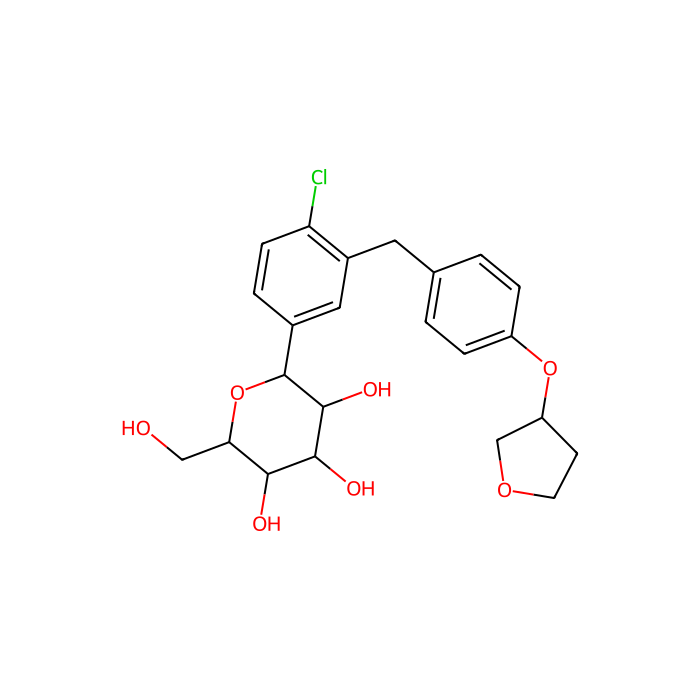
Empagliflozin (BI 10773) is a small-molecule C‑aryl glycoside designed to engage a membrane transporter binding site.
SKU: E409159
CAS: 864070-44-0 (product data)
PubChem CID: 11949646 (product data)
Grade: Moligand™ (product data)
InChIKey: Not specified for this item; refer to CoA/Spec Sheet.
SMILES: Not specified for this item; refer to CoA/Spec Sheet.
Molecular formula: C23H27ClO7 (literature)
Molecular weight: ~450.91 g/mol (literature)
Structural features (descriptive, literature):
Contains a β-glycosidic scaffold in which the anomeric position is C‑aryl substituted (C–C bond to an aryl ring), yielding a metabolically stable “C‑glucoside.”
Aromatic region comprises a chlorophenyl ring further substituted with a secondary aryl/heteroaryl ether motif; overall, the core is polyfunctional with multiple alcohols (polyol from the sugar) and one chloro substituent.
Stereochemistry: multiple defined stereocenters on the sugar ring (gluco-configured), typically leading to a single, well-defined stereochemical array.
2D description in words: a six-membered glucopyranosyl ring (chair conformation) bearing four hydroxyls and a C‑1 aryl substituent; the aryl moiety is para‑chloro substituted and linked to an additional aryl ether fragment, giving a rigid, extended, amphiphilic topology suitable for binding in a transmembrane pocket.
Notes:
Identifiers not explicitly listed in the product data are provided as literature descriptions for user convenience and should be confirmed against the item’s CoA/Spec Sheet for regulated use.
Synthetic Utility
As supplied, this is a final, polyfunctional, stereochemically defined small molecule. It is not commonly used as a synthetic reagent. Nevertheless, chemists may leverage its functionality for probe construction and SAR exploration.
Functional group landscape (chemistry perspective):
Multiple secondary alcohols on a glucopyranosyl ring enable selective protection (silyl, benzyl, acyl) and derivatization (carbonate, carbamate, ether formation) to add linkers or reporter groups.
Aryl chloride and aryl ether motifs provide opportunities for late-stage edits on analogs (e.g., cross-coupling if halogen position is accessible in a designed intermediate; electrophilic aromatic substitution where deactivation permits).
The C‑aryl glycosidic bond is robust to hydrolysis, supporting manipulations that would cleave O‑glycosides.
Utility scenarios (general):
Synthesis of affinity probes: Convert one hydroxyl to a carbonate tether bearing biotin/fluorophore/azide for pull-down, imaging, or click-chemistry applications.
Immobilization: Attach via a spacer to solid supports (e.g., NHS-activated agarose) through a suitably derivatized alcohol.
Metabolite analogs: Isotopic labeling or minor modifications to explore transporter binding determinants.
Caveats:
Protect group strategy must preserve transporter-binding pharmacophore; derivatization can markedly change affinity/selectivity.
Reaction conditions should avoid strong acids/bases or oxidants that may degrade polyol/aryl ether functionalities.
Target Specificity
Item-specific target validation data (e.g., measured potency, selectivity profile, assay format) are not provided in the product data for this catalog entry.
From general literature: Empagliflozin is widely used as a selective ligand/inhibitor for SGLT2 (SLC5A2) over SGLT1, but quantitative parameters depend on assay conditions and expression systems.
For this catalog item, please refer to the CoA/Spec Sheet for any available in-house target assessment. Absent such data, users should determine activity and selectivity in their specific assay context.
We use cookies to ensure the website functions properly and, where permitted, to improve your experience. You can manage your preferences at any time in Settings. Learn more in our Cookie Policy.
Shall we send you a message when we have discounts available?
Remind me later
Thank you! Please check your email inbox to confirm.
Products are supplied to verified businesses, institutions, and qualified professionals for research and development use only. Not for use in humans, animals, diagnosis, or therapy.

 L2201032