≥99% for sensitive chromatographic and analytical workflows requiring minimal baseline interference.
🌡
Storage & shipping
Store at 2-8°C Ships Wet ice Check lot-specific COA for exact specifications.
📋
Quality documents
SDS, COA, datasheet, and spec sheet available for download. Lot-specific COA accessible via lot number lookup.
📚
Literature proof
Cited in 0 peer-reviewed publications across chromatography, organic synthesis, and cross-coupling reactions.
Descripción general
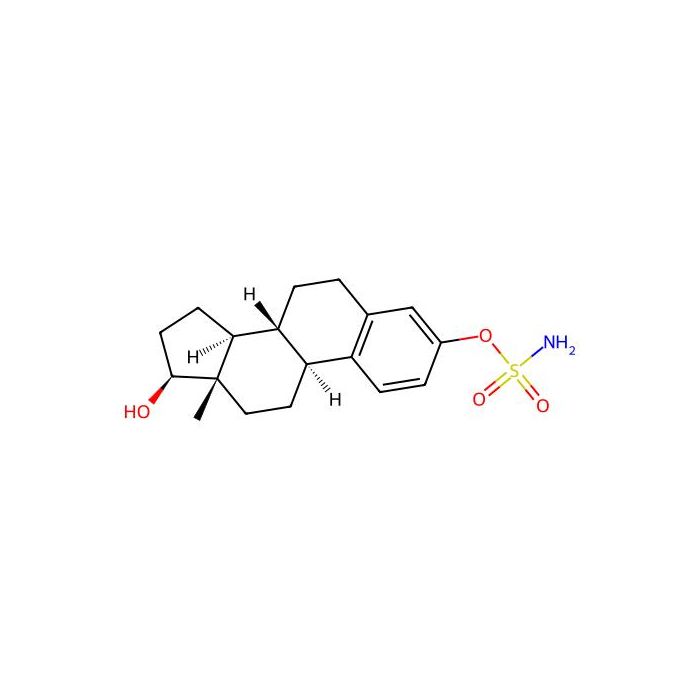
Estradiol 3-sulfamate (BLE 00084; E2MATE; ES-J 995) is a long-acting and orally active steroid sulfatase inhibitor; inhibits estrone sulfatase with an IC50 of 251 nM and a Ki of 133 nM.
Specifications
Especificaciones y pureza
≥99%
Condiciones de almacenamiento de almacenamiento
Store at 2-8°C
Enviado en
Wet ice
Este producto requiere envío en cadena de frío. Los servicios terrestres y otros servicios económicos no están disponibles.
This compound belongs to the class of organic compounds known as estrane steroids. These are steroids with a structure based on the estrane skeleton.
External Descriptors
Not available
1. Djoumbou Feunang Y, Eisner R, Knox C, Chepelev L, Hastings J, Owen G, Fahy E, Steinbeck C, Subramanian S, Bolton E, Greiner R, and Wishart DS. ClassyFire: Automated Chemical Classification With A Comprehensive, Computable Taxonomy. Journal of Cheminformatics, 2016, 8:61.
Certificados (CoA, COO, BSE/TSE y tabla de análisis)
C of A & Other Certificates(BSE/TSE, COO):
Analytical Chart:
Propiedades químicas y físicas
Peso molecular
351.500 g/mol
XLogP3
1.900
Hydrogen Bond Donor Count
2
Hydrogen Bond Acceptor Count
5
Rotatable Bond Count
2
Exact Mass
351.15 Da
Monoisotopic Mass
351.15 Da
Topological Polar Surface Area
98.000 Ų
Heavy Atom Count
24
Formal Charge
0
Complexity
588.000
Isotope Atom Count
0
Defined Atom Stereocenter Count
5
Undefined Atom Stereocenter Count
0
Defined Bond Stereocenter Count
0
Undefined Bond Stereocenter Count
0
The total count of all stereochemical bonds
0
Covalently-Bonded Unit Count
1
Calculadoras de soluciones
Molarity Calculator
Determine the necessary mass, volume, or concentration for preparing a solution.
Dilution Calculator
Determine the dilution needed to prepare a stock solution.
Reconstitution Calculator
Reseñas
Reseñas de cliente
Application Protocols
No manufacturer-tested bioassay protocols are provided for this SKU.
General guidance (for research use only):
Stock solution: dissolve in anhydrous DMSO (e.g., 10–100 mM). Filter-sterilize if sterility is required for cell-free assays.
Dilution: add stock slowly into vigorously stirred or vortexed buffer to reach desired concentration, keeping final DMSO ≤1–2% v/v unless your system tolerates more.
Controls: include vehicle controls matching the highest DMSO level used. Assess compound solubility visually and by LC–MS/UV where possible.
Storage of working solutions: keep on ice during use; discard if precipitation or discoloration occurs.
For synthetic applications, follow standard organic synthesis work practices; see Reaction Conditions for representative conditions. Always consult the SDS and CoA for lot-specific handling and quality information.
Biological Roles
Note: The following is general biochemical context and not a statement of therapeutic use.
Context (literature):
Estradiol 3-sulfamate is a modified estrogen where the phenolic 3-hydroxyl is converted to a sulfamate. This substitution markedly alters interaction with steroid-metabolizing enzymes, particularly steroid sulfatase (STS), which normally hydrolyzes aryl sulfates. Sulfamate esters of phenols are widely used as probes/inhibitors in STS research.
Receptor interactions: conversion of the 3-OH to a sulfamate reduces direct phenolic hydrogen bonding typical of native estradiol to estrogen receptors; any binding/activity profile is assay- and substitution-dependent and distinct from estradiol. Researchers use such derivatives to decouple receptor-mediated signaling from metabolic processing in vitro.
Metabolic stability: sulfamate moieties can modify phase II metabolism pathways (e.g., glucuronidation/sulfation of the phenolic site is blocked), thereby changing distribution and clearance in model systems (no clinical claims implied).
Comparative role to sulfates: endogenous estradiol-3-sulfate is a storage/transport form processed by STS; the sulfamate is a non-natural analogue used to interrogate the same enzyme pathways with altered reactivity.
Use cases in the lab:
As a tool compound to study enzyme specificity, catalytic mechanism, and inhibitor design for sulfatases.
As a reference standard in analytical methods aimed at profiling sulfamate-containing steroid analogues by LC–MS/MS.
Buffer Applications
This item is a hydrophobic small-molecule steroidal derivative, not a buffering agent. It does not serve as a pH buffer or buffer component in the conventional sense.
Practical note for assay buffers:
When using in biochemical assays, dissolve first in DMSO and add to the aqueous buffer with robust mixing; maintain final DMSO content at low percentages consistent with your assay tolerance. Include vehicle controls.
If precipitation occurs, increase surfactant (e.g., low % Tween-20) or adjust cosolvent within assay-validated limits. These are general practices, not item-specific specifications.
Green Alternatives
Green chemistry perspective for handling and dissolving estradiol 3-sulfamate focuses on solvent and process choices rather than on the compound itself.
Greener solvent options (context-specific):
Ethanol or isopropanol: renewable, low-toxicity options for low-concentration solutions, though solubility may limit concentration relative to DMSO/DMF.
2-Methyltetrahydrofuran (2-MeTHF): a bio-based ether that can sometimes dissolve steroidal compounds for synthetic work; verify solubility experimentally.
Ethyl acetate: comparatively benign for workups and extractions.
Comparison (general; select based on task):
DMSO vs Ethanol: DMSO maximizes solubility and assay compatibility; ethanol is greener but may not reach needed stock concentrations and can perturb biological assays at lower percentages.
DMF/NMP vs 2-MeTHF/EtOAc: DMF/NMP offer superior polarity but are reproductive toxins/CMR; where feasible, use 2-MeTHF or EtOAc for extractions/recrystallizations and reserve DMF/NMP for indispensable steps.
Process considerations:
Minimize DMSO volumes by preparing higher-concentration master stocks and aliquoting to reduce waste.
Use closed-vessel dissolution with mild warming to accelerate solubilization in greener alcohols, avoiding reflux.
Apply microscale screening (mini-solubility panels) to identify the least hazardous solvent meeting performance needs.
Waste and exposure reduction:
Collect steroidal waste separately; avoid drain disposal. Use syringe filters to rescue undissolved solids and reduce repeat dissolutions.
Pharmaceutical Uses
This product is supplied strictly for research use only.
Context (general, non-clinical):
Estradiol 3-sulfamate is a functionalized steroid used in discovery research as a tool compound and analytical reference. It is not a typical pharmaceutical excipient and is not provided under pharmacopeial monographs.
In formulation research settings, it may be dissolved in DMSO or appropriate organic solvents to create dosing solutions for in vitro assays, permeability studies, and enzyme kinetics. Any in vivo or clinical use is outside the scope of this catalog item and is not endorsed.
Regulatory note:
No medical or therapeutic claims are made. For any regulated application, users must establish suitability, purity, and stability independently and consult relevant regulations.
Physical Properties
Item-specific specifications (this SKU):
Appearance: Not specified for this item; refer to CoA/Spec Sheet.
Molecular weight: Not specified for this item; refer to CoA/Spec Sheet.
Other specifications (mp, bp, density, water/peroxide/metals, UV cutoff): Not specified for this item; refer to CoA/Spec Sheet.
General/literature characteristics for estradiol 3-sulfamate (informational, not item specifications):
Physical state: typically a solid steroidal sulfamate ester.
Polarity/solubility: sparingly soluble in water; commonly soluble in polar organic solvents such as DMSO and DMF; limited solubility in lower alcohols and moderately nonpolar solvents may be observed depending on crystal form.
Partitioning: expected to be lipophilic due to the steroid core, with increased polarity vs estradiol from the sulfamate group (logP higher than many drug-like molecules but lower than estradiol diesters; exact value varies by source).
Melting behavior: many steroid sulfamates exhibit sharp melting points; reported values in the literature can vary with solvate and polymorph. Verify for this item via CoA.
Spectral features: strong S=O stretches in IR (~1350–1380 and ~1150–1200 cm⁻1, literature); phenolic O–S bond signals and characteristic steroidal C–H and O–H features.
Practical notes:
Prepare concentrated stocks in anhydrous DMSO for biochemical work; dilute into assay buffer with vigorous mixing to avoid precipitation (general practice).
If exact solubility or mp is critical, obtain the lot-specific certificate as Aladdin does not list these specs for this SKU.
Quality and Grades
Item-specific quality information for SKU E768925:
Grade/purity: Not specified for this item; refer to CoA/Spec Sheet.
Guidance on interpreting grades (general):
Research grade indicates suitability for exploratory synthesis, screening, and mechanistic studies. When HPLC or LC–MS trace impurity profiles are needed, consult the CoA for chromatographic purity and impurity thresholds.
If “Analytical” or “HPLC” grades are provided on a variant of this product, they typically imply tighter limits on non-volatile residue and UV-absorbing impurities to minimize baseline drift in chromatographic assays.
Stabilizers: Not indicated for this SKU. Estradiol 3-sulfamate generally does not require added stabilizers if stored properly; absence or presence of stabilizers should always be verified on the CoA.
What to check on the Aladdin CoA before critical work:
Lot-specific purity method (e.g., HPLC area%, qNMR, or titration) and reference conditions.
Identity confirmation (IR/NMR/MS) and acceptance criteria.
Residual solvents and water (Karl Fischer) if moisture sensitivity or mass balance is important.
Any specified polymorph/solvate form, as steroidal materials can exhibit polymorphism affecting solubility and melting point.
Reaction and Applications
Focus: This compound is most often used as a biochemical tool compound and reference material in research on steroid metabolism and sulfatase pathways, and as a functionalized steroid for further chemical modification.
Applications in research (general/literature):
Steroid sulfatase studies: 3-sulfamate substitution on a phenolic steroid is commonly employed to probe steroid sulfatase (STS) binding and catalysis in vitro. Estradiol 3-sulfamate can serve as a comparator to related sulfamates (e.g., estrone 3-sulfamate) in enzyme kinetics and structure–activity work.
Prodrug concept evaluation: sulfamate esters are used in medicinal chemistry as masked phenols; enzymatic or chemical lability can be evaluated across pH and biological matrices. Use this compound to benchmark hydrolytic stability versus alternative 3-ethers/esters (literature context; no clinical claims).
Derivatization handle: retains the 17β-hydroxyl for selective acylation/etherification; the sulfamate itself can be modified at nitrogen (N-alkylation) to vary physicochemical properties.
Practical tips:
Maintain anhydrous conditions during manipulations intended to preserve the sulfamate; avoid strong base which can cleave the O–S bond.
For enzyme assays, pre-dissolve in DMSO; add slowly to buffered media with vigorous mixing to minimize precipitation. Include vehicle controls for DMSO effects.
Monitor transformations by LC–MS: diagnostic S=O stretches in IR and neutral loss patterns in MS/MS (e.g., loss of SO2 or NH3 fragments are often observed in sulfamate-containing molecules, literature).
Related chemistry:
Compare activity and stability against aryl sulfates and carbamates to delineate electronic effects of the 3-substituent in steroidal frameworks.
Reaction Conditions
General literature conditions for preparing estradiol 3-sulfamate (for reference only; not product specifications):
Sulfamoylation reagents: sulfamoyl chloride (H2NSO2Cl) or related sulfamoyl transfer reagents.
Base: tertiary amines (e.g., pyridine, triethylamine) or DMAP as catalyst; conditions tuned to minimize overreaction at 17β-OH.
Solvent: anhydrous dichloromethane, THF, or DMF are commonly used.
Temperature: 0 °C to room temperature; cooling during addition helps control exotherm and selectivity for the 3-phenolic OH.
Workup: aqueous quench, extraction into organic phase, and purification by column chromatography or recrystallization.
Stability considerations:
The O–sulfamate linkage is generally stable under neutral and mildly acidic conditions. Strong base (e.g., alkoxides) can induce cleavage; strong acids may lead to hydrolysis or rearrangement—validate conditions case by case.
Downstream modifications:
17β-esterification: DMAP-catalyzed acylation in CH2Cl2 or pyridine at 0–25 °C affords 17-esters while preserving the 3-sulfamate.
N-alkylation: mild base (e.g., NaH or K2CO3) in DMF with alkyl halides at 0–25 °C can introduce N-substituents on the sulfamate nitrogen; monitor to avoid O-alkylation or elimination.
Analytical controls:
LC–MS to verify mass gain consistent with sulfamate installation.
IR (S=O stretches) and disappearance of phenolic OH in 1H NMR confirm conversion.
Expected yields: vary widely with reagent and protection strategy; optimize stoichiometry and temperature for selectivity.
Safety and Handling
Authoritative safety data must be taken from the product SDS.
Item-specific hazard information:
Signal word: Not specified for this item; refer to SDS.
H-statements: Not specified for this item; refer to SDS.
GHS classification: Not specified for this item; refer to SDS.
GHS pictograms: Not specified for this item; refer to SDS.
General safety considerations for steroidal sulfamate esters (informational, not item specifications):
Likely hazards: may cause skin/eye irritation and respiratory irritation as fine particulate; avoid dust formation and inhalation. Handle with appropriate containment when weighing.
PPE: lab coat, safety glasses, and suitable gloves (e.g., nitrile). Use in a fume hood. Wash thoroughly after handling.
Incompatibilities: strong oxidizers and strong bases can degrade sulfamate esters; avoid prolonged exposure to moisture and elevated temperature.
First aid overview: on skin/eye contact, rinse with water for several minutes; remove contaminated clothing. If inhaled, move to fresh air. If ingested, rinse mouth; seek medical attention. Always follow SDS instructions.
Environmental care: prevent release to drains; collect spills with inert absorbent and dispose per institutional and local regulations.
Special risks/practices:
Dust control: steroidal powders can become airborne; use antistatic tools and closed containers.
Solution stability: sulfamate esters are generally stable in neutral/aprotic media; hydrolysis can occur under strongly basic or strongly acidic aqueous conditions—prepare fresh working solutions as needed.
Solvent Selection
Compound class and polarity considerations:
Estradiol 3-sulfamate is a lipophilic steroidal scaffold bearing a polar sulfamate ester and a secondary alcohol. It is overall poorly water-soluble but dissolves in polar aprotic organics.
Practical solvent guidance (general/literature):
Good solvents for stocks: DMSO (anhydrous), DMF, NMP. These offer high solvating power for steroidal cores and hydrogen-bonding capacity for the sulfamate.
Moderately suitable: acetone, acetonitrile, ethyl acetate, methanol, ethanol; solubility may be limited—sonication or gentle warming can help.
Poor: alkanes and aqueous buffers without cosolvent.
Dielectric/miscibility notes (context):
DMSO (ε ~47, miscible with water) is preferred for making concentrated freezer-stable stocks then diluting into assay media.
DMF/NMP offer similar performance but with higher volatility/tox concerns (DMF) or viscosity (NMP). Choose based on downstream compatibility.
Selection scenarios:
Enzymology/biochemical assays: prepare 10–100 mM stocks in DMSO; keep final DMSO ≤1–2% v/v in assay buffer to avoid enzyme inhibition by solvent (general best practice).
Synthetic manipulations: for further derivatization, use dry polar aprotics (CH2Cl2, THF, DMF) under inert atmosphere as needed.
Small comparison (general):
DMSO: maximal solubility and aqueous miscibility; higher boiling point eases handling.
Ethanol/MeOH: greener but often lower solubility; may hydrogen-bond competitively in assays.
Acetonitrile: cleaner evaporation; solubility variable; limited water miscibility impact on precipitation during dilution.
Storage and Reconstitution
Item-specific storage and shipping (from Product Data):
Storage Conditions: Store at 2–8 °C.
Shipped In: Wet ice.
General handling and reconstitution (research use only):
Solid material: keep container tightly closed, protected from light and moisture. Allow vial to equilibrate to room temperature in a desiccator before opening to prevent moisture condensation.
Stock solutions: prepare concentrated stocks in anhydrous DMSO under inert gas if possible. Dispense single-use aliquots in amber vials or microtubes to minimize freeze–thaw and light exposure.
Short-term stability: DMSO stocks are typically stable for weeks at −20 °C; verify by LC–MS/HPLC before critical experiments (general guidance, not a specification).
Aqueous media: avoid prolonged storage in aqueous buffers; prepare fresh working solutions immediately before use to limit hydrolysis of the sulfamate under extreme pH.
Specifically not provided for this item:
Exact shelf life, assay purity over time, and solution stability windows: Not specified for this item; refer to CoA/Spec Sheet.
Disposal:
Dispose of unused material, solutions, and contaminated consumables as hazardous chemical waste in accordance with institutional and local regulations.
Structure and Identity
Brief overview: Estradiol 3-sulfamate is a sulfamate ester of the steroidal estrogen estradiol, bearing a –OSO2NH2 group at the phenolic 3-position of the A-ring.
Item-specific (from Product Data):
CAS: 172377-52-5
PubChem CID: 6918339
InChIKey: 449872 (as provided)
SMILES: Not specified for this item; refer to CoA/Spec Sheet.
Molecular formula: Not specified for this item; refer to CoA/Spec Sheet.
Molecular weight: Not specified for this item; refer to CoA/Spec Sheet.
Structural features (general/steroid chemistry knowledge):
Core scaffold: tetracyclic cyclopenta[a]phenanthrene steroid nucleus (three fused cyclohexane rings and one cyclopentane ring).
Functional groups: phenolic oxygen at C3 converted to a sulfamate ester (–O–SO2–NH2); secondary alcohol at C17 (typical of estradiol); multiple ring junction stereocenters characteristic of the estrane framework.
Stereochemistry: trans-fused A/B, B/C, and C/D ring junctions consistent with 17β-estradiol topology; multiple defined chiral centers across the steroid backbone.
2D description in words: an aromatic A-ring (phenolic) substituted at position 3 with an O-sulfamate, fused to two saturated cyclohexanes (B and C rings) and a terminal cyclopentane (D ring) bearing the 17β-hydroxyl.
Notes:
Exact identifiers such as SMILES and definitive InChIKey for this item are not specified in the Product Data; consult the Aladdin CoA/SDS for lot-resolved identity details. Literature entries for estradiol 3-sulfamate may list alternative identifiers and synonyms (e.g., E2-3-sulfamate, E2MATE).
Synthetic Utility
Role in synthesis (general):
Estradiol 3-sulfamate presents two orthogonal handles: the 3-sulfamate ester (–OSO2–NH2) and the 17β-hydroxyl. This enables selective downstream transformations while the phenolic site is masked as a sulfamate.
Transformations and strategies:
Protection/activation: the sulfamate functions as a protecting group for the phenolic 3-OH, often stable to many acylation/alkylation conditions at C17. It can be removed under specific acidic/basic or nucleophilic conditions (method-dependent; monitor to avoid O–S cleavage side reactions).
N-derivatization: N-alkylation or N-sulfonylation of the sulfamate nitrogen can tune lipophilicity and electronic properties; Mitsunobu-like activation is generally unnecessary because the phenolic oxygen is already derivatized.
17β-OH chemistry: selective esterification (e.g., with acid chlorides/anhydrides) or etherification under standard conditions allows libraries of 17-substituted analogues while retaining the 3-sulfamate motif.
Cross-coupling on A-ring is not typical for this substrate due to lack of halogenation; electrophilic aromatic substitution on the A-ring is attenuated by the sulfamate substitution but may be explored under directed conditions.
Analytical tracking:
The sulfamate’s S=O groups give strong IR bands and characteristic MS fragments aiding reaction monitoring.
1H/13C NMR: diagnostic downfield shifts for the A-ring aromatic region; disappearance of phenolic OH; confirm 17β-OH integrity via coupling patterns.
Retrosynthetic note:
Prepared from estradiol via sulfamoylation of the 3-phenolic OH (see Reaction Conditions tab).
Target Specificity
Not applicable to this product category. Estradiol 3-sulfamate is a small-molecule compound, not an antibody, enzyme, or affinity reagent with defined biological targets provided in the Product Data.
For biochemical studies where enzyme interactions (e.g., sulfatases) are investigated, any specificity claims must be established experimentally under your assay conditions.
We use cookies to ensure the website functions properly and, where permitted, to improve your experience. You can manage your preferences at any time in Settings. Learn more in our Cookie Policy.
Shall we send you a message when we have discounts available?
Remind me later
Thank you! Please check your email inbox to confirm.
Products are supplied to verified businesses, institutions, and qualified professionals for research and development use only. Not for use in humans, animals, diagnosis, or therapy.