Determine the necessary mass, volume, or concentration for preparing a solution.
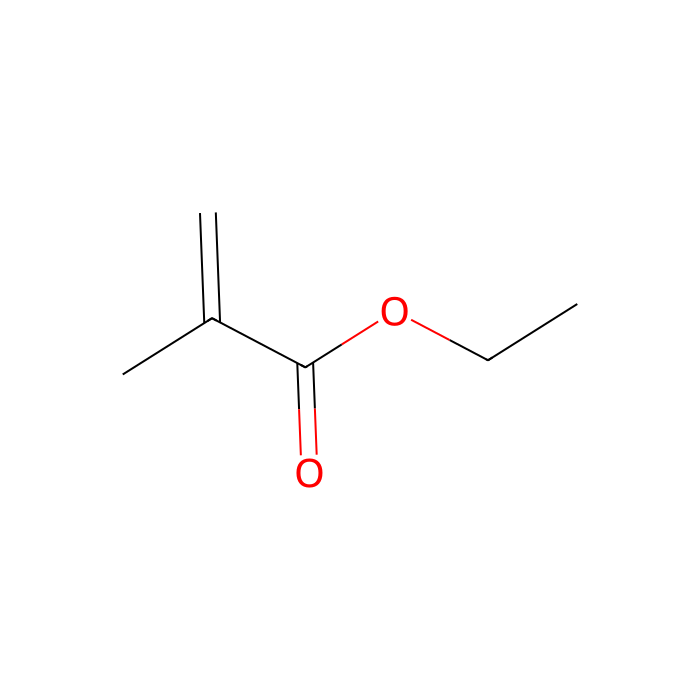
Ethyl methacrylate (EMA) is a monomer commonly used in the field of polymer industries. It is an ester of methacrylic acid and ethanol and is a colorless liquid with a characteristic odor. EMA is widely used in the production of various polymers such as poly(methyl methacrylate) (PMMA), poly(ethyl acrylate) (PEA), and ethylene-EMA (EE). These polymers find their application in various fields, including medical implant devices, packaging, paper coatings, textile coatings, emulsion polymers, and plastics.
Ethyl methacrylate is a readily polymerizable monomer used for certain types of acrylic resins. The monomethyl ether hydroxyl quinone present in it is an inhibitor that prevents polymerization.
Ethyl methacrylate (EMA) can be used as a monomer in the following applications:
To synthesize artificial nanosized latexes of poly(styrene-co-methyl methacrylate) or poly(styrene-co-ethyl methacrylate), which are in producing drug-releasing films.
In the production of additive-manufactured methacrylate-based resins used in dentistry.
In the synthesis of a star-shaped block copolymer electrolyte for all-solid-state lithium batteries.
In the synthesis of a copolymer used as a matrix for semiconductor nanoparticles, which is crucial for the formation of a stable matrix for the quantum dots-copolymer composite material used in optoelectronic applications.
It can also be used to prepare copolymers of EMA on waxy maize starch and hydroxypropyl starch, the potential application of these copolymers are as excipients for compressed non-disintegrating matrix tablets. It may be used to study reactions of n-butyl acrylate and EMA with ozone in the gas phase.
Taxonomy Tree
| Kingdom | Organic compounds |
|---|---|
| Superclass | Organic acids and derivatives |
| Clase | Carboxylic acids and derivatives |
| Subclass | Carboxylic acid derivatives |
| Intermediate Tree Nodes | Carboxylic acid esters - Alpha,beta-unsaturated carboxylic esters |
| Direct Parent | Enoate esters |
| Alternative Parents | Monocarboxylic acids and derivatives Organic oxides Hydrocarbon derivatives Carbonyl compounds |
| Molecular Framework | Aliphatic acyclic compounds |
| Substituents | Enoate ester - Monocarboxylic acid or derivatives - Organic oxygen compound - Organic oxide - Hydrocarbon derivative - Organooxygen compound - Carbonyl group - Aliphatic acyclic compound |
| Descripción | This compound belongs to the class of organic compounds known as enoate esters. These are an alpha,beta-unsaturated carboxylic ester of general formula R1C(R2)=C(R3)C(=O)OR4 (R4= organyl compound) in which the ester C=O function is conjugated to a C=C double bond at the alpha,beta position. |
| External Descriptors | Not available |
Find and download the COA for your product by matching the lot number on the packaging.
| Lot Number | Certificate Type | Fecha | Articulo |
|---|---|---|---|
| Certificate of Analysis | Aug 03, 2026 | E103001 | |
| Certificate of Analysis | Jan 21, 2026 | E103001 | |
| Certificate of Analysis | Jul 12, 2025 | E103001 | |
| Certificate of Analysis | Jul 12, 2025 | E103001 | |
| Certificate of Analysis | Jul 12, 2025 | E103001 | |
| Certificate of Analysis | Jul 12, 2025 | E103001 | |
| Certificate of Analysis | Jul 12, 2025 | E103001 | |
| Certificate of Analysis | Jul 12, 2025 | E103001 | |
| Certificate of Analysis | Jul 12, 2025 | E103001 | |
| Certificate of Analysis | Nov 28, 2024 | E103001 | |
| Certificate of Analysis | Nov 28, 2024 | E103001 | |
| Certificate of Analysis | Nov 04, 2024 | E103001 | |
| Certificate of Analysis | Aug 05, 2024 | E103001 | |
| Certificate of Analysis | Jul 15, 2024 | E103001 | |
| Certificate of Analysis | May 08, 2024 | E103001 | |
| Certificate of Analysis | May 07, 2024 | E103001 | |
| Certificate of Analysis | May 07, 2024 | E103001 | |
| Certificate of Analysis | Oct 20, 2022 | E103001 | |
| Certificate of Analysis | Sep 09, 2022 | E103001 | |
| Certificate of Analysis | Sep 09, 2022 | E103001 | |
| Certificate of Analysis | Sep 09, 2022 | E103001 | |
| Certificate of Analysis | Sep 09, 2022 | E103001 | |
| Certificate of Analysis | Sep 09, 2022 | E103001 | |
| Certificate of Analysis | Sep 09, 2022 | E103001 | |
| Certificate of Analysis | Sep 09, 2022 | E103001 | |
| Certificate of Analysis | Sep 09, 2022 | E103001 | |
| Certificate of Analysis | Aug 09, 2022 | E103001 | |
| Certificate of Analysis | Apr 26, 2022 | E103001 | |
| Certificate of Analysis | Feb 12, 2022 | E103001 |
| Solubilidad | Insoluble in water; Soluble in Ether,Alcohol |
|---|---|
| Sensibilidad | Light sensitive;Heat sensitive |
| Índice de refracción | 1.41 |
| Punto de inflamación (°F) | 66.2 °F - closed cup |
| Punto de inflamación (°C) | 19 °C - closed cup |
| Punto de ebullición (°C) | 119°C |
| Punto de fusión (°C) | -75°C |
| Peso molecular | 114.14 |
| XLogP3 | 1.900 |
| Hydrogen Bond Donor Count | 0 |
| Hydrogen Bond Acceptor Count | 2 |
| Rotatable Bond Count | 3 |
| Exact Mass | 114.068 Da |
| Monoisotopic Mass | 114.068 Da |
| Topological Polar Surface Area | 26.300 Ų |
| Heavy Atom Count | 8 |
| Formal Charge | 0 |
| Complexity | 105.000 |
| Isotope Atom Count | 0 |
| Defined Atom Stereocenter Count | 0 |
| Undefined Atom Stereocenter Count | 0 |
| Defined Bond Stereocenter Count | 0 |
| Undefined Bond Stereocenter Count | 0 |
| The total count of all stereochemical bonds | 0 |
| Covalently-Bonded Unit Count | 1 |
H225:Highly Flammable liquid and vapor
H315:Causes skin irritation
H317:May cause an allergic skin reaction
H319:Causes serious eye irritation
H335:May cause respiratory irritation
P210:Keep away from heat, hot surface, sparks, open flames and other ignition sources. - No smoking.
P233:Keep container tightly closed.
P240:Ground/bond container and receiving equipment.
P241:Use explosion-proof [electrical/ventilating/lighting/.../] equipment.
P242:Use only non-sparking tools.
P243:Take precautionary measures against static discharge.
P261:Avoid breathing dust/fume/gas/mist/vapors/spray.
P264:Wash hands [and …] thoroughly after handling.
P271:Use only outdoors or in a well-ventilated area.
P272:Contaminated work clothing should not be allowed out of the workplace.
P280:Wear protective gloves/protective clothing/eye protection/face protection.
P321:Specific treatment (see ... on this label).
P302+P352:IF ON SKIN: wash with plenty of water.
P303+P361+P353:IF ON SKIN (or hair): Take off Immediately all contaminated clothing. Rinse SKIN with water [or shower].
P304+P340:IF INHALED: Remove person to fresh air and keep comfortable for breathing.
P305+P351+P338:IF IN EYES: Rinse cautiously with water for several minutes. Remove contact lenses if present and easy to do - continue rinsing.
P333+P313:IF SKIN irritation or rash occurs: Get medical advice/attention.
P362+P364:Take off contaminated clothing and wash it before reuse.
P370+P378:In case of fire: Use ... to extinguish.
P405:Store locked up.
P403+P233:Store in a well-ventilated place. Keep container tightly closed.
P403+P235:Store in a well-ventilated place. Keep cool.
P501:Dispose of contents/container to an approved waste disposal plant.
P264+P265:Wash hands [and …] thoroughly after handling. Do not touch eyes.
P337+P317:If eye irritation persists: Get medical help.
P332+P317:If skin irritation occurs: Get medical help.
P319:Get medical help if you feel unwell.