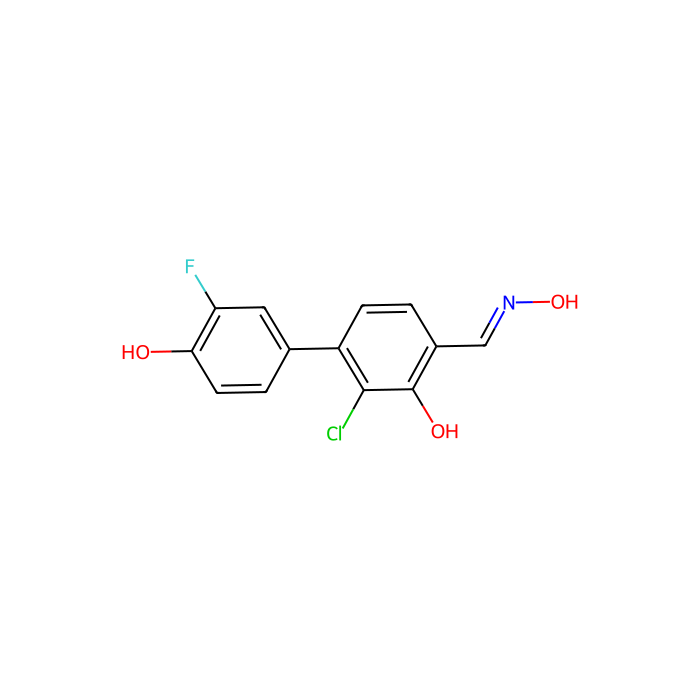
This compound belongs to the class of organic compounds known as chlorinated biphenyls. These are organic compounds containing at least one chlorine atom attached to either benzene ring of the biphenyl moiety.
External Descriptors
Not available
1. Djoumbou Feunang Y, Eisner R, Knox C, Chepelev L, Hastings J, Owen G, Fahy E, Steinbeck C, Subramanian S, Bolton E, Greiner R, and Wishart DS. ClassyFire: Automated Chemical Classification With A Comprehensive, Computable Taxonomy. Journal of Cheminformatics, 2016, 8:61.
Certificados (CoA, COO, BSE/TSE y tabla de análisis)
C of A & Other Certificates(BSE/TSE, COO):
Analytical Chart:
Propiedades químicas y físicas
Solubilidad
Solvent:DMSO, Max Conc. mg/mL: 28.17, Max Conc. mM: 100; Solvent:ethanol, Max Conc. mg/mL: 28.17, Max Conc. mM: 100
Peso molecular
281.660 g/mol
XLogP3
3.300
Hydrogen Bond Donor Count
3
Hydrogen Bond Acceptor Count
5
Rotatable Bond Count
2
Exact Mass
281.025 Da
Monoisotopic Mass
281.025 Da
Topological Polar Surface Area
73.100 Ų
Heavy Atom Count
19
Formal Charge
0
Complexity
331.000
Isotope Atom Count
0
Defined Atom Stereocenter Count
0
Undefined Atom Stereocenter Count
0
Defined Bond Stereocenter Count
1
Undefined Bond Stereocenter Count
0
The total count of all stereochemical bonds
1
Covalently-Bonded Unit Count
1
Calculadoras de soluciones
Molarity Calculator
Determine the necessary mass, volume, or concentration for preparing a solution.
Dilution Calculator
Determine the dilution needed to prepare a stock solution.
Reconstitution Calculator
Reseñas
Reseñas de cliente
Application Protocols
No validated application protocols are provided for this item in the Product Data.
General HTS/assay handling (not item-specific)
Stock preparation: Dissolve in anhydrous DMSO to 10–50 mM. Vortex and, if needed, briefly sonicate. Filter (0.2 µm PTFE) if particulate persists.
Plate handling: Dispense using acoustic or positive-displacement systems to minimize DMSO carryover and concentration errors. Seal plates to limit evaporation and DMSO gradient effects.
Final assay conditions: Keep DMSO ≤0.5–1% v/v where possible. Include vehicle controls at matched DMSO levels. Perform solubility/precipitation pre-checks at the highest test concentration.
Interference controls: Include detergent (e.g., 0.01% Tween-20) to reduce aggregation, and add redox or fluorescence interference counters as appropriate to the readout.
Documentation
Record lot/sku, preparation date, exact concentration (verified spectroscopically or gravimetrically), and storage conditions. Attach CoA and any analytical confirmation (LC–MS/HPLC) to the experiment record.
Biological Roles
Item-specific biological function or target information is not provided for FERb 033.
General guidance for library compounds (not item-specific)
Discovery role: Such compounds are typically evaluated as potential modulators of enzymes, receptors, or protein–protein interactions. Any observed activity is provisional until confirmed through orthogonal assays and counter-screens.
Liability profiling: Early checks often include PAINS and REOS filters, redox activity assays, aggregation testing (e.g., with 0.01–0.1% non-ionic detergent), and reactivity panels to rule out assay interference.
ADME-relevant properties: If a structure becomes available, in silico predictions (cLogP, TPSA, pKa) can guide permeability, solubility, and protein-binding expectations before committing to detailed in vitro ADME.
Chemical stability: Evaluate stability in assay buffer, in DMSO at room temperature/4°C, and under light exposure, as degradation can confound biological readouts.
Documentation and data integrity
Record lot number, confirmed concentration, and purity with each biological readout. Re-verify identity/purity for critical studies or if anomalous behavior is observed.
Note
No target specificity, mechanism of action, or pathway assignments are supplied in the Product Data. Avoid biological conclusions until verified experimentally with this exact batch.
Buffer Applications
This product is a small-molecule library compound, not a buffering agent. Buffer preparation guidance is generally not applicable to the compound itself.
General practical notes (for assay compatibility)
When preparing assay plates, dissolve FERb 033 in DMSO (typical 10–50 mM stocks), then dilute into the chosen assay buffer ensuring the final DMSO concentration (commonly ≤0.5–1% v/v) does not perturb the system.
If precipitation occurs upon dilution, consider: slower addition with vortexing, pre-dilution with a miscible organic (ACN/MeOH), adjusting buffer ionic strength, or slightly altering pH within acceptable assay limits.
For pH-sensitive assays, confirm that the compound does not absorb strongly at the assay’s detection wavelength or fluoresce within the detection window.
Item-specific buffer roles: Not applicable; no buffering capacity or buffer formulations are provided for this item.
Green Alternatives
In the absence of compound-specific process chemistry, green considerations relate mainly to solvent choice and workflow design for screening and analytical operations.
Greener solvent substitutions (general guidance)
Replace DMF/NMP with safer polar aprotics where possible (e.g., Cyrene, propylene carbonate, or dimethyl isosorbide) for sample preparation or reactions involving this compound.
Consider ethanol or isopropanol instead of methanol for routine dilutions/extractions when compatible with the assay.
For chromatography, evaluate water–acetonitrile gradients over water–methanol if waste volume and energy use favor ACN at your site; conversely, MeOH can be greener depending on sourcing—assess locally.
Comparison (general, not item-specific)
DMSO vs. alternatives: DMSO is relatively benign and widely accepted for bioassays; ensure minimal volumes and proper waste segregation. Where DMSO interferes, propylene carbonate or PEG-400 (low %) may substitute, balancing viscosity and compatibility.
Operational greening
Miniaturize assays (384/1536-well) to cut solvent use and waste per data point.
Use analytical-scale verification (UPLC vs. HPLC) to reduce solvent and time.
Consolidate LC–MS runs and employ smart sequences to minimize purges and rinses.
Trade-offs
Greener choices must preserve data quality: verify solubility, stability, and assay performance when moving away from conventional solvents. Document any shifts in potency readouts due to solvent system changes.
Pharmaceutical Uses
No pharmacopeial status, excipient role, or formulation use is specified for FERb 033 in the Product Data. The product is designated for research use only.
General context for screening compounds (not item-specific)
Discovery phase: Compounds like this are typically used in early-stage screening and SAR development rather than in formulated drug products.
Pre-formulation studies: If biological activity warrants, solubility profiling, polymorph screening, and preliminary stability testing (pH, light, oxidative) may be performed to inform medicinal chemistry optimization.
Excipient compatibility: Not applicable at this stage; any formulation discussions would be premature without defined development intent and thorough safety dossiers.
Regulatory note
No claims of safety, efficacy, or therapeutic use are made. This material is not intended for human or veterinary use and is not approved as an API or excipient.
Physical Properties
Item-specific property data are not provided in the current listing.
Item-specific facts (from Product Data)
Appearance: Not specified for this item; refer to CoA/Spec Sheet.
Molecular weight: Not specified for this item; refer to CoA/Spec Sheet.
Melting point, boiling point, density, refractive index, pKa/logP, aqueous/organic solubility: Not specified for this item; refer to CoA/Spec Sheet.
Literature/general guidance for small-molecule screening compounds (not specific to this item)
Physical state: Library compounds are often supplied as solids or DMSO solutions. If solid, they may be crystalline powders or amorphous solids depending on polymorph and purity.
Solubility strategy: Begin with DMSO solubilization (e.g., 10–50 mM stock), then dilute into assay buffers; include ≤1% DMSO final to minimize biological interference. For poor DMSO solubility, consider co-solvents (acetonitrile, ethanol) or gentle heating/sonication.
pKa/logP estimation: If a structure becomes available, use ACD/Labs, ChemDraw, or open-source calculators (e.g., RDKit) to estimate ionization, lipophilicity, and permeability proxies.
Hygroscopicity: Some heteroatom-rich molecules can be hygroscopic. Minimize headspace and use desiccant until actual behavior is confirmed.
Practical characterization (recommended, general)
Record actual solubility limits in DMSO/water and common assay buffers at room temperature.
If a melting point is measurable, record it as a quick identity check and stability indicator.
For purity and identity, confirm by LC–MS (single dominant [M+H]+), HPLC/UPLC purity, and, if needed, 1H NMR.
Quality and Grades
Item-specific quality designations are not provided in the listing; rely on the CoA for batch-specific metrics.
Item-specific facts (from Product Data)
Grade/Purity: Not specified for this item; refer to CoA/Spec Sheet.
What to look for on the CoA (general guidance)
Purity methodology: HPLC/UPLC area% (typ. ≥95% for screening), or qNMR when available. Confirm method details (wavelengths, gradient, column) to interpret area% reliably.
Residual solvents and water: GC for Class 1/2 solvents; KF for water content. Reported limits ensure reproducible weighing and solubility.
Inorganic/elemental impurities: Not commonly specified for discovery libraries but may be included; check for ICP-MS if relevant to sensitive assays.
Implications for use (general)
Screening assays: Higher purity and accurate identity reduce false positives/assay artifacts. If purity <95%, consider repurification or orthogonal confirmation.
Photostability: If the CoA notes light sensitivity, protect from light during handling and storage.
Salt vs. free base/acid: Grade may specify salt form; this impacts molecular weight used for stock calculations and solubility.
Documentation
Retain CoA, SDS, and any vendor spectral data with your ELN entry for traceability.
Reaction and Applications
Item-specific reactivity and application notes are not provided. As a library compound (screening chemical), the primary use is in discovery assays rather than as a synthetic reagent.
Research and screening applications (general)
High-throughput screening (HTS) and fragment-like/lead-like testing in biochemical or cell-based assays to identify hits for further optimization.
Orthogonal target profiling and selectivity panels once a primary activity is observed.
Mechanistic follow-up: If activity is detected, perform counterscreens, redox interference checks, and colloidal aggregation controls (e.g., detergent addition, DLS) to reduce false positives.
Analytical considerations
Verify identity by LC–MS upon receipt and after storage. Track freeze–thaw cycles for DMSO stocks.
Determine intrinsic fluorescence/UV absorbance to anticipate assay interference (inner-filter effects). Perform test wells for fluorescence quenching/auto-fluorescence.
Potential synthetic use (conditional)
Without structural information, no specific named-reaction guidance can be provided. If functional groups are known (e.g., aryl halide, nitrile, amide), the molecule might serve as a building block or diversification point (e.g., cross-coupling, reduction/oxidation, amidation). Refer to the compound’s structure on the CoA.
Documentation
Record batch/lot, concentration verification, and purity in assay data packages to ensure reproducibility.
Reaction Conditions
No structure or functional group data are provided for FERb 033; therefore, specific reaction conditions cannot be recommended for transformations involving this molecule.
General guidance (not item-specific)
Solvent and temperature: Begin with conditions commensurate with the functional groups present once identified. For polar aromatics, DMF/DMSO/MeCN at 20–100°C are typical; for moisture-sensitive reactions, use anhydrous conditions and inert atmosphere.
Catalysis: If cross-couplings are applicable, modern Pd catalysts (e.g., XPhos/BrettPhos systems) or Ni variants can be effective at low loadings. For hydrogenations, use H2 (1–50 bar) with Pd/C, PtO2, or Raney Ni as appropriate.
Photoredox/electrochemistry: Consider these for mild redox steps when classical reagents show poor selectivity.
Workup and purification: Plan quench and extraction around the molecule’s ionization profile. Reverse-phase flash/Prep-LC can be preferable for polar or zwitterionic compounds.
Expected yields and times
Not specified for this item; refer to literature once the specific functional groups and scaffold are known.
Safety and Handling
Safety details are not specified in the current listing; consult the SDS for authoritative guidance.
Item-specific facts (from Product Data)
GHS classification: Not specified for this item; refer to SDS.
Signal word and H-statements: Not specified for this item; refer to SDS.
Pictograms: Not specified for this item; refer to SDS.
Storage: Store at 2–8°C. Shipped on wet ice.
Research use: For research use only.
General laboratory precautions for small organic molecules (not item-specific)
PPE: Lab coat, safety glasses, and appropriate chemically resistant gloves (e.g., nitrile). Handle powders in a fume hood to avoid inhalation.
Avoid ingestion, inhalation, and skin contact. Wash thoroughly after handling. Do not pipette by mouth.
Incompatibilities: Until functional groups are known, segregate from strong oxidizers/reducers, strong acids/bases, and ignition sources. Avoid reactive metal hydrides and strong nucleophiles/electrophiles without prior compatibility checks.
Spill response: For small spills of non-volatile organics, absorb with inert material (e.g., vermiculite), collect in appropriate waste. Ventilate area and prevent environmental release.
First aid (overview): If on skin/eyes, rinse with water for 15 minutes; remove contaminated clothing. If inhaled, move to fresh air. If swallowed, rinse mouth; seek medical attention in all cases. Provide SDS to responders.
Waste disposal (general)
Dispose via organic solvent/solid hazardous waste streams in accordance with institutional and local regulations. Do not discharge to drains.
SDS note
Request the SDS for CAS 1111084-78-6 or CID 135931707 to obtain definitive hazard statements and handling recommendations.
Solvent Selection
No compound-specific solubility data are provided. The strategy below reflects common practice for small-molecule library members.
Primary solvents (general guidance)
DMSO: First-line solvent for screening stocks (e.g., 10–50 mM). Widely compatible with biochemical and cell-based assays at ≤0.5–1% v/v final.
Acetonitrile or ethanol: Useful co-solvents or alternatives when DMSO solubility is limited or to reduce DMSO-related assay effects.
Water/buffer: Viable if the compound bears ionizable groups; determine pH-solubility profile experimentally.
Miscibility and polarity (general expectations)
DMSO is fully miscible with water and many organics, enabling staged dilutions. If precipitation appears on dilution into aqueous buffers, pre-dilute DMSO stocks into an intermediate miscible solvent or add slowly with vortexing.
Practical selection tips
Start with a small test panel: DMSO, DMF, MeOH, ACN, and 1:1 DMSO:water. Document solubility limits at room temperature and at 37°C.
For LC-based assays, prefer low-UV solvents (ACN, MeOH) and confirm the compound’s UV profile to avoid detector saturation.
For unstable compounds, consider anhydrous, oxygen-free solvents and amber vials; validate stability by LC–MS over time.
Comparison snapshot (general)
DMSO vs. DMF: DMSO is generally preferred for bioassays due to lower toxicity and better water miscibility; DMF can be considered for stubborn solubility but is less desirable biologically.
ACN vs. MeOH: ACN offers lower viscosity and stronger elution in RP-HPLC; MeOH is greener but can change selectivity.
Storage and Reconstitution
Item-specific facts (from Product Data)
Storage Conditions: Store at 2–8°C.
Shipped In: Wet ice.
General storage guidance for small-molecule library compounds (not item-specific)
Solid material: Store tightly closed in a desiccated environment at 2–8°C, protected from light if the compound is chromophoric. Allow container to equilibrate to room temperature before opening to avoid condensation.
Solution stocks: For DMSO stocks (e.g., 10–50 mM), aliquot into low-bind, inert vials or plates to minimize freeze–thaw cycles. Typical storage: −20°C to −80°C for long-term; however, confirm stability for this specific compound before deviating from the item’s 2–8°C storage instruction for the solid.
Light/air sensitivity: If the CoA/SDS indicates sensitivity, purge headspace with inert gas (N2/Ar) and use amber containers.
Reconstitution (general)
Solvent: Begin with anhydrous DMSO. If insoluble, test ACN, MeOH, or co-solvent mixtures. Document maximum attainable concentration without visible particulates.
Procedure: Weigh quickly, add calculated solvent volume to reach target molarity, vortex/sonicate gently, and verify concentration by UV or LC–MS if possible. Filter through 0.2 µm PTFE when particulate persists.
Notes
Do not store aqueous working solutions for extended periods unless stability has been verified. Always refer to the CoA/Spec Sheet for any item-specific stability notes beyond the provided 2–8°C storage instruction.
Structure and Identity
Brief overview: FERb 033 is supplied as a small-molecule library member intended for research and screening workflows. Item-specific structural descriptors are largely not provided in the current listing.
Item-specific facts (from Product Data)
SKU: F288353
Product Name: FERb 033
CAS: 1111084-78-6
PubChem CID: 135931707
InChIKey: 207394 (as provided; standard InChIKeys are typically 27 characters—verify on CoA/SDS)
SMILES: Not specified for this item; refer to CoA/Spec Sheet.
Molecular formula: Not specified for this item; refer to CoA/Spec Sheet.
Molecular weight: Not specified for this item; refer to CoA/Spec Sheet.
Structural features (general guidance)
Without a SMILES or structure image, functional groups, ring systems, stereochemistry, and heteroatom content cannot be enumerated for this entry.
If available in your organization’s compound registry, cross-reference CAS 1111084-78-6 or CID 135931707 to retrieve a definitive 2D/3D structure for cheminformatics, property prediction, and assay compatibility checks.
How to describe the 2D structure (general method)
Start from the core scaffold (e.g., aromatic/heteroaromatic, aliphatic, fused system), identify substituents and heteroatoms (N/O/S/halogens), and note any chiral centers or E/Z alkene geometry.
Record tautomeric state and salt form, if any; neutral free base/acid vs. counterion can impact solubility and assay behavior.
Verification note
For unambiguous identification, confirm at minimum two orthogonal identifiers (e.g., CAS and SMILES/InChI) from the CoA or vendor SDS before initiating critical studies.
Synthetic Utility
Item-specific functional groups and reactivity are not disclosed, so detailed synthetic roles cannot be assigned.
General considerations (not item-specific)
If the structure contains common handles (e.g., aryl halides, boronates, nitriles, amides, esters, alkenes/alkynes), diversified transformations may include: cross-couplings (Suzuki–Miyaura, Buchwald–Hartwig), nucleophilic substitutions, reductions/oxidations, hydrolysis/amidation, and heterocycle modifications.
Protecting-group compatibility and chemoselectivity should be assessed once the functional group map is known. Use orthogonal conditions to preserve sensitive motifs (e.g., avoid strong base with nitroaryl benzyl ethers, avoid peroxide-forming oxidants with thioethers).
Late-stage functionalization: If the scaffold tolerates C–H activation, consider mild conditions (photoredox, Minisci, or electrochemical methods) for analog generation without full resynthesis.
Analytical support
Track reaction progress by UPLC–MS, monitoring both parent consumption and impurity growth. If the compound is highly UV-active, adjust wavelengths to avoid detector saturation.
Caveat
Until the precise structure is confirmed (via CoA/SDS), treat any synthetic planning as provisional and validate on milligram scale.
Target Specificity
No target, mechanism of action, or binding specificity information is provided for FERb 033 in the Product Data.
Tested targets, epitope details, species reactivity, clone/isotype: Not applicable to small molecules and not specified for this item.
Guidance
If used in screening, any apparent target specificity should be validated with orthogonal assays, counterscreens, and, where applicable, biophysical methods (SPR, ITC, DSF) using the exact lot referenced by the CoA.
Preguntas frecuentes
What is the purity of this product, and how is it determined?
This product is supplied at ≥98% purity, determined by HPLC. Lot-specific values are stated on the Certificate of Analysis.
How should this product be stored?
Store at 2–8 °C. Refrigerated storage is required to maintain the specified shelf life.
How is this product shipped?
This product ships chilled on wet ice. Unpack on arrival and transfer it to the storage condition stated above.
What are the CAS number, molecular formula and molecular weight?
The CAS Number is 1111084-78-6, the molecular formula is C13H9ClFNO3, and the molecular weight is 281.67 g/mol. InChIKey LRRMQNGSYOUANY-OMCISZLKSA-N.
What documentation is provided?
Available product documentation, including Certificates of Analysis (COA), Safety Data Sheets (SDS), and specification sheets, is shown in the product document area. Document availability and access follow the current site policy.
Utilizamos cookies para garantizar el correcto funcionamiento del sitio web y, cuando esté permitido, para mejorar su experiencia. Puede gestionar sus preferencias en cualquier momento en Configuración. Más información en nuestra Política de Cookies.
¿Quieres que te enviemos un mensaje cuando tengamos descuentos disponibles?
Recordármelo más tarde
¡Gracias! Por favor, revisa tu bandeja de entrada de correo electrónico para confirmar.
Products are supplied to verified businesses, institutions, and qualified professionals for research and development use only. Not for use in humans, animals, diagnosis, or therapy.