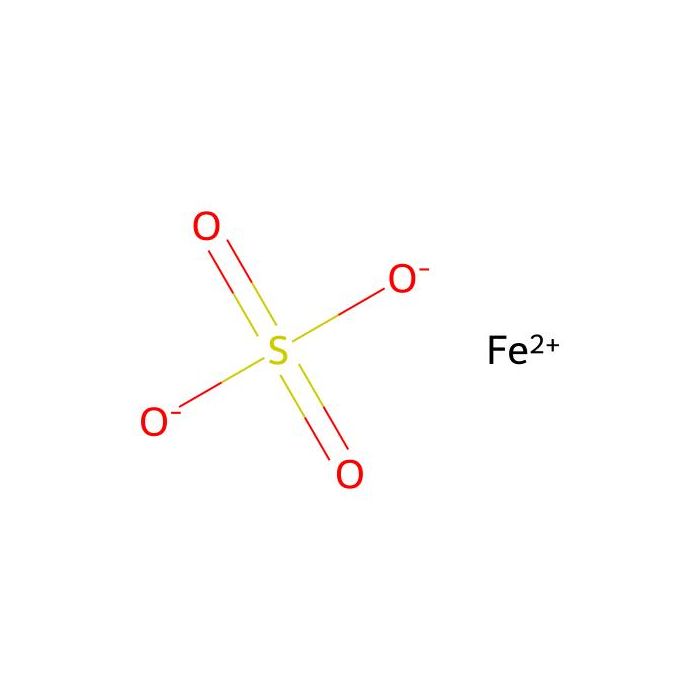
FERROUS SULFATE standard solution - 0.25mol/L in H2O , CAS No.7720-78-7

CAS: 7720-78-7 Cat. No.: F709863 Fórmula: FeSO4 Peso molecular: 151.91 Número EC: 231-753-5
Disponible para pedir
CALIDAD & PUREZA 0.25mol/L in H2O
Storage
Room temperature
★
Talla
Alemania (EU)
USA*
Precio
Cantidad
500ml
F709863-500ml
Fabricado bajo pedido · 8–12 semanas

100,57€

117,93€
Guardar 17,35 € (14.72%)
Enter a quantity for the sizes you want to add.
🧪
Por qué esta calidad

0.25mol/L in H2O para flujos de trabajo cromatográficos y analíticos sensibles que requieren una interferencia mínima de la línea base.

🌡

Almacenamiento y envío

Room temperature Envío . Consulte el COA específico del lote para conocer las especificaciones exactas.

📋

Documentos de calidad

SDS, COA, ficha técnica y hoja de especificaciones disponibles para descargar. COA específico del lote accesible mediante búsqueda por número de lote.

📚

Prueba documental

Citado en 291 publicaciones revisadas por pares sobre cromatografía, síntesis orgánica y reacciones de acoplamiento cruzado.

Especificaciones

Especificaciones y pureza
0.25mol/L in H2O
Condiciones de almacenamiento de almacenamiento
Room temperature
Nombres e identificadores
Sonrisas canónicas
[O-]S(=O)(=O)[O-].[Fe+2]
IUPAC Name
iron(2+);sulfate
InChIKey
BAUYGSIQEAFULO-UHFFFAOYSA-L
INCHI
1S/Fe.H2O4S/c;1-5(2,3)4/h;(H2,1,2,3,4)/q+2;/p-2
Isómeros SMILES
[O-]S(=O)(=O)[O-].[Fe+2]
CAS alternativo
7720-78-7; 7782-63-0(heptahydrate),15438-31-0 (Parent)
Términos de entrada MeSH
Aktiferrin;Apo-Ferrous Sulfate;biofer;Ceferro;Conferon;Eisendragees-ratiopharm;Eisensulfat Stada;Feospan;Fer-Gen-Sol;Fer-in-Sol;Feratab;Fero-Gradumet;Ferodan;Ferogradumet;Ferro-Gradumet;Ferrogamma;Ferrograd;FERROinfant;ferrous sulfate;ferrous sulfate, hep
Peso molecular
151.91

Documentación

📋 Hoja de datos de seguridad (SDS)

Documento completo sobre peligros, manipulación, almacenamiento y cumplimiento normativo.

<<<<<<< HEAD Descargar SDS → ======= Descargar SDS → >>>>>>> release248-p3

✅ Certificado de análisis (COA)

Datos de calidad específicos del lote. Introduzca su número de lote para obtener el COA exacto.

Buscar COA →

📊 Ficha técnica

Resumen de referencia rápida de las especificaciones y aplicaciones del producto.

Ver ficha técnica →

🔬 Hoja de especificaciones

Atributos de calidad completos y criterios de aceptación para esta calidad.

Ver hoja de especificaciones →

Datos avanzados

Taxonomic Classification

Taxonomy Tree

KingdomInorganic compounds
SuperclassMixed metal/non-metal compounds
ClaseTransition metal oxoanionic compounds
SubclassTransition metal sulfates
Intermediate Tree Nodes Not available
Direct ParentTransition metal sulfates
Alternative Parents Inorganic salts  Inorganic oxides  
Molecular FrameworkNot available
Substituents Transition metal sulfate - Inorganic oxide - Inorganic salt
DescripciónThis compound belongs to the class of inorganic compounds known as transition metal sulfates. These are inorganic compounds in which the largest oxoanion is sulfate, and in which the heaviest atom not in an oxoanion is a transition metal.
External Descriptors metal sulfate - iron molecular entity
Estructura 3D
Modelo de Estructura Química Interactiva


Certificados (CoA, COO, BSE/TSE y tabla de análisis)
C of A & Other Certificates(BSE/TSE, COO):
Analytical Chart:
Propiedades químicas y físicas
Peso molecular151.910 g/mol
XLogP3
Hydrogen Bond Donor Count0
Hydrogen Bond Acceptor Count4
Rotatable Bond Count0
Exact Mass151.887 Da
Monoisotopic Mass151.887 Da
Topological Polar Surface Area88.600 Ų
Heavy Atom Count6
Formal Charge0
Complexity62.200
Isotope Atom Count0
Defined Atom Stereocenter Count0
Undefined Atom Stereocenter Count0
Defined Bond Stereocenter Count0
Undefined Bond Stereocenter Count0
The total count of all stereochemical bonds0
Covalently-Bonded Unit Count2
Preguntas frecuentes y artículos
Transition-Metal Salts/Precursor Selection Guide: How “Different Salts of the Same Metal” Start from Different Chemical Realities—and How to Reproduce Results (including a Selection Navigator and Product Tables 1–5)
Procyanidins: Structural Features and Key Points for Research and Application
Phytase: Enzymological Properties, Mechanism of Action, and Applications in Feed and Food
Chlorophyll: Structural Features, Physicochemical Properties, and Key Points for Research and Industrial Applications
Coelenterazine (CTZ) Differences and an Application Overview
Physicochemical Properties of Diphenylamine, Analytical Applications, and a Review of Its DNA Colorimetric Reaction
Types of Inorganic Salts That Can Undergo Reduction Reactions: Nitrates, Sulfur-Containing Salts, Halogen Oxyanion Salts, and Metal Salts
Comparison of Iron Content Detection Methods: TPTZ, 1,10-Phenanthroline, Ferrozine, 2,2'-Bipyridine, and Instrumental Analysis
How Do Collagen Peptides Act on the Skin? From Surface Hydration and Percutaneous Delivery to Fibroblasts and Collagen Homeostasis
What Is “Plant Collagen”? Distinguishing Ingredient Types, Structural Differences, Production Methods, and Skincare Effects
Citations of This Product
Calculadoras de soluciones
Reseñas

Reseñas de cliente

¿Quieres que te enviemos un mensaje cuando tengamos descuentos disponibles?

Recordármelo más tarde

¡Gracias! Por favor, revisa tu bandeja de entrada de correo electrónico para confirmar.

¡Vaya! Las notificaciones están desactivadas.