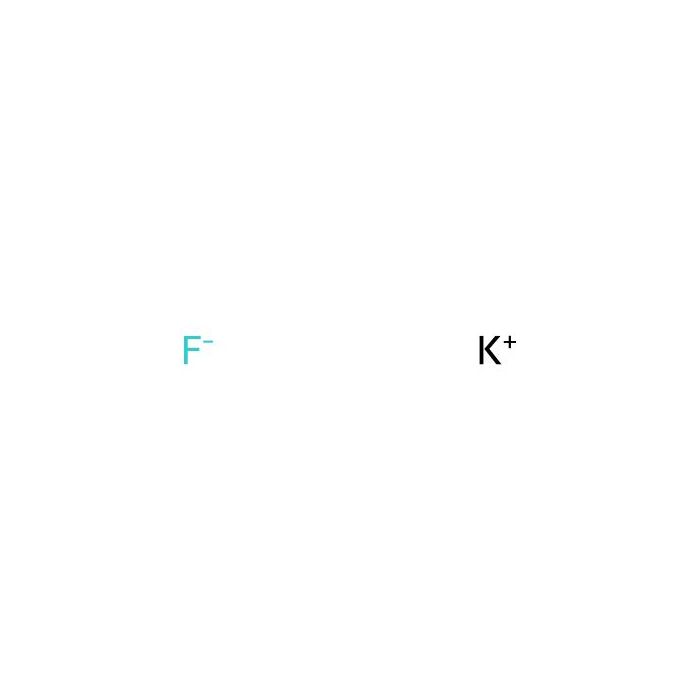
Fluoruro de potasio - UltraBio™, ≥99,5%(F) , CAS No.7789-23-3

CAS: 7789-23-3 Cat. No.: P755684 Fórmula: KF Peso molecular: 58.1 Beilstein Registry Number: 3902818 Número EC: 232-151-5
Disponible para pedir
CALIDAD & PUREZA UltraBio™ ? UltraBio™ — Aladdin's line for molecular-biology applications. Use for nuclease-free, high-consistency reagents across molecular workflows. ≥99.5%(F)
Storage
Temperatura ambiente
Shipped In
FedEx DG Service
★
Talla
Alemania (EU)
USA*
Precio
Cantidad
100g
P755684-100g
Fabricado bajo pedido · 8–12 semanas
136,15€
500g
P755684-500g
Fabricado bajo pedido · 8–12 semanas
586,50€
Enter a quantity for the sizes you want to add.
🧪
Por qué esta calidad

UltraBio™, ≥99,5%(F) UltraBio™ para flujos de trabajo cromatográficos y analíticos sensibles que requieren una interferencia mínima de la línea base.

🌡

Almacenamiento y envío

Temperatura ambiente Envío FedEx DG Service. Consulte el COA específico del lote para conocer las especificaciones exactas.

📋

Documentos de calidad

SDS, COA, ficha técnica y hoja de especificaciones disponibles para descargar. COA específico del lote accesible mediante búsqueda por número de lote.

📚

Prueba documental

Citado en 181 publicaciones revisadas por pares sobre cromatografía, síntesis orgánica y reacciones de acoplamiento cruzado.

Descripción general

El fluoruro de potasio puede utilizarse en el análisis termodinámico de la unión ADN-ligando y en estudios sobre la estabilidad estructural de proteínas y péptidos.
Una fuente versátil de iones fluoruro utilizada en un estudio de hinchamiento y desinflamación específicos de iones de geles de polímeros anfolíticos, en la oxidación a temperatura ambiente de metales nobles en HF y en la medición de polarizabilidades electrónicas de iones en polímeros de haluros alcalinos.

Especificaciones

Especificaciones y pureza
UltraBio™, ≥99,5%(F)
Condiciones de almacenamiento de almacenamiento
Temperatura ambiente
Enviado en
FedEx DG Service
Grado
UltraBio™
Pureza
≥99.5%(F)
Nombres e identificadores
PH
7.0-8.5 (25 °C, 1 M in H 2 O)
Sonrisas canónicas
[F-].[K+]
IUPAC Name
potassium;fluoride
InChIKey
NROKBHXJSPEDAR-UHFFFAOYSA-M
INCHI
1S/FH.K/h1H;/q;+1/p-1
Isómeros SMILES
[F-].[K+]
WGK Alemania
1
Número ONU
1812
Grupo de embalaje
III
Peso molecular
58.1
Beilstein
3902818

Documentación

📋 Hoja de datos de seguridad (SDS)

Documento completo sobre peligros, manipulación, almacenamiento y cumplimiento normativo.

<<<<<<< HEAD Descargar SDS → ======= Descargar SDS → >>>>>>> release248-p3

✅ Certificado de análisis (COA)

Datos de calidad específicos del lote. Introduzca su número de lote para obtener el COA exacto.

Buscar COA →

📊 Ficha técnica

Resumen de referencia rápida de las especificaciones y aplicaciones del producto.

Ver ficha técnica →

🔬 Hoja de especificaciones

Atributos de calidad completos y criterios de aceptación para esta calidad.

Ver hoja de especificaciones →

Datos avanzados

Taxonomic Classification

Taxonomy Tree

KingdomInorganic compounds
SuperclassMixed metal/non-metal compounds
ClaseAlkali metal salts
SubclassAlkali metal fluorides
Intermediate Tree Nodes Not available
Direct ParentAlkali metal fluorides
Alternative Parents Inorganic salts  
Molecular FrameworkNot available
Substituents Alkali metal fluoride - Inorganic salt
DescripciónThis compound belongs to the class of inorganic compounds known as alkali metal fluorides. These are inorganic compounds in which the largest halogen atom is fluorine, and the heaviest metal atom is an alkali metal.
External Descriptors fluoride salt - potassium salt
Estructura 3D
Modelo de Estructura Química Interactiva


Certificados (CoA, COO, BSE/TSE y tabla de análisis)
C of A & Other Certificates(BSE/TSE, COO):
Analytical Chart:
Propiedades químicas y físicas
SolubilidadH 2 O: 1 M at 20 °C, clear, colorless
Punto de ebullición (°C)1505°C
Punto de fusión (°C)858°C
Peso molecular58.096 g/mol
XLogP3
Hydrogen Bond Donor Count0
Hydrogen Bond Acceptor Count1
Rotatable Bond Count0
Exact Mass57.9621 Da
Monoisotopic Mass57.9621 Da
Topological Polar Surface Area0.000 Ų
Heavy Atom Count2
Formal Charge0
Complexity2.000
Isotope Atom Count0
Defined Atom Stereocenter Count0
Undefined Atom Stereocenter Count0
Defined Bond Stereocenter Count0
Undefined Bond Stereocenter Count0
The total count of all stereochemical bonds0
Covalently-Bonded Unit Count2
Preguntas frecuentes y artículos
UltraBio™: Defining Excellence in Molecular Biology Applications
One Atom Can Change a Drug’s Fate: Atom-Level Knobs and a Functional-Group Toolbox for Medicinal Chemistry (Methyl / Halogen Bonding / 3D Building Blocks / Late-Stage Fluorination + Product-Selection Tables)
Late-Stage Fluorination Toolbox: “Minimally Invasive Upgrades” for Lead Candidates: Four “Fluorine Knobs” → Two major routes (electrophilic vs nucleophilic) → An ¹⁸F-PET tracer branch → Selection navigation & representative product list
OSF/ASF Dual-Channel Toolbox: Divergent Reactions of Four-Membered Ring Sulfonyl Fluorides, Condition “Knobs,” and Selection Navigation
Selection of Common Research Salts: A Task Map for Alkali Metal Salts & Alkaline Earth Metal Salts (with Product Tables 1–6)
Perovskite PV/PeLED Precursor Guide: Selecting Metal Halide Salts, Key Conditions, and Reproducible Performance (including Product Tables 1–4 and a Selection Navigation Guide)
Systematic Anticoagulant Selection Strategy
Choosing Boron Sources to Make Reactions Robust: How Boronic Acids, Boronate Esters, BF₃K Salts, and MIDA Improve Suzuki–Miyaura Start-Up and Scale-Up Reproducibility (with Product Tables 1–5)
How to Make the Suzuki–Miyaura Reaction Robust: Pinpoint the Bottleneck and Lock in a Reproducible Operating Window (with Selection Navigation and Product Tables 1–5)
Selection Logic for the Teoc Amino Protecting Group: From Fluoride-Triggered Deprotection to Orthogonal Protecting-Group Design
Experimental Judgment for TFPN in Carboxylic Acid Activation: Suitable Scenarios, Intermediate Distribution, and Nucleophile Compatibility
Experimental Selection Logic for Phase-Transfer Catalysts: Choosing Catalysts by Phase-State System, Source of Anionic Species, and Reaction Task
Design Logic of Fluorinated 3,3-Disubstituted Oxetane Building Blocks: Structural Construction and Modulation of Amine Basicity, Lipophilicity, and Metabolic Stability
Selectivity Mechanism of the Triple Aryne–Tetrazine Cascade Reaction: Reaction-Pathway Switching and Intermediate Transformations
Citations of This Product
Calculadoras de soluciones
Reseñas

Reseñas de cliente

¿Quieres que te enviemos un mensaje cuando tengamos descuentos disponibles?

Recordármelo más tarde

¡Gracias! Por favor, revisa tu bandeja de entrada de correo electrónico para confirmar.

¡Vaya! Las notificaciones están desactivadas.