Determine the necessary mass, volume, or concentration for preparing a solution.
| Activity Type | Activity Value -log(M) | Mechanism of Action | Activity Reference | Publications (PubMed IDs) |
|---|

Moligand™, ≥99%(HPLC) Moligand™ for sensitive chromatographic and analytical workflows requiring minimal baseline interference.
Protected from light,Store at -20°C Ships Ice chest + Ice pads Check lot-specific COA for exact specifications.
SDS, COA, datasheet, and spec sheet available for download. Lot-specific COA accessible via lot number lookup.
Cited in 0 peer-reviewed publications across chromatography, organic synthesis, and cross-coupling reactions.
| Pubchem Sid | 504764763 |
|---|---|
| Pubchem Sid Url | https://pubchem.ncbi.nlm.nih.gov/substance/504764763 |
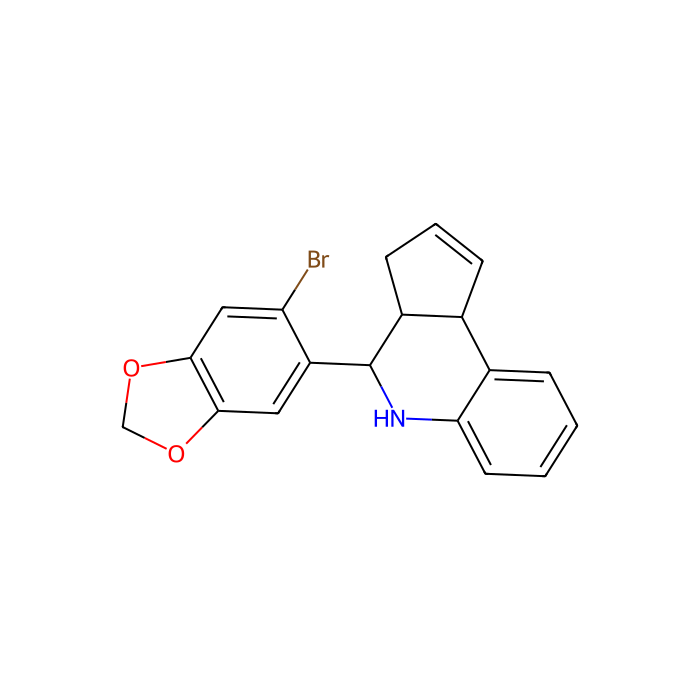
| Sonrisas canónicas | C1C=CC2C1C(NC3=CC=CC=C23)C4=CC5=C(C=C4Br)OCO5 |
| IUPAC Name | (3aS,4R,9bR)-4-(6-bromo-1,3-benzodioxol-5-yl)-3a,4,5,9b-tetrahydro-3H-cyclopenta[c]quinoline |
| InChIKey | YOLTZIVRJAPVPH-MJLGCCKJSA-N |
| INCHI | 1S/C19H16BrNO2/c20-15-9-18-17(22-10-23-18)8-14(15)19-13-6-3-5-11(13)12-4-1-2-7-16(12)21-19/h1-5,7-9,11,13,19,21H,6,10H2/t11-,13-,19+/m0/s1 |
| Isómeros SMILES | C1C=C[C@@H]2[C@H]1[C@@H](NC3=CC=CC=C23)C4=CC5=C(C=C4Br)OCO5 |
| Peso molecular | 370.24 |
| Reaxy-Rn | 25760746 |
| Reaxys-RN_link_address | https://www.reaxys.com/reaxys/secured/hopinto.do?context=S&query=IDE.XRN=25760746&ln= |
Comprehensive hazard, handling, storage, and regulatory compliance document.
Download SDS →Lot-specific quality data. Enter your lot number to retrieve the exact COA.
Look up COA →Full quality attributes and acceptance criteria for this grade.
View spec sheet →Taxonomy Tree
| Kingdom | Organic compounds |
|---|---|
| Superclass | Organoheterocyclic compounds |
| Clase | Quinolines and derivatives |
| Subclass | Hydroquinolines |
| Intermediate Tree Nodes | Not available |
| Direct Parent | Hydroquinolines |
| Alternative Parents | Benzodioxoles Secondary alkylarylamines Aralkylamines Benzenoids Aryl bromides Oxacyclic compounds Azacyclic compounds Acetals Organopnictogen compounds Organobromides Hydrocarbon derivatives |
| Molecular Framework | Aromatic heteropolycyclic compounds |
| Substituents | Tetrahydroquinoline - Benzodioxole - Secondary aliphatic/aromatic amine - Aralkylamine - Aryl bromide - Aryl halide - Benzenoid - Acetal - Oxacycle - Secondary amine - Azacycle - Organonitrogen compound - Organobromide - Organohalogen compound - Hydrocarbon derivative - Organopnictogen compound - Organic oxygen compound - Organooxygen compound - Amine - Organic nitrogen compound - Aromatic heteropolycyclic compound |
| Descripción | This compound belongs to the class of organic compounds known as hydroquinolines. These are derivatives of quinoline in which in which at least one double bond in the quinoline moiety are reduced by adding two hydrogen atoms. |
| External Descriptors | Not available |
| Activity Type | Activity Value -log(M) | Mechanism of Action | Activity Reference | Publications (PubMed IDs) |
|---|
| Activity Type | Relation | Activity value | Units | Action Type | Journal | PubMed Id | doi | Assay Aladdin ID |
|---|
| Activity Type | Relation | Activity value | Units | Action Type | Journal | PubMed Id | doi | Assay Aladdin ID |
|---|
| Activity Type | Relation | Activity value | Units | Action Type | Journal | PubMed Id | doi | Assay Aladdin ID |
|---|
| Activity Type | Relation | Activity value | Units | Action Type | Journal | PubMed Id | doi | Assay Aladdin ID |
|---|
| Activity Type | Relation | Activity value | Units | Action Type | Journal | PubMed Id | doi | Assay Aladdin ID |
|---|
Find and download the COA for your product by matching the lot number on the packaging.
| Lot Number | Certificate Type | Fecha | Articulo |
|---|---|---|---|
 L2322030 L2322030 | Certificate of Analysis | Sep 21, 2026 | G286562 |
| J2115164 | Certificate of Analysis | Jul 15, 2024 | G286562 |
| J2115202 | Certificate of Analysis | Jul 15, 2024 | G286562 |
| J2115206 | Certificate of Analysis | Jul 15, 2024 | G286562 |
| J2115245 | Certificate of Analysis | Jul 15, 2024 | G286562 |
| Solubilidad | Solvent:DMSO, Max Conc. mg/mL: 18.51, Max Conc. mM: 50 |
|---|---|
| Sensibilidad | light sensitive |
| Peso molecular | 370.200 g/mol |
| XLogP3 | 4.900 |
| Hydrogen Bond Donor Count | 1 |
| Hydrogen Bond Acceptor Count | 3 |
| Rotatable Bond Count | 1 |
| Exact Mass | 369.036 Da |
| Monoisotopic Mass | 369.036 Da |
| Topological Polar Surface Area | 30.500 Ų |
| Heavy Atom Count | 23 |
| Formal Charge | 0 |
| Complexity | 484.000 |
| Isotope Atom Count | 0 |
| Defined Atom Stereocenter Count | 3 |
| Undefined Atom Stereocenter Count | 0 |
| Defined Bond Stereocenter Count | 0 |
| Undefined Bond Stereocenter Count | 0 |
| The total count of all stereochemical bonds | 0 |
| Covalently-Bonded Unit Count | 1 |
No tested application protocols are provided in the Product Data for this item. The following general templates can help design robust workflows once solubility and stability are verified for G‑15.
Stock solution preparation (general)
Biochemical assay dosing (general)
Stability check (general)
Analytical QC (general)
Note: For any target- or assay-specific parameters (e.g., cofactors, substrates, cell lines), follow your validated internal SOPs or primary literature. No item-specific dilutions, positive controls, WB/IHC/IF/FC conditions are provided for this product.
Item-specific biological roles are not provided in the Product Data and must not be inferred. The following guidance outlines how Moligand™ small molecules are commonly positioned in research.
General (not specific to this item)
Assay implications (general)
Compliance note
This product is a small-molecule ligand and not a buffering reagent. As such, it is not typically used to establish or maintain pH in solution.
Practical note (general)
Buffer specifications (item-specific)
Context: For small-molecule screening ligands, the principal environmental impact often arises from solvent use and cold-chain logistics rather than the compound itself. Without item-specific synthesis or solvent requirements, greener practice focuses on solvent choice and workflow design.
Greener solvent strategies (general)
Comparison (general guidance)
Operational improvements
Waste management
Note: No alternative chemical substitute for G‑15 can be recommended without the verified structure and use context; consider class-matched ligands with better safety/environmental profiles once the target and SAR are defined.
No pharmacopeial/excipient status or formulation role is provided for this Moligand™ research chemical.
Item-specific status
General guidance (non-clinical)
Compliance statement: For research use only. Not for human or veterinary use, not for diagnostic procedures.
Summary: Definitive physicochemical specifications are not provided in the Product Data and must be taken from the CoA for the supplied lot.
Item-specific specs (Product Data)
Typical handling form (general for small-molecule ligands)
Solubility and partitioning (general/literature guidance)
Thermal properties (literature/general)
Density/UV cutoff/trace metals/peroxide: Not specified for this item; refer to CoA/Spec Sheet.
Practical note: If you will quantify by UV/Vis or LC–UV, determine the compound’s absorbance maxima from a test spectrum after obtaining the verified structure; do not assume chromophores without confirmation.
Grade definition for this item: Moligand™ (Aladdin) — denotes small‑molecule ligands curated for research screening, target engagement studies, and chemical biology. This labeling emphasizes suitability for in vitro research; it is not a pharmacopoeial grade and is not intended for human or veterinary use.
Item-specific (from Product Data)
What Moligand™ typically implies (general information)
Stabilizers/additives
Practical guidance
Scope: This section focuses on research uses of a Moligand™ small-molecule entry in discovery workflows rather than synthetic transformations, since no reactive functional groups or synthetic role are specified for this item.
Research applications (general for small-molecule ligands)
Assay setup considerations (general)
Analytics
Note: Specific mechanistic/target claims for G‑15 are not provided in the Product Data and should not be assumed. Refer to the CoA or primary literature once the exact structure is verified.
This Moligand™ listing is intended for use as a research ligand rather than as a reagent in chemical synthesis. No reaction condition data are provided for this item.
If derivatization is planned (general guidance only)
Yields/timelines: Not specified for this item; literature values depend entirely on structure and transformation and must not be assumed.
Note: For assay preparation (non-synthetic), typical conditions involve dissolving the solid in anhydrous DMSO at room temperature, followed by sterile filtration if required for cell-based work.
Safety overview: Specific GHS data are not provided in the Product Data. Treat G‑15 as a research chemical of unknown toxicity and handle under prudent laboratory practices. Always consult the item SDS for authoritative safety information.
Item-specific (from Product Data)
General laboratory precautions (general guidance)
First-aid overview (general guidance; defer to SDS)
Waste: Dispose of in accordance with institutional hazardous waste protocols; do not discharge to drains.
Intent: Provide practical guidance for preparing stocks and working solutions for a Moligand™ small-molecule ligand when specific solubility data are not supplied.
Primary solvent choices (general best practices)
Polarity/miscibility (general)
Practical tips
Comparison snapshot (general)
Item-specific conditions (from Product Data)
Reconstitution guidance (general for small-molecule ligands)
Stability notes
Compliance: For research use only.
Overview: G-15 (SKU G286562) is supplied under Aladdin’s Moligand™ line as a small‑molecule research ligand. Item-specific identifiers are limited in the provided Product Data; consult the CoA/Spec Sheet for full structural details.
Item-specific (from Product Data)
Structural features (general guidance)
2D structure description (general)
Registry cross-references
Note: Where identifiers appear inconsistent (e.g., abbreviated InChIKey), the CoA/Spec Sheet and SDS are the authoritative sources for structure and identity.
Given the absence of structural and functional group information in the Product Data, no specific synthetic transformations can be advised for this item. The following content is general to small molecules and may guide those considering derivatization after confirming the exact structure.
General considerations (not specific to this item)
Analytical support
Caution
Item-specific target, selectivity profile, and binding constants are not provided in the Product Data for G‑15.
Verified data required
General guidance
Note: No target claims are made here. This product is sold strictly for research use without implied biological performance guarantees.
Our grade selection guide covers purity, stabilizer status, and application suitability for all variants in our catalog.
View Moligand™ grade guide →