This compound belongs to the class of organic compounds known as aminoglycosides. These are molecules or a portion of a molecule composed of amino-modified sugars.
External Descriptors
Not available
1. Djoumbou Feunang Y, Eisner R, Knox C, Chepelev L, Hastings J, Owen G, Fahy E, Steinbeck C, Subramanian S, Bolton E, Greiner R, and Wishart DS. ClassyFire: Automated Chemical Classification With A Comprehensive, Computable Taxonomy. Journal of Cheminformatics, 2016, 8:61.
Determine the necessary mass, volume, or concentration for preparing a solution.
Dilution Calculator
Determine the dilution needed to prepare a stock solution.
Reconstitution Calculator
Reseñas
Reseñas de cliente
Application Protocols
No item-specific, validated protocols are provided. The following are general, literature-style workflows for macrolide research; adapt to your system.
MIC determination (broth microdilution, general):
Prepare a sterile stock solution in DMSO or methanol (e.g., 1–10 mg/mL).
Dispense two-fold serial dilutions across microtiter wells in cation-adjusted Mueller–Hinton broth, keeping final DMSO ≤1% (v/v).
Inoculate with standardized bacterial suspension (e.g., 5×10^5 CFU/mL).
Incubate at 35–37 °C for 16–20 h; read MIC as the lowest concentration with no visible growth.
LC–MS/MS quantitation (general):
Spike samples with internal standard.
Perform protein precipitation (ACN or MeOH, 3× volume) or SPE (mixed-mode cation exchange).
Chromatography: C18, gradient water/ACN with 0.1% FA; monitor positive ESI transitions optimized for the macrolide.
Validate linearity, matrix effects, accuracy, precision, and stability per accepted guidelines.
Cell-based assays:
Dilute DMSO stocks into culture media; verify absence of precipitation by visual inspection and test a vehicle control.
Always confirm solvent compatibility and exposure limits for your biological system. Sterilize working solutions by 0.22 µm filtration where needed.
Biological Roles
General macrolide/azalide biology (no clinical claims):
Primary molecular target: The 50S ribosomal subunit (23S rRNA, nascent peptide exit tunnel). Binding blocks elongation/translocation, leading to inhibition of bacterial protein synthesis.
Pharmacology class: Macrolide/azalide; typically exerts bacteriostatic effects at standard exposures, with bactericidal activity possible against select organisms at higher concentrations (organism- and condition-dependent).
Cellular distribution: Amphiphilic weak base with a tertiary amine; tends to accumulate in acidic organelles and phagocytic cells via ion trapping, a property exploited in distribution studies.
Resistance mechanisms:23S rRNA methylation (erm), efflux pumps (mef/msr), and target mutations; cross-resistance patterns are of research interest when profiling macrolides.
Biotransformation: Macrolides can undergo O- and N-dealkylation, lactone hydrolysis, and phase II conjugation in biological systems; stability is matrix- and pH-dependent.
Assay implications: Potency often decreases with high protein binding or at alkaline pH where the fraction of protonated species is lower.
Use this material as a research tool compound to interrogate ribosome function, study resistance determinants, and benchmark analytical methods (e.g., LC-MS/MS in complex matrices). For in vitro work, maintain consistent pH and protein content to ensure reproducible apparent potency.
Buffer Applications
This product is not a buffering reagent. However, buffer conditions strongly influence its solubility and assay performance.
Practical guidance (general):
Stock preparation: Prepare in DMSO, methanol, or ethanol; dilute into assay buffer while keeping final organic ≤0.5–1% (v/v) when possible.
pH effects: Solubility and ionization increase in mildly acidic buffers (e.g., acetate, citrate, or phosphate adjusted to pH 5.5–6.5). At neutral pH, use DMSO cosolvent to avoid precipitation.
Common assay buffers:
Phosphate-buffered saline (PBS): pH ~7.2–7.4; may require DMSO cosolvent.
HEPES or MOPS: Suitable for cell-based assays; check precipitation upon dilution.
Acetate buffer (pH 4.5–5.5): Enhances solubility for analytical sample prep and some microbiological media adjustments.
Sterile filtration: If used in microbiological assays, filter a working solution (0.22 µm) rather than terminally sterilizing by heat.
Recipes and exact concentrations depend on your assay and organism/system; verify compatibility with cells/enzymes and maintain consistent pH/ionic strength to ensure reproducibility.
Green Alternatives
As a complex macrolide analyte/standard, “green alternatives” center on solvent and workflow choices rather than replacing the active itself.
Greener solvent choices (general guidance):
Prefer ethanol or isopropanol over chlorinated solvents where feasible for stock preparation or cleaning.
Use water with mild acidification (formic or acetic acid) for LC mobile phases rather than non-volatile mineral acids.
For extraction, consider ethyl acetate or 2-MeTHF instead of dichloromethane when partitioning behavior allows.
Mini-comparison (general; not product specs):
Ethanol vs Methanol: Ethanol is less toxic and more sustainable; methanol may dissolve macrolides slightly faster and evaporates more readily.
ACN vs MeOH in LC: ACN provides lower backpressure and sharper peaks; MeOH is greener but may require higher pressures/longer times.
Closed-vial handling and cold storage minimize degradation and waste.
Note: The choice of greener solvents must not compromise analyte stability; macrolide glycosidic and ketal linkages are sensitive to strong acid/base and prolonged heating.
Pharmaceutical Uses
Context for formulation and manufacturing research (no therapeutic/clinical claims):
Role: Gamithromycin is a macrolide/azalide active pharmaceutical ingredient (API) used in veterinary medicine; in a research/manufacturing context it serves as a reference standard for analytical method development, impurity profiling, and stability studies.
Form considerations: Free base vs. salt forms can differ markedly in solubility, hygroscopicity, and crystallinity; define the form used when developing methods or formulations.
Excipients (general): For solution formulations, co-solvents (e.g., ethanol, propylene glycol), acidity regulators (e.g., citric or acetic acid), and antioxidants may be employed depending on stability needs.
Analytical controls: Establish system suitability using known reference lots; track related substances using validated gradient RP-HPLC or LC-MS methods with volatile acids (e.g., 0.1% formic).
Stability studies: Conduct ICH-like stress (acid/base hydrolysis, oxidation, thermal, photolysis) to define degradation pathways and support stability-indicating methods; monitor lactone integrity and sugar stability.
Regulatory note: For laboratory research and development only unless accompanied by appropriate regulatory documentation; this catalog item is designated For research use only.
Physical Properties
Item-specific physico-chemical data:
Appearance: Not specified for this item; refer to CoA/Spec Sheet.
Grade/Purity: Not specified for this item; refer to CoA/Spec Sheet.
Molecular weight: Not specified for this item; refer to CoA/Spec Sheet.
Molecular formula: Not specified for this item; refer to CoA/Spec Sheet.
General/literature expectations for macrolide/azalide solids (for planning only; not product specifications):
State: Typically an off-white to beige solid; macrolides can be amorphous or microcrystalline depending on salt/form.
Acid–base behavior: Weakly basic due to the dimethylamino sugar; macrolide pKa values (for the basic center) often near 8–9 (literature, class trend).
Solubility profile:
Good solubility in DMSO and methanol; moderate in acetonitrile; limited in nonpolar solvents.
Aqueous solubility is low at neutral pH but improves in acidified water (formation of protonated species).
Partitioning: Amphiphilic; cationic at acidic pH with increased aqueous compatibility; neutral/basic forms prefer organic media.
Hygroscopicity: Many macrolides are moisture-sensitive; hydration and amorphous transitions can occur upon humidity exposure.
Use notes:
For quantitative work (e.g., MIC assays), determine actual solubility in your chosen matrix experimentally.
Avoid strong base/strong acid when stability of glycosidic and ketal linkages is critical.
Refractive index, UV cutoff, metal content, water content: Not specified for this item; refer to CoA/Spec Sheet.
Quality and Grades
Grade/Purity: Not specified for this item; refer to CoA/Spec Sheet.
Guidance on quality considerations for macrolide research materials (general):
Identity confirmation: Verify by orthogonal techniques (e.g., 1H/13C NMR in CD3OD, HRMS, and HPLC/UPLC purity assessment). Macrolides often show multiple rotamers/conformers; broadened resonances are common.
Purity vs. salt/form: Macrolides can be supplied as free base or as acid salts (e.g., tartrate, citrate). The salt form impacts assay potency and solubility; ensure your method and calculations reflect the correct counterion content.
Chromatographic profile: HPLC UV at 210–220 nm is commonly used; ELSD or CAD detection is useful when UV chromophores are weak.
Residual solvents/water: Many macrolides are hygroscopic; Karl Fischer and LOD can vary with storage history. If critical, measure prior to gravimetric dosing.
Impurities: Typical related substances include O-/N-dealkylated species, lactone-opened acids, and sugar-hydrolyzed congeners. Gradient methods on C18 with acidic modifiers aid separation.
Documentation: Request the CoA/Spec Sheet for batch-specific assay, water, and residual solvent data, as well as salt/form information and recommended reference methods.
Stabilizers/inhibitors: Not specified for this item; refer to CoA/Spec Sheet.
Reaction and Applications
This compound is not typically used as a general-purpose reagent or solvent; it is a complex macrolide used primarily as a reference standard, analytical control, or bioactive probe in microbiology and chemical biology research.
Research applications (general):
Microbial susceptibility testing: Establish MIC/IC50 values against bacterial panels; compare to other macrolides/azalides.
Mechanistic studies: Probe 50S ribosomal subunit binding and translation inhibition in cell-free systems.
Pharmacokinetic and tissue distribution research (preclinical): Analyze extraction, stability, and quantitation protocols by LC-MS/MS (no clinical use claims).
Stability/forced degradation studies: Map degradation pathways (acid/base, oxidative, thermal, photolytic) to support analytical method validation.
Analytical chemistry considerations:
Sample prep: Protein precipitation (ACN/MeOH), solid-phase extraction (SPE, mixed-mode cation exchange), or liquid–liquid extraction with pH control to retain protonated form in aqueous or transfer to organic as needed.
Detection: Positive ESI MS/MS is typically sensitive due to tertiary amine; optimize source temperature to minimize in-source fragmentation of glycosidic linkages.
Because of its size and functionality, gamithromycin is rarely employed in synthetic transformations as a building block; see “Synthetic Utility” for limited derivatization notes.
Reaction Conditions
This compound is not commonly used as a reagent in standard organic reactions. Where chemical modification is pursued (general guidance):
Solvents: Dry, polar aprotic media (e.g., DMF, DMSO, MeCN) for coupling/alkylation; CH2Cl2 or EtOAc for acylation under mild base (e.g., pyridine, DIPEA). Prefer greener choices (EtOAc, MeCN) where possible.
Temperatures: Typically 0–25 °C to preserve glycosidic/ketal integrity; brief warming to 40 °C may be acceptable for sluggish reactions with monitoring.
Bases/Acids: Use non-nucleophilic, mild bases (DIPEA, TEA) and weak acids (AcOH, TFA in small amounts, short times). Avoid strong mineral acids/bases and prolonged exposure.
Coupling reagents: For carbamate/carbonate/ester formation, use carbonyldiimidazole (CDI), NHS/EDC, or p-nitrophenyl carbonates under mild conditions.
Protecting groups: Employ silyl (TBDMS/TBS) or acyl protections to control chemoselectivity; remove under gentle conditions (e.g., HF-pyridine alternatives avoided; use TBAF or mild acid carefully).
Workup/purification: Quench to near-neutral pH, extract with EtOAc, and purify by RP-HPLC if needed; monitor by LC-MS (positive ESI).
Expected yields are highly transformation- and site-dependent for complex natural products; plan for modest yields with careful optimization and extensive analytical verification.
Safety and Handling
GHS classification, signal word, pictograms, H-statements: Not specified for this item; refer to the SDS for authoritative safety information.
Intended use: For research use only.
General laboratory safety guidance for macrolide powders (general chemistry knowledge):
PPE: Lab coat, nitrile gloves, and splash-resistant safety glasses. Handle powders in a fume hood or ventilated enclosure to avoid inhalation of aerosols/particulates.
Avoid exposure: Prevent skin/eye contact and inhalation; macrolides may cause irritation or sensitization in susceptible individuals.
First aid (overview):
Skin/eye contact: Rinse with plenty of water for ≥15 minutes; remove contaminated clothing; seek medical attention if irritation persists.
Inhalation: Move to fresh air; monitor breathing; obtain medical advice if symptoms occur.
Ingestion: Rinse mouth; do not induce vomiting; seek medical advice.
Handling cautions:
Avoid strong acids/bases and prolonged heating that may cleave glycosidic/ketal linkages or open the lactone.
Prevent moisture ingress; many macrolides are humidity sensitive and may clump or degrade in wet conditions.
Incompatibilities (typical): Strong oxidizers; strong acids/bases under forcing conditions.
Spill response: Avoid dust generation; collect with damp disposable towels or HEPA vacuum; dispose according to institutional and local regulations.
Waste: Treat as organic chemical waste; incineration via licensed contractor is common.
Always consult the SDS provided with the product for material-specific hazards, toxicological data, and regulatory transport classifications.
Solvent Selection
Gamithromycin is a large, amphiphilic, weakly basic macrolide. Practical dissolution strategy (general guidance):
Primary solvents:
DMSO: Excellent solubilizer; recommended for concentrated stock solutions for bioassays; miscible with water for serial dilutions.
Methanol or ethanol: Good solubility for preparing intermediate stocks; can be diluted into buffered media.
Acetonitrile: Moderate solubility; compatible with LC-MS sample prep.
Aqueous media: Limited solubility at neutral pH; improves with mild acidification (e.g., 0.1%–0.5% formic or acetic acid) due to protonation of the amine. Avoid strong acid that can compromise glycosidic integrity upon prolonged exposure.
Nonpolar solvents (hexanes, toluene): Generally poor solubility; not recommended.
Comparison (general):
DMSO vs MeOH: DMSO gives higher stock concentration and better long-term stability; MeOH facilitates rapid drying/removal and suits LC-MS.
Acidified water vs buffers at pH 7–8: Acidified water increases solubility but may affect biological systems; neutral buffers preserve assay conditions but may require DMSO cosolvent.
Tips:
Prepare a 10–100 mM DMSO stock for screening, then perform serial dilutions into assay buffer with final DMSO ≤0.5–1% (v/v) as permitted by the system (general practice).
Warm gently (≤40 °C) and vortex/sonicate to assist dissolution; filter through 0.22 µm if sterility is required.
For LC-MS, use ACN/H2O with 0.1% FA to enhance ionization and peak shape.
Storage and Reconstitution
Storage conditions (item-specific): Store at -20 °C, argon charged.
Shipping: Ice chest + ice pads (cold chain).
Best practices (general):
Protection: Keep container tightly sealed, protected from moisture and light. Purge headspace with inert gas (argon or nitrogen) after each use to limit oxidative/hydrolytic degradation.
Temperature excursions: Short-term handling at room temperature is acceptable for weighing and solution prep; return to -20 °C promptly.
Reconstitution:
Dissolve in DMSO for concentrated stocks; alternatives include methanol or ethanol.
For aqueous use, dilute organic stocks into buffer with gentle mixing; consider mild acidification to enhance solubility if biologically acceptable.
Concentration and filtration: Prepare working solutions freshly; filter through 0.22 µm if sterility is required.
Aliquoting: Prepare single-use aliquots to avoid repeated freeze–thaw cycles.
Stability notes: Macrolides can degrade under strong acid/base, high humidity, and heat; monitor by HPLC/LC-MS for long experiments.
If the exact salt/form and stability-indicating methods are critical for your application, consult the CoA/Spec Sheet for batch-specific details.
Structure and Identity
SKU: G333703 Product name: Gamithromycin
CAS: 145435-72-9
PubChem CID: 59364992
InChIKey (as provided): 389949
SMILES: Not specified for this item; refer to CoA/Spec Sheet.
Molecular formula: Not specified for this item; refer to CoA/Spec Sheet.
Molecular weight: Not specified for this item; refer to CoA/Spec Sheet.
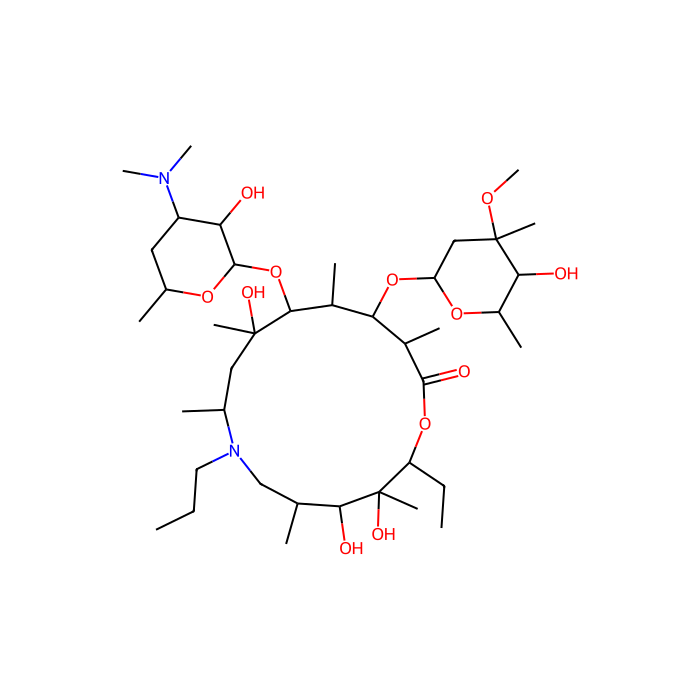
Core scaffold: Large macrocyclic lactone ring containing an inserted nitrogen (azalide) relative to classic 14-membered macrolides.
Sugar moieties: Typically bears a desosamine amino sugar (tertiary dimethylamino functionality, basic) and a neutral deoxy sugar attached via O-glycosidic linkages to the lactone.
Functional groups: Tertiary amine (cationic under acidic conditions), multiple hydroxyls, ethers, acetal/ketal motifs, and the lactone carbonyl.
Stereochemistry: Highly stereodefined with numerous chiral centers across the macrocycle and sugars; macrolides generally exist as single stereochemical arrays defined by their semi-synthetic lineage.
2D structure in words: A large, oxygen-rich macrocycle with pendant sugars; one sugar carries a dimethylamino group, conferring basicity and cationic behavior at physiological/acidic pH; extensive oxygenation provides amphiphilic character.
Notes:
Identity elements such as exact SMILES or full InChI should be taken from the product CoA or authoritative databases for record-keeping and registration.
Synthetic Utility
Gamithromycin is not a routine synthetic building block; however, as a richly functionalized macrolide it supports selective derivatization for probe and SAR studies (general chemistry guidance):
Amine functionalization: The tertiary amine on the desosamine sugar can be quaternized or converted to salts; careful conditions avoid glycosidic cleavage.
Acylation/alkylation: Hydroxyl groups on the macrocycle/sugars allow acylation, carbamate, or carbonate formation; selectivity often achieved via protecting-group strategies (e.g., silyl, acyl).
Oxidation/reduction: Limited, site-selective redox adjustments can tune polarity; avoid over-oxidation near sensitive ketals/acetals.
Conjugation: Installation of fluorophores or affinity tags via NHS-esters or click handles (after introducing azide/alkyne) is feasible for imaging/target engagement studies.
Prodrug approaches: Transient esters/carbonates at alcohol sites can modulate permeability/solubility for in vitro delivery experiments.
Analytical derivatization: Formation of more ionizable adducts for MS sensitivity or chromophores for HPLC-UV detection.
Caveats:
The macrocycle contains acid- and base-labile linkages (glycosides, ketals, lactone). Employ mild, chemoselective conditions, low temperatures, and short exposure times.
Stereochemical integrity is critical; avoid conditions that promote sugar anomerization or lactone opening.
Purification often benefits from reverse-phase chromatography with volatile modifiers.
Target Specificity
This listing is a small-molecule macrolide, not an antibody or biologic; therefore, antigen/epitope/clone/isotype information does not apply.
General target interaction (biochemical context):
Binds to the bacterial 50S ribosomal subunit (23S rRNA) within the peptide exit tunnel, overlapping with other macrolides.
Selectivity is driven by rRNA sequence/structure; activity is typically limited to prokaryotic ribosomes, with substantially lower affinity for eukaryotic cytosolic ribosomes.
For detailed binding constants or species selectivity, consult primary literature specific to gamithromycin or closely related azalides.
We use cookies to ensure the website functions properly and, where permitted, to improve your experience. You can manage your preferences at any time in Settings. Learn more in our Cookie Policy.
Shall we send you a message when we have discounts available?
Remind me later
Thank you! Please check your email inbox to confirm.
Products are supplied to verified businesses, institutions, and qualified professionals for research and development use only. Not for use in humans, animals, diagnosis, or therapy.

 A2304151