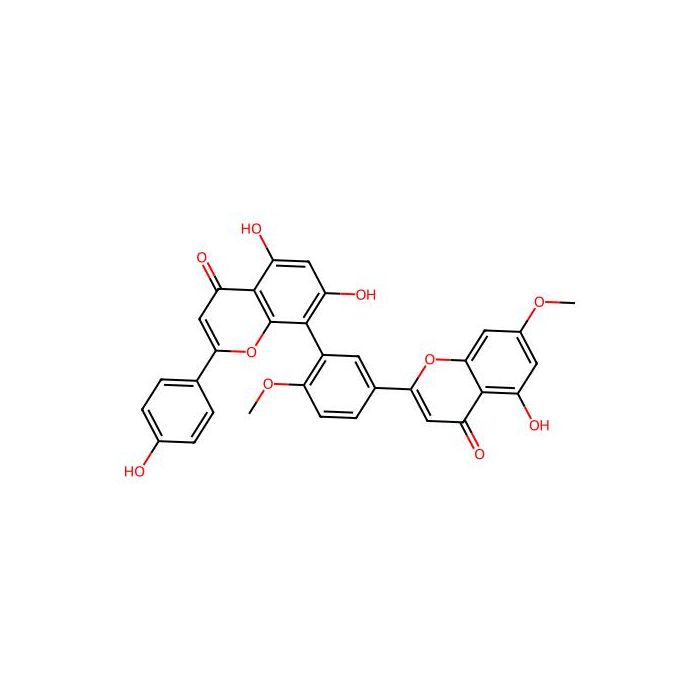
Ginkgetin - Moligand™,≥97% , CAS No.481-46-9

CAS: 481-46-9 Cat. No.: G646748 Fórmula: C32H22O10 Peso molecular: 566.51 PubChem CID: 5271805
Disponible para pedir
GRADE & PURITY Moligand™ ? Moligand™ — Aladdin's line of ligands and bioactive small molecules. Use for receptor, pathway, and binding studies needing defined small-molecule tools. ≥97%
Synonyms
AKOS015896770 | DTXSID70197416 | 3''',8-Biflavone, 4',5,5'',7-tetrahydroxy-4''',7''-dimethoxy- | 7,4'-Dimethylamentoflavone | Q-100523 | SCHEMBL888410 | BSPBio_003374 | HY-N0889 | LMPK12040003 | Spectrum5_000339 | 4''',5,5'',7''-tetrahydroxy-4',7-dimethox
Storage
Protected from light,Store at -20°C,Desiccated
Shipped In
Ice chest + Ice pads
★
Size
Alemania (EU)
USA*
Price
Qty
1mg
G646748-1mg
Fabricado bajo pedido · 8–12 semanas
32,89€
5mg
G646748-5mg
Fabricado bajo pedido · 8–12 semanas
81,48€
10mg
G646748-10mg
Fabricado bajo pedido · 8–12 semanas
130,07€
25mg
G646748-25mg
Fabricado bajo pedido · 8–12 semanas
225,53€
50mg
G646748-50mg
Fabricado bajo pedido · 8–12 semanas
338,33€
Enter a quantity for the sizes you want to add.
🧪

Why this grade

Moligand™,≥97% Moligand™ for sensitive chromatographic and analytical workflows requiring minimal baseline interference.

🌡

Storage & shipping

Protected from light,Store at -20°C,Desiccated Ships Ice chest + Ice pads Check lot-specific COA for exact specifications.

📋

Quality documents

SDS, COA, datasheet, and spec sheet available for download. Lot-specific COA accessible via lot number lookup.

📚

Literature proof

Cited in 0 peer-reviewed publications across chromatography, organic synthesis, and cross-coupling reactions.

Descripción general

Ginkgetin, a biflavone, is isolated from Ginkgo biloba leaves. Ginkgetin exhibit anti-tumor, anti-inflammatory, neuroprotective, anti-fungal activities. Ginkgetin is also a potent inhibitor of Wnt signaling , with an IC 50 of 5.92 μΜ.

In Vitro

Ginkgetin (2.5-20 μM; 48 h) inhibits the growth of Daoy and D283 cell lines, and induces G 2 /M cell cycle arrest in Daoy cells. Ginkgetin (20-40 μM; 24 h) significantly activates the apoptosis of osteosarcoma cells in a concentration-dependent manner. Ginkgetin (10-20 μM; 3-24 h) down-regulated the expression of Wnt target genes without affecting the expression of β-catenin in medulloblastoma cells. Ginkgetin (1-10 μM; 24 or 48 h) significantly inhibits the VEGF-induced endothelial cell proliferation, migration, and wound recovery in a concentration-dependent manner. Ginkgetin (5-10 μM; 48 h) induces autophagy responsible for cell death in A549 . MCE has not independently confirmed the accuracy of these methods. They are for reference only. Cell Viability AssayCell Line: Daoy and D283 cell lines Concentration: 2.5, 5, 10, 20 μM Incubation Time: 48 hours Result: Inhibited the cell growth, with IC 50 s of 14.65 and 15.81 μM for Daoy and D283 cells, respectively. Apoptosis AnalysisCell Line: Osteosarcoma cells Concentration: 20, 30, 40 μM Incubation Time: 24 hours Result: Markedly induced the apoptosis of osteosarcoma cells in a concentration-dependent manner. Cell Cycle AnalysisCell Line: Daoy cells Concentration: 2.5, 5, 10, 20 μM Incubation Time: 24 hours Result: Increased G 2 /M phase, compared with that of control, indicating a G 2 /M cell phase arrest. Cell Cycle AnalysisCell Line: Daoy and D283 cell lines Concentration: 10, 20 μM Incubation Time: 3, 6, 12, 24 hours Result: Attenuated the expression of Wnt target genes, Axin2, cyclin D1 and survivin at 20 μM for 24 h in Daoy cells. Unaffected the level of total β-catenin and diminished the level of β-catenin phosphorylation in a time- and concentration-dependent manner.

In Vivo

Ginkgetin (25-100 mg/kg; i.p. 2 hours after the onset of ischemia) exerts anti-inflammatory effects on cerebral ischemia/reperfusion-induced injury in a rat model via the TLR4/NF-κB signaling pathway. Ginkgetin (30 mg/kg; intragastrically once per day for 42 d) suppresses tumor growth in A549 cells bearing nude mice. MCE has not independently confirmed the accuracy of these methods. They are for reference only. Animal Model: Male Sprague-Dawley rats (200-220 g)Dosage: 25, 50, 100 mg/kg Administration: I.p. 2 hours after the onset of ischemia Result: Reduced the neurological deficit score. Suppressed the expression of NF-κB, TLR4 and IκBαin ischemic penumbra cortex, and inhibited the degradation of IκBα. Decreased the expressions of ICAM-1, COX-2, and iNOS. Downregulated downstream inflammatory factor PGE2 and TNF-α expression. Decreased IL-1β, IL-6, IL-8, and IL-10 protein expression.

Form:Solid

Specifications

Sinónimos
AKOS015896770 | DTXSID70197416 | 3''',8-Biflavone, 4',5,5'',7-tetrahydroxy-4''',7''-dimethoxy- | 7,4'-Dimethylamentoflavone | Q-100523 | SCHEMBL888410 | BSPBio_003374 | HY-N0889 | LMPK12040003 | Spectrum5_000339 | 4''',5,5'',7''-tetrahydroxy-4',7-dimethox
Especificaciones y pureza
Moligand™,≥97%
Mecanismos bioquímicos y fisiológicos
Ginkgetin, a biflavone, is isolated from Ginkgo biloba leaves. Ginkgetin exhibit anti-tumor, anti-inflammatory, neuroprotective, anti-fungal activities. Ginkgetin is also a potent inhibitor of Wnt signaling , with an IC 50 of 5.92 μΜ.
Condiciones de almacenamiento de almacenamiento
Protected from light,Store at -20°C,Desiccated
Enviado en
Ice chest + Ice pads
Este producto requiere envío en cadena de frío. Los servicios terrestres y otros servicios económicos no están disponibles.
Grado
Moligand™
Tipo de acción
INHIBITOR
Pureza
≥97%
Nombres e identificadores
Sonrisas canónicasCOC1=C(C=C(C=C1)C2=CC(=O)C3=C(C=C(C=C3O2)OC)O)C4=C(C=C(C5=C4OC(=CC5=O)C6=CC=C(C=C6)O)O)O
IUPAC Name5,7-dihydroxy-8-[5-(5-hydroxy-7-methoxy-4-oxochromen-2-yl)-2-methoxyphenyl]-2-(4-hydroxyphenyl)chromen-4-one
InChIKeyAIFCFBUSLAEIBR-UHFFFAOYSA-N
INCHI1S/C32H22O10/c1-39-18-10-20(34)30-23(37)13-27(41-28(30)11-18)16-5-8-25(40-2)19(9-16)29-21(35)12-22(36)31-24(38)14-26(42-32(29)31)15-3-6-17(33)7-4-15/h3-14,33-36H,1-2H3
Isómeros SMILES COC1=C(C=C(C=C1)C2=CC(=O)C3=C(C=C(C=C3O2)OC)O)C4=C(C=C(C5=C4OC(=CC5=O)C6=CC=C(C=C6)O)O)O
CAS alternativo 481-46-9
PubChem CID 5271805
Términos de entrada MeSH ginkgetin
Peso molecular 566.51

Documentation

📋 Safety Data Sheet (SDS)

Comprehensive hazard, handling, storage, and regulatory compliance document.

Download SDS →

✅ Certificate of Analysis (COA)

Lot-specific quality data. Enter your lot number to retrieve the exact COA.

Look up COA →

📊 Datasheet

Quick-reference summary of product specifications and applications.

View datasheet →

🔬 Specification Sheet

Full quality attributes and acceptance criteria for this grade.

View spec sheet →

Advanced Data

Taxonomic Classification

Taxonomy Tree

KingdomOrganic compounds
SuperclassPhenylpropanoids and polyketides
ClaseFlavonoids
SubclassBiflavonoids and polyflavonoids
Intermediate Tree Nodes Not available
Direct ParentBiflavonoids and polyflavonoids
Alternative Parents 4'-O-methylated flavonoids  7-O-methylated flavonoids  4'-hydroxyflavonoids  5-hydroxyflavonoids  7-hydroxyflavonoids  Flavones  Chromones  Methoxybenzenes  Anisoles  Phenoxy compounds  1-hydroxy-2-unsubstituted benzenoids  Alkyl aryl ethers  Pyranones and derivatives  1-hydroxy-4-unsubstituted benzenoids  Heteroaromatic compounds  Vinylogous acids  Oxacyclic compounds  Organic oxides  Hydrocarbon derivatives  
Molecular FrameworkAromatic heteropolycyclic compounds
Substituents Bi- and polyflavonoid skeleton - 4p-methoxyflavonoid-skeleton - 7-methoxyflavonoid-skeleton - 4'-hydroxyflavonoid - 5-hydroxyflavonoid - 7-hydroxyflavonoid - Flavone - Hydroxyflavonoid - Chromone - Benzopyran - 1-benzopyran - Phenoxy compound - Anisole - Methoxybenzene - Phenol ether - Phenol - 1-hydroxy-2-unsubstituted benzenoid - Pyranone - 1-hydroxy-4-unsubstituted benzenoid - Alkyl aryl ether - Benzenoid - Pyran - Monocyclic benzene moiety - Vinylogous acid - Heteroaromatic compound - Organoheterocyclic compound - Ether - Oxacycle - Organic oxygen compound - Organic oxide - Hydrocarbon derivative - Organooxygen compound - Aromatic heteropolycyclic compound
DescripciónThis compound belongs to the class of organic compounds known as biflavonoids and polyflavonoids. These are organic compounds containing at least two flavan/flavone units. These units are usually linked through CC or C-O-C bonds. Some examples include C2-O-C3, C2-O-C4, C3'-C3''', and C6-C8''.
External Descriptors Biflavonoids and polyflavonoids
Estructura 3D
Modelo de Estructura Química Interactiva


Certificados (CoA, COO, BSE/TSE y tabla de análisis)
C of A & Other Certificates(BSE/TSE, COO):
Analytical Chart:

Find and download the COA for your product by matching the lot number on the packaging.

5 results found

Lot NumberCertificate TypeFechaArticulo
G2624235Certificate of AnalysisFeb 11, 2026 G646748
G2624237Certificate of AnalysisFeb 11, 2026 G646748
G2624280Certificate of AnalysisFeb 11, 2026 G646748
G2624350Certificate of AnalysisFeb 11, 2026 G646748
G2624351Certificate of AnalysisFeb 11, 2026 G646748
Propiedades químicas y físicas
SolubilidadDMSO : ≥ 20.83 mg/mL (36.77 mM)
Peso molecular566.500 g/mol
XLogP35.700
Hydrogen Bond Donor Count4
Hydrogen Bond Acceptor Count10
Rotatable Bond Count5
Exact Mass566.121 Da
Monoisotopic Mass566.121 Da
Topological Polar Surface Area152.000 Ų
Heavy Atom Count42
Formal Charge0
Complexity1080.000
Isotope Atom Count0
Defined Atom Stereocenter Count0
Undefined Atom Stereocenter Count0
Defined Bond Stereocenter Count0
Undefined Bond Stereocenter Count0
The total count of all stereochemical bonds0
Covalently-Bonded Unit Count1
Calculadoras de soluciones
Reseñas

Reseñas de cliente

Preguntas frecuentes

What is the purity of this product?
This product is supplied at ≥97% purity (chemical assay). Lot-specific values are stated on the Certificate of Analysis.
What is Moligand??
Moligand? is one of Aladdin Scientific's premium product lines, formulated for high-purity applications across multiple workflows. Compared to standard grades in the same workflow, Moligand? products typically offer tighter specifications, more rigorous QC, and stronger lot-to-lot consistency.
How should this product be stored?
Store at ?20 °C, protected from light, desiccated. Keep the container tightly closed with desiccant — the material is moisture-sensitive.
How is this product shipped?
This product ships in an insulated container with ice pads. Unpack on arrival and transfer it to the storage condition stated above.
What are the CAS number, molecular formula and molecular weight?
The CAS Number is 481-46-9, the molecular formula is C32H22O10, and the molecular weight is 566.51 g/mol. InChIKey AIFCFBUSLAEIBR-UHFFFAOYSA-N.
What documentation is provided?
Available product documentation, including Certificates of Analysis (COA), Safety Data Sheets (SDS), and specification sheets, is shown in the product document area. Document availability and access follow the current site policy.

Need help choosing the grade?

Our grade selection guide covers purity, stabilizer status, and application suitability for all variants in our catalog.

View Moligand™ grade guide →

Shall we send you a message when we have discounts available?

Remind me later

Thank you! Please check your email inbox to confirm.

Oops! Notifications are disabled.