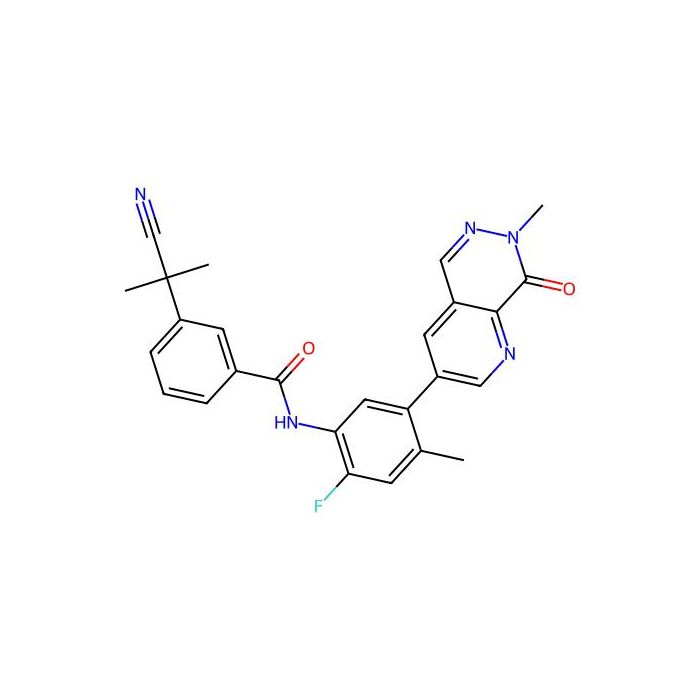
GNE-9815 (compound 7) is a highly selective, pan- RAF inhibitor with good oral bioavailability. GNE-9815 exhibits K i values of 0.062 and 0.19 nM for CRAF and BRAF , respectively. GNE-9815 combines with MEK inhibitor Cobimetinib shows synergistic modulation of MAPK pathway. GNE-9815 can be used in studies of KRAS mutant cancers
In Vitro
GNE-9815 shows synergistic activity in KRAS mutant A549 and HCT116 cancer cells in combination with the MEK inhibitor Cobimetinib. MCE has not independently confirmed the accuracy of these methods. They are for reference only.
In Vivo
GNE-9815 (15 mg/kg; p.o.; single) demonstrates synergistic MAPK pathway modulation when combines with the MEK inhibitor Cobimetinib in an HCT116 xenograft mouse model . GNE-9815 (5 mg/kg; p.o.; single) shows good oral bioavailability and (1 mg/kg; i.v.; single) exhibits low blood clearance, moderate volume of distribution, and short half-life . MCE has not independently confirmed the accuracy of these methods. They are for reference only. Animal Model: Female NCR nude mice (6 to 8-week-old; 24-26 g; HCT116 xenograft mice model) . Dosage: 15 mg/kg Administration: Intravenous injection or oral administration; single. Result: Resulted in pathway inhibition as demonstrated by partial inhibition of pRSK between 2 and 24 h, but more robust, albeit transient, inhibition of the downstream MAPK target genes, DUSP6 and SPRY4. Led to deeper inhibition of the downstream MAPK target genes DUSP6 and SPRY4, when combined with the MEK inhibitor Cobimetinib, with maximal inhibition at 8 h and with a more modest rebound in levels at 24 h, post final dose. Animal Model: Female NCR nude mice (6 to 8-week-old; 24-26 g) . Dosage: 1 mg/kg (for i.v.); 5 mg/kg (for p.o.). Administration: Intravenous injection or oral administration; single. Result: Exhibited CL b , V dss and t 1/2 values of 17 mL/min∙kg, 1.7 L/kg and 1.9 h, respectively. Showed good oral bioavailability with F% of 37%. (methylcellulose/Tween formulation).
IC50& Target:CRAF 0.062 nM (Ki) Braf 0.19 nM (Ki)
Especificaciones
Especificaciones y pureza
10mM in DMSO
Mecanismos bioquímicos y fisiológicos
GNE-9815 (compound 7) is a highly selective, pan- RAF inhibitor with good oral bioavailability. GNE-9815 exhibits K i values of 0.062 and 0.19 nM for CRAF and BRAF , respectively. GNE-9815 combines with MEK inhibitor Cobimetinib ( HY-13064 ) shows synergi
Condiciones de almacenamiento de almacenamiento
Store at -80°C
Enviado en
Dry ice packs + Cold packs
Este producto requiere envío en cadena de frío. Los servicios terrestres y otros servicios económicos no están disponibles.
Tipo de acción
INHIBITOR
Nombres e identificadores
Peso molecular
455.48
Datos avanzados
Certificados (CoA, COO, BSE/TSE y tabla de análisis)
C of A & Other Certificates(BSE/TSE, COO):
Analytical Chart:
Calculadoras de soluciones
Molarity Calculator
Determine the necessary mass, volume, or concentration for preparing a solution.
Dilution Calculator
Determine the dilution needed to prepare a stock solution.
Reconstitution Calculator
Reseñas
Reseñas de cliente
Application Protocols
No item-specific, validated applications are provided in the Product Data. The following is general guidance for handling small-molecule tool compounds in biochemical or cellular assays.
Stock preparation (general):
Warm compound to ambient in a desiccator before opening. Dissolve in anhydrous DMSO to 10–50 mM. Vortex, sonicate gently if needed.
Pass through a 0.2 µm PTFE filter for particle removal if required.
Aliquot into low-bind tubes (e.g., 10–50 µL) and store at −80 °C. Avoid repeated freeze–thaw cycles.
Working solutions:
Prepare serial dilutions in DMSO (e.g., 3-fold or 10-fold) and spike into assay buffer/media to reach final solvent ≤0.1–1% v/v.
Include matched vehicle controls and, when possible, a positive control of known activity.
Assay precautions:
Check for precipitation visually and by light scattering if available.
For fluorescence or absorbance assays, test for intrinsic compound interference and adjust readouts or use orthogonal detection.
Documentation:
Record lot number, stock concentration, solvent, preparation date, and storage conditions in ELN.
Note: Adapt volumes, solvent percentages, and timing to your specific assay platform and institutional SOPs.
Biological Roles
Item-specific biological target(s), pathways, or mechanism(s) of action for GNE-9815 are not disclosed in the provided Product Data. The following notes cover general roles of small-molecule probes in research.
Functional role (general): Small molecules modulate protein function (enzymes, receptors, transporters), protein–protein interactions, or nucleic-acid-associated processes, enabling causal interrogation of cellular pathways.
Use cases in chemical biology:
Time-resolved perturbations to dissect signaling cascades and feedback regulation.
Phenotypic profiling across cell lines or primary cells to map pathway dependencies.
Target deconvolution through chemoproteomics, CRISPR modifier screens, or resistance mutation mapping.
ADME/stability considerations (general):
Protein binding, permeability, and metabolic stability can shape observed cellular potency. Verify exposure (e.g., LC-MS of media/cell lysate) where conclusions depend on intracellular target engagement.
Off-target awareness: Aggregate-based inhibition, redox cycling, and fluorescence interference can yield false readouts; apply orthogonal assays and counterscreens.
Note: No claims are made here about any therapeutic effects. For GNE-9815 specifically, consult the CoA or primary literature for any disclosed target or pathway information.
Buffer Applications
Not typically applicable. GNE-9815 is a small-molecule research compound rather than a buffering agent.
Practical assay-related notes (general):
Prepare a concentrated stock in DMSO (or another suitable solvent), then dilute into the desired assay buffer immediately before use.
Maintain consistent vehicle concentration across samples (e.g., 0.1–1% v/v DMSO), and include a matched vehicle control.
To mitigate precipitation upon dilution, add the compound solution slowly to vortexing buffer and consider including 0.01–0.05% non-ionic surfactant if assay-compatible.
Common assay buffers (example frameworks; composition must suit your assay):
Enzyme assays: HEPES or Tris buffer with defined salt, pH 7.0–7.5, and reducing agent if required by the enzyme system.
May be used as a reference compound or tool in preclinical discovery workflows (target validation, SAR benchmarking, analytical method development).
Can support formulation screening studies at bench scale (e.g., co-solvent systems, cyclodextrin inclusion, nanoemulsions) to understand solubility and stability—strictly for laboratory investigations.
Suitable for use as a system suitability/positive-control material in screening cascades when a target/mechanism is established by the user.
Regulatory/compendial status:
Not described in pharmacopeias per provided data. Any GMP suitability or impurity limits are Not specified for this item; refer to CoA/Spec Sheet.
Documentation and traceability:
Maintain lot-specific CoA/SDS with experimental records.
If used in regulated method development (e.g., bioanalytical), establish internal qualification (identity, purity, stability) per your quality system.
Note: No clinical or in vivo use is endorsed; all work must remain within research laboratory settings.
Physical Properties
Item-specific physical constants are not provided in the Product Data. Do not treat any typical values below as specifications—verify experimentally or consult the CoA/SDS.
State/appearance: Not specified for this item; refer to CoA/Spec Sheet.
Melting point (literature/general for drug-like solids): often 80–250 °C (varies widely). Not specified for this item; refer to CoA/Spec Sheet.
Boiling point: Not applicable for most high-MW bioactive solids; decomposition may occur. Not specified for this item; refer to CoA/Spec Sheet.
Density: Not specified for this item; refer to CoA/Spec Sheet.
LogP/logD, pKa(s): Not specified for this item; refer to CoA/Spec Sheet.
UV-Vis characteristics: Not specified for this item; refer to CoA/Spec Sheet.
Solubility guidance (general, not item-specific):
DMSO is commonly used for 10–50 mM stock solutions of lipophilic research compounds.
Aqueous solubility upon dilution depends on ionization state and formulation aids (co-solvent, surfactant, cyclodextrin). Determine empirically.
Hygroscopicity/photolability: Not specified for this item; refer to CoA/Spec Sheet.
Practical notes (general):
Start with a small-scale solubility screen (DMSO, DMF, ethanol, acetonitrile, water/buffer with co-solvent) to establish workable concentration ranges for your assay.
Filter sterilize assay solutions when needed (0.2 µm PTFE for organic-rich, PES for aqueous) and record final co-solvent percentages.
Quality and Grades
Grade/Purity: Not specified for this item; refer to CoA/Spec Sheet.
What to expect on documentation:
CoA typically includes HPLC/UPLC purity, identity confirmation (MS/HRMS, 1H NMR), and water/volatile content if relevant. For this specific item, values are Not specified for this item; refer to CoA/Spec Sheet.
Interpreting common research grades (general):
“Screening/Library grade”: suitable for biochemical/cellular assays; purity often ≥95% by HPLC (but verify per CoA).
“Medicinal chemistry grade”: often accompanied by detailed spectral data and tighter impurity controls.
Stabilizers/salt forms:
Presence of stabilizers, counterions, or solvate/hydrate state is Not specified for this item; refer to CoA/Spec Sheet.
Lot-to-lot consistency:
Record lot/batch numbers with all biological data.
Re-verify purity after long storage or repeated freeze–thaw.
Acceptance testing on receipt (recommended practice):
Quick LC-MS identity check and HPLC purity pass/fail against your internal threshold.
Prepare a reference NMR if structural details are available to your lab.
Documentation: Retain CoA, SDS, and shipping records with your ELN or QC system.
Reaction and Applications
This product is positioned as a bioactive small-molecule research tool rather than a synthetic reagent. No item-specific biochemical target or application is provided in the Product Data. The following discusses general research applications and good practices.
Typical research uses (general):
Chemical biology and target validation: evaluate phenotypic effects, build dose–response curves, and estimate apparent IC50/EC50 where relevant.
Pathway probing: assess changes in signaling readouts, gene expression, or metabolite profiles after timed exposure.
Method development: serve as a control/benchmark compound in screening cascades or analytical workflows.
Practical tips:
Prepare concentrated DMSO stocks (e.g., 10 mM), verify clarity, and store as single-use aliquots to prevent freeze–thaw.
Confirm identity/purity by LC-MS/HPLC before critical experiments.
Use a dilution scheme that minimizes precipitation on aqueous addition; add compound last to buffered media while vortexing.
Monitor compound stability in assay media over the experimental window (e.g., by LC-MS time-course).
Data quality controls:
Include vehicle controls and, when available, orthogonal assays to rule out assay interference (fluorescence quenching, redox cycling, aggregation).
Consider detergent (e.g., 0.01–0.05% Tween-20) to reduce colloidal aggregation artifacts, if compatible with the assay.
Note: No target, potency, or selectivity information is specified for this item; consult literature/CoA if available.
Reaction Conditions
Not primarily applicable—GNE-9815 is sold as a completed small-molecule tool rather than a reagent or building block. No item-specific reaction data are provided.
General guidance if derivatization is pursued by the user (structure-dependent and for reference only):
Couplings: Carbodiimide/HATU/HBTU-mediated amidations in DMF or DCM with base (DIPEA) at 0–25 °C; monitor by LC-MS.
Carbonate/urethane formation: Chloroformates or CDI-based methods in anhydrous solvents at 0–25 °C.
Aryl functionalization (if applicable): Pd-catalyzed cross-couplings (Suzuki, Buchwald–Hartwig) under inert atmosphere; base and ligand selection per substrate electronics.
Purification: Reverse-phase preparative HPLC or normal-phase chromatography depending on polarity; confirm purity by orthogonal methods (HPLC-UV and LC-MS).
Important: These are literature-style, general conditions and are not item-specific specifications. Validate feasibility based on the actual structure and conduct small-scale trials first.
Safety and Handling
Safety data specific to GNE-9815 are not provided in the Product Data. Always consult the SDS for authoritative guidance.
GHS classification, pictograms, signal word, H-statements: Not specified for this item; refer to SDS.
General laboratory precautions:
Handle in a chemical fume hood; avoid inhalation, ingestion, and skin/eye contact.
Wear appropriate PPE: lab coat, safety glasses, and nitrile gloves. Double-glove for extended handling of DMSO solutions.
Storage incompatibilities (general):
Keep away from strong oxidizers and strong acids/bases unless compatibility is known.
Protect from moisture if the compound is moisture-sensitive; store tightly sealed under inert gas when feasible.
Thermal/light sensitivity: Unknown; minimize exposure to heat and direct light until stability is confirmed.
First aid (general overview):
Skin/eye contact: Rinse with water for at least 15 minutes; remove contaminated clothing; seek medical attention as needed.
Inhalation: Move to fresh air; seek medical attention if symptoms persist.
Ingestion: Rinse mouth; seek immediate medical advice.
Spill and waste:
Absorb small spills with inert material; dispose in accordance with institutional and local regulations.
Treat solutions as hazardous chemical waste.
Research use only: Not for human or veterinary use.
Solvent Selection
Because GNE-9815 is offered as a small-molecule research tool without item-specific solubility data, select solvents empirically starting from robust, assay-compatible options.
Primary stock solvent (general best practice):
DMSO (anhydrous) for 10–50 mM stocks is commonly effective for drug-like molecules.
Secondary/co-solvents for formulation screens:
DMF or NMP (high solvency, less assay-friendly—use sparingly).
Ethanol or acetonitrile for intermediate polarity; often acceptable at ≤1% v/v in assays.
Aqueous buffers with co-solvent (0.1–1% DMSO or EtOH) after preparing a concentrated organic stock.
Miscibility and handling:
DMSO mixes with water and most organics; allow gentle warming (≤40 °C) and sonication to assist dissolution.
Filter through 0.2 µm PTFE for organic-rich solutions.
Choosing among options (general comparison):
DMSO: highest solvency, broad assay compatibility; may increase compound permeability in cells.
Ethanol: greener, volatile; low percentages preferred in cells/enzymes.
PEG-400: co-solvent/vehiculum for in vivo method development (research-only); viscous, slow diffusion.
Assay constraints:
Keep final organic co-solvent usually ≤0.1–1% v/v.
Include vehicle controls matching the highest solvent concentration.
Storage and Reconstitution
Storage (item-specific): Store at −80 °C (per Product Data). Keep container tightly closed. Minimize freeze–thaw by using single-use aliquots.
Shipping (item-specific): Shipped on dry ice packs + cold packs to maintain low temperature during transit.
Light/moisture: Sensitivity is not specified; as a precaution, protect from light and moisture. Consider storing under inert gas (argon/nitrogen) if long-term stability is a concern.
Reconstitution (general):
Equilibrate to room temperature in a desiccator before opening to prevent condensation.
Dissolve in anhydrous DMSO to prepare a concentrated stock (e.g., 10–50 mM), then aliquot into low-bind vials.
For aqueous use, dilute the DMSO stock into buffer/media with thorough mixing; maintain consistent vehicle concentration across samples.
Stability: Not specified for this item; refer to CoA/Spec Sheet. Verify stability periodically by LC-MS/HPLC, especially after 3–6 months of storage or if potency drifts.
Disposal: Dispose of unused material and solutions according to institutional hazardous waste procedures and local regulations.
Reminder: For research use only; not for human or veterinary use.
Structure and Identity
Brief overview: GNE-9815 is supplied as a research-use small molecule in our screening/compound library portfolio.
SKU: G654584
Product name: GNE-9815
CAS: 2729996-45-4
Category: Small molecules & compound libraries (research use)
Molecular formula: Not specified for this item; refer to CoA/Spec Sheet.
Molecular weight: Not specified for this item; refer to CoA/Spec Sheet.
SMILES: Not specified for this item; refer to CoA/Spec Sheet.
InChIKey: Not specified for this item; refer to CoA/Spec Sheet.
Structural description (general):
Item-specific structural features (ring systems, heteroatoms, stereocenters) are not disclosed in the provided Product Data.
As a named small-molecule tool compound, GNE-9815 is expected to be a single, discrete organic entity rather than a mixture; however, stereochemistry, salt/solvate form, and exact functional groups are Not specified for this item; refer to CoA/Spec Sheet.
Identification & traceability:
Recommended identifiers for lab records: SKU G654584 and CAS 2729996-45-4.
For spectral identity (1H/13C NMR, LC-MS, HRMS) and chromatographic purity, consult the item’s Certificate of Analysis (CoA) and Specification Sheet when available.
Synthetic Utility
GNE-9815 is offered as a finished small-molecule tool, not primarily as a building block. Without item-specific functional group disclosure, only general remarks can be provided.
As a template for analog design (general):
If structure is known to the user, derivatization at non-critical positions can support SAR exploration, photoaffinity or biotin tagging, or linker installation for target engagement assays.
Prodrug strategies (e.g., esterification, carbonate formation) may be considered in research settings to modulate solubility/permeability—subject to structural feasibility.
Conjugation and immobilization:
If a suitable handle exists (amine, carboxyl, phenol), standard coupling chemistries (amide, carbonate, sulfonamide) can prepare probes for pull-downs or imaging.
Analytical method development:
Use as a reference standard (when identity is known) for LC-MS method qualification, retention time locking, or spectral library creation.
Caveat: No functional groups, reactivity patterns, or salts/solvates are specified in the Product Data. For any synthetic modification program, obtain or elucidate the structure and confirm reactivity/stability experimentally.
Target Specificity
Declared biochemical target(s), binding site(s), and selectivity data: Not specified for this item; refer to CoA/Spec Sheet and primary literature if available.
Species reactivity, pathway context, or phenotype associations: Not specified for this item.
Guidance for users (general):
If GNE-9815 has a known target in your program, document assay format (biochemical vs cellular), binding mode evidence (kinetics, CETSA, DARTS, SPR, ITC), and selectivity panel results.
Incorporate orthogonal assays and genetic controls (e.g., target knockdown/knockout or resistance mutations) to corroborate specificity.
Quantify on-target engagement where possible (e.g., NanoBRET, thermal shift, activity-based probes) and report apparent Ki/Kd/IC50 with assay conditions.
Preguntas frecuentes
How should this product be stored?
Store at ?80 °C. Ultra-low temperature storage is required to maintain the specified shelf life.
How is this product shipped?
This product ships frozen with dry ice and cold packs. Unpack on arrival and transfer it to the storage condition stated above; handle dry ice with insulated gloves in a ventilated area.
What are the CAS number, molecular formula and molecular weight?
The CAS Number is 2729996-45-4, the molecular formula is C26H22FN5O2, and the molecular weight is 455.48 g/mol.
What documentation is provided?
Available product documentation, including Certificates of Analysis (COA), Safety Data Sheets (SDS), and specification sheets, is shown in the product document area. Document availability and access follow the current site policy.
Utilizamos cookies para garantizar el correcto funcionamiento del sitio web y, cuando esté permitido, para mejorar su experiencia. Puede gestionar sus preferencias en cualquier momento en Configuración. Más información en nuestra Política de Cookies.
¿Quieres que te enviemos un mensaje cuando tengamos descuentos disponibles?
Recordármelo más tarde
¡Gracias! Por favor, revisa tu bandeja de entrada de correo electrónico para confirmar.
Products are supplied to verified businesses, institutions, and qualified professionals for research and development use only. Not for use in humans, animals, diagnosis, or therapy.