The GST Pull-Down assay is based on the reversible, specific interaction between glutathione-S-transferase (GST) and glutathione (GSH). It is used to isolate and purify unknown prey proteins using a GST-tagged bait protein. The basic principle is as follows: GSH is immobilized onto magnetic beads, forming GSH-magnetic beads. The bait protein is expressed as a fusion protein with GST, and the resulting GST−bait fusion protein can bind to the GSH-magnetic beads. If prey proteins that interact with the bait protein are present in the system, a "magnetic beads−GSH−GST-bait protein-prey protein" complex will form. This allows for the isolation and subsequent detection of the prey proteins that interact with the bait protein.
This product is manufactured by covalently coupling high−quality reduced glutathione (GSH) to magnetic beads. It features high binding capacity, rapid and convenient operation, and strong specificity. It can specifically bind to proteins containing a GST tag from sources such as cell or microbial lysates. The product offers the advantages of easy operation, high binding capability, and broad applicability。
Precautions
1. This product is intended for scientific research use by professionals only.
2. After adding GSH to the elution buffer (GSH required), the GSH contained is prone to oxidation. It is recommended to prepare the buffer fresh immediately before use.
3. Unless otherwise specified, all steps are recommended to be performed at 4°C to minimize potential protein degradation. If cell lysis is insufficient, sonication may be used after adding the lysis buffer.
4. Glutathione Magarose Beads should be stored in the storage solution to prevent drying. Before use, mix thoroughly by gently inverting the tube several times to ensure uniform suspension of the beads. Avoid vigorous vortex or shaking to prevent antibody denaturation.
5. Beads that have been boiled lose their binding capacity and should not be reused.
6. Reagent volumes can be adjusted according to experimental needs. It is recommended to perform preliminary experiments to validate immunoprecipitation conditions or optimize lysis parameters.
7. Please follow safety guidelines and adhere to laboratory reagent handling protocols.
8. The lysis buffer included in this kit already contains protease inhibitors. If specific needs arise, other appropriate inhibitor cocktails can be used.
9. After harvesting, protein samples should be purified as soon as possible and kept at 4 °C or on ice at all times to minimize protein degradation and denaturation
10. It is recommended to include positive and negative control groups during immunoprecipitation or purification procedures.
Procedure (Unless otherwise specified, all procedures should be performed at 4°C)
1. Reagent Preparation
Additional Required Materials:
(1) Reagents to be prepared by the user:
a) Primary Antibody: GST tag antibody.
b) Secondary Antibodies: Goat Anti-Mouse IgG H&L (HRP), Goat Anti-Rabbit IgG H&L (HRP).
c) Other Reagents: TBST, running buffer, transfer buffer, reducing SDS‑PAGE gel, as well as the bait protein and target protein used for protein‑protein interaction assays.
(2) Required Equipment:
Electrophoresis Apparatus, Transfer Apparatus, Imaging System
The above reagents, if required, can be ordered from Aladdin: GST Tag Mouse mAb (Ab155828), Recombinant GST tag Antibody (Ab106638), Goat Anti-Rabbit IgG H&L (HRP) (Ab176443), Goat Anti-Mouse IgG H&L (HRP) (Ab179001).
2. Solution Preparation
You may use the buffers provided in the kit, or prepare different buffer systems according to actual needs. It is recommended to filter all buffers through a 0.22 μm or 0.45 μm membrane filter before use. Buffers should be stored at 4°C. If any reagent appears cloudy, discard it immediately.
(1) Preparation of Elution Buffer: Weigh 3.1 mg of GSH powder using an analytical balance, dissolve in 1 mL of 1×PBS to prepare glutathione elution buffer at a final concentration of 10 mM (prepare fresh immediately before use), then adjust to neutral pH with NaOH.
(2) Preparation of 1×Lysis Buffer: Use 100-200 μL of lysis buffer containing inhibitors per 0.5-1 million cells for lysis. Mix lysis buffer with 100× protease inhibitor at a ratio of 100:1. For example, add 10 μL of 100× protease inhibitor to 1 mL of lysis buffer to obtain 1 mL of lysis buffer supplemented with inhibitors. The prepared lysis buffer with inhibitors should be kept on ice or at 4 °C temporarily.
Note 1: Lysis buffer containing inhibitors should be prepared fresh and not stored frozen for later use.
Note 2: This lysis buffer is suitable for mammalian cells.
(3) Preparation of 1×PBS: Dilute 10×PBS with deionized water at a ratio of 9:1. For example, add 9 mL of deionized water to 1 mL of 10×PBS and mix thoroughly to obtain 1×PBS.
(4) Magnetic Bead Washing: Gently resuspend the GST-tag protein purification agarose magnetic beads to form a uniform bead suspension. Using 40 μL of well-mixed bead suspension per sample (all subsequent immunoprecipitation steps use 40 μL bead suspension per sample as an example), transfer an appropriate amount of GST-tag protein purification agarose magnetic beads to a clean centrifuge tube. Add 0.5 mL of 1×PBS, place on a magnetic stand for 1 minute to separate, discard the supernatant, and repeat this step twice.
Note: It is more convenient to aspirate the bead suspension using a wide-bore tip (e.g., by cutting off the end of a pipette tip with scissors).
3. Preparation of Bait Protein Samples (Note: Perform all sample lysis steps at 4°C or on ice)
(1) For GST-tagged fusion protein expressed in Escherichia coli:
Grow and transform E. coli according to standard protocols. Transfer 5 mL of IPTG-induced E. coli culture to a sterile centrifuge tube. Centrifuge at 5000×g for 5 minutes and discard the culture supernatant. Resuspend the pellet in 1 mL of PBS buffer per 5 mL of original culture volume, and mix by pipetting or vortex. Transfer 1 mL of cell suspension to a 1.5 mL microcentrifuge tube. Centrifuge at 5000×g for 5 minutes and discard the supernatant. Resuspend the pellet in 200 μL of ice-cold PBS buffer per 5 mL of original culture volume, and mix by pipetting or vortex. Protease inhibitors may be added as needed; for optimal results, a protease inhibitor cocktail is recommended during cell lysate preparation. Add 200 μL of pull-down lysis buffer per 5 mL of original culture volume, and immediately invert the tube until thoroughly mixed. Incubate on ice for approximately 30 minutes, inverting the tube periodically. Centrifuge at 12000×g for 5 minutes to clarify the crude E. coli lysate. Transfer the supernatant to a new microcentrifuge tube, store on ice, and label as “bait lysate”.
(2) For secreted GST-tagged fusion protein:
Collect the culture supernatant and determine the bait protein concentration. If the bait protein concentration is high, dilute to a final concentration of 500 μg/mL with 1×PBS for subsequent experiments.
3) For pre-purified GST-tagged fusion protein:
Determine the bait protein concentration. If the bait protein concentration is high, dilute it to a final concentration of 500 μg/mL with 1×PBS for subsequent experiments.
Note: If the bait protein contains GSH, GSH must first be removed by dialysis or ultrafiltration before proceeding to subsequent steps.
4.Pull-Down Assay
(1) Immobilization of Bait Protein.
1) Add the bait protein obtained in Step 3 to the pre-washed magnetic beads, mix gently, and incubate on a shaker at 4 °C for 3 h. Reserve a portion of the bait protein sample as an input control for later detection.
2) Separation. After incubation, place on a magnetic stand for 1 minute, transfer the supernatant to a new centrifuge tube, and store for analysis.
3) Transfer the complex in the centrifuge tube to a new centrifuge tube, place on a magnetic stand for 1 minute, transfer the supernatant to a new centrifuge tube, and label as “bait flow-through” for later detection.
Note: For cell or bacterial lysates, add at least 500 μL of GST-tagged fusion protein lysate. For pre-purified GST-tagged fusion protein, use a sufficient volume to ensure the addition of approximately 100-150 μg of bait protein.
4) Add 500 μL of 1×PBS to the centrifuge tube, invert gently several times to wash the beads, place on a magnetic stand for 1 minute, and discard the supernatant. Repeat 4 times to obtain the bait protein–bead complex.
(2) Capture of Target Protein.
1) Add 800 μL of the prepared prey protein sample to the bait protein–bead complex. Incubate with gentle shaking on a shaker at 4 °C for at least 3 hours or overnight. Reserve a portion of the prey protein sample as a prey input for later detection.
Note: Longer incubation times may be required to ensure sufficient binding between bait and prey proteins, and can be adjusted according to experimental conditions.
2) After incubation, place on a magnetic stand for 1 minute, transfer the supernatant to a new centrifuge tube, and label as “prey flow-through” for later detection.
3) Add 500 μL of 1×PBS to the centrifuge tube, invert gently several times to wash the beads, place on a magnetic stand for 1 minute, and discard the supernatant. Repeat 4 times to obtain the bait–prey protein–bead complex.
5. Elution of Bait-Prey Protein Complex: Elution can be performed using one of the following two methods, depending on the characteristics of the tagged protein and requirements of subsequent experiments.
(1) Non-Denaturing Elution
Pipette 100 μL of the prepared GST elution buffer into the washed beads, mix thoroughly, then separate and collect the eluate. If elution is inefficient, increase the glutathione concentration or perform multiple elution steps.
(2) Elution with SDS-PAGE Loading Buffer
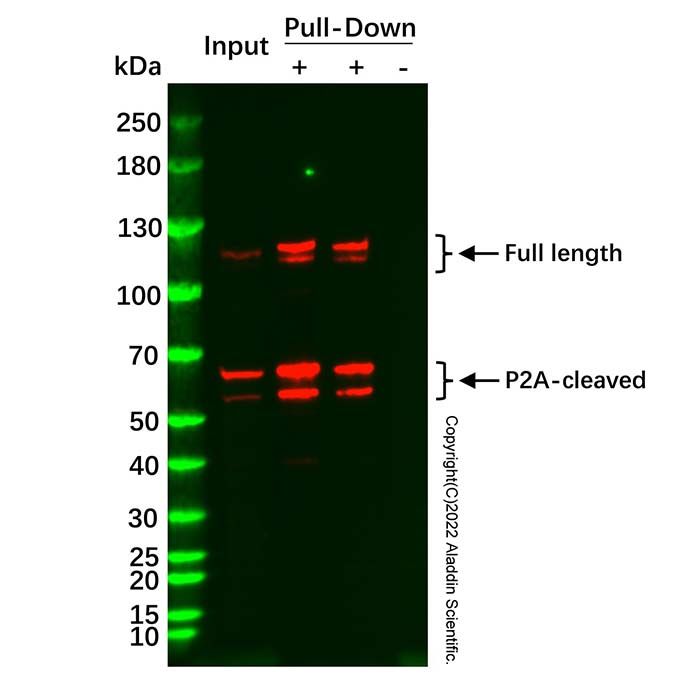
Resuspend the beads with 50 μL of PBS per 40 μL of original bead volume, then add 50 μL of 2×SDS Loading Buffer. Mix gently and heat at 95-100 °C for 5-10 minutes. Centrifuge at 1250×g for 30 seconds at 4 °C, and use the supernatant for SDS-PAGE or Western blot analysis.
Note: The recommended loading volume for WB is 20 μL or less. The remaining sample can be stored at -20°C.

 ZJ26F0434381