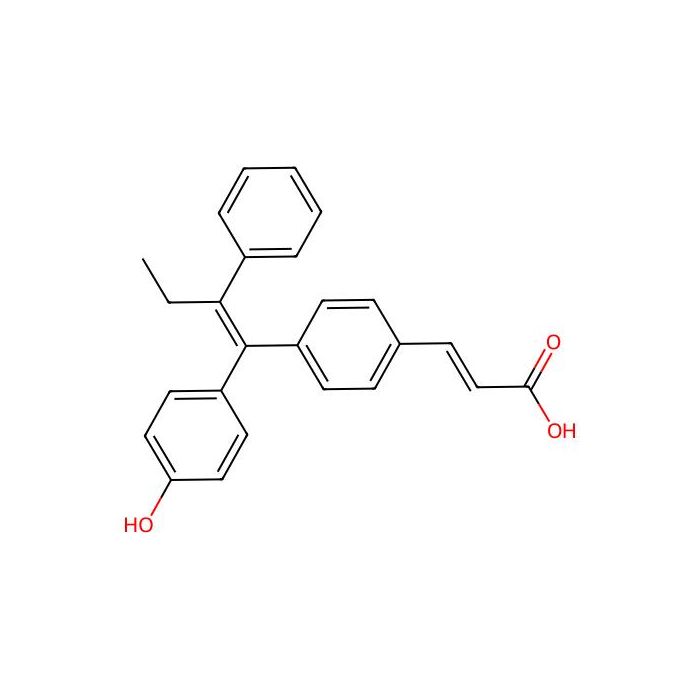
GW7604 is an antiestrogen. GW7604 is the metabolite of GW5638, which is a high affinity estrogen receptor (ER) antagonist.
In Vitro
GW7604 is the presumed metabolite of GW5638 in breast (MCF-7) and endometrial (ECC-1) cell lines. GW7604 (0.1 nM-1 μM; 24 hours) inhibits both Estradiol (1 nM) and 4-hydroxytamoxifen (4-OHT; 10 and 100 nM) induction of TGF-alpha in a concentration related manner (1-1000 nM) in MDA-MB-231 cells. MCE has not independently confirmed the accuracy of these methods. They are for reference only. Western Blot AnalysisCell Line: MDA-MB-231 cells Concentration: 0.1 nM, 1 nM, 10 nM, 100 nM, 1 μM Incubation Time: 24 hours Result: Blocked the effect of estradiol (E2; 1 n M) in a concentration-related manner.
Form:Solid
Especificaciones
Especificaciones y pureza
≥98%
Mecanismos bioquímicos y fisiológicos
GW7604 is an antiestrogen. GW7604 is the metabolite of GW5638, which is a high affinity estrogen receptor (ER) antagonist.
Condiciones de almacenamiento de almacenamiento
Store at -20°C
Enviado en
Ice chest + Ice pads
Este producto requiere envío en cadena de frío. Los servicios terrestres y otros servicios económicos no están disponibles.
This compound belongs to the class of organic compounds known as stilbenes. These are organic compounds containing a 1,2-diphenylethylene moiety. Stilbenes (C6-C2-C6 ) are derived from the common phenylpropene (C6-C3) skeleton building block. The introduction of one or more hydroxyl groups to a phenyl ring lead to stilbenoids.
External Descriptors
Not available
1. Djoumbou Feunang Y, Eisner R, Knox C, Chepelev L, Hastings J, Owen G, Fahy E, Steinbeck C, Subramanian S, Bolton E, Greiner R, and Wishart DS. ClassyFire: Automated Chemical Classification With A Comprehensive, Computable Taxonomy. Journal of Cheminformatics, 2016, 8:61.
Certificados (CoA, COO, BSE/TSE y tabla de análisis)
C of A & Other Certificates(BSE/TSE, COO):
Analytical Chart:
Propiedades químicas y físicas
Peso molecular
370.4
XLogP3
6.700
Hydrogen Bond Donor Count
2
Hydrogen Bond Acceptor Count
3
Rotatable Bond Count
6
Exact Mass
370.157 Da
Monoisotopic Mass
370.157 Da
Topological Polar Surface Area
57.500 Ų
Heavy Atom Count
28
Formal Charge
0
Complexity
554.000
Isotope Atom Count
0
Defined Atom Stereocenter Count
0
Undefined Atom Stereocenter Count
0
Defined Bond Stereocenter Count
2
Undefined Bond Stereocenter Count
0
The total count of all stereochemical bonds
2
Covalently-Bonded Unit Count
1
Calculadoras de soluciones
Molarity Calculator
Determine the necessary mass, volume, or concentration for preparing a solution.
Dilution Calculator
Determine the dilution needed to prepare a stock solution.
Reconstitution Calculator
Reseñas
Reseñas de cliente
Application Protocols
No vendor-tested protocols are specified for this item. The following are general, literature-style procedures for small-molecule receptor ligands; adapt and validate for your system.
Receptor reporter assay (cell-based)
Prepare a 10 mM DMSO stock. Seed ER-responsive reporter cells in 96-well plates. After attachment, treat with serial dilutions (maintain constant DMSO, e.g., 0.1% v/v). Incubate 16–24 h. Read reporter signal. Analyze concentration–response.
Competitive binding assay (biochemical)
Incubate recombinant ER LBD with a fluorescent or radiolabeled tracer in binding buffer. Add serial dilutions of compound. After equilibrium, separate bound/free and quantify displacement to estimate Ki.
qPCR target engagement (cell-based)
Treat ER-expressing cells with compound or vehicle for a defined period (e.g., 4–8 h). Isolate RNA, synthesize cDNA, and quantify expression of ER target genes vs housekeeping controls.
These protocols are provided as general guidance only. Optimize cell density, incubation time, temperature, and detection reagents for your specific experimental setup.
Biological Roles
General literature context (no medical/clinical claims; not product-specific performance)
GW7604 is widely cited as a synthetic small-molecule ligand used to study estrogen receptor (ER) biology in vitro. It serves as a tool for probing ER-mediated transcription, coactivator/corepressor dynamics, and ligand-dependent receptor conformations.
In biochemical and cellular systems, such ligands are used to examine dose–response relationships, receptor selectivity (ERα vs ERβ), and downstream pathway modulation (e.g., gene expression signatures) under controlled laboratory conditions.
Off-target profiling: As with many bioactive small molecules, comprehensive selectivity panels (nuclear receptors, kinases, transporters) are recommended to understand potential secondary interactions; consult primary literature and perform in-house counter-screens relevant to your system.
Note: Specific potency, efficacy, or selectivity data are not provided for this catalog item. Users should consult primary references for GW7604 and characterize performance under their assay conditions.
Buffer Applications
This product is a small-molecule research ligand and is not a buffering reagent. It does not form classical buffer systems. For assay work, prepare vehicle-dosed controls in your chosen biological buffer (e.g., PBS, HBSS, assay media) with matched co-solvent (commonly ≤0.1–0.5% DMSO or ethanol). pH control should be provided by established buffers appropriate to the biological assay.
Green Alternatives
Context
GW7604 is a target-specific research compound; “green alternatives” are typically considered for solvents and process reagents rather than the active small molecule itself.
Vehicle and process considerations (general guidance)
Prefer greener solvents for handling and analytics when feasible. For stock solutions and dilutions, DMSO and ethanol are commonly preferred over higher-toxicity aprotic dipolar solvents (e.g., DMF, NMP) when solubility allows.
| Use case | Conventional option | Greener alternative | Notes |
|---|---|---|---|
| Stock solution | DMF | DMSO, ethanol | Lower toxicity and better biodegradability profile than DMF/NMP; verify solubility. |
| LC mobile phase | Acetonitrile | Methanol (when compatible) | MeOH has a better environmental profile; may change selectivity/pressure. |
| Workup/extraction | Dichloromethane | Ethyl acetate, MTBE | Reduced halogenated solvent waste; check partitioning and stability. |
Adopt microscale experiments, minimize solvent volumes, and use closed systems to reduce emissions. These recommendations pertain to handling media, not to substituting the compound itself.
Pharmaceutical Uses
This catalog item is supplied strictly for research use only. It is not an excipient, not manufactured under pharmacopeial monographs, and is not intended for human or veterinary use.
Permitted laboratory contexts (general examples):
Reference standard in analytical method development and validation for discovery programs.
Tool compound in target validation, receptor pharmacology, and SAR studies.
Spike/recovery controls for bioanalytical assays in matrices, where permitted by institutional guidelines.
No drug product, clinical, or GMP formulation claims are made for this item. If an excipient or GMP-grade material is required, consult pharmacopeia-compliant suppliers and relevant regulatory frameworks.
Physical Properties
Item-specific specifications
Appearance: Not specified for this item; refer to CoA/Spec Sheet.
Melting point (MP): Not specified for this item; refer to CoA/Spec Sheet.
Boiling point (BP): Not applicable/unknown for this solid research compound; refer to CoA/Spec Sheet.
Density: Not specified for this item; refer to CoA/Spec Sheet.
Solubility: Not specified for this item; refer to CoA/Spec Sheet.
LogP, pKa, refractive index: Not specified for this item; refer to CoA/Spec Sheet.
Solubility handling: Compounds of this class are commonly dissolved in DMSO to prepare concentrated stocks (e.g., 10–50 mM), then diluted into assay media; aqueous solubility may be limited without co-solvent or surfactant.
Ionization: Many nuclear receptor ligands contain weakly basic or phenolic groups; ionization state can influence solubility and membrane permeability. Verify with measured pKa for the exact batch/form.
Stability: Store frozen and minimize exposure to moisture, light, and repeated thaw cycles to limit degradation and isomerization. Protect solutions from prolonged room-temperature exposure.
Note: For quantitative values (solubility limits, extinction coefficients, partition coefficients), consult the CoA/Spec Sheet or primary literature for GW7604; such values are not specified for this catalog item.
Quality and Grades
Item-specific details
Grade/Purity: Not specified for this item; refer to CoA/Spec Sheet.
Interpretation and guidance
Purity reporting: For bioassay tool compounds, vendors typically report purity by HPLC/UPLC with a defined detection wavelength and may provide supplementary NMR/MS identity data. Confirm the analytical method and cutoff criteria on the CoA.
Impurities and isomers: Trace synthetic byproducts or geometric/isomeric impurities can affect receptor assays. If your application is sensitive (e.g., SAR profiling), request full chromatograms and spectral data.
Stabilizers: None stated for this item. If a stabilizer or salt form is used, it will be indicated on the CoA; absence of such a note suggests the neat free base/acid or neutral form, but verify before quantitative work.
Batch-to-batch control: For reproducibility, document lot numbers, retain aliquots, and align assay baselines when switching lots. If conducting quantitative bioassays, determine an in-house potency benchmark for each lot.
For regulatory or GLP contexts, obtain the latest CoA/Spec Sheet detailing purity, residual solvents, water content, and identity testing. These are not specified in the provided product data.
Reaction and Applications
Scope of use
This product is supplied as a research small molecule and is not typically employed as a synthetic reagent or catalyst. Its primary utility is as a reference compound/ligand in biochemical and cellular assays.
Research applications (literature/general; not product-specific performance claims)
Nuclear receptor biology: Frequently used in mechanistic studies to interrogate estrogen receptor (ER) signaling, reporter gene activation, and target gene expression. Suitable for competitive binding assays and transcriptional profiling when paired with appropriate controls.
Chemical biology: Employed as a tool compound in pathway dissection, including co-regulator recruitment and structure–activity relationship (SAR) benchmarking against analogues.
Analytical: Serves as a reference standard for LC/LC–MS assay development, stability testing, and method validation in discovery workflows.
Practical tips
Prepare fresh working dilutions immediately before use; maintain consistent vehicle concentrations across control and treated samples.
Verify compound integrity by LC–MS prior to critical experiments. Light and prolonged room-temperature exposure can promote degradation in some ligand classes.
Include orthogonal readouts (e.g., binding plus functional assays) to confirm on-target activity and to detect potential off-target effects.
Reaction Conditions
As supplied, GW7604 is used as a research ligand rather than a reagent in chemical transformations; accordingly, there are no canonical “reaction conditions” associated with its use in synthesis.
Stock solutions: Dissolve in anhydrous DMSO to 10–50 mM; vortex and, if needed, sonicate briefly. Filter sterilize (0.22 µm PTFE) for cell-based assays.
Working concentrations: Serially dilute into assay buffer/media to the desired nM–µM range, maintaining constant final vehicle percentage across all wells/samples.
Incubation: Equilibrate cells or proteins with compound for sufficient time to reach steady-state binding or transcriptional response (often 1–24 h in cellular systems; minutes to hours in biochemical assays), as dictated by your assay design.
Controls: Include vehicle-only and positive/negative control ligands; perform concentration–response curves for EC50/IC50 estimation.
All times, temperatures, and concentrations should be optimized empirically for the specific assay format. No yields or synthetic outcomes are relevant to this item.
Safety and Handling
GHS/SDS information (item-specific)
Signal word: Not specified for this item; refer to SDS.
Hazard statements (H-phrases): Not specified for this item; refer to SDS.
Pictograms / Classification: Not specified for this item; refer to SDS.
General laboratory handling (good practice; not a substitute for SDS)
Personal protective equipment: Use lab coat, safety glasses, and appropriate chemical-resistant gloves. Handle powders in a fume hood to avoid inhalation and dust generation.
Avoid: Contact with skin/eyes, inhalation of dust, ingestion. Prevent environmental release; collect waste in properly labeled containers.
First aid (overview): If inhaled, move to fresh air; if on skin, wash with soap/water; if in eyes, rinse cautiously with water; if ingested, seek medical attention. Always follow SDS-specific instructions.
Incompatibilities: Strong oxidizers and strong acids/bases may degrade organic small molecules. Avoid prolonged exposure to light/UV if the compound contains photosensitive motifs.
Special risks: Small-molecule receptor ligands can be biologically active at low concentrations. Prevent exposure and cross-contamination; dedicate tools and wipe down surfaces after use.
Always consult the product’s SDS for authoritative hazard classification, spill response, and disposal guidance prior to use.
Solvent Selection
Polarity and vehicle considerations (general)
Typical vehicles: DMSO is the standard stock-solution solvent for hydrophobic research ligands; ethanol or DMF are secondary options when solubility is limited. Cosolvent percentages in biological media are commonly kept ≤0.1–0.5% v/v to minimize vehicle effects.
Miscibility: DMSO is miscible with water and most organic solvents, enabling serial dilution into buffers. Ethanol offers rapid mixing but may perturb cell membranes at higher percentages.
Practical guidance
Start with DMSO to prepare a concentrated master stock (e.g., 10 mM), confirm clarity after dissolution, then sterile-filter if sterility is required for cell-based assays. Avoid aqueous-first dissolution if precipitation occurs.
For NMR: Deuterated DMSO (DMSO‑d6) or CD3OD are common; select based on solubility and the need to observe exchangeable protons.
For LC/LC–MS method development: Mobile phases with low DMSO carryover are preferred; dissolve in acetonitrile or methanol when compatible, then inject with aqueous-organic gradients.
Note: Specific solubility limits and UV cutoffs are not specified for this item; verify experimentally for your system.
Storage and Reconstitution
Item-specific (from Product Data)
Storage conditions: Store at −20°C.
Shipping: Shipped in an ice chest with ice pads.
General handling and reconstitution guidance (not product specifications)
Upon receipt: Allow the container to equilibrate to room temperature in a desiccator before opening to avoid condensation. Reseal promptly after use.
Stock solutions: Dissolve in anhydrous DMSO to prepare concentrated stocks (e.g., 10–50 mM). Aliquot into single-use vials to minimize freeze–thaw cycles. Label with concentration, date, and lot.
Storage of solutions: Store aliquots at −20°C or below. Protect from light if the compound contains photosensitive motifs. Avoid repeated freeze–thaw; thaw on ice and use immediately.
Aqueous working solutions: Prepare fresh on the day of use. If precipitation occurs on dilution, increase mixing time, warm gently, or adjust co-solvent percentage within assay limits.
For definitive stability windows, retest intervals, and solubility limits for this specific item, consult the CoA/Spec Sheet; these details are not specified in the provided product data.
Structure and Identity
Item-specific (from Product Data)
Product name: GW7604 (SKU: G648944)
CAS: 195611-82-6
PubChem CID: 9799518
InChIKey (as provided): 332607
SMILES: Not specified for this item; refer to CoA/Spec Sheet.
Molecular formula: Not specified for this item; refer to CoA/Spec Sheet.
Molecular weight: Not specified for this item; refer to CoA/Spec Sheet.
Literature/General information (for context only; not item specifications)
Compound class: small-molecule research tool; frequently cited as a synthetic ligand used in nuclear receptor biology studies (not a peptide/biologic).
Structural features (general): reported to contain multiple aromatic rings and heteroatom functionality consistent with receptor-binding chemotypes. Exact stereochemistry and substituent pattern should be confirmed from primary literature or the product CoA.
2D structural description (general)
The scaffold is typically described in the literature as a polyaromatic framework bearing polarizable substituents and a basic/ionizable moiety suitable for receptor engagement. Please consult the certificate of analysis or primary references for definitive atom-by-atom structure.
Synthetic Utility
GW7604 is not typically employed as a synthetic reagent, catalyst, or building block. Its primary value lies in its use as a characterized small-molecule tool in biochemical assays.
However, in chemical biology workflows, derivatives may be prepared for specialized purposes (literature/general):
Affinity probes: Installation of photoaffinity or clickable handles (e.g., diazirine/alkyne) for target engagement studies and chemoproteomics. This requires synthetic modification of positions that preserve receptor binding.
Immobilized ligands: Conjugation to solid supports for pull‑down assays to study protein–ligand interactions.
Reporter conjugates: Attachment of fluorophores or biotin through linkers to enable imaging or enrichment, followed by validation of retained activity.
Such derivatizations are project-specific and require route scouting and SAR awareness; the parent compound itself is not a general-purpose synthon.
Target Specificity
This product is a small-molecule tool, not an antibody or biologic. Item-specific target binding constants or selectivity data are not provided in the product data.
Literature context (for background only; not a product claim): GW7604 is commonly discussed in the context of estrogen receptor (ER) biology. Users should consult primary publications for quantitative affinity/selectivity data and verify activity under their assay conditions.
For this catalog item, no clone, isotype, species reactivity, or epitope information applies.
Utilizamos cookies para garantizar el correcto funcionamiento del sitio web y, cuando esté permitido, para mejorar su experiencia. Puede gestionar sus preferencias en cualquier momento en Configuración. Más información en nuestra Política de Cookies.
¿Quieres que te enviemos un mensaje cuando tengamos descuentos disponibles?
Recordármelo más tarde
¡Gracias! Por favor, revisa tu bandeja de entrada de correo electrónico para confirmar.
Products are supplied to verified businesses, institutions, and qualified professionals for research and development use only. Not for use in humans, animals, diagnosis, or therapy.