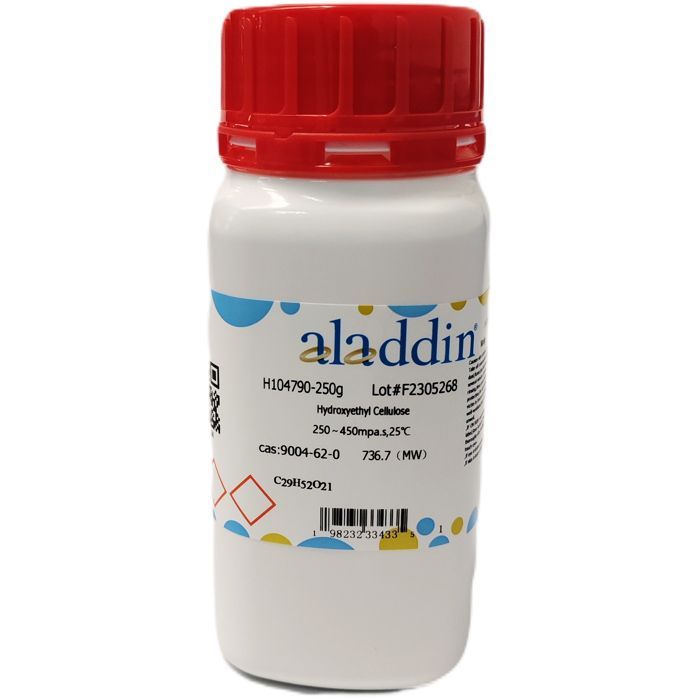
Hydroxyethyl Cellulose(HEC) - 250~450mpa.s,25℃ , CAS No.9004-62-0

CAS: 9004-62-0 Cat. No.: H104790 Número EC: 618-387-5
Disponible para pedir
CALIDAD & PUREZA 250~450mpa.s,25℃
Synonyms
2-Hydroxyethyl cellulose
Storage
Room temperature,Desiccated
Shipped In
Normal
★
Talla
Alemania (EU)
USA*
Precio
Cantidad
250g
H104790-250g
2 Disponible
4 Disponible

25,95€

38,96€
Guardar 13,02 € (33.41%)
Enter a quantity for the sizes you want to add.
🧪
Por qué esta calidad

250~450mpa.s,25℃ para flujos de trabajo cromatográficos y analíticos sensibles que requieren una interferencia mínima de la línea base.

🌡

Almacenamiento y envío

Room temperature,Desiccated Envío Normal. Consulte el COA específico del lote para conocer las especificaciones exactas.

📋

Documentos de calidad

SDS, COA, ficha técnica y hoja de especificaciones disponibles para descargar. COA específico del lote accesible mediante búsqueda por número de lote.

📚

Prueba documental

Citado en 214 publicaciones revisadas por pares sobre cromatografía, síntesis orgánica y reacciones de acoplamiento cruzado.

Especificaciones

Sinónimos
2-Hydroxyethyl cellulose
Especificaciones y pureza
250~450mpa.s,25℃
Condiciones de almacenamiento de almacenamiento
Room temperature,Desiccated
Enviado en
Normal
Nombres e identificadores
Pubchem Sid
Pubchem Sid Url
https://pubchem.ncbi.nlm.nih.gov/substance/488200704
Sonrisas canónicas
CC1C(C(C(C(O1)CO)OC2C(C(C(C(O2)COC3C(C(C(C(O3)CO)OC)O)O)OC4C(C(C(C(O4)CO)OC)O)OCCO)O)O)O)O
IUPAC Name
5-[6-[[3,4-dihydroxy-6-(hydroxymethyl)-5-methoxyoxan-2-yl]oxymethyl]-3,4-dihydroxy-5-[4-hydroxy-3-(2-hydroxyethoxy)-6-(hydroxymethyl)-5-methoxyoxan-2-yl]oxyoxan-2-yl]oxy-6-(hydroxymethyl)-2-methyloxane-3,4-diol
InChIKey
CWSZBVAUYPTXTG-UHFFFAOYSA-N
INCHI
1S/C29H52O21/c1-10-15(34)16(35)24(13(8-33)45-10)49-28-20(39)18(37)25(50-29-26(43-5-4-30)21(40)23(42-3)12(7-32)47-29)14(48-28)9-44-27-19(38)17(36)22(41-2)11(6-31)46-27/h10-40H,4-9H2,1-3H3
Isómeros SMILES
CC1C(C(C(C(O1)CO)OC2C(C(C(C(O2)COC3C(C(C(C(O3)CO)OC)O)O)OC4C(C(C(C(O4)CO)OC)O)OCCO)O)O)O)O
WGK Alemania
1
RTECS
FJ5958000
Reaxy-Rn
24866087
Reaxys-RN_link_address
https://www.reaxys.com/reaxys/secured/hopinto.do?context=S&query=IDE.XRN=24866087&ln=

Documentación

📋 Hoja de datos de seguridad (SDS)

Documento completo sobre peligros, manipulación, almacenamiento y cumplimiento normativo.

<<<<<<< HEAD Descargar SDS → ======= Descargar SDS → >>>>>>> release248-p3

✅ Certificado de análisis (COA)

Datos de calidad específicos del lote. Introduzca su número de lote para obtener el COA exacto.

Buscar COA →

📊 Ficha técnica

Resumen de referencia rápida de las especificaciones y aplicaciones del producto.

Ver ficha técnica →

🔬 Hoja de especificaciones

Atributos de calidad completos y criterios de aceptación para esta calidad.

Ver hoja de especificaciones →

Datos avanzados

Taxonomic Classification

Taxonomy Tree

KingdomOrganic compounds
SuperclassOrganic oxygen compounds
ClaseOrganooxygen compounds
SubclassCarbohydrates and carbohydrate conjugates
Intermediate Tree Nodes Not available
Direct ParentOligosaccharides
Alternative Parents O-glycosyl compounds  Oxanes  Secondary alcohols  Oxacyclic compounds  Dialkyl ethers  Acetals  Primary alcohols  Hydrocarbon derivatives  
Molecular FrameworkAliphatic heteromonocyclic compounds
Substituents Oligosaccharide - O-glycosyl compound - Glycosyl compound - Oxane - Secondary alcohol - Oxacycle - Organoheterocyclic compound - Ether - Dialkyl ether - Acetal - Hydrocarbon derivative - Primary alcohol - Alcohol - Aliphatic heteromonocyclic compound
DescripciónThis compound belongs to the class of organic compounds known as oligosaccharides. These are carbohydrates made up of 3 to 10 monosaccharide units linked to each other through glycosidic bonds.
External Descriptors Not available
Estructura 3D
Modelo de Estructura Química Interactiva


Certificados (CoA, COO, BSE/TSE y tabla de análisis)
C of A & Other Certificates(BSE/TSE, COO):
Analytical Chart:

Find and download the COA for your product by matching the lot number on the packaging.

35 results found

Lot NumberCertificate TypeFechaArticulo
I2601613I2601613Certificate of AnalysisAug 04, 2026 H104790
I2601612I2601612Certificate of AnalysisAug 04, 2026 H104790
I2601610I2601610Certificate of AnalysisAug 04, 2026 H104790
I2601590I2601590Certificate of AnalysisAug 04, 2026 H104790
L2518278L2518278Certificate of AnalysisNov 25, 2025 H104790
L2518273L2518273Certificate of AnalysisNov 25, 2025 H104790
G2530055G2530055Certificate of AnalysisFeb 13, 2025 H104790
K2511134K2511134Certificate of AnalysisFeb 13, 2025 H104790
B2526207B2526207Certificate of AnalysisFeb 13, 2025 H104790
B2526208B2526208Certificate of AnalysisFeb 13, 2025 H104790
B2526214B2526214Certificate of AnalysisFeb 13, 2025 H104790
B2526215B2526215Certificate of AnalysisFeb 13, 2025 H104790
L2402339L2402339Certificate of AnalysisNov 08, 2024 H104790
L2402338L2402338Certificate of AnalysisNov 08, 2024 H104790
L2402337L2402337Certificate of AnalysisNov 08, 2024 H104790
L2402336L2402336Certificate of AnalysisNov 08, 2024 H104790
E2427058E2427058Certificate of AnalysisMay 14, 2024 H104790
J2424323J2424323Certificate of AnalysisMay 14, 2024 H104790
E2427059E2427059Certificate of AnalysisMay 14, 2024 H104790
E2427060E2427060Certificate of AnalysisMay 14, 2024 H104790
E2427061E2427061Certificate of AnalysisMay 14, 2024 H104790
A2009179A2009179Certificate of AnalysisNov 01, 2023 H104790
F2305268F2305268Certificate of AnalysisFeb 11, 2023 H104790
F2305269F2305269Certificate of AnalysisFeb 11, 2023 H104790
F2305271F2305271Certificate of AnalysisFeb 11, 2023 H104790
F2305272F2305272Certificate of AnalysisFeb 11, 2023 H104790
H2209443H2209443Certificate of AnalysisJun 17, 2022 H104790
K2215105K2215105Certificate of AnalysisJun 17, 2022 H104790
H2209445H2209445Certificate of AnalysisJun 17, 2022 H104790
H2209444H2209444Certificate of AnalysisJun 17, 2022 H104790
H2209442H2209442Certificate of AnalysisJun 17, 2022 H104790
C2222401C2222401Certificate of AnalysisFeb 15, 2022 H104790
C2222403C2222403Certificate of AnalysisFeb 15, 2022 H104790
C2222405C2222405Certificate of AnalysisFeb 15, 2022 H104790
C2222406C2222406Certificate of AnalysisFeb 15, 2022 H104790
Propiedades químicas y físicas
SensibilidadMoisture sensitive
Punto de fusión (°C)288-290°C
Peso molecular736.700 g/mol
XLogP3-7.700
Hydrogen Bond Donor Count11
Hydrogen Bond Acceptor Count21
Rotatable Bond Count15
Exact Mass736.3 Da
Monoisotopic Mass736.3 Da
Topological Polar Surface Area315.000 Ų
Heavy Atom Count50
Formal Charge0
Complexity999.000
Isotope Atom Count0
Defined Atom Stereocenter Count0
Undefined Atom Stereocenter Count20
Defined Bond Stereocenter Count0
Undefined Bond Stereocenter Count0
The total count of all stereochemical bonds0
Covalently-Bonded Unit Count1
Preguntas frecuentes y artículos
Microcrystalline Cellulose (MCC): A Comprehensive Primer and Selection Guide—Structural Features, Key Performance Metrics, and Application Scenarios
Understanding Hydrophilic Polymers in Aqueous Systems: Hydration Mechanisms, Structural Knobs, and Task-Oriented Selection Guide (Including Tables 1–3)
Applications and Selection of Acrylic Resins in Coatings: Analysis of Architectural, Industrial, and Supporting Materials
Natural Resins in Coating Formulations: Functional Positioning, Structure–Property Relationships, and Selection Validation
Waterborne Resin Technology Explained: Waterborne Forms, Performance Balance, and a Technology Map
Waterborne Resin Application Guide: Formulation Synergy, Troubleshooting, and Technology Development Trends
Why LABSA (Sulfonic Acid) Is Commonly Used in Household Cleaning Formulations: Neutralization Mechanism, Detergency Action, and Formulation Application Points
From Structure to Performance: Conditioning, Film-Forming, Thickening, and Chelating Applications of Functional Ingredients in Personal Care and Home Care
From Structure to Rheology: How Carbomer Forms Gel Structures and Enables Thickening, Suspension, and Auxiliary Emulsion Stabilization
What Is the Difference Between Triethanolamine and Diethanolamine: Understanding Their Formulation Functions, Application Differences, and Selection Logic from a Molecular-Structure Perspective
Thickening, Suspension, Auxiliary Stabilization, and Agglomeration Mechanisms of Xanthan Gum in Personal Care Formulations: From Molecular Structure to Processing Applications
AES (Fatty Alcohol Polyoxyethylene Ether Sulfate) in Personal and Home-Care Cleansing Formulations: An Analysis of Structure, Performance, and Low-Temperature Flowability
Understanding CAPB from Its Structure: How Cocamidopropyl Betaine Improves Foam, Enhances Mildness, and Supports Thickening
From Structure to Rheology: Thickening, Stabilization, and Selection Logic of Cellulose Ethers for Personal Care Applications
How to Select Thickeners for Strongly Acidic Cleaning Systems: Comparison of Thickening Mechanisms and Application Considerations for Fatty Amine Ethoxylates
Analysis of the Production Process of Hydroxypropyl Methylcellulose (HPMC) for Putty: Understanding Differences in Substitution Structure and Gelation Temperature from High-Ratio and Low-Ratio Formulations
Why Are Daily Chemical Products Prone to Viscosity Thinning in Summer? Core Mechanisms, Troubleshooting Methods, and Solutions
Types, Mechanisms of Action, Key Quality Indicators, and Selection and Application of Common Cellulose Ethers in Wall Putty
Influencing Factors and Control Strategies for Blistering in Neutral Wall Putty: An Experimental Analysis Based on HPMC Dosage, Viscosity, and Ground Calcium Carbonate Fineness
How to Select Binding/Gel Materials for Neutral Wall Putty? A Comparison of Pregelatinized Starch, PVA, and Redispersible Polymer Powder Based on Four Application Trials
Causes and Mechanism Analysis of Delamination During Sanding of Water-Resistant Putty
What Are the Differences Between Polyvinyl Alcohol 1788, 2488, and 2699? Understanding Workability, Bonding Strength, and Relative Water Resistance from the Perspective of Degree of Polymerization and Degree of Hydrolysis
Common Problems and Formulation Adjustment Strategies for Neutral Putty Under High Summer Temperatures
Differences and Application Selection of Cassava- and Corn-Based Pregelatinized Starch in Neutral Putty Formulations
The Role, Selection, Cracking Risk Analysis, and Dosage Control of Bentonite in Neutral Putty
Dispersants, Anti-Redeposition Agents, and Scale-Control Materials in Household Cleaning Formulations: Mechanisms of Action, Selection Logic, and Representative Products
Experimental Applications of Carboxymethyl Cellulose (CMC) Solution in Enzyme Assays, Suspension Systems, and Functional Materials
Niacinamide Brightening Mechanisms and Formulation Design: Melanosome Transfer, pH Regulation, and Combination Strategies
Citations of This Product
Calculadoras de soluciones
Reseñas

Reseñas de cliente

¿Quieres que te enviemos un mensaje cuando tengamos descuentos disponibles?

Recordármelo más tarde

¡Gracias! Por favor, revisa tu bandeja de entrada de correo electrónico para confirmar.

¡Vaya! Las notificaciones están desactivadas.