CALIDAD & PUREZACarrier Free?Carrier-free — supplied without added carrier protein/stabilizer. Use when carriers (e.g. BSA) would interfere with conjugation or sensitive assays.Azide Free?Azide-free — without sodium azide preservative. Use in conjugations, cell work, or assays where azide is toxic or inhibitory.Validated?Validated grade — performance confirmed in defined applications before release. Use when you want documented assurance the reagent works as stated.PBS Only?PBS-only formulation — supplied in phosphate-buffered saline with no other additives. Use when you need a clean PBS buffer free of stabilizers/carriers.≥95%(SDS-PAGE)See COA
Rat anti Human IL-4 Antibody, Monoclonal (MP4-25D2), could be used for Flow, in vitro IL-4 neutralization and so on. Application Flow: Use at an assay dependent concentration. in vitro IL-4 neutralization: Use at an assay dependent concentration. Protein Function Participates in at least several B-cell activation processes as well as of other cell types. It is a costimulator of DNA-synthesis. It induces the expression of class II MHC molecules on resting B-cells. It enhances both secretion and cell surface expression of IgE and IgG1. It also regulates the expression of the low affinity Fc receptor for IgE (CD23) on both lymphocytes and monocytes.
Especificaciones
Product Name
IL-4 Rat mAb - Anticuerpo primario, specific to IL4, Rat IgG1
Carrier Free,Azide Free,Validated,PBS Only,≥95%(SDS-PAGE),See COA
Especies hospedadoras
consejo
Especificidad
IL4
Inmunógeno
Recombinant human IL-4 expressing CHO cells
Conjugación
Unconjugated
Grado
Azide Free, Carrier Free, PBS Only, Validated
Isotipo
Rat IgG1
Tipo de cadena ligera
kappa
SDS-PAGE
150 kDa
Método de purificación
Protein G purified
Concentración
See COA
Product Line
Productos biológicos
Almacenamiento y envío
Forma
Liquid
Condiciones de almacenamiento de almacenamiento
Store at 2-8°C,Do not freeze
Enviado en
Wet ice,Do not freeze
Estabilidad y almacenamiento
Shipped at 4°C. Store at 4°C long term (12 months). Do not freeze. Upon receipt, it is recommended to aliquot.
Imágenes
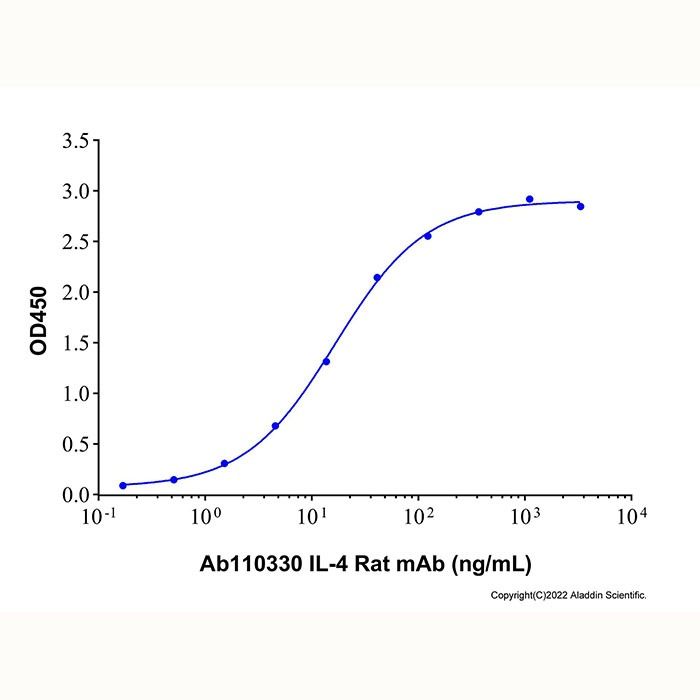
IL-4 Rat mAb (Ab110330) - ELISA Immobilized Recombinant Human IL-4 protein (rp156008) at 1.0 μg/mL can bind IL-4 Rat mAb (Ab110330) with the EC
₅₀
of 16.60 ng/mL.
Determine the necessary mass, volume, or concentration for preparing a solution.
Dilution Calculator
Determine the dilution needed to prepare a stock solution.
Reconstitution Calculator
Reseñas
Reseñas de cliente
Application Protocols
Not specified for this item; refer to CoA/Spec Sheet.
No tested applications (e.g., WB, IHC, IF, ELISA, FC), recommended dilutions, or sample preparation guidelines are provided in the Product Data.
Consult the lot-specific datasheet for any validated protocols, suggested working concentrations, and positive control materials when available.
Biological Roles
Item-specific target
Antigen: Interleukin-4 (IL-4). This antibody is a rat monoclonal directed against IL-4 (host species per Product Name). Species reactivity, epitope, and neutralizing capability are not specified for this item; refer to CoA/Spec Sheet.
IL-4 biology (literature; general background)
Molecular function: IL-4 is a pleiotropic type I cytokine that signals through the IL-4 receptor complex (IL-4Rα with γc or IL-13Rα1), activating JAK/STAT pathways—predominantly STAT6—to regulate gene expression associated with type 2 immune responses.
Cellular sources: Classically secreted by Th2 cells, group 2 innate lymphoid cells (ILC2), basophils, mast cells, and eosinophils under appropriate stimuli.
Key roles: Drives Th2 differentiation, promotes class-switch recombination to IgE and IgG1 in B cells (species-dependent isotypes), enhances alternative (M2-like) macrophage activation, and modulates epithelial and stromal cell responses linked to barrier immunity.
Crosstalk: Shares functional overlap with IL-13; both signal via IL-4Rα-containing receptor complexes, with distinct but intersecting effects on target cells.
Biochemical properties: IL-4 is a small, disulfide-bonded helical cytokine (monomeric), typically ~15–20 kDa mature form (literature), with short in vivo half-life and high-affinity receptor interactions (KD often sub-nanomolar to low-nanomolar, context-dependent).
Research implications
Anti–IL-4 mAbs are used to map IL-4 expression, quantify cytokine levels in fluids or lysates, and probe IL-4-dependent signaling pathways in cell-based systems without making clinical claims.
Buffer Applications
Item-specific buffer information
Supplied: PBS Only (per Product Data). Exact composition/pH not specified; refer to CoA/Spec Sheet.
General buffer guidance for antibodies (literature/practice)
PBS (phosphate-buffered saline): Typical formulations are 10 mM phosphate, 137 mM NaCl, 2.7 mM KCl, pH 7.2–7.6 (literature). Suitable for storage and most immunoassays.
TBS (Tris-buffered saline): 20–50 mM Tris, 150 mM NaCl, pH 7.4–8.0 (literature). Preferred where phosphate may interfere with binding or enzymatic reactions.
Additives for assays: 0.05–0.1% Tween-20 (PBST/TBST) to reduce nonspecific binding; 0.1–1% BSA or casein as blocking agents in ELISA and blotting (ensure compatibility with carrier-free requirements at the time of use).
Sterility: As the item is Azide Free, maintain aseptic technique. Filter diluents (0.22 µm) and prepare fresh working solutions for cell-based assays.
Practical tips
Prepare working dilutions immediately before use to limit adsorption and microbial growth.
For enzyme-conjugated secondary systems, avoid azide-containing buffers since azide inhibits peroxidase and cytochrome oxidase enzymes.
Validate buffer choice empirically for your matrix (serum, plasma, tissue lysate), as ionic strength and pH can influence IL-4 epitope recognition.
Green Alternatives
Context
This product is an aqueous protein formulation (PBS Only), Carrier Free and Azide Free. Organic solvent use is not inherent to its application, and the environmental footprint is primarily from cold-chain logistics and single-use plastics.
Greener handling strategies (general guidance)
Buffer choice: Continue using aqueous PBS or TBS—these are inherently greener than organic solvent systems.
Preservatives: Azide-free formulation avoids sodium azide (acute aquatic toxin); maintain sterility to obviate the need for hazardous preservatives.
Waste minimization: Aliquot to reduce spoilage; employ low-binding, recyclable plastics where validated. Decontaminate protein waste with enzymatic cleaners instead of bleach when compatible with institutional policy.
Cold-chain efficiency: Consolidate shipments, select wet-ice over dry ice where stability permits (this item ships on wet ice), and minimize door-open time of refrigerators.
Comparison (general; not item-specific specifications)
Azide-containing antibody vs Azide-free antibody:
Environmental/safety: Azide-free avoids hazardous sodium azide disposal and potential formation of heavy metal azides in plumbing.
Microbial control: Azide-containing products resist microbial growth; azide-free products rely on aseptic technique and shorter in-use times.
Assay compatibility: Azide inhibits peroxidases and some cellular enzymes; azide-free is preferred for enzyme-mediated detection and live-cell applications.
Note: No alternative grades or greener reformulations are specified for this item; refer to CoA/Spec Sheet for available pack sizes and formats.
Pharmaceutical Uses
Item-specific status
Research Use Only: This product is designated for research use only and is not intended for diagnostic, therapeutic, or human/animal administration.
General formulation considerations for monoclonal antibodies (literature/practice; not item-specific claims)
Excipients: Therapeutic-grade antibodies commonly use histidine or phosphate buffers, sugars (sucrose/trehalose), amino acids (arginine), and surfactants (polysorbate 20/80) to enhance stability; this product is PBS Only and Carrier Free as supplied.
Preservatives: Sodium azide is a common laboratory preservative but is excluded here (Azide Free) to support enzyme-based assays and cell work. For pharmaceutical manufacturing, alternative microbial controls and aseptic processing are employed instead of azide.
Concentration and viscosity: High-concentration formulations (>50 mg/mL) demand rheology and interfacial stability control; working lab stocks are typically much lower and prepared fresh from supplied material.
Regulatory note
No pharmacopeial monograph, GMP status, or lot-release specifications are provided for this item. Any use beyond basic research would require separate quality, regulatory, and safety evaluations not covered by this product.
Physical Properties
Item-specific properties
Formulation: PBS Only (per Product Data). Detailed buffer composition (pH, ionic strength), protein concentration, and excipients: Not specified for this item; refer to CoA/Spec Sheet.
Appearance: Not specified for this item; refer to CoA/Spec Sheet.
Molecular weight: Not specified for this item; refer to CoA/Spec Sheet.
General/literature values for monoclonal antibodies (for context; not item-specific specifications)
Typical molecular weight: ~150 kDa for full-length IgG; may vary with isotype/glycosylation.
Isoelectric point (pI): Commonly ~7–9 depending on sequence and glycosylation.
Solubility: Readily soluble in isotonic aqueous buffers (e.g., PBS, TBS) at mg/mL concentrations; aggregation risk increases outside neutral pH or high ionic strength.
Stability considerations: Sensitive to repeated freeze–thaw, interfacial stress (vortexing/foaming), and elevated temperatures; stabilized by appropriate pH, salt, and protein carriers (e.g., BSA) when compatible with the experiment.
Storage temperature: 2–8°C recommended in Product Data; do not freeze.
Not provided for this item; refer to CoA/Spec Sheet
Exact protein concentration, extinction coefficient (A280), pH, osmolality, viscosity, and any preservative content (stated as Azide Free, but alternatives not specified).
Carrier Free: No added protein carriers (e.g., BSA, gelatin). Advantages: precise protein dosing for functional assays, reduced background in immunoassays, compatibility with downstream conjugation. Considerations: higher propensity to surface adsorption—use low-binding plastics and avoid excessive dilution without stabilizers if compatible with your assay.
Azide Free: No sodium azide preservative. Advantages: compatible with peroxidase-based detection and cell-based functional assays. Considerations: increased bioburden risk—practice aseptic technique; consider sterile filtration of diluents.
Validated: The product is denoted as validated; specific validation methods, clones, and applications are not detailed in the Product Data. Refer to CoA/Spec Sheet for scope of validation (e.g., ELISA, WB, IHC, neutralization).
PBS Only: Supplied in phosphate-buffered saline. Exact pH, ionic strength, and any stabilizers are not specified; refer to CoA/Spec Sheet.
General guidance on grade implications (literature/practice)
For quantitative biophysical work (e.g., kinetic binding, SPR/BLI), carrier-free and azide-free formulations reduce artifactual signals and interference.
For long-term storage or very low working concentrations, users often add assay-compatible stabilizers (e.g., 0.1% carrier protein or trehalose) to aliquots—ensure such additions do not conflict with your assay and acknowledge that this item ships without carriers by design.
Reaction and Applications
Item-specific tested applications are not provided in the Product Data; refer to CoA/Spec Sheet for validated use cases and performance characteristics.
General application landscape for IL-4 monoclonal antibodies (literature/practice; not item-specific claims)
Immunoassays: Commonly used in sandwich ELISA as capture or detection antibody for quantifying IL-4 in biological samples. Pairing with a non-competing anti–IL-4 clone is essential to avoid epitope overlap.
Immunoblotting: Detection of denatured IL-4 under reducing/non-reducing conditions depends on epitope sensitivity; optimization of blocking and transfer conditions is essential due to IL-4’s small size (~15–20 kDa mature cytokine, literature).
Immunocytochemistry/Immunohistochemistry: Fixation and antigen retrieval conditions must preserve IL-4 epitopes; low-abundance cytokines may require signal amplification.
Neutralization/functional assays: Some anti–IL-4 mAbs can block IL-4 receptor engagement; suitability depends on epitope/affinity and is clone-specific.
Affinity purification: Coupling to resins for immunoaffinity capture of IL-4 from complex matrices, provided the antibody maintains binding under coupling/elution conditions.
Practical tips
Titrate antibody to determine minimal concentration that yields acceptable signal-to-noise.
Use azide-free buffers for enzyme-based detection or live-cell assays (this item is Azide Free).
Validate species cross-reactivity and matrix effects experimentally when target samples differ from the conditions used to generate the antibody.
Reaction Conditions
Not typically applicable in the classical chemical sense.
Antibodies are used under biochemical assay conditions rather than chemical reaction conditions. Typical working environments are aqueous buffers at neutral pH and ambient to physiological temperatures.
General assay-condition guidance (literature/practice; not item-specific specifications)
Temperature: Keep on ice during setup to minimize proteolysis; incubations commonly at room temperature or 4°C for binding assays and overnight steps.
pH/Ionic strength: Near-neutral pH (7.2–7.6) with physiological ionic strength (e.g., 150 mM NaCl) maintains antibody conformation and binding.
Detergents: Low concentrations of non-ionic detergents (e.g., 0.05% Tween-20) can decrease nonspecific interactions in immunoassays.
Compatibility: This item is Azide Free; maintain azide-free conditions for enzyme-based detection or live-cell work.
For validated, item-specific incubation times, temperatures, and dilutions, refer to the product’s CoA/Spec Sheet (not specified here).
Safety and Handling
Item-specific hazard information
GHS Classification: Not specified for this item; refer to SDS.
Signal Word / H-Statements / Pictograms: Not specified for this item; refer to SDS.
Research Use Note: For research use only (not for diagnostic or therapeutic use).
Storage per Product Data: Store at 2–8°C. Do not freeze. Shipped on wet ice; do not freeze during shipment.
General safety guidance for protein antibodies (literature/practice)
Expected hazards: Antibody solutions in PBS without azide are generally considered low hazard; nonetheless, treat as laboratory chemicals/biologicals. Avoid ingestion, inhalation of aerosols, and contact with skin/eyes.
PPE: Laboratory coat, nitrile gloves, and safety glasses. Use a biological safety cabinet if handling with human/animal biological samples to prevent aerosol generation and contamination.
Incompatibilities: Avoid strong oxidizers and extremes of pH or temperature that can denature proteins. Do not mix with sodium azide if downstream enzyme-based assays (e.g., peroxidase) are planned, as azide inhibits heme enzymes; this item is Azide Free by specification.
First aid (overview; defer to SDS): Rinse with water after skin/eye contact; remove contaminated clothing. If inhaled, move to fresh air. If ingested, rinse mouth; seek medical attention as appropriate.
Handling tips: Minimize vortexing/foaming; avoid repeated freeze–thaw cycles (this item should not be frozen). Aliquot under sterile conditions if subdividing for multiple uses.
Solvent Selection
Item-specific context
Supplied in PBS Only (aqueous). Alternative solvents are not applicable for a protein biologic of this type.
General guidance for antibody diluents (literature/practice)
Primary diluent: Phosphate-buffered saline (PBS, pH ~7.2–7.6) is standard for storage and routine assays.
Alternate assay buffers: Tris-buffered saline (TBS) for some immunoassays where phosphate interferes; HEPES-buffered saline for cell-based work near physiological pH without CO2 dependency.
Additives (if assay-compatible): 0.05–0.1% Tween-20 to reduce nonspecific binding in immunoassays; low levels of carrier protein (e.g., 0.1% BSA) to minimize adsorption for very low antibody concentrations. Note: This item is Carrier Free and Azide Free as supplied—any additives should be user-determined and assay-compatible.
Avoid: Organic solvents, extreme pH, and high ionic strength that can denature or aggregate antibodies. Metal-chelators or divalent cations may influence certain assays and should be used judiciously.
Selection tips
Choose PBS for most binding assays and storage (as supplied).
Consider TBS if downstream phosphatase activity or phosphate-sensitive interactions are being studied.
Maintain isotonicity and near-neutral pH to preserve antibody conformation and IL-4 binding capability.
Not specified for this item; refer to CoA/Spec Sheet
Exact PBS composition (pH, NaCl concentration).
Storage and Reconstitution
Item-specific instructions (from Product Data)
Storage temperature: Store at 2–8°C.
Freezing: Do not freeze.
Shipping: Shipped on wet ice; do not freeze during transit.
Not specified for this item; refer to CoA/Spec Sheet
Reconstitution procedure (if lyophilized) or handling of concentrates
Recommended aliquoting strategy and shelf life after opening
General handling best practices (for context; not item-specific specifications)
Mix gently by inversion; avoid vortexing/foaming.
Use low-binding tubes and pre-chilled pipette tips for small-volume aliquots to minimize adsorption.
Maintain aseptic technique, especially since the product is Azide Free.
Structure and Identity
Item-specific facts (from Product Data)
Product: IL-4 Rat mAb (monoclonal antibody)
Type/Host: Rat monoclonal antibody
Antigen target: Interleukin-4 (IL-4)
Grade/Purity: Carrier Free, Azide Free, Validated, PBS Only
CAS, InChIKey, SMILES: Not applicable to biologic antibodies; not specified for this item; refer to CoA/Spec Sheet.
General antibody structural features (literature)
Molecular class: Immunoglobulin (typically IgG) protein composed of two heavy chains and two light chains linked by disulfide bonds.
Domain architecture: Variable domains (VH/VL) confer IL-4 binding; constant domains (CH/CL) define isotype/effector functions. Hinge region imparts flexibility.
2D description in words: Y-shaped glycoprotein with two identical antigen-binding sites at the tips of the Fab arms recognizing IL-4 epitopes; the Fc stem mediates interactions with Fc receptors and complement (isotype-dependent).
Post-translational features: N-linked glycosylation on Fc (and sometimes Fab) regions influences stability and effector function (isotype- and host-cell dependent).
Notes
Clone designation, isotype/subclass, light-chain type (kappa/lambda), and recombinant vs hybridoma origin are not specified for this item; refer to CoA/Spec Sheet.
Synthetic Utility
Not typically applicable.
As a rat monoclonal antibody against IL-4, this product is a biologic reagent for immunoassays and cell-based studies, not a synthetic building block or reagent. For practical value, see Reaction & Applications, Biological Roles, and Application Protocols (when available on the CoA/Spec Sheet).
Target Specificity
Item-specific details (from Product Data)
Antigen/Target: Interleukin-4 (IL-4)
Antibody type: Monoclonal antibody (mAb)
Host species: Rat
Not specified for this item; refer to CoA/Spec Sheet
Clone designation/ID
Isotype/subclass and light chain type
Species reactivity (e.g., human, mouse, rat)
Epitope mapping/neutralizing capability
Cross-reactivity profile and negative/positive controls used in validation
¿Necesita ayuda para elegir la calidad?
Nuestra guía de selección de calidades cubre la pureza, el estado del estabilizador y la idoneidad de la aplicación para todas las variantes de nuestro catálogo.
Utilizamos cookies para garantizar el correcto funcionamiento del sitio web y, cuando esté permitido, para mejorar su experiencia. Puede gestionar sus preferencias en cualquier momento en Configuración. Más información en nuestra Política de Cookies.
¿Quieres que te enviemos un mensaje cuando tengamos descuentos disponibles?
Recordármelo más tarde
¡Gracias! Por favor, revisa tu bandeja de entrada de correo electrónico para confirmar.
Products are supplied to verified businesses, institutions, and qualified professionals for research and development use only. Not for use in humans, animals, diagnosis, or therapy.

 ZJ26F0433769