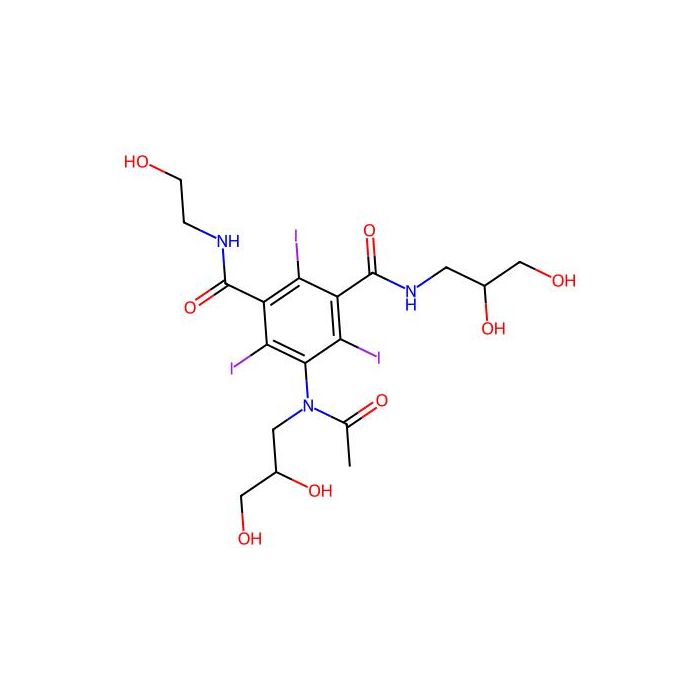
Ioxilan - ≥98% , Diagnostic agent, CAS No.107793-72-6, Diagnostic agent

CAS: 107793-72-6 Cat. No.: I646147 Fórmula: C18H24I3N3O8 Peso molecular: 791.11 PubChem CID: 3743
Disponible para pedir
CALIDAD & PUREZA ≥98%
Synonyms
IOXILAN [JAN]|Ioxilane|IOXILAN [INN]|Ioxilan(400 mg)|Imagenil|IOXILAN [USP-RS]|1,3-BENZENEDICARBOXAMIDE, 5-(ACETYL(2,3-DIHYDROXYPROPYL)AMINO)-N1-(2,3-DIHYDROXYPROPYL)-N3-(2-HYDROXYETHYL)-2,4,6-TRIIODO-|5-(N-2,3-dihydroxypropylacetamido)-2,4,6-triiodo-N-(2-hydroxyethyl)-N'-(2,3-dihydroxypropyl)isophthalamide|IOXILAN (USP-RS)|Ioxilanum [INN-Latin]|Ioxitol|Oxilan-300|IOXILAN (USP MONOGRAPH)|Ioxilan (USAN:USP:INN)|Ioxilan [USAN:USP:INN]|Loxilan|Ioxilanum (INN-Latin)|3-(3-Methyl-4-oxo-thiazolidin-2-ylideneamino)-benzoicacid|IOXILAN [MART.]|Pharmakon1600-01503838|5-[acetyl(2,3-dihydroxypropyl)amino]-3-N-(2,3-dihydroxypropyl)-1-N-(2-hydroxyethyl)-2,4,6-triiodobenzene-1,3-dicarboxamide|1,3-Benzenedicarboxamide, 5-(acetyl(2,3-dihydroxypropyl)amino)-N-(2,3-dihydroxypropyl)-N'-(2-hydroxyethyl)-2,4,6-triiodo-|IOXILAN (USP IMPURITY)|1,3-Benzenedicarboxamide, 5-[acetyl(2,3-dihydroxypropyl)amino]-N1-(2,3-dihydroxypropyl)-N3-(2-hydroxyethyl)-2,4,6-triiodo-|5-[Acetyl(2,3-dihydroxypropyl)amino]-N-(2,3-dihydroxypropyl)-N'-(2-hydroxyethyl)-2,4,6-triiodoisophthalamide|N-(2,3-Dihydroxypropyl)-5-(N-(2,3-dihydroxypropyl)acetamido)-N'-(2-hydroxyethyl)-2,4,6-triiodoisophthalamide|Oxilan-300 (TN)|N-(2,3-Dihdroxypropyl)-N -(2-hydroxyethyl)-5-[N-(2,3-dihydroxypropyl)acetamido]-2,4,6-triiodoiosphthalamide|IOXILAN [VANDF]|LOXILAN [VANDF]|ioxilan|IOXILAN (400 MG)|IOXILAN [USAN]|Ioxilanum|IOXILAN [WHO-DD]|IOXILAN [MI]|IOXILAN [ORANGE BOOK]|N-(2,3-dihydroxypropyl)-N'-(2- hydroxyethyl)-5-[N-(2,3-dihydroxypropyl) acetamido]-2,4,6-triiodoisophthal-amide|IOXILAN (MART.)|Ioxilane [INN-French]|IOXILAN [USP IMPURITY]|5-(N-2,3-dihydroxypropylacetamido)-2,4,6-triiodo-N-(2-hydroxyethyl)-N -(2,3-dihydroxypropyl)-isophthalamide|Ioxilan (JAN/USP/INN)|N1-(2,3-dihydroxypropyl)-5-[N-(2,3-dihydroxypropyl)acetamido]-N3-(2-hydroxyethyl)-2,4,6-triiodobenzene-1,3-dicarboxamide|IOXILAN [USP MONOGRAPH]|Oxilan
Storage
Store at -20°C
Shipped In
Ice chest + Ice pads
★
Talla
Alemania (EU)
USA*
Precio
Cantidad
5mg
I646147-5mg
Fabricado bajo pedido · 8–12 semanas
191,68€
10mg
I646147-10mg
Fabricado bajo pedido · 8–12 semanas
304,49€
Enter a quantity for the sizes you want to add.

Descripción general

Ioxilan is a low-osmolar, nonionic and tri-iodinated diagnostic contrast agent. Ioxilan is also an X-ray contrast agent for excretory urography and contrast enhanced computed tomographic (CECT) imaging of the head and body. Intravascular injection results in opacification of vessels in the path of flow of the contrast medium, permitting radiographic visualization of the internal structures of the human body until significant hemodilution occurs .

In Vitro

As a low-osmolar nonionic monomer, Ioxilan increases the safety and tolerance of X-ray contrast agents. The development of Ioxilan is based on the introduction of a double methylene as a hydrophobic region and masking it with a hydrophilic hydroxyl group could lower the osmolality without adversely affecting the biological tolerance. MCE has not independently confirmed the accuracy of these methods. They are for reference only.

In Vivo

Rapid intravenous injection of water-soluble X-ray contrast agents (Ioxilan) can be performed with dynamic computed tomography to improve the detectability of liver lesions. When injected intravenously, water-soluble, intravenous X-ray contrast agents are largely distributed in the extracellular fluid space and excreted unchanged by the kidneys. Contrast enhancement of a region of interest depends on the route of administration, delivery of the agent to the area by blood flow, and the final iodine concentration in the region . MCE has not independently confirmed the accuracy of these methods. They are for reference only.

Form:Solid

Especificaciones

Sinónimos
IOXILAN [JAN] | Ioxilane | IOXILAN [INN] | Ioxilan(400 mg) | Imagenil | IOXILAN [USP-RS] | 1,3-BENZENEDICARBOXAMIDE, 5-(ACETYL(2,3-DIHYDROXYPROPYL)AMINO)-N1-(2,3-DIHYDROXYPROPYL)-N3-(2-HYDROXYETHYL)-2,4,6-TRIIODO- | 5-(N-2,3-dihydroxypropylacetamido)-2,4,6-triiodo-N-(2-hydroxyethyl)-N'-(2,3-dihydroxypropyl)isophthalamide | IOXILAN (USP-RS Show more
Especificaciones y pureza
≥98%
Mecanismos bioquímicos y fisiológicos
Ioxilan is a low-osmolar, nonionic and tri-iodinated diagnostic contrast agent. Ioxilan is also an X-ray contrast agent for excretory urography and contrast enhanced computed tomographic (CECT) imaging of the head and body. Intravascular injection results
Condiciones de almacenamiento de almacenamiento
Store at -20°C
Enviado en
Ice chest + Ice pads
Este producto requiere envío en cadena de frío. Los servicios terrestres y otros servicios económicos no están disponibles.
Mecanismo de acción
Diagnostic agent
Pureza
≥98%
Propiedades del producto
ALogP
-2.4
Nombres e identificadores
SMILES
CC(=O)N(CC(CO)O)C1=C(C(=C(C(=C1I)C(=O)NCC(CO)O)I)C(=O)NCCO)I
IUPAC Name
5-[acetyl(2,3-dihydroxypropyl)amino]-3-N-(2,3-dihydroxypropyl)-1-N-(2-hydroxyethyl)-2,4,6-triiodobenzene-1,3-dicarboxamide
InChIKey
UUMLTINZBQPNGF-UHFFFAOYSA-N
InChI
1S/C18H24I3N3O8/c1-8(28)24(5-10(30)7-27)16-14(20)11(17(31)22-2-3-25)13(19)12(15(16)21)18(32)23-4-9(29)6-26/h9-10,25-27,29-30H,2-7H2,1H3,(H,22,31)(H,23,32)
Isómeros SMILES
CC(=O)N(CC(CO)O)C1=C(C(=C(C(=C1I)C(=O)NCC(CO)O)I)C(=O)NCCO)I
PubChem CID
3743
Peso molecular
791.11

Datos avanzados

Taxonomic Classification

Taxonomy Tree

KingdomOrganic compounds
SuperclassBenzenoids
ClaseBenzene and substituted derivatives
SubclassBenzoic acids and derivatives
Intermediate Tree Nodes Not available
Direct ParentAcylaminobenzoic acid and derivatives
Alternative Parents O-haloacetanilides  P-haloacetanilides  2-halobenzoic acids and derivatives  4-halobenzoic acids and derivatives  Benzamides  Benzoyl derivatives  N-acylethanolamines  Iodobenzenes  Aryl iodides  Tertiary carboxylic acid amides  Vinylogous halides  Acetamides  Secondary alcohols  Secondary carboxylic acid amides  Organoiodides  Organic oxides  Hydrocarbon derivatives  Carbonyl compounds  Organopnictogen compounds  Primary alcohols  
Molecular FrameworkAromatic homomonocyclic compounds
Substituents Acylaminobenzoic acid or derivatives - O-haloacetanilide - P-haloacetanilide - Haloacetanilide - Acetanilide - 2-halobenzoic acid or derivatives - 4-halobenzoic acid or derivatives - Halobenzoic acid or derivatives - Benzamide - Anilide - N-acylethanolamine - Benzoyl - Halobenzene - Iodobenzene - Aryl iodide - Aryl halide - Acetamide - Vinylogous halide - Tertiary carboxylic acid amide - Carboxamide group - Secondary carboxylic acid amide - Secondary alcohol - Alkanolamine - Carboxylic acid derivative - Organohalogen compound - Primary alcohol - Organic nitrogen compound - Alcohol - Carbonyl group - Hydrocarbon derivative - Organic oxide - Organopnictogen compound - Organic oxygen compound - Organoiodide - Organonitrogen compound - Organooxygen compound - Aromatic homomonocyclic compound
DescripciónThis compound belongs to the class of organic compounds known as acylaminobenzoic acid and derivatives. These are derivatives of amino benzoic acid derivatives where the amine group is N-acylated.
External Descriptors Not available
Estructura 3D
Modelo de Estructura Química Interactiva


Objetivos asociados (no humanos)
Hdac6 Histone deacetylase 6 (222 Activities)
Activity TypeRelationActivity valueUnitsAction TypeJournalPubMed IddoiAssay Aladdin ID
rep Replicase polyprotein 1ab (378 Activities)
Activity TypeRelationActivity valueUnitsAction TypeJournalPubMed IddoiAssay Aladdin ID
Mecanismos de acción
Certificados (CoA, COO, BSE/TSE y tabla de análisis)
C of A & Other Certificates(BSE/TSE, COO):
Analytical Chart:
Propiedades químicas y físicas
SolubilidadDMSO : ≥ 250 mg/mL (316.01 mM)
Peso molecular791.1
XLogP3-2.400
Hydrogen Bond Donor Count7
Hydrogen Bond Acceptor Count8
Rotatable Bond Count11
Exact Mass790.87 Da
Monoisotopic Mass790.87 Da
Topological Polar Surface Area180.000 Ų
Heavy Atom Count32
Formal Charge0
Complexity647.000
Isotope Atom Count0
Defined Atom Stereocenter Count0
Undefined Atom Stereocenter Count2
Defined Bond Stereocenter Count0
Undefined Bond Stereocenter Count0
The total count of all stereochemical bonds0
Covalently-Bonded Unit Count1
Calculadoras de soluciones
Reseñas

Reseñas de cliente

Application Protocols

No manufacturer-tested bioassay protocols are provided for this item. The following general, research-use procedures illustrate common laboratory applications for iodinated radiopaque standards:

A. CT calibration phantom solution (general)

  • Prepare a series of aqueous solutions at defined iodine concentrations (e.g., 0, 2, 5, 10 mg I/mL) by dissolving the compound in deionized water. Warm to 30–40 °C with stirring to aid dissolution.
  • Filter (0.22–0.45 µm) into sealed vials, label with iodine concentration, and equilibrate to imaging temperature before scanning.
  • Acquire scans using standardized parameters; plot HU versus iodine concentration to obtain calibration curves.

B. HPLC reference standard preparation (general)

  • Accurately weigh analyte into volumetric flask; dissolve in water (or water:acetonitrile 9:1) to prepare a primary stock (e.g., 1–5 mg/mL).
  • Sonicate briefly if needed; filter through 0.22 µm PTFE/PES prior to injection.
  • Store aliquots frozen to minimize degradation; verify concentration by UV or mass balance.

C. Hydrogel phantom embedding (general)

  • Prepare agarose (1–4% w/v) in buffer; cool to ~50–60 °C.
  • Add calculated amount of compound to reach target iodine level; mix gently to avoid bubbles; cast and allow to set.

These are illustrative only; optimize parameters for your instruments and objectives.

Biological Roles

Ioxilan does not serve a native biochemical role; it is a synthetic, nonionic, tri‑iodinated aromatic designed to be highly X‑ray attenuating and water‑soluble. For research contexts, key physicochemical interactions in biological systems can be summarized as follows (general chemistry/biochemistry knowledge):

  • Mechanism of contrast: photoelectric absorption by iodine (Z=53) dominates at diagnostic X‑ray energies, producing strong attenuation that scales with iodine concentration.
  • Protein binding: nonionic iodinated agents are typically characterized by low plasma protein binding in vitro, a property linked to multiple hydroxyl groups and steric shielding of the aromatic core; exact values are agent‑specific and not provided here.
  • Osmolality/viscosity: concentrated aqueous solutions can exhibit high osmolality and viscosity; in model systems this influences diffusion, convection, and contrast kinetics.
  • Stability in aqueous media: generally stable at neutral pH and room temperature for practical timescales; prolonged heating or extreme pH can promote hydrolysis or deiodination.
  • Cellular interactions: largely inert with limited membrane partitioning due to high polarity and hydrogen bonding capacity; transport across lipid bilayers is restricted without facilitators.

Note: Any in vivo behavior, ADME, or safety profile is outside the scope of this listing. This product is for research use only and not for human or animal diagnostic applications.

Buffer Applications

This compound is not a buffering agent and does not establish a defined pH range. However, in research workflows it can be incorporated into aqueous buffers to impart controlled X‑ray attenuation for imaging phantoms or instrument calibration.

Practical guidance (general):

  • Matrix selection: PBS, Tris, or HEPES buffers at neutral pH are commonly used as carriers when biological mimicry is desired. Ensure buffer components do not precipitate at high ionic strengths if combined with other solutes.
  • Preparation: dissolve the weighed amount directly into the buffer with gentle warming (25–40 °C) and stirring. Verify final pH; the compound is nonionic and typically exerts minimal pH shift.
  • Filtration: 0.22–0.45 µm sterile filtration is recommended for optical clarity and bioburden control in long‑term phantom storage.
  • Additives: viscosity modifiers (e.g., glycerol, PVP) or gel matrices (agarose, PVA) may be added to tune mechanical properties; confirm compatibility and lack of phase separation.

For rigorous pH control, pair with a true buffer system appropriate for your target pH; this material contributes attenuation, not buffering capacity.

Green Alternatives

Context: Iodinated, tri‑iodo aromatics are specialty materials; “green” selection focuses on achieving the imaging/analytical objective with minimal environmental burden while ensuring lab safety.

Alternative strategies (general, application-driven):

  • Use inorganic iodide solutions (e.g., KI, NaI) when ionic strength, corrosion, and osmolality are acceptable. These salts are cheaper, simpler to handle, and readily biodegradable compared to complex organoiodines.
  • Consider lower‑viscosity nonionic agents (e.g., iohexol, iopamidol) if reduced pumping energy or easier filtration is a priority; minor differences in viscosity at given iodine molarity can improve process efficiency.
  • Right‑sizing iodine concentration: design phantoms and calibrants to the minimum iodine loading that achieves measurement fidelity; reduces iodine footprint and waste.
  • Closed-loop use: capture and reuse phantom solutions where feasible; verify stability via HPLC before reuse.

Comparison snapshot (literature/general):

  • Ioxilan vs KI: similar X‑ray attenuation per iodine atom; ioxilan offers nonionic behavior and lower corrosivity at equivalent iodine content but is more persistent as an organic compound.
  • Ioxilan vs iohexol/ioversol: broadly comparable attenuation; selection may be based on solubility/viscosity and availability. Environmental profiles are similar among nonionic tri‑iodinated agents.

Waste minimization:

  • Segregate iodine‑containing aqueous waste for recovery or specialized disposal. Avoid discharge to general drains without institutional approval.
Pharmaceutical Uses

No pharmacopeial grade, monograph compliance, or clinical use status is stated for this catalog item. It is supplied strictly for research use only.

Formulation and manufacturing considerations (general knowledge for nonionic iodinated media):

  • Role in formulations: functions as a radiopaque agent providing X‑ray attenuation; typically formulated as concentrated aqueous solutions with defined iodine content.
  • Typical excipients (literature/general): water for injection (WFI) equivalents in research, tonicity agents (e.g., minimal or none for nonionic media), pH adjusters (buffers in the mildly acidic to neutral range), and stabilizers (oxygen scavengers generally not required). This item does not specify any excipients.
  • Critical attributes to control for research formulations: iodine assay (w/v), osmolality, viscosity (temperature dependent), pH, endotoxin/bioburden (if sterility is required for model systems).
  • Container/closure: glass vials or HDPE bottles; select materials compatible with high‑density aqueous solutions; avoid closures susceptible to creep under viscous load.

If a pharmacopeial or clinical-grade supply is required, do not use this item; contact us to discuss availability of appropriate grades and documentation.

Physical Properties

Item-specific physico-chemical specifications were not provided with this listing. Values below are general/literature-style guidance for nonionic tri‑iodinated benzamide contrast media and should not be treated as specifications for this SKU.

  • Appearance (product data): Not specified for this item; refer to CoA/Spec Sheet.
  • Melting point (literature, class-typical): often >150 °C (decomposes); exact value is compound/formulation dependent.
  • Boiling point: Not applicable for these high-MW, nonvolatile solids; decomposition occurs before boiling (literature, class-typical).
  • Density: Not typically reported for the dry solid; aqueous solution densities increase with concentration (literature, class-typical).
  • Solubility (literature, class-typical): highly soluble in water; sparingly soluble in alcohols; essentially insoluble in nonpolar solvents due to multiple hydroxyl/amide groups.
  • Partitioning (literature, class-typical): very low logP/logD; strong preference for aqueous phase; negligible volatility.
  • pKa: no strongly ionizable groups in the clinical pH range; overall nonionic; amide functions are not titratable under mild conditions (literature, class-typical).
  • Refractive index: typically reported for solutions rather than solids; increases with concentration (literature, class-typical).

For certified values and acceptance limits (e.g., water content, impurities, UV absorbance), see the batch CoA/Spec Sheet. Do not substitute literature values for quality control of this item.

Quality and Grades
  • Grade/Purity (product data): Not specified for this item; refer to CoA/Spec Sheet.

How to interpret grades for this product category (general guidance):

  • Research or reagent grade indicates suitability for laboratory studies, method development (e.g., CT phantom calibration), and synthesis/analytical standards. It does not imply compliance with pharmacopeial monographs unless explicitly stated.
  • If an HPLC or LC–MS grade were specified, it would indicate low nonvolatile residue and low UV background for chromatographic applications. In absence of that, confirm suitability by running blank gradients and assessing baseline noise.
  • For materials sometimes formulated with stabilizers (e.g., antimicrobial agents in solutions), check labeling; this listing does not specify any stabilizer. Solid, neat material is typically provided without added excipients.

Item-specific QC parameters to confirm on CoA:

  • Identity by NMR/IR/HPLC retention time; purity by HPLC/LC–MS; residual solvents; water content (Karl Fischer); iodine assay (where applicable); heavy metals.
  • Microbial limits only apply if supplied as an aqueous solution; this listing does not specify solution form.

If your application requires a defined grade (e.g., USP/EP, injection-grade), contact us to discuss availability; this catalog item is for research use only as noted in the product data.

Reaction and Applications

Research and laboratory applications (non-clinical):

  • X‑ray/CT calibration standards: prepare defined iodine concentrations for HU–iodine response curves, quality assurance of CT systems, and dual‑energy/spectral CT material decomposition algorithm validation.
  • Imaging phantoms: incorporate into hydrogel or polymer matrices (e.g., agarose, PVA cryogels, polyurethane) to fabricate radiopaque phantoms with tunable attenuation and known relaxation/viscosity profiles.
  • Micro-CT/µCT contrast for materials: dope resins, cements, or biological specimens ex vivo to enhance contrast in nonliving samples; rinse protocols control penetration depth.
  • Density/viscosity modifiers: concentrated aqueous solutions provide high density and viscosity for flow visualization or separations modeling, with the added benefit of strong X‑ray attenuation for flow imaging.
  • Analytical standards: use as a calibration or system‑suitability compound for HPLC methods targeting nonionic iodinated media; reference retention time and UV absorbance (end‑absorbance in low‑UV region may be modest due to iodine/aryl chromophore).

Practical tips:

  • Dissolution: add incrementally to warm water (25–40 °C) with stirring; avoid local supersaturation. Degas if needed to prevent bubble artifacts in phantoms.
  • Filtration: 0.22 µm PTFE or PES filters are suitable; high viscosity at elevated concentrations may require 0.45 µm.
  • Sterility: for biological model systems, sterile-filter or autoclave compatible containers post‑preparation (heat stability depends on matrix; avoid prolonged >80 °C exposure to limit degradation).

Note: This product is for research use only and not for human or animal diagnostic use.

Reaction Conditions

This product is generally used as a formulated, highly water‑soluble analyte/standard rather than as a substrate in preparative reactions. Consequently, there are no typical “reaction conditions” specific to this compound in synthetic chemistry.

Method-development contexts (general guidance):

  • HPLC analysis: reversed-phase columns (C18, polar-embedded) with high aqueous mobile phases (e.g., 95–100% water with 0.1% formic acid or ammonium acetate), gradients into moderate organic (acetonitrile) to elute; column temperatures 25–40 °C. Detection by UV at low wavelengths (200–254 nm) and/or ELSD; iodine-specific detection by ICP-MS post-column is possible.
  • Stability studies: aqueous solutions at neutral pH and ambient temperature are typically stable for days to weeks; accelerated conditions (e.g., 60–80 °C, pH ≤3 or ≥10, peroxide exposure) promote degradation for stress testing. Monitor by HPLC with MS or high‑resolution UV.
  • Phantom preparation: dissolve to target iodine molarity; degas to remove bubbles; cast in molds; allow equilibration to room temperature to stabilize density/viscosity prior to imaging.

These are literature/general practices; for this SKU, consult the CoA/Spec Sheet for any item-specific recommendations.

Safety and Handling
  • GHS/CLP classification: Not specified for this item; refer to SDS.
  • Signal word / Hazard statements / Pictograms: Not specified for this item; refer to SDS.

General safe-handling guidance (laboratory, research use only):

  • Avoid inhalation of dusts and contact with eyes/skin. Use in a chemical fume hood or well-ventilated area.
  • Recommended PPE: lab coat, safety glasses or face shield, and appropriate chemical-resistant gloves (e.g., nitrile). Consider splash protection when preparing concentrated aqueous solutions.
  • Hygiene: wash thoroughly after handling; avoid eating or drinking in work areas.

Incompatibilities and stability (general chemistry knowledge):

  • Stable as a solid under recommended storage. Avoid strong oxidizers, strong acids/bases at elevated temperature, and prolonged heating which may lead to degradation (deiodination, amide hydrolysis, Maillard-type discoloration in presence of reducing sugars).
  • Solutions: microbial growth can occur without preservative; use sterile technique for biological or imaging phantom applications. Protect solutions from excessive heat and light.

First-aid overview (refer to SDS for authoritative instructions):

  • Inhalation: move to fresh air; seek medical attention if symptoms persist.
  • Skin/eyes: rinse with water for several minutes; remove contaminated clothing; obtain medical advice for persistent irritation.
  • Ingestion: rinse mouth; do not induce vomiting; seek medical attention.

Spills and disposal:

  • Contain solids with minimal dust generation; clean with damp absorbent. Dispose in accordance with institutional and local regulations.
Solvent Selection

Solubility and solvent behavior (general chemistry knowledge for nonionic iodinated benzamides):

  • Primary solvent: water. Multiple hydroxyl and amide groups confer high aqueous solubility; concentrates to high w/v possible with warming and stirring.
  • Miscibility profile: insoluble to poorly soluble in nonpolar solvents (hexanes, toluene); limited solubility in lower alcohols (methanol, ethanol) and polar aprotics (DMSO) may be achievable but is typically inferior to water.
  • Polarity class: highly polar, hydrogen-bond donor/acceptor rich; effectively nonvolatile.
  • Dielectric considerations: aqueous systems provide optimal dielectric environment; viscosity rises with concentration and temperature dependence should be considered for handling and filtration.

When to choose water vs alternatives:

  • Use water (or buffered saline) for imaging phantom preparation, X‑ray attenuation standards, density-matched media, and hydrophilic conjugation workflows.
  • Use aqueous-organic blends (e.g., water–methanol) only for method development in chromatography or for sample dissolution prior to LC analysis; verify compatibility with columns/detectors.

Comparative notes:

  • Compared to inorganic iodides (KI, NaI), organic tri‑iodinated media provide high iodine content with reduced ionic strength/osmolality effects and lower corrosivity.
  • Compared to other nonionic media (e.g., iohexol, ioversol), solubility/viscosity differ modestly; select based on target iodine concentration, viscosity limits, and analytical calibration curves.

Always filter aqueous stock solutions (0.22–0.45 µm) to remove particulates for optical or imaging applications.

Storage and Reconstitution
  • Storage conditions (product data): Store at -20 °C.
  • Shipping (product data): Ice chest + ice pads.
  • Appearance (product data): Not specified for this item; refer to CoA/Spec Sheet.

Storage guidance (general):

  • Keep container tightly closed in a dry environment. Protect from moisture to prevent caking and hydrolytic degradation.
  • Minimize freeze–thaw of aqueous stocks by aliquoting. For long-term solid storage, -20 °C is suitable as stated; allow to equilibrate to room temperature in a sealed container before opening to avoid condensation.

Reconstitution (general procedure):

  • Solvent: deionized water (preferred). Buffer may be used if compatible with your application.
  • Technique: add incrementally with stirring; mild warming (25–40 °C) can accelerate dissolution. Avoid overheating or prolonged exposure to >60–70 °C.
  • Clarification: filter through 0.22–0.45 µm to remove particulates/bioburden when optical clarity is required.
  • Concentration: determine target by intended iodine content; verify by suitable assay (e.g., HPLC, ICP‑OES/MS, or density correlation) when quantitative accuracy is needed.

Stability of solutions (general):

  • Store refrigerated or frozen when feasible. Protect from light and microbial contamination. Monitor for discoloration or precipitate; discard if degradation is evident.

Research Use Note (product data): For research use only.

Structure and Identity

Ioxilan is a nonionic, tri‑iodinated, benzamide-based contrast agent molecule designed for high X‑ray attenuation while maintaining aqueous solubility.

  • CAS: 107793-72-6 (product data)
  • PubChem CID: Not specified for this item; refer to CoA/Spec Sheet. (product data gave CID but not a standard identifier)
  • InChIKey: Not specified for this item; refer to CoA/Spec Sheet. (product data)
  • SMILES: Not specified for this item; refer to CoA/Spec Sheet. (product data)
  • Molecular formula: Not specified for this item; refer to CoA/Spec Sheet. (product data)
  • Molecular weight: Not specified for this item; refer to CoA/Spec Sheet. (product data)

Structural features (general chemistry knowledge):

  • Central 1,3,5-triiodinated benzene ring bearing amide and carbamoyl substituents typical of nonionic, low‑osmolality iodinated media.
  • Multiple vicinal diol/secondary alcohol functionalities on side chains that enhance water solubility and reduce protein binding.
  • Neutral overall charge at physiological pH; numerous H‑bond donors/acceptors (amides, hydroxyls) and three heavy iodine atoms responsible for X‑ray attenuation.
  • 2D description: a tri‑iodo benzene core substituted with two amide-linked polyhydroxyalkyl chains; no stereogenic centers of consequence in the aryl core; side chains may contain secondary alcohol stereochemistry depending on substitution pattern in specific isomeric description.

Note: For exact constitutional depiction (SMILES/InChI) and batch identity, please consult the item’s CoA/Spec Sheet.

Synthetic Utility

Ioxilan is a highly functionalized, tri‑iodinated aromatic designed as a final radiopaque agent; it is not commonly used as a synthetic intermediate. Nevertheless, in method development and analytical chemistry it can serve roles that support synthesis and QC:

  • HPLC/LC–MS system suitability: a challenging, high‑polarity analyte useful to evaluate aqueous mobile-phase methods, column retention of hydrophilic aromatics, and detection linearity for iodine-rich molecules.
  • Iodine standard for quantitation: enables calibration of iodine content by ICP‑OES/ICP‑MS or X‑ray attenuation correlation, thereby supporting process monitoring where iodinated aromatics are synthesized.
  • Stress-testing substrate: useful for forced degradation studies to benchmark hydrolysis/deiodination pathways in tri‑iodinated benzamides, informing stability-indicating method development.

Reactivity considerations (general):

  • The aryl iodines are embedded in a deactivated 1,3,5-triiodo ring and are not practical handles for cross-coupling without extensive protection/deprotection; the dense substitution and electron-withdrawing amide functions suppress typical electrophilic substitution.
  • Multiple amide and alcohol functions render the molecule highly polar and resistant to common organic reactions without protective group strategies.

For synthetic building-block needs, consider less elaborated iodinated benzoic acid derivatives that offer more accessible reactivity.

Target Specificity

Not applicable. This product is a small-molecule, nonionic iodinated compound and is not an antibody, protein, or targeted ligand. No antigen/epitope or species reactivity applies. Refer to the Reaction & Applications tab for relevant research uses.

Preguntas frecuentes

What is the purity of this product?
This product is supplied at ≥98% purity (chemical assay). Lot-specific values are stated on the Certificate of Analysis.
How should this product be stored?
Store at ?20 °C. Freezer storage is required to maintain the specified shelf life.
How is this product shipped?
This product ships in an insulated container with ice pads. Unpack on arrival and transfer it to the storage condition stated above.
What are the CAS number, molecular formula and molecular weight?
The CAS Number is 107793-72-6, the molecular formula is C18H24I3N3O8, and the molecular weight is 791.11 g/mol. InChIKey UUMLTINZBQPNGF-UHFFFAOYSA-N.
What documentation is provided?
Available product documentation, including Certificates of Analysis (COA), Safety Data Sheets (SDS), and specification sheets, is shown in the product document area. Document availability and access follow the current site policy.

¿Quieres que te enviemos un mensaje cuando tengamos descuentos disponibles?

Recordármelo más tarde

¡Gracias! Por favor, revisa tu bandeja de entrada de correo electrónico para confirmar.

¡Vaya! Las notificaciones están desactivadas.