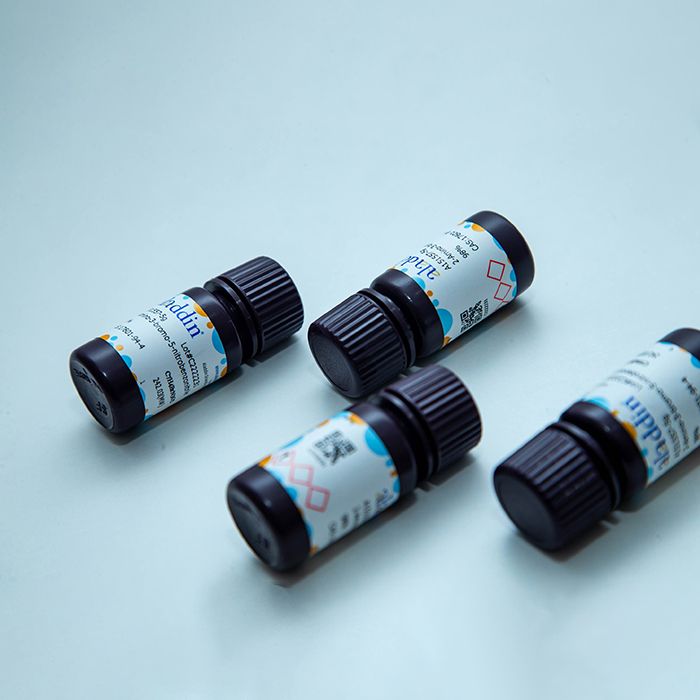
Ipafricept (OMP-54F28; FZD8-Fc) is the first class of recombinant fusion proteins, consisting of the extracellular portion of the human fried-8 receptor fused to the Fc fragment of human IgG1 binding to the Wnt ligand . Ipafricept shows solid tumor inhibition activity, with well tolerance
Form:Liquid
IC50& Target:Wnt ligand
Especificaciones
Especificaciones y pureza
≥96%
Mecanismos bioquímicos y fisiológicos
Ipafricept (OMP-54F28; FZD8-Fc) is the first class of recombinant fusion proteins, consisting of the extracellular portion of the human fried-8 receptor fused to the Fc fragment of human IgG1 binding to the Wnt ligand . Ipafricept shows solid tumor inhibi
Condiciones de almacenamiento de almacenamiento
Store at -20°C
Enviado en
Ice chest + Ice pads
Este producto requiere envío en cadena de frío. Los servicios terrestres y otros servicios económicos no están disponibles.
Tipo de acción
INHIBITOR
Pureza
≥96%
Datos avanzados
Certificados (CoA, COO, BSE/TSE y tabla de análisis)
C of A & Other Certificates(BSE/TSE, COO):
Analytical Chart:
Calculadoras de soluciones
Molarity Calculator
Determine the necessary mass, volume, or concentration for preparing a solution.
Dilution Calculator
Determine the dilution needed to prepare a stock solution.
Reconstitution Calculator
Reseñas
Reseñas de cliente
Application Protocols
Only item-specific, tested application details are permitted in this section. The Product Data for SKU I651794 does not include validated application types, recommended dilutions, or positive controls.
Tested applications: Not specified for this item; refer to CoA/Spec Sheet.
Recommended working concentrations/dilutions: Not specified for this item; refer to CoA/Spec Sheet.
Positive/negative controls: Not specified for this item; refer to CoA/Spec Sheet.
Users should develop pilot protocols tailored to their assay system; consult the Reaction & Applications and Reaction Conditions sections for general, literature-based guidance.
Biological Roles
This section provides general biological context for Fc-fusion decoy receptors that bind Wnt ligands via the Frizzled-8 cysteine-rich domain (CRD). No therapeutic claims are made.
Canonical Wnt ligands bind Frizzled (FZD) receptors and LRP5/6 co-receptors to stabilize β-catenin, leading to TCF/LEF-dependent transcription programs that control proliferation, differentiation, and stem cell maintenance.
Non-canonical pathways (planar cell polarity, Ca2+ signaling) are activated by distinct Wnt–FZD combinations independent of β-catenin.
Decoy receptor mechanism:
The FZD8 CRD recognizes palmitoleoylated Wnt proteins; as a soluble Fc-fusion, it sequesters Wnts extracellularly, competing with cell-surface receptors and dampening downstream signaling.
Dimeric Fc architecture may enhance apparent avidity for multivalent or clustered ligands.
Experimental utility:
Dissecting autocrine/paracrine Wnt dependencies in cultured cells or organoids by attenuating extracellular Wnt availability.
Benchmarking small-molecule pathway modulators (e.g., PORCN or tankyrase inhibitors) by comparing phenotypic and transcriptional outcomes.
Studying ligand selectivity among Wnt family members (e.g., Wnt1, Wnt3a, Wnt5a) through binding and neutralization assays.
Item-specific binding profile, kinetics, or bioactivity values are not provided; consult primary literature on FZD8-CRD–Fc constructs and the product CoA for lot-specific data if available.
Buffer Applications
Ipafricept is a protein biologic; practical performance depends critically on buffer composition and handling. Item-specific formulation is not provided; the following are general, literature-based recommendations.
Reconstitution/dilution buffers:
PBS (10–50 mM phosphate, 150 mM NaCl), pH 7.2–7.4: Widely compatible with binding and cell assays.
HEPES-buffered saline (10–25 mM HEPES, 150 mM NaCl), pH 7.3–7.6: Superior pH control in CO2-independent workflows.
Additives: 0.1% carrier protein (BSA/HSA) reduces adsorption to plastics; 5–20% glycerol supports frozen storage post-aliquoting.
pH range and ionic strength:
Maintain near-neutral pH (7.0–7.6). High ionic strength (≥150 mM NaCl) can suppress nonspecific interactions without generally impairing Fc stability.
Sterility and preservatives:
For cell culture, avoid sodium azide; prepare and maintain sterility via filtration and aseptic technique. For biochemical assays, low levels of azide may be acceptable but are toxic to cells and interfere with peroxidase-based readouts.
Adsorption and recovery:
Use low-bind tubes and pre-blocked pipette tips or include carrier protein to mitigate surface losses at sub-μg/mL concentrations.
Compatibility notes:
Avoid chelators or detergents that could disrupt protein–lipid interactions relevant to Wnt binding.
Always verify compatibility with your assay system and consult the lot-specific CoA for any supplied buffer composition.
Green Alternatives
Greener practices for working with recombinant proteins focus on buffer selection, resource efficiency, and minimizing hazardous preservatives.
Buffer and preservative choices (general):
Prefer phosphate- or HEPES-based buffers over Tris for wastewater compatibility when feasible.
Avoid sodium azide where possible (acute aquatic toxicity); instead, use sterile technique, single-use aliquots, and 0.2 μm filtration to control bioburden.
Assay design:
Use miniaturized, high-content cell assays to reduce reagent consumption and plastic waste.
Replace animal-derived supplements with xeno-free or recombinant alternatives to improve sustainability and batch consistency.
Cold-chain optimization:
Plan shipments to consolidate orders and reduce dry-ice/ice-pack usage; immediate transfer to -20°C storage prevents re-shipments.
Comparative considerations (general):
Protein decoy receptors vs. small molecules: Fc-fusions are aqueous, eliminating organic solvent stocks (e.g., DMSO), which simplifies waste handling; however, they require cold-chain logistics and may have shorter shelf life after thawing.
Immobilized formats: Where appropriate, immobilizing Fc-fusions on solid supports can enable reuse and reduce total protein consumption in binding assays.
Note: No item-specific green certifications or compositions are provided. Implement institutional green lab practices alongside standard biosafety procedures.
Pharmaceutical Uses
No clinical or therapeutic uses are claimed or supported for this catalog item. The information below addresses research/formulation contexts only.
Potential roles in pharmaceutical research workflows (literature/general):
Reference reagent for target validation: A protein decoy receptor that neutralizes Wnt ligands can serve as a biological tool to benchmark small-molecule Wnt modulators in discovery programs.
Assay system control: Use as a positive control for Wnt pathway inhibition in reporter assays, aiding hit triage and SAR interpretation.
Formulation studies: Fc-fusions are model systems for evaluating buffer, stabilizer, and cryoprotectant effects on stability (aggregation, fragmentation) and for optimizing storage/handling processes.
Bioanalytical method development: Serves as an Fc-containing analyte for developing ligand-binding assays (ELISA, SPR/BLI) or for testing anti-human Fc capture/detection systems.
Pharmacopeial/compendial status: Not specified for this item; refer to CoA/Spec Sheet.
All uses are for laboratory research only. This product is not intended for human or veterinary use, diagnostics, or as a drug substance/excipient in manufacturing without appropriate qualifications.
Physical Properties
Item-specific physicochemical specifications are not provided for this recombinant protein.
Appearance: Not specified for this item; refer to CoA/Spec Sheet.
Molecular Weight: Not specified for this item; refer to CoA/Spec Sheet.
Molecular Formula: Not specified for this item; refer to CoA/Spec Sheet.
Extinction coefficient, pI, glycosylation state: Not specified for this item; refer to CoA/Spec Sheet.
Solubility (item-specific): Not specified for this item; refer to CoA/Spec Sheet.
Literature/general characteristics for guidance (non-specification):
Form: Typically supplied lyophilized or as a frozen aqueous protein solution in a neutral buffer (e.g., PBS) with stabilizers (e.g., trehalose, glycerol, carrier protein). Exact composition varies by lot/vendor.
Approximate size: Fusion proteins of FZD-CRD–Fc type commonly behave as disulfide-linked Fc dimers (apparent mass often in the 100–120 kDa range by SDS-PAGE under non-reducing conditions); monomeric Fc-fusion chain ~50–65 kDa depending on sequence and glycosylation.
Solubility (general): Readily soluble in physiological buffers (PBS, HEPES) at μg/mL–mg/mL concentrations; avoid extreme pH and high ionic detergents that may denature or aggregate Fc fusions.
Stability considerations: Sensitive to repeated freeze–thaw; stability improved by aliquoting, adding protein carrier (e.g., 0.1% BSA) and cryoprotectants (e.g., 10–20% glycerol) for frozen storage.
Note: Use the lot-specific CoA/Spec Sheet for definitive physical data and handling concentrations.
Quality and Grades
Item-specific grade, purity, and assay criteria are not provided.
Grade/Purity: Not specified for this item; refer to CoA/Spec Sheet.
General guidance on quality attributes for Fc-fusion recombinant proteins (literature/general):
Identity: Verified by SDS-PAGE (reducing/non-reducing), Western blot (anti-human Fc), and/or mass spectrometry peptide mapping.
Purity: Commonly reported as % by densitometry on Coomassie-stained gels and by SEC-HPLC for aggregate/fragment content. Monomeric content and low high–molecular weight species are critical for consistent activity.
Glycosylation: Fc glycoforms can vary with expression host; this influences stability and Fc-mediated interactions. Vendors may provide host cell line and glycan profile when relevant.
Bioactivity: Functional assays often include Wnt-ligand neutralization in reporter cell lines (e.g., TCF/LEF luciferase) or ELISA-based binding to purified Wnt proteins. EC50/IC50 values, if provided, are method-dependent and not directly comparable across labs.
Endotoxin/bioburden: Low endotoxin levels (e.g., ≤1 EU/μg protein) and sterility/bioburden limits are typical quality metrics for cell-based work. Confirm with the lot CoA when planning sensitive cell assays.
Aggregate control: Storage and handling conditions affect aggregation; SEC profiles before critical experiments are recommended.
Interpret any reported numerical specs on the lot-specific CoA/Spec Sheet; do not assume unlisted attributes.
Reaction and Applications
As a Wnt-ligand decoy receptor Fc-fusion, Ipafricept is used as a functional tool to modulate Wnt/Frizzled signaling in research settings. No medical or clinical uses are implied.
Typical research applications (literature/general):
Ligand sequestration: Binds extracellular Wnt ligands via the Frizzled-8 CRD, preventing receptor activation and downstream β-catenin–dependent transcription.
Pathway dissection: Employed in TCF/LEF reporter assays to confirm Wnt dependence of cellular phenotypes by neutralizing exogenous or autocrine Wnt activity.
Binding studies: Used in ELISA, SPR/BLI, or pulldown formats to characterize interactions with specific Wnt isoforms under defined conditions.
Differentiation and developmental signaling: Tool to attenuate Wnt cues in stem/progenitor cell culture and organoid systems to probe lineage specification mechanisms (optimize dose empirically).
Target engagement controls: Acts as a positive control for Wnt inhibition alongside small-molecule PORCN inhibitors or tankyrase inhibitors.
Practical tips (general):
Titrate broadly (e.g., low pM to low nM) in cell assays; effective levels depend on Wnt expression, presence of carrier proteins/lipids (Wnt is lipidated), and medium composition.
Pre-incubate with ligand in conditioned medium where applicable to allow complex formation before cell exposure.
Confirm specificity with orthogonal readouts (β-catenin stabilization, Axin2 expression) and appropriate negative Fc controls.
Item-specific activity data, concentration recommendations, and EC50/IC50 values are not provided; consult the CoA or perform pilot titrations.
Reaction Conditions
Classical chemical reaction conditions do not apply. For assay-focused work with a Wnt-ligand decoy receptor, consider the following literature-based, non-item-specific guidance:
Cell-based pathway assays:
Medium: Serum-containing (e.g., 0.5–10% FBS) or serum-free defined media; serum can bind Wnt proteins and may affect effective concentrations.
Dosing: Empirical titration across sub-nanomolar to low-nanomolar ranges is common for Wnt neutralization; optimal concentrations depend on ligand abundance and cell line sensitivity.
Incubation: Pre-equilibrate Ipafricept with Wnt-conditioned medium or recombinant Wnt (typically 15–60 min) before applying to cells to promote complex formation.
Readouts: TCF/LEF luciferase activity, β-catenin stabilization (immunoblot/immunofluorescence), and expression of target genes (e.g., AXIN2) after 6–24 h.
Biophysical interaction studies:
Buffers: Neutral pH, 150 mM NaCl, low-detergent conditions; include carrier protein to stabilize Wnt ligands.
Surfaces: Use anti-Fc capture for SPR/BLI to ensure oriented presentation; verify that immobilization does not impair binding.
Controls:
Include human IgG1 Fc-only protein as a negative control and, where feasible, orthogonal Wnt inhibitors (small molecules) for benchmarking.
Item-specific guidance on concentration, kinetics, or expected activity is not provided; perform pilot experiments to define working conditions.
Safety and Handling
Item-specific hazard classification data are not provided.
GHS/CLP for this item:
Signal Word: Not specified for this item; refer to SDS.
Hazard Statements (H-Statements): Not specified for this item; refer to SDS.
GHS Classification and Pictograms: Not specified for this item; refer to SDS.
General laboratory safety guidance for recombinant proteins (literature/general):
Expected hazards: Proteins typically present low acute toxicity but may elicit allergenic or immunogenic responses upon repeated exposure. Avoid aerosol generation and skin contact.
PPE: Lab coat, safety glasses, and disposable nitrile gloves. Use a certified biosafety cabinet for reconstitution, sterile filtration, and aliquoting to minimize contamination and aerosols.
Handling: Use aseptic technique. Avoid vigorous vortexing or foaming that can denature Fc-fusions. Prefer gentle mixing and brief, low-speed centrifugation to collect contents.
Incompatibilities: Strong oxidizers, extremes of pH, and proteases can degrade the protein. Sodium azide, if present as a preservative, is toxic—avoid contact with copper/lead plumbing to prevent formation of explosive azides.
First aid (overview; consult SDS): Inhalation—move to fresh air. Skin/eye contact—rinse with water for several minutes. Ingestion—rinse mouth. Seek medical attention if symptoms persist.
Spills and disposal: Absorb small spills with paper towels, disinfect work surface (e.g., 70% ethanol), and dispose of waste per institutional biosafety procedures.
Always consult the product’s SDS and institutional EHS policies for authoritative safety requirements.
Solvent Selection
For protein biologics like Ipafricept, “solvent” selection equates to choosing appropriate aqueous buffers that preserve structure and activity.
Polarity and miscibility: Use fully aqueous, isotonic buffers. Avoid organic cosolvents (DMSO, acetonitrile) that can denature proteins unless required at very low percentages during analytical procedures.
Common buffer systems (general guidance):
PBS, pH 7.2–7.4: Routine handling, ELISA, and neutral physiological assays.
HEPES, 10–25 mM, pH 7.2–7.6: Superior pH stability in CO2-independent cell assays.
Tris, pH 7.4–8.0: Useful for some biochemical assays; note temperature-dependent pKa.
Additives: 150 mM NaCl (tonicity, reduces nonspecific interactions); 0.01–0.1% carrier protein (BSA or HSA) to minimize adsorption; 5–20% glycerol as cryoprotectant for frozen storage; non-ionic detergents (0.001–0.01% Tween-20) only if compatible with downstream assays.
When to choose which:
Cell-based Wnt signaling assays: PBS or HEPES-buffered saline without azide; serum-free conditions may reduce interference, but many protocols use low-serum media.
Biophysical/analytical work (SEC, DSC): Low-UV, filtered buffers; avoid Tris for A280 quantitation adjustments.
Incompatibilities: Avoid extremes of pH (<6 or >8.5) and high ionic detergents (SDS) that disrupt folding; minimize divalent chelators if metal-dependent interactions are studied.
Note: Specific buffer composition for this item is not specified; consult the CoA/Spec Sheet for exact formulation if supplied in solution.
Storage and Reconstitution
Item-specific storage and shipping:
Storage Conditions: Store at -20°C (per Product Data). Avoid repeated freeze–thaw cycles.
Shipped In: Ice chest + ice pads (per Product Data). Transfer to -20°C promptly upon receipt.
General guidance for recombinant Fc-fusions (literature/general; not item-specific specifications):
Reconstitution (if supplied lyophilized):
Briefly centrifuge the vial to collect contents. Reconstitute with sterile, PBS or HEPES-buffered saline at neutral pH to the desired concentration (e.g., 0.1–1 mg/mL), mixing gently without vortexing.
Include 0.1% carrier protein (BSA/HSA) to minimize adsorption losses when working at low concentrations.
Aliquoting and storage:
Prepare single-use aliquots in low-bind tubes. For frozen storage, add 5–20% glycerol if compatible with downstream assays to improve freeze–thaw tolerance.
Short-term: 2–8°C for hours to a few days may be acceptable once in buffer without microbial preservatives; maintain sterility.
Long-term: -20°C (per Product Data) or lower; avoid frost-free freezers that cycle temperatures.
Thawing and handling:
Thaw on ice, mix gently, and keep on ice during use. Do not repeatedly refreeze the same aliquot.
Stability: Exact shelf life, activity retention, and buffer composition are not specified for this item; refer to CoA/Spec Sheet.
For authoritative handling instructions, consult the product CoA/SDS and align with institutional biosafety practices.
Structure and Identity
Ipafricept (SKU: I651794) is a recombinant biologic research reagent designed to sequester Wnt ligands via a Frizzled-derived extracellular domain fused to an IgG Fc.
Item-specific identifiers from Product Data:
Product Name: Ipafricept
CAS: 1391727-24-4
Storage: Store at -20°C
Shipped: Ice chest + ice pads
Molecular Formula: Not specified for this item; refer to CoA/Spec Sheet.
Molecular Weight: Not specified for this item; refer to CoA/Spec Sheet.
SMILES / InChIKey: Not applicable for recombinant protein constructs; not specified for this item.
Literature/General identity (non-specification):
Also known as OMP-54F28 in literature.
Construct concept: the cysteine-rich domain (CRD) of human Frizzled-8 (FZD8) fused to a human IgG Fc region, forming a dimeric decoy receptor in solution.
Structural features: modular protein with an N-terminal CRD (rich in disulfides) responsible for Wnt binding, linked to a C-terminal Fc facilitating dimerization and extended serum stability in biological systems.
2D description in words: a signal peptide (removed in mature secreted form) → FZD8-CRD extracellular domain → linker → human IgG1 Fc heavy-chain constant domains (CH2–CH3), forming a symmetric dimer via Fc disulfide bonds.
Category Path: 全部 / 可售 / 小分子和化合物库 (catalog classification only; not a small molecule chemically).
Synthetic Utility
This section is not typically applicable. Ipafricept is a recombinant protein Fc-fusion, not a small-molecule building block or reagent for chemical synthesis.
If your objective is chemical synthesis or medicinal chemistry, consider targeting small-molecule modulators of the Wnt pathway (e.g., PORCN or tankyrase inhibitors) for which classical synthetic planning applies.
For biologics-focused applications, see the sections Reaction & Applications, Biological Roles, and Buffer Applications.
Target Specificity
Only item-specific data are permitted in this section. No target specificity information is provided in the Product Data for SKU I651794.
Target, epitope, species reactivity, clone/isotype (if applicable): Not specified for this item; refer to CoA/Spec Sheet.
For general biological context about Wnt/Frizzled interactions and decoy receptor mechanisms, see the Biological Roles section.
Preguntas frecuentes
What is the purity of this product?
This product is supplied at ≥96% purity (chemical assay). Lot-specific values are stated on the Certificate of Analysis.
How should this product be stored?
Store at ?20 °C. Freezer storage is required to maintain the specified shelf life.
How is this product shipped?
This product ships in an insulated container with ice pads. Unpack on arrival and transfer it to the storage condition stated above.
What are the CAS number, molecular formula and molecular weight?
The CAS Number is 1391727-24-4.
What documentation is provided?
Available product documentation, including Certificates of Analysis (COA), Safety Data Sheets (SDS), and specification sheets, is shown in the product document area. Document availability and access follow the current site policy.
Utilizamos cookies para garantizar el correcto funcionamiento del sitio web y, cuando esté permitido, para mejorar su experiencia. Puede gestionar sus preferencias en cualquier momento en Configuración. Más información en nuestra Política de Cookies.
¿Quieres que te enviemos un mensaje cuando tengamos descuentos disponibles?
Recordármelo más tarde
¡Gracias! Por favor, revisa tu bandeja de entrada de correo electrónico para confirmar.
Products are supplied to verified businesses, institutions, and qualified professionals for research and development use only. Not for use in humans, animals, diagnosis, or therapy.