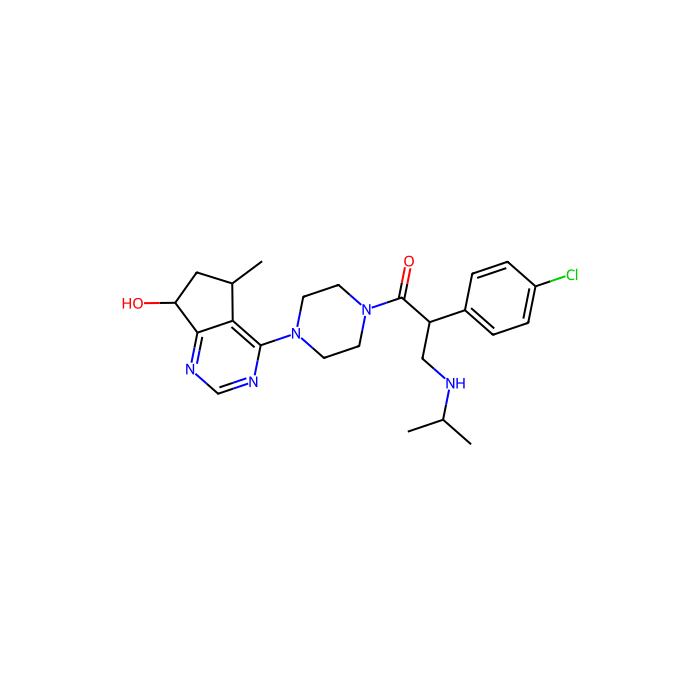
Ipatasertib (GDC-0068) - Moligand™, 10mM in DMSO , Serine/threonine-protein kinase AKT inhibitor, CAS No.1001264-89-6, Serine/threonine-protein kinase AKT inhibitor

CAS: 1001264-89-6 Cat. No.: I408335 Fórmula: C24H32ClN5O2 Peso molecular: 458
Disponible para pedir
CALIDAD & PUREZA Moligand™ ? Moligand™ — Aladdin's line of ligands and bioactive small molecules. Use for receptor, pathway, and binding studies needing defined small-molecule tools. 10mM in DMSO
Synonyms
RG7440 | (S)-2-(4-chlorophenyl)-1-(4-((5R,7R)-7-hydroxy-5-methyl-6,7-dihydro-5H-cyclopenta[d]pyrimidin-4-yl)piperazin-1-yl)-3-(isopropylamino)propan-1-one
Storage
Store at -80°C
Shipped In
Dry ice packs + Cold packs
★
Talla
Alemania (EU)
USA*
Precio
Cantidad
1ml
I408335-1ml
—
2 Disponible

601,26€

876,33€
Guardar 275,07 € (31.39%)
Enter a quantity for the sizes you want to add.
🧪
Por qué esta calidad

Moligand™, 10mM in DMSO Moligand™ para flujos de trabajo cromatográficos y analíticos sensibles que requieren una interferencia mínima de la línea base.

🌡

Almacenamiento y envío

Store at -80°C Envío Dry ice packs + Cold packs. Consulte el COA específico del lote para conocer las especificaciones exactas.

📋

Documentos de calidad

SDS, COA, ficha técnica y hoja de especificaciones disponibles para descargar. COA específico del lote accesible mediante búsqueda por número de lote.

📚

Prueba documental

Citado en 0 publicaciones revisadas por pares sobre cromatografía, síntesis orgánica y reacciones de acoplamiento cruzado.

Descripción general

Information

Ipatasertib (GDC-0068, RG7440) is a highly selective pan-Akt inhibitor targetingAkt1/2/3withIC50of 5 nM/18 nM/8 nM in cell-free assays, 620-fold selectivity over PKA. Phase 2.
In vitro

Testing against a broad panel of 230 kinases, GDC-0068 only inhibits 3 kinases by >70% at 1 μM concentration (PRKG1α, PRKG1β, and p70S6K, with IC50 of 98 nM, 69 nM, and 860 nM, respectively). GDC-0068 displays >100-fold selectivity for Akt over PKA with IC50 of 3.1 μM. In LNCaP, PC3 and BT474M1 cells, GDC-0068 treatment inhibits the phosphorylation of the Akt substrate, PRAS40 with IC50 of 157 nM, 197 nM, and 208 nM, respectively. Furthermore, GDC-0068 selectively inhibits cell cycle progression and viability of cancer cell lines driven by Akt signaling, including those with defects in the tumor suppressor PTEN, oncogenic mutations in PIK3CA, and amplification of HER2, with strongest effects in HER2+ and Luminal subtypes. [1-4]

In vivo

Oral administration of GDC-0068 in PC3 prostate tumor xenografts model induces down-regulation of p-PRAS40. In BT474-Tr xenografts, GDC-0068 treatment reduces pS6 and peIF4G levels, re-localizes FOXO3a to nucleus, and induces feedback upregulation of HER3 and pERK. Administration of GDC-0068 exhibits potent antitumor efficacy in multiple xenograft tumor models, including the PTEN-deficient prostate cancer models LNCaP and PC3, the PIK3CA H1047R mutant breast cancer model KPL-4, and MCF7-neo/HER2 tumor model. [1-4]
Cell Data

cell lines:

Concentrations:

Incubation Time:

Powder Purity:≥99%

Especificaciones

Sinónimos
RG7440 | (S)-2-(4-chlorophenyl)-1-(4-((5R,7R)-7-hydroxy-5-methyl-6,7-dihydro-5H-cyclopenta[d]pyrimidin-4-yl)piperazin-1-yl)-3-(isopropylamino)propan-1-one
Especificaciones y pureza
Moligand™, 10mM in DMSO
Mecanismos bioquímicos y fisiológicos
Ipatasertib (GDC-0068, RG7440) is a highly selective pan-Akt inhibitor targeting Akt1/2/3 with IC50 of 5 nM/18 nM/8 nM in cell-free assays, 620-fold selectivity over PKA. Phase 2.
Condiciones de almacenamiento de almacenamiento
Store at -80°C
Enviado en
Dry ice packs + Cold packs
Este producto requiere envío en cadena de frío. Los servicios terrestres y otros servicios económicos no están disponibles.
Grado
Moligand™
Tipo de acción
INHIBITOR
Mecanismo de acción
Serine/threonine-protein kinase AKT inhibitor
Propiedades del producto
ALogP
2.5
Nombres e identificadores
Isómeros SMILES
C[C@@H]1C[C@H](C2=C1C(=NC=N2)N3CCN(CC3)C(=O)[C@H](CNC(C)C)C4=CC=C(C=C4)Cl)O
Peso molecular
458
Reaxy-Rn
29538777
Reaxys-RN_link_address
https://www.reaxys.com/reaxys/secured/hopinto.do?context=S&query=IDE.XRN=29538777&ln=

Documentación

📋 Hoja de datos de seguridad (SDS)

Documento completo sobre peligros, manipulación, almacenamiento y cumplimiento normativo.

<<<<<<< HEAD Descargar SDS → ======= Descargar SDS → >>>>>>> release248-p3

✅ Certificado de análisis (COA)

Datos de calidad específicos del lote. Introduzca su número de lote para obtener el COA exacto.

Buscar COA →

📊 Ficha técnica

Resumen de referencia rápida de las especificaciones y aplicaciones del producto.

Ver ficha técnica →

🔬 Hoja de especificaciones

Atributos de calidad completos y criterios de aceptación para esta calidad.

Ver hoja de especificaciones →

Datos avanzados

Objetivos asociados (humanos)
PRKG1 Tchem cGMP-dependent protein kinase 1 (1 Activities)
Activity TypeActivity Value -log(M)Mechanism of ActionActivity ReferencePublications (PubMed IDs)
AKT3 Tchem RAC-gamma serine/threonine-protein kinase (3 Activities)
Activity TypeActivity Value -log(M)Mechanism of ActionActivity ReferencePublications (PubMed IDs)
AKT2 Tchem RAC-beta serine/threonine-protein kinase (3 Activities)
Activity TypeActivity Value -log(M)Mechanism of ActionActivity ReferencePublications (PubMed IDs)
AKT1 Tchem RAC-alpha serine/threonine-protein kinase (3 Activities)
Activity TypeActivity Value -log(M)Mechanism of ActionActivity ReferencePublications (PubMed IDs)
Certificados (CoA, COO, BSE/TSE y tabla de análisis)
C of A & Other Certificates(BSE/TSE, COO):
Analytical Chart:
Propiedades químicas y físicas
SolubilidadSolubility (25°C) In vitro DMSO: 4 mg/mL (14.16 mM);    
Preguntas frecuentes y artículos
Calculadoras de soluciones
Reseñas

Reseñas de cliente

Application Protocols
  • Tested applications and recommended conditions: Not specified for this item; refer to CoA/Spec Sheet.

General guidance (for planning only; not product specifications)

  • Prepare a DMSO mother stock (e.g., 10 mM), aliquot, and store at −80 °C. Thaw once, dilute into assay buffer/media keeping final DMSO ≤0.1–1% v/v.
  • Include vehicle controls and, when possible, an orthogonal pathway control compound.
  • Verify target modulation using pathway-relevant readouts (e.g., phosphorylation biomarkers) over a time course to capture primary vs compensatory effects.
Biological Roles
  • Pathway context (literature/general)

    • AKT (PKB) is a serine/threonine kinase central to PI3K–AKT–mTOR signaling, integrating inputs from growth factors and controlling metabolism, protein synthesis, and survival pathways. Three isoforms (AKT1/2/3) display overlapping yet distinct tissue roles and substrate preferences.
  • Mechanistic note (literature)

    • Ipatasertib (GDC‑0068) is described in the literature as an ATP‑competitive, small‑molecule inhibitor that binds the catalytic domain of AKT isoforms. Inhibition reduces phosphorylation of downstream substrates (e.g., GSK‑3, PRAS40, FOXO substrates) in cell systems.
  • Research utility (general)

    • Tool for dissecting feedback mechanisms in PI3K/mTOR signaling, including compensatory pathway activation upon AKT blockade.
    • Enables time‑resolved studies of phosphorylation dynamics, phosphoproteomics, and target‑engagement assays (e.g., CETSA, NanoBRET target engagement) to validate pathway hypotheses.
  • Off‑target and selectivity considerations (general)

    • As with most kinase inhibitors, profiling across diverse kinase panels is recommended to contextualize phenotypes; potency can vary across isoforms and assay formats (ATP concentration, substrate, cofactors).
  • Important caveats

    • Outcomes are assay‑ and context‑dependent; verify concentration ranges that modulate biomarkers without nonspecific cytotoxicity from vehicle or compound.

No medical or clinical claims are made; this product is supplied strictly for research use only.

Buffer Applications

This compound is not a buffering agent and is not used to establish or maintain solution pH.

  • Practical note

    • For biological assays, prepare DMSO stock and dilute into the assay buffer of choice (e.g., PBS, HEPES, Tris-based buffers) while maintaining a consistent final DMSO percentage across control and treatment wells. Verify compound stability in the selected buffer over the assay timeframe.
  • If pH sensitivity is suspected (general)

    • Perform a small stability screen across assay-relevant pH values to ensure no rapid hydrolysis or precipitation occurs upon dilution.
Green Alternatives

While the compound itself is a fixed entity, greener choices can be made in handling and assay workflows.

  • Solvent considerations (general)

    • Prefer DMSO over DMF/NMP when feasible; DMSO offers strong solvency with a more favorable environmental/health profile.
    • For assay dilutions, use aqueous buffers and minimize organic cosolvent to ≤0.1–1% v/v where compatible with the biology.
  • Process/assay design

    • Adopt microscale screening to reduce solvent and compound consumption.
    • Use glass vials/syringes to limit adsorption and avoid repeat rinses. Implement multi‑use mother plates (sealed, low‑temperature storage) to reduce plate preparation waste.
  • Waste and energy

    • Consolidate organic waste streams and avoid halogenated solvents. Where cold storage is required, organize inventory to reduce freezer openings; consider secondary working aliquots at −20 °C to avoid repeated access to −80 °C stores.

Comparison (general trends)

  • DMF/NMP: High solvency but reproductive toxicity concerns; minimize use.
  • Ethanol/PEG‑400: Greener cosolvents for certain in vivo‑adjacent formulations (not applicable to all in vitro assays); evaluate assay compatibility.
  • Water-based buffers: Ideal final diluent when stability/solubility allow.

Note: These are workflow-level alternatives; the active chemical identity of Ipatasertib is unchanged.

Pharmaceutical Uses

No excipient or formulation role is specified for this catalog item; pharmacopeial status is not indicated.

  • Research/manufacturing context (general)

    • As a reference small molecule, Ipatasertib may be used in analytical method development, calibration standards for bioanalytical assays (LC–MS/MS), or as a positive control in in vitro kinase or cellular signaling studies.
    • Any preclinical formulation exploration (e.g., DMSO/PEG‑400/saline vehicles) should be regarded as research-only and fit-for-purpose, with stability and compatibility verified experimentally.
  • Regulatory note

    • This product is labeled For research use only and is not intended for human or veterinary use, diagnostic procedures, or as an active pharmaceutical ingredient.
  • Documentation

    • For GMP-adjacent analytics or GLP studies, source and retain the CoA/Spec Sheet and SDS, and perform internal qualification appropriate to your quality system.
Physical Properties
  • Item-specific physical properties (specification)

    • Appearance: Not specified for this item; refer to CoA/Spec Sheet.
    • Molecular Formula: Not specified for this item; refer to CoA/Spec Sheet.
    • Molecular Weight: Not specified for this item; refer to CoA/Spec Sheet.
  • Thermal properties (literature/general)

    • Melting point (typical for bioactive solids): often observed as a defined melting or decomposition range; consult literature/SDS for compound-specific data.
    • Boiling point: not typically applicable for high-MW, nonvolatile kinase inhibitors; literature values may be absent or not meaningful due to decomposition.
  • Partitioning/solubility (literature/general guidance)

    • LogP/logD: Kinase inhibitors frequently exhibit moderate-to-high lipophilicity to balance permeability and target affinity; consult databases (via CID 24788740) for calculated values.
    • Solubility: Stock solutions are commonly prepared in DMSO due to limited aqueous solubility; aqueous solubility can be enhanced using cosolvents or complexation (e.g., cyclodextrins), as appropriate for assay design.
  • Spectroscopic identifiers (general)

    • UV-Vis: Many kinase inhibitors show strong UV absorbance in the 200–350 nm range; exact maxima and extinction coefficients should be obtained from the CoA or literature for Ipatasertib.

Note: Where precise numeric values are required for method development or QC, rely on the item’s CoA/Spec Sheet or replicate trusted database entries; do not substitute literature ranges for product specifications.

Quality and Grades
  • Item-specific grade

    • Grade/Purity: Moligand™ (as listed). This denotes supply as a small‑molecule tool compound intended for ligand discovery, screening, and research applications. Item-specific purity assays and acceptance criteria are Not specified for this item; refer to CoA/Spec Sheet.
  • What Moligand™ typically implies (general explanation; not a specification)

    • Emphasis on identity confirmation (e.g., LC–MS/HRMS, 1H NMR) and chromatographic purity suitable for biochemical/biophysical assays.
    • Batch documentation: CoA/Spec Sheet generally provides identity, purity method(s), and storage guidance so researchers can qualify material for screening or probe studies.
  • Practical considerations for assay use (general)

    • Low nonvolatile residue and minimal adventitious salts are desirable for biophysical methods (SPR, DSF, MST). Verify with CoA prior to critical experiments.
    • For quantitative biology/analytical work, consider in‑house verification (orthogonal HPLC and MS) upon receipt to align with your assay system’s detection wavelength and mobile phase.
  • Stabilizers/additives

    • Presence/absence of stabilizers: Not specified for this item; refer to CoA/Spec Sheet. If stabilizers are present, note potential interference with UV or bioassays.
  • Trace impurities/elemental limits

    • Not specified for this item; refer to CoA/Spec Sheet. For sensitive applications, implement fit‑for‑purpose QC (e.g., metal screening by ICP‑MS if catalytic interference is a concern).
Reaction and Applications

This product is a bioactive small molecule used as a research tool rather than as a synthetic reagent.

  • Primary research application (literature/general)

    • Ipatasertib (GDC‑0068) is reported in the literature as a potent, ATP‑competitive inhibitor of AKT kinases (AKT1/2/3). It is widely used to interrogate PI3K–AKT–mTOR signaling in biochemical assays, cell‑based studies, and target‑engagement experiments.
  • Typical experimental contexts (general)

    • In vitro kinase assays: Determine IC50/Ki against recombinant AKT isoforms and selectivity across kinase panels.
    • Cell signaling studies: Time‑course modulation of phosphorylation biomarkers (e.g., p‑AKT substrates) using DMSO stocks diluted into culture media.
    • Chemical biology: Evaluate pathway crosstalk, feedback activation, and combination perturbations with PI3K/mTOR pathway modulators.
  • Practical tips (general guidance)

    • Prepare fresh working solutions from frozen DMSO stocks to minimize degradation and adsorption to plastics; include matched vehicle controls.
    • Confirm compound integrity by analytical HPLC/LC–MS after repeated freeze–thaw or extended room‑temperature handling.
    • When benchmarking potency, standardize ATP concentrations in kinase assays, as ATP‑competitive inhibitors show apparent potency shifts with ATP levels.

Note: No synthetic reaction applications (e.g., coupling, catalysis) are typical for this item; for synthetic reagents see our building‑block catalog.

Reaction Conditions

Not typically applicable. Ipatasertib is used as a biochemical tool compound, not as a reagent or substrate in synthetic transformations.

  • Assay-condition guidance (general)
    • Stock preparation: DMSO (anhydrous), commonly 10–50 mM stocks; store as aliquots to avoid freeze–thaw.
    • Working concentrations: Determine empirically based on assay sensitivity and desired target engagement; include vehicle controls matched for final DMSO content.
    • Temperature and light: Keep solutions protected from light; perform prolonged incubations at temperatures compatible with assay stability.

For detailed synthetic reaction conditions, consult sections relevant to building blocks and reagents.

Safety and Handling
  • GHS classification and hazards (item-specific)

    • Signal Word: Not specified for this item; refer to SDS.
    • H‑Statements: Not specified for this item; refer to SDS.
    • GHS Classification/Pictograms: Not specified for this item; refer to SDS.
  • General laboratory precautions (best practice)

    • Handle in a chemical fume hood, minimizing dust/aerosol formation.
    • Wear appropriate PPE: lab coat, safety glasses, and chemically resistant gloves (e.g., nitrile). Consider double‑gloving for DMSO stock handling to mitigate rapid dermal transport of solutes.
    • Avoid inhalation, ingestion, and skin/eye contact. Wash thoroughly after handling.
  • First aid (overview; defer to SDS)

    • Inhalation: Move to fresh air; seek medical attention if symptoms occur.
    • Skin/eye contact: Rinse with water for at least 15 minutes; remove contaminated clothing; seek medical advice if irritation persists.
    • Ingestion: Rinse mouth; do not induce vomiting; obtain medical attention.
  • Storage incompatibilities and stability (general)

    • Protect from light and moisture; avoid repeated freeze–thaw of DMSO stocks which may accelerate degradation.
    • Incompatibilities: Strong oxidizers and strong acids/bases may degrade heteroaromatic amide scaffolds; segregate accordingly.
  • Waste disposal

    • Collect organic solutions and contaminated disposables as hazardous chemical waste per institutional and local regulations. Do not discharge to drains.

Authoritative safety information is provided on the SDS; always prioritize the SDS for decision‑making.

Solvent Selection
  • Solubility strategy (general for kinase inhibitors)

    • Primary solvent: Anhydrous DMSO is the standard for preparing concentrated stocks (e.g., 10–50 mM) due to broad solubilizing power for heteroaromatic amides and reduced risk of hydrolysis relative to aqueous media.
    • Secondary solvents/cosolvents: DMF, NMP, or ethanol can be used for intermediate stocks; for biological assays, dilute DMSO stocks into aqueous buffers to a final DMSO content typically ≤0.1–1% v/v to minimize vehicle effects (assay‑dependent; literature/general practice).
  • Aqueous formulation approaches (general)

    • Use co‑solvent systems (DMSO + buffer), surfactants (e.g., ≤0.01% Tween‑20 if compatible), or complexing agents (hydroxypropyl‑β‑cyclodextrin) to enhance apparent solubility while maintaining target engagement.
    • Adjust pH only if the compound has ionizable groups and the assay tolerates such adjustments; verify stability across the pH range used.
  • Compatibility considerations

    • Avoid prolonged exposure to strong acids/bases and oxidants; protect from light if chromophores are present (common in kinase inhibitors).
    • Filter sterilization (0.22 μm) of diluted working solutions can reduce particulates for cell‑free assays; confirm no adsorption losses on the membrane.
  • Comparison notes (general)

    • DMSO vs ethanol: DMSO provides higher solubility and stability for many kinase inhibitors; ethanol may be preferable when DMSO perturbs a biological readout. DMF/NMP are powerful but less favored in live‑cell systems due to cytotoxicity and extraction of plastics.
Storage and Reconstitution
  • Item-specific storage and shipping

    • Storage Conditions: Store at −80 °C (from Product Data).
    • Shipped In: Dry ice packs + Cold packs (from Product Data).
  • Stability notes (general)

    • Protect from light and moisture. Keep container tightly closed under inert headspace if possible. Avoid repeated freeze–thaw cycles; use single‑use aliquots.
  • Reconstitution (general guidance; not a specification)

    • Solvent: Use anhydrous DMSO to prepare a concentrated stock (e.g., 10–50 mM). Vortex and, if needed, gently warm (≤37 °C) to aid dissolution; do not overheat.
    • Filtration: If particulate persists after dissolution, pass through a 0.22 μm PTFE filter; confirm no significant adsorption losses.
    • Working solutions: Dilute the DMSO stock into pre-equilibrated assay buffer or media, ensuring consistent final DMSO content across all samples.
  • In-use handling

    • Keep on ice and protected from light during setup. Discard any unused, thawed aliquots after the experiment unless stability has been verified analytically.
  • Documentation

    • For exact shelf life, retest dates, and purity at release, consult the item’s CoA/Spec Sheet. Maintain inventory logs for aliquot preparation dates and freeze–thaw counts.
Structure and Identity

Brief profile for a research‑grade small‑molecule tool compound supplied under Aladdin’s Moligand™ line.

  • Item-specific identifiers (from Product Data)

    • SKU: I408335
    • Product Name: Ipatasertib (GDC-0068)
    • CAS: 1001264-89-6
    • PubChem CID: 24788740
    • InChIKey: Not specified for this item; refer to CoA/Spec Sheet.
    • SMILES: Not specified for this item; refer to CoA/Spec Sheet.
  • Molecular formula and molecular weight

    • Item-specific values: Not specified for this item; refer to CoA/Spec Sheet.
    • Literature (for Ipatasertib, free base): commonly reported values can be found via the provided PubChem CID (24788740); consult primary databases for the current canonical formula/MW.
  • Structural features (general, literature)

    • Ipatasertib is reported as a small-molecule ATP-competitive inhibitor of AGC-family kinases, designed to engage the AKT (PKB) catalytic site.
    • Typical features for this chemotype include heteroaromatic ring systems, multiple hydrogen-bond donors/acceptors, and an amide motif enabling hinge-binding in kinases.
  • 2D structure description (general, literature)

    • The scaffold contains fused/linked heteroaryl rings bearing polar functionalities positioned for kinase hinge interactions, with substituents conferring selectivity and potency against AKT isoforms. For definitive atom connectivity and stereochemistry, consult the SDS/CoA or the referenced PubChem record.
Synthetic Utility

This product is a finished bioactive small molecule (tool compound) and is not typically employed as a building block or reagent in synthetic organic chemistry.

  • If derivatization is required (general)

    • Any semi-synthetic modification (e.g., prodrug or tagged analogs) should begin from a documented synthetic route to Ipatasertib rather than direct late-stage functionalization, unless literature precedents support selective transformations on this scaffold.
  • Recommendation

    • For synthetic methodology development, please refer to our catalog of building blocks, coupling partners, and catalysts better suited for reaction optimization and scope studies.
Target Specificity
  • Item-specific target data: Not specified for this item; refer to CoA/Spec Sheet.

Note: Literature commonly describes Ipatasertib as a pan‑AKT (AKT1/2/3) inhibitor; however, per catalog policy, only product-provided target and validation data can be displayed here. Please consult primary literature or the SDS/CoA for assay-verified specificity data.

Preguntas frecuentes

What is Moligand??
Moligand? is one of Aladdin Scientific's premium product lines, formulated for high-purity applications across multiple workflows. Compared to standard grades in the same workflow, Moligand? products typically offer tighter specifications, more rigorous QC, and stronger lot-to-lot consistency.
How should this product be stored?
Store at ?80 °C. Ultra-low temperature storage is required to maintain the specified shelf life.
How is this product shipped?
This product ships frozen with dry ice and cold packs. Unpack on arrival and transfer it to the storage condition stated above; handle dry ice with insulated gloves in a ventilated area.
What are the CAS number, molecular formula and molecular weight?
The CAS Number is 1001264-89-6, the molecular formula is C24H32ClN5O2, and the molecular weight is 458 g/mol.
What documentation is provided?
Available product documentation, including Certificates of Analysis (COA), Safety Data Sheets (SDS), and specification sheets, is shown in the product document area. Document availability and access follow the current site policy.

¿Necesita ayuda para elegir la calidad?

Nuestra guía de selección de calidades cubre la pureza, el estado del estabilizador y la idoneidad de la aplicación para todas las variantes de nuestro catálogo.

Ver la guía de calidades Moligand™ →

¿Quieres que te enviemos un mensaje cuando tengamos descuentos disponibles?

Recordármelo más tarde

¡Gracias! Por favor, revisa tu bandeja de entrada de correo electrónico para confirmar.

¡Vaya! Las notificaciones están desactivadas.