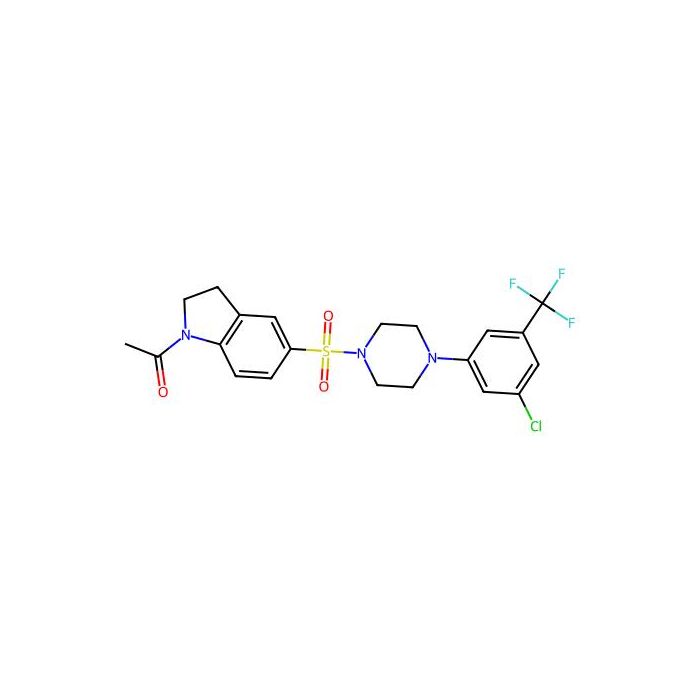
JH-LPH-33, a sulfonyl piperazine analog, is a potent UDP-2,3-diacylglucosamine pyrophosphate hydrolase LpxH inhibitor. JH-LPH-33 displays outstanding antibiotic activity with a MIC value of 0.66 μg/mL.
In Vitro
JH-LPH-33 displays IC 50 values of 0.026 μM against K. pneumoniae LpxH and 0.046 μM against E. coli LpxH, respectively. JH-LPH-33 potently inhibits bacterial growth at 1.6 μg/mL and displayes a MIC value of >64 μg/mL against E. coli. MCE has not independently confirmed the accuracy of these methods. They are for reference only.
Form:Solid
Especificaciones
Especificaciones y pureza
≥98%
Mecanismos bioquímicos y fisiológicos
JH-LPH-33, a sulfonyl piperazine analog, is a potent UDP-2,3-diacylglucosamine pyrophosphate hydrolase LpxH inhibitor. JH-LPH-33 displays outstanding antibiotic activity with a MIC value of 0.66 μg/mL.
Condiciones de almacenamiento de almacenamiento
Store at -20°C
Enviado en
Ice chest + Ice pads
Este producto requiere envío en cadena de frío. Los servicios terrestres y otros servicios económicos no están disponibles.
Tipo de acción
INHIBITOR
Pureza
≥98%
Nombres e identificadores
Peso molecular
487.92
Datos avanzados
Certificados (CoA, COO, BSE/TSE y tabla de análisis)
C of A & Other Certificates(BSE/TSE, COO):
Analytical Chart:
Calculadoras de soluciones
Molarity Calculator
Determine the necessary mass, volume, or concentration for preparing a solution.
Dilution Calculator
Determine the dilution needed to prepare a stock solution.
Reconstitution Calculator
Reseñas
Reseñas de cliente
Application Protocols
No validated/tested application protocols are supplied for JH-LPH-33 in the product data.
General suggestions for research handling (not item-specific):
Prepare a 10 mM DMSO stock, verify concentration by LC–UV with external standard or by qNMR when feasible.
Aliquot into low-binding tubes or plates; minimize freeze–thaw by dispensing single-use portions.
For assay setup, ensure final DMSO content is compatible with the biological or biochemical system; include vehicle controls.
Refer to your institutional SOPs and method development guidelines.
Biological Roles
No biological function, target class, or pathway association has been provided for JH-LPH-33.
Item-specific roles: Not specified for this item; refer to CoA/Spec Sheet or internal project documentation.
General notes for small molecules (research use only):
If used as a screening compound, any observed activity in biochemical or cell-based assays should be considered preliminary until orthogonal confirmation and artifact controls (aggregation, redox cycling, PAINS) are performed.
Establish counter-screens and biophysical binding methods (e.g., DSF, MST, ITC, SPR) to validate direct interactions with proteins of interest.
Evaluate basic ADME-relevant properties (solubility, stability in buffer/microsomes, permeability in PAMPA/MDCK) to contextualize assay outcomes.
No clinical or therapeutic claims are made or implied for this product.
Buffer Applications
This product is a small molecule with undisclosed structure; it is not a defined buffering agent.
Item-specific buffer roles: Not specified for this item; refer to CoA/Spec Sheet.
General guidance (if dissolution in buffers is required for assays):
Prepare primary stocks in DMSO, then dilute into assay buffers (e.g., PBS, HEPES, Tris) ensuring final DMSO is within assay tolerance (commonly ≤0.5–1% v/v).
Control pH shift upon addition if the compound is acidic/basic once such functionality is known.
Green Alternatives
This section typically addresses greener choices for solvents or reagents with significant EHS impact. JH-LPH-33 is a small-molecule library member rather than a commodity solvent or reagent class, so direct “green alternative to X” guidance is not typically applicable.
General greener-practice suggestions (not item-specific):
Dissolution media: Prefer water, EtOH, MeOH, ACN over chlorinated solvents where chemically compatible. For nonpolar materials, consider 2-MeTHF or CPME instead of THF/diethyl ether when feasible.
Workup and purification: Minimize chlorinated eluents; use heptane/EtOAc or heptane/IPA gradients for flash chromatography when compatible.
Energy: Conduct reactions/formulations at ambient temperature and pressure when stability allows; avoid unnecessary cryogenic conditions.
Scale awareness: For HTS plating, minimize DMSO volume and use low-dead-volume dispensing to reduce waste.
Trade-offs:
Alternative solvents may alter solubility and stability; always verify compound integrity by LC–MS/HPLC after switching media.
If the structural class later indicates inherent hazards (e.g., azides, nitroso, peroxides), consult specific green chemistry guidelines for safer surrogates and controls.
Pharmaceutical Uses
No pharmacopeial status, excipient role, or formulation use is provided for JH-LPH-33.
Item-specific regulatory/compendial information: Not specified for this item; refer to CoA/Spec Sheet.
General research-only note:
Materials in compound libraries are typically supplied for discovery research and method development. Any use in human or veterinary applications is not permitted. If preformulation studies are contemplated, confirm purity, impurities, residual solvents, and stability, and conduct all work under appropriate research governance.
Physical Properties
Item-specific physicochemical constants have not been provided for JH-LPH-33.
Item-specific values:
Appearance: Not specified for this item; refer to CoA/Spec Sheet.
Melting point / Boiling point: Not specified for this item; refer to CoA/Spec Sheet.
Density/Refractive index: Not specified for this item; refer to CoA/Spec Sheet.
LogP/pKa/Solubility profile: Not specified for this item; refer to CoA/Spec Sheet.
General guidance (literature/practice, not item-specific):
For solids, determine MP by DSC or capillary; hygroscopic samples may show MP depression.
For liquids/oils, determine density/refractive index at 20–25°C to aid identity checks.
Solubility screening (typical for small molecules) can be performed at 10 mg/mL in: water, PBS (pH 7.4), MeOH, EtOH, ACN, DMSO, DMF, and EtOAc; assess visually and by HPLC area count.
If acid/base sites are suspected, evaluate apparent pKa via UV–vis titration or potentiometric titration to inform salt-form selection and buffer choice.
If volatility is suspected, check TGA and establish headspace GC to prevent evaporative loss during weighing.
Note: Treat any literature/computed values as guidance only until confirmed by the Certificate of Analysis for this specific lot.
Quality and Grades
Item-specific grade/purity and stabilizer information have not been provided for JH-LPH-33.
Item-specific status:
Grade/Purity: Not specified for this item; refer to CoA/Spec Sheet.
Stabilizers/Inhibitors: Not specified for this item; refer to CoA/Spec Sheet.
General guidance for interpreting quality data in the CoA (not item-specific):
Purity reporting: May be by HPLC area %, GC %, or qNMR. Confirm the analytical method, detection wavelength, and reference standard used.
Identity confirmation: Look for HRMS (exact mass), 1H/13C NMR, and where applicable, IR and LC–MS retention time vs. an authenticated standard.
Residual solvents/volatiles: Headspace GC per USP <467> or analogous methods; ensure compliance with your internal limits.
Inorganics: If catalytic synthesis was used, check ICP-MS/ICP-OES for residual metals.
Water content: Karl Fischer (Coulometric/Volumetric) where applicable.
UV profile (for chromatographic use): Low-UV-absorbing grades are specified for mobile phase components; not typical for arbitrary screening compounds.
Lot-to-lot control:
Confirm batch number, packaging size, appearance, and assay on receipt. If material is sensitive, request storage/stability data and recommended retest date.
If your application is analytical/HTS screening, typical acceptance criteria are ≥95–98% HPLC purity with a single major component peak; verify your internal thresholds.
Reaction and Applications
The product is listed under a small-molecule/compound library category. Without a disclosed structure, detailed synthetic reactivity or target class cannot be specified. However, typical research applications for such cataloged entities include:
General research uses (not item-specific):
Chemical probe discovery and hit triage in biochemical or cell-free assays (research use only). Prepare validated stock solutions and confirm identity/purity prior to screening.
Physicochemical property determination (logD, pKa, solubility) to inform formulation and SAR if analogs are pursued.
If a functional handle is present (once structure is known), derivatization for biotinylation/fluorophore tagging or immobilization on resins for pull-downs.
Parallel synthesis/medchem: serve as a starting point or intermediate if the scaffold contains modifiable positions (e.g., halogen for cross-coupling, amine/acid for amide coupling) — contingent on actual structure.
For HTS, standardize to 10 mM DMSO stocks, aliquot to avoid freeze–thaw, and validate stability in assay media.
If light/air sensitivity is suspected, conduct manipulations under low light and inert atmosphere.
Note: Replace the generalities above with structure-specific reaction classes (e.g., Suzuki, Buchwald–Hartwig, click chemistry) once the CoA provides functional group information.
Reaction Conditions
No structure-specific reaction condition guidance can be provided for JH-LPH-33 at this time.
General experimental guidance (not item-specific):
Solubility scouting: 1–10 mg/mL trials in DMSO, DMF, ACN, MeOH, EtOH, and buffered aqueous media (pH 2–9) at 25–40°C with sonication. Document outcomes.
Stability checks: Incubate solutions at room temperature and 4°C for 24–72 h; analyze by HPLC/LC–MS for degradation products. Test light sensitivity with and without foil wrap.
If chemical transformations are planned (after structure disclosure), run micro-scale screens to bracket base/acid tolerance (e.g., DIPEA, K2CO3, DBU; AcOH/TFA) and redox conditions (NaBH4, catalytic hydrogenation, mCPBA) before scale-up.
Purification: Choose normal-phase or reverse-phase chromatography based on polarity/ionization; add 0.1% TFA/AcOH or NH4OH to mobile phases to sharpen peak shapes for ionizable compounds.
These are general practices to establish workable conditions pending structure-specific optimization.
Safety and Handling
Safety data specific to JH-LPH-33 are not provided in the product record. Always consult the product SDS for authoritative hazard and precautionary statements.
Item-specific hazard data:
Signal word: Not specified for this item; refer to SDS.
H-statements / GHS classification / Pictograms: Not specified for this item; refer to SDS.
General safe-handling guidance (good laboratory practice):
Wear appropriate PPE: lab coat, safety glasses or chemical splash goggles, and nitrile gloves. Work in a certified chemical fume hood.
Avoid inhalation of dust/vapors and contact with skin/eyes. Prevent aerosol generation during weighing or solution prep.
Storage: Product data indicate cold storage. Keep tightly closed at −20°C; protect from moisture and light until specific sensitivities (air, acid/base, oxidants) are known. Segregate from incompatible reagents based on structural information once available.
First aid (general): If inhaled—move to fresh air; if on skin—wash with soap and water; if in eyes—rinse cautiously with water for several minutes; if ingested—rinse mouth. Seek medical attention as needed. Provide SDS to responders.
Spill/accident: Contain with inert absorbent, avoid dust, collect in labeled waste. Decontaminate area per institutional protocol.
Waste: Dispose according to local regulations for organic laboratory chemicals; do not release to drains.
Note: In absence of detailed hazard data, handle as a substance of unknown toxicity suitable for research use only.
Solvent Selection
No item-specific solubility data are available. For small-molecule research compounds with unknown polarity/ionization, a stepwise solvent strategy is recommended.
General solvent strategy (not item-specific):
Primary stock for screening: DMSO (anhydrous) at 10–50 mM is commonly used. Warm (25–40°C) and sonicate to assist dissolution. Filter (0.2 µm PTFE) if needed.
If DMSO insoluble or stability is an issue, try: DMF, ACN, MeOH/EtOH, or solvent blends (e.g., DMSO:water 1:1 for amphiphiles). For highly nonpolar materials, consider THF, 2-MeTHF, CPME, toluene, or EtOAc.
Aqueous work: Prepare cosolvent systems (e.g., 1–5% DMSO or 10–30% ACN/MeOH in buffer) as dictated by assay tolerability. Adjust pH if ionizable groups are present (when known).
Salt formation: If poor solubility stems from basic/acidic functionality, form water-soluble salts (e.g., HCl salt of amines, sodium salts of acids) provided the structure supports it.
Practical notes:
Document solvent lot/water content; many compounds are moisture sensitive.
Verify concentration by UV–vis, HPLC with external standard, or qNMR when extinction coefficients are unknown.
Stability screening in chosen solvent over 24–72 h at room temperature and 4°C is recommended before HTS or long incubations.
Storage and Reconstitution
Item-specific conditions:
Storage: Store at −20°C (from product data). Keep container tightly closed. Protect from moisture and light as a precaution.
Solids: Allow vial to equilibrate to room temperature in a desiccator before opening to prevent moisture condensation. Weigh quickly. Dissolve initially in anhydrous DMSO to prepare a 10–50 mM stock; adjust based on solubility and intended use.
Liquids/oils: Mix thoroughly before aliquoting; if viscous, gently warm to 30–40°C.
Filtration: If necessary, sterile-filter through 0.2 µm PTFE for biochemical assays (when compatible).
Aliquoting: Dispense single-use aliquots to avoid repeated freeze–thaw cycles. Store working stocks at −20°C or below. Record retest date and monitor by HPLC for long-term stability.
Unknown sensitivities:
In absence of structural data, treat as potentially air/moisture/light sensitive. Consider inert gas backfill (N2/Ar) after opening and amber vials for storage.
Research use note: For research use only; not for human or veterinary use.
Structure and Identity
Concise identification details for this catalog entry. Item-specific identifiers are limited; consult the CoA/Spec Sheet for definitive structural data.
Molecular Formula: Not specified for this item; refer to CoA/Spec Sheet.
Molecular Weight: Not specified for this item; refer to CoA/Spec Sheet.
SMILES: Not specified for this item; refer to CoA/Spec Sheet.
InChIKey: Not specified for this item; refer to CoA/Spec Sheet.
Structural features (general note):
No structural representation has been provided in the product data. Absent a formula/SMILES, functional groups, ring systems, stereocenters, and overall topology cannot be described for this item.
For cheminformatics workflows (substructure/SMARTS searching, property prediction, registration), please obtain the structural string (SMILES/InChI) and confirm against the CoA.
2D/descriptor guidance (general):
If you receive structure in the CoA, document: heteroatom content, aromatic vs aliphatic balance, HBA/HBD count, formal charge, rotatable bonds, and stereochemical flags. These features guide solubility selection, storage atmosphere, and handling (e.g., base/acid sensitivity).
Synthetic Utility
Structural information is not disclosed for JH-LPH-33; therefore, specific retrosynthetic disconnections or reaction manifolds cannot be assigned.
General utility guidance for small molecules (not item-specific):
If the scaffold contains halogens (Ar–Br/Cl/I, vinyl/allyl halides), consider cross-couplings (Suzuki–Miyaura, Buchwald–Hartwig, Sonogashira, Negishi) to access analogs for SAR.
If amine/acid/alcohol functionalities are present, routine transformations include amide/ester formation, carbamate/urethane protection, reductive amination, Mitsunobu or activated-ester couplings.
For heterocycles, N-oxidation, N-alkylation, and annulation strategies may diversify the chemotype.
Late-stage diversification: C–H functionalization (radical or directed metalation) where the core tolerates such conditions.
Analytical support:
Map reactivity by small-scale scouting with orthogonal bases/acids and oxidants/reductants while monitoring by LC–MS.
Use qNMR to quantify assay-ready material after any modification.
Replace the above with precise tactics once functional groups and substitution patterns are available from the CoA.
Target Specificity
Target, binding site, and selectivity information are not provided for JH-LPH-33.
Item-specific target/epitope/clone/isotype data: Not applicable and not specified for this item.
Note: If used as a screening compound, determine specificity through orthogonal assays and counterscreens to eliminate assay interference.
Preguntas frecuentes
What is the purity of this product?
This product is supplied at ≥98% purity (chemical assay). Lot-specific values are stated on the Certificate of Analysis.
How should this product be stored?
Store at ?20 °C. Freezer storage is required to maintain the specified shelf life.
How is this product shipped?
This product ships in an insulated container with ice pads. Unpack on arrival and transfer it to the storage condition stated above.
What are the CAS number, molecular formula and molecular weight?
The CAS Number is 2414590-04-6, the molecular formula is C21H21ClF3N3O3S, and the molecular weight is 487.92 g/mol.
What documentation is provided?
Available product documentation, including Certificates of Analysis (COA), Safety Data Sheets (SDS), and specification sheets, is shown in the product document area. Document availability and access follow the current site policy.
Utilizamos cookies para garantizar el correcto funcionamiento del sitio web y, cuando esté permitido, para mejorar su experiencia. Puede gestionar sus preferencias en cualquier momento en Configuración. Más información en nuestra Política de Cookies.
¿Quieres que te enviemos un mensaje cuando tengamos descuentos disponibles?
Recordármelo más tarde
¡Gracias! Por favor, revisa tu bandeja de entrada de correo electrónico para confirmar.
Products are supplied to verified businesses, institutions, and qualified professionals for research and development use only. Not for use in humans, animals, diagnosis, or therapy.