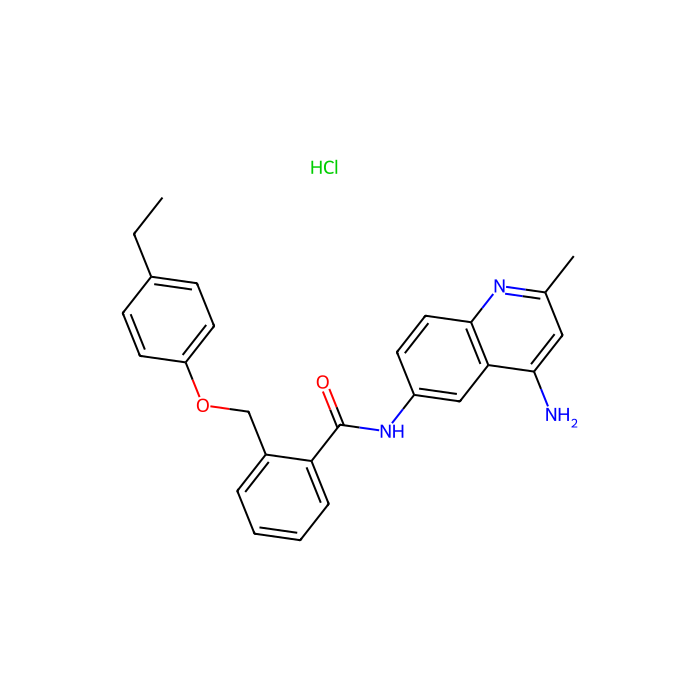
10mM in DMSO for sensitive chromatographic and analytical workflows requiring minimal baseline interference.
🌡
Storage & shipping
Store at -80°C Ships Dry ice packs + Cold packs Check lot-specific COA for exact specifications.
📋
Quality documents
SDS, COA, datasheet, and spec sheet available for download. Lot-specific COA accessible via lot number lookup.
📚
Literature proof
Cited in 0 peer-reviewed publications across chromatography, organic synthesis, and cross-coupling reactions.
Descripción general
Information
JTC-801 is a selectiveopioid receptor-like1 (ORL1) receptorantagonist withIC50of 94 nM, weakly inhibits receptors δ, κ, and μ. In vitro
JTC-801 displays about 12.5-, 129-, and 1055-fold selectivity for ORL1 receptor (Ki = 8.2 nM) over μ-, κ-, and δ-opioid receptors, respectively. JTC-801 does not inhibit forskolin-stimulated cyclic AMP accumulation in human ORL1 receptor-expressing HeLa cells, but it prevents nociceptin-induced inhibition of cyclic AMP accumulation, indicating that JTC-801 possesses full antagonistic activity. In rat cerebrocortical membrane, JTC-801 inhibits ORL1 receptor with IC50 of 472 nM and μ-receptor with IC50 of 1831 nM. JTC-801 completely antagonizes the suppression of nociceptin on forskolin-induced accumulation of cyclic AMP with IC50 of 2.58 μM in HeLa cells expressing ORL1 receptor.
In vivo
Oral administration of JTC-801 (0.3-3 mg/kg) antagonizes nociceptin-induced allodynia in mice, and shows analgesic effect in a hot plate test using mice and in a formalin test using rats. In mouse hot-plate test, JTC-801 prolongs escape response latency (ERL) or exposed heat stimulus with minimum effective doses (MED) of 0.01 mg/kg by i.v. or 1 mg/kg by p.o. In the rat formalin test, JTC-801 reduces both the first and second phases of the nociceptive response with MED of 0.01 mg/kg71 by i.v. or 1 mg/kg by p.o. JTC-801 dose-dependently normalizes paw withdrawal latency (PWL). Although JTC-801 does not inhibit a chronic constriction injury (CCI)-induced decrease in bone mineral content (BMC) and bone mineral density (BMD), it inhibits an increase in the number of osteoclasts. Tactile allodynia induced by L5/L6 spinal nerve ligation is reversed by both systemic (3-30 mg/kg) and spinal (22.5 and 45 pg) JTC-801 in a dose-dependent manner. Furthermore, systemic JTC-801 reduces Fos-like immunoreactivity in the dorsal horn of the spinal cord (laminae I/II). JTC-801 produces dose-dependent mechanical and cold anti-allodynic effects with ED50 of 0.83 mg/kg and 1.02 mg/kg, respectively. Cell Data
Determine the necessary mass, volume, or concentration for preparing a solution.
Dilution Calculator
Determine the dilution needed to prepare a stock solution.
Reconstitution Calculator
Reseñas
Reseñas de cliente
Preguntas frecuentes
How should this product be stored?
Store at ?80 °C. Ultra-low temperature storage is required to maintain the specified shelf life.
How is this product shipped?
This product ships frozen with dry ice and cold packs. Unpack on arrival and transfer it to the storage condition stated above; handle dry ice with insulated gloves in a ventilated area.
What are the CAS number, molecular formula and molecular weight?
The CAS Number is 244218-51-7, the molecular formula is C26H25N3O2·HCl, and the molecular weight is 447.96 g/mol.
What documentation is provided?
Available product documentation, including Certificates of Analysis (COA), Safety Data Sheets (SDS), and specification sheets, is shown in the product document area. Document availability and access follow the current site policy.
We use cookies to ensure the website functions properly and, where permitted, to improve your experience. You can manage your preferences at any time in Settings. Learn more in our Cookie Policy.
Shall we send you a message when we have discounts available?
Remind me later
Thank you! Please check your email inbox to confirm.
Products are supplied to verified businesses, institutions, and qualified professionals for research and development use only. Not for use in humans, animals, diagnosis, or therapy.