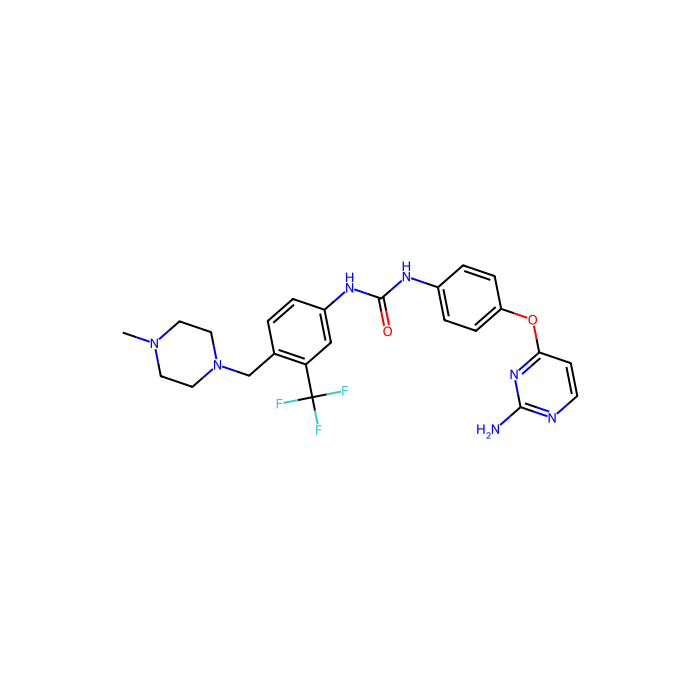
K03861 is an ATP site-binding, cyclin-competitive, type II CDK2 inhibitor that selectively targets and locks the kinase in its inactive DFG-out conformation (CDK2 Kd = 50 nM, DFG-out stabilizing CDK2-C118L/A144C mutant Kd = 9.7 nM without vs. 134.1 nM wit
Condiciones de almacenamiento de almacenamiento
Store at -20°C
Enviado en
Ice chest + Ice pads
Este producto requiere envío en cadena de frío. Los servicios terrestres y otros servicios económicos no están disponibles.
This compound belongs to the class of organic compounds known as diarylethers. These are organic compounds containing the dialkyl ether functional group, with the formula ROR', where R and R' are aryl groups.
External Descriptors
Not available
1. Djoumbou Feunang Y, Eisner R, Knox C, Chepelev L, Hastings J, Owen G, Fahy E, Steinbeck C, Subramanian S, Bolton E, Greiner R, and Wishart DS. ClassyFire: Automated Chemical Classification With A Comprehensive, Computable Taxonomy. Journal of Cheminformatics, 2016, 8:61.
Solvent:DMSO, Max Conc. mg/mL: 25.08, Max Conc. mM: 50; Solvent:ethanol, Max Conc. mg/mL: 50.15, Max Conc. mM: 100
Peso molecular
501.500 g/mol
XLogP3
2.800
Hydrogen Bond Donor Count
3
Hydrogen Bond Acceptor Count
10
Rotatable Bond Count
6
Exact Mass
501.21 Da
Monoisotopic Mass
501.21 Da
Topological Polar Surface Area
109.000 Ų
Heavy Atom Count
36
Formal Charge
0
Complexity
700.000
Isotope Atom Count
0
Defined Atom Stereocenter Count
0
Undefined Atom Stereocenter Count
0
Defined Bond Stereocenter Count
0
Undefined Bond Stereocenter Count
0
The total count of all stereochemical bonds
0
Covalently-Bonded Unit Count
1
Calculadoras de soluciones
Molarity Calculator
Determine the necessary mass, volume, or concentration for preparing a solution.
Dilution Calculator
Determine the dilution needed to prepare a stock solution.
Reconstitution Calculator
Reseñas
Reseñas de cliente
Application Protocols
The following general-purpose protocols support the use of small-molecule research compounds in biochemical and cell-based assays. Adjust based on your assay and after confirming the compound’s identity and purity.
DMSO stock preparation (general)
Equilibrate vial to room temperature in a desiccated environment.
Weigh the required amount quickly to minimize moisture uptake.
Add anhydrous DMSO to achieve 10 mM (or desired) concentration; vortex and sonicate briefly if needed.
If particulates persist, warm gently (≤40 °C) and filter through a 0.22 µm PTFE/PVDF syringe filter.
Aliquot into amber, low-bind microtubes; store at −20 °C per Product Data.
Serial dilution for assays (general)
Prepare intermediate DMSO or buffer-based dilutions to achieve final assay concentrations with ≤0.1–1% DMSO. Mix thoroughly at each step to prevent precipitation.
Enzyme assay setup (example template)
Add buffer, cofactors/substrate, and the compound dilution to wells; pre-incubate if target binding is slow; include vehicle (DMSO) and positive/negative controls; measure activity using orthogonal readouts where possible.
Cell-based assay handling (general)
Add compound last to minimize precipitation; gently mix plates; include DMSO-matched controls; verify compound stability in complete media over the assay period.
QC check (general)
Run a quick LC–MS of working solutions to ensure no rapid degradation or unexpected adducts under assay conditions.
Biological Roles
Item-specific biological function or target engagement is not provided in the Product Data for K 03861 (CAS 853299-07-7; CID 11260561).
General considerations for small-molecule research tools (non-clinical):
Small molecules can act as binders, inhibitors, activators, or allosteric modulators of enzymes, receptors, or protein–protein interactions. The actual role depends on the compound’s structure and context, which are not specified here.
If a target is suspected from literature associated with the CAS/CID, validate activity in-house with dose–response curves, orthogonal assay formats, and appropriate counter-screens to exclude assay artifacts (aggregation, redox cycling, fluorescence interference).
ADME-relevant properties (permeability, stability in microsomes/plasma, and protein binding) should be characterized experimentally if biological studies are intended; no such data are provided for this item.
Off-target assessment using selectivity panels or chemoproteomic profiling can de-risk false positives in phenotypic assays.
No therapeutic or clinical claims are made. This product is supplied strictly for research use only, as indicated in the Product Data.
Buffer Applications
This item is a small-molecule research compound and is not itself a buffering agent. However, practical considerations apply when adding small-molecule stocks to buffers for biochemical or cell-based assays:
Stock preparation and dilution (general)
Prepare concentrated DMSO stocks (e.g., 10 mM) and add to the buffer with vigorous mixing to prevent local supersaturation and precipitation.
Typical final DMSO in assay buffers: ≤0.1–1% v/v, validated per assay for biological tolerance.
Buffer selection
Choose buffers that do not react with the compound’s functional groups (unknown here); common systems include HEPES, PBS, Tris, and MOPS. Avoid high concentrations of nucleophiles or metal ions if the compound is potentially reactive.
Additives
0.01–0.1% nonionic surfactant (Tween-20/80, Pluronic F-127) can mitigate aggregation and improve apparent solubility for hydrophobic analytes.
Filtration
After dilution, inspect for turbidity; if needed, filter through 0.22 µm PVDF/nylon filters to remove particulates (ensure no adsorption losses with a quick recovery check).
Item-specific buffer compatibility, pKa, and ionization behavior are not specified; consult the CoA and perform a small-scale compatibility test before committing precious samples.
Green Alternatives
With no item-specific solvent or process constraints provided, green chemistry considerations focus on solvent choice and waste minimization during dissolution, assay preparation, and any exploratory synthesis involving this compound.
Prefer greener solvents when feasible (general guidance)
Replace DMF/NMP with safer alternatives such as Cyrene (dihydrolevoglucosenone) or propylene carbonate for dissolution trials when compatible with the biology or analytics.
Use ethanol, isopropanol, or water (adjusted pH if ionizable) as co-solvents to reduce DMSO load in assays, while monitoring biological tolerability.
Process efficiency
Prepare the highest practical stock concentration to minimize solvent volumes and shipping/handling footprint, provided solubility and stability allow.
Aliquot stocks to reduce freeze–thaw degradation and product waste.
Comparative solvent attributes (general)
DMSO: Excellent solvency; miscible with water; moderate EHS profile; broadly accepted in bioassays.
Cyrene/propylene carbonate: Emerging greener dipolar aprotics; viscosity and compatibility with some bioassays may limit use.
Ethanol: Renewable routes available; good biocompatibility at low percentages; volatility requires sealed handling.
Tradeoffs and cautions
Greener solvents may alter assay performance, detection baselines, or compound stability. Validate assay windows and control responses after any solvent substitution.
Always confirm compound solubility and chemical stability in the chosen greener medium before scaling procedures.
Pharmaceutical Uses
No formulation or pharmacopeial status is provided for this item. This product is supplied for research use only and is not intended for human or veterinary use.
General formulation context for small molecules (non-clinical, pre-formulation screening):
Solubility screening in biorelevant media (FaSSIF/FeSSIF, simulated gastric/intestinal fluids) may be informative for mechanistic studies, but no claims are made for this item’s suitability.
Excipients often employed in research formulations include cyclodextrins (e.g., HP-β-CD), PEG-400, propylene glycol, and polysorbates to enhance apparent solubility and dispersion; compatibility must be established experimentally.
Solid-state considerations (salt screening, co-crystals, amorphous dispersions) can alter solubility and stability; item-specific applicability is unknown here.
Do not use this product in diagnostic, therapeutic, or clinical applications. No pharmacopeia monographs or excipient roles are specified for this item.
Physical Properties
Item-specific physicochemical data are not provided in the Product Data.
Melting point (MP): Not specified for this item; refer to CoA/Spec Sheet.
Boiling point (BP): Not specified for this item; refer to CoA/Spec Sheet.
Density: Not specified for this item; refer to CoA/Spec Sheet.
Solubility: Not specified for this item; refer to CoA/Spec Sheet.
LogP/logD: Not specified for this item; refer to CoA/Spec Sheet.
pKa: Not specified for this item; refer to CoA/Spec Sheet.
Refractive index: Not applicable/unknown for solids; otherwise not specified for this item; refer to CoA/Spec Sheet.
Appearance: Not specified for this item; refer to CoA/Spec Sheet.
General guidance for library small molecules (literature/general):
Many screening compounds are hydrophobic solids with limited aqueous solubility; DMSO stocks (e.g., 10–50 mM) are commonly used for assay preparation.
Solubility can often be improved with co-solvents (DMSO, DMF), surfactants (0.01–0.1% Tween 80), or pH adjustment if ionizable groups are present; verify pKa before pH-based solubilization.
Hygroscopicity and light sensitivity vary by scaffold; handle under dry conditions and minimize light exposure until item-specific guidance is known from the CoA.
Thermal behavior (DSC/TGA) and polymorphism can affect handling and solubility; consider a brief solubility screen (aqueous buffers ± DMSO/EtOH/PEG-400) before large-scale experiments.
Quality and Grades
Grade/Purity (Product Data): Not specified for this item; refer to CoA/Spec Sheet.
Interpretation and best practices (general guidance for library compounds):
Typical library-grade small molecules are supplied at ≥95% purity by HPLC/LC–MS, but this is NOT specified for this item. Verify the actual batch purity and analytical methods (HPLC trace, MS, NMR) on the CoA.
UV/Vis background and residual solvents can influence assay readouts (fluorescence, absorbance). Review the CoA for residual solvent profile (GC) and UV spectra when available.
If a stabilizer or salt form is used, it should be declared on the CoA. No stabilizer/salt form is specified in the Product Data.
For quantitative biology or analytical work, consider in-house QC:
Identity: LC–MS, 1H/13C NMR.
Purity: HPLC with multiwavelength detection.
Water content: Karl Fischer, if hygroscopic tendencies are suspected.
Salt content/counterions: Ion chromatography or NMR integration.
Trace specifications (water, peroxides, metals, UV cutoff) are not provided and should not be assumed. Always defer to the lot-specific CoA for authoritative specifications.
Reaction and Applications
This product is positioned as a research small-molecule for screening and probe development; no specific reactivity or named-reaction role is provided in the Product Data.
Research applications (general, non-therapeutic):
Chemical biology and screening
Use as a test article in target-based enzyme assays, binding studies (e.g., SPR, MST), or phenotypic cell assays to explore structure–activity relationships once the identity is verified.
Assay development
Evaluate signal windows, dynamic range, and assay interference (fluorescence/absorbance) by running compound-only controls and orthogonal readouts where feasible.
Analytical characterization
Confirm lot identity/purity by LC–MS and NMR; establish a stability-indicating HPLC method to monitor degradation under storage and assay conditions.
Practical tips (general best practice):
Solubilization: Prepare concentrated DMSO stocks (e.g., 10 mM), filter if particulate persists, and aliquot to avoid freeze–thaw cycles.
Interference checks: Screen for pan-assay interference (PAINS) behaviors if structural motifs are known; run detergent controls (0.01% Tween-20/80) to mitigate aggregation-based inhibition.
Counter-screens: Incorporate orthogonal assays and redox/thiol-reactivity counters if cysteine-rich targets are involved.
Note: Because functional groups and reactivity are not specified for this item, no claims are made about specific named reactions or mechanistic applications. Consult the CoA and primary literature associated with CAS 853299-07-7/CID 11260561 before advanced use.
Reaction Conditions
No reaction condition guidance can be provided without knowledge of the compound’s structure and functional groups.
General guidance (only after confirming structure):
Solvent choice should match functional group tolerance; begin with polar aprotics (DMSO, DMF, acetonitrile) or alcohols if appropriate; validate stability by TLC/HPLC.
Temperature: Start at ambient and increase cautiously while monitoring for decomposition by LC–MS; many heteroaromatics and sensitive motifs degrade above 80–120 °C.
Catalysts/bases/acids: Select based on known reactivity of the scaffold; employ inert atmosphere for air/moisture-sensitive substrates.
Workup: Quench carefully; use buffered aqueous workups to minimize acid/base-labile degradation; include antioxidant or chelator if the scaffold is redox-sensitive.
Because this item lacks disclosed functional groups, any specific temperature, catalyst, or yield expectations would be speculative. Establish small-scale feasibility experiments with in-process analytics before scaling.
Safety and Handling
Safety information specific to this item is not provided in the Product Data. Treat as a research chemical of unknown hazards.
Hazard classification (Product Data)
Signal Word: Not specified for this item; refer to SDS.
H-Statements: Not specified for this item; refer to SDS.
GHS Classification: Not specified for this item; refer to SDS.
Pictograms: Not specified for this item; refer to SDS.
General laboratory precautions (defer to SDS/CoA as authoritative):
PPE: Wear lab coat, safety glasses or face shield, and appropriate chemically resistant gloves (e.g., nitrile). Work in a certified fume hood to avoid inhalation exposure.
Avoid ingestion, inhalation of dust/aerosols, and skin/eye contact. Do not pipette by mouth. Wash thoroughly after handling.
Storage incompatibilities: Until detailed structure is confirmed, segregate from strong oxidizers, strong acids/bases, and reactive reducing agents. Keep container tightly closed, dry, and protected from light.
First aid (overview): If inhaled—move to fresh air; if on skin—wash with soap/water; if in eyes—rinse cautiously with water for several minutes; if ingested—rinse mouth. Seek medical attention in all exposure cases. Provide the SDS to responders.
Spill/accidental release: Avoid dust formation. Absorb small spills with inert material; collect in chemical waste. Ventilate area.
Waste disposal: Dispose according to institutional chemical waste protocols; do not discharge to drains.
Always consult the item-specific SDS for authoritative hazards, handling, and exposure controls.
Solvent Selection
Given the absence of item-specific solubility data, select solvents using a tiered approach suitable for small-molecule screening compounds.
Primary stock solvent (general best practice)
DMSO: Widely used due to broad solvency and miscibility with water and most polar organics; suitable for preparing 10–50 mM stocks. Filter (0.22 µm) if needed.
Secondary/co-solvents (as appropriate)
DMF or NMP: High solvency for polar/heteroaromatic scaffolds; consider toxicity and disposal.
Ethanol or isopropanol: Lower toxicity; useful as minor co-solvents (5–20%) in aqueous buffers.
PEG-400 or propylene glycol: For poorly soluble compounds in biological media; adjust viscosity considerations.
Aqueous buffers
If the compound is ionizable (pKa-dependent), modest pH adjustments can enhance solubility. Confirm ionization behavior before applying pH-driven strategies.
Practical selection workflow
Attempt dissolution in anhydrous DMSO at target concentration (e.g., 10 mM).
If insoluble, warm gently (≤40 °C), vortex, and sonicate briefly.
Explore co-solvents (DMF, ethanol) or reduce target concentration.
For assay use, dilute DMSO stock into buffer, keeping final DMSO typically ≤0.1–1% v/v to minimize biological interference.
Comparison (general)
DMSO vs DMF: DMSO is generally preferred for bioassays (lower volatility/odor, better biocompatibility); DMF can improve solubility for certain rigid/aromatic scaffolds but may be harsher on cells.
Aqueous-only: Preferable when feasible but often limited by hydrophobicity without ionizable groups.
Storage and Reconstitution
Storage conditions (Product Data)
Store at −20 °C.
Shipped in: Ice chest + ice pads.
Reconstitution (general best practice for small molecules)
Allow the sealed vial to warm to room temperature before opening to avoid moisture condensation.
Reconstitute in anhydrous DMSO to prepare a concentrated stock (e.g., 10 mM), unless item-specific solubility data suggest an alternative solvent.
Mix thoroughly (vortex/brief sonication). If necessary, warm gently (≤40 °C) to complete dissolution.
If aqueous use is intended, dilute the DMSO stock into buffer with vigorous mixing, keeping final DMSO typically ≤0.1–1% v/v.
Aliquoting and stability (general)
Dispense single-use aliquots in amber, low-bind tubes to minimize freeze–thaw cycles and potential adsorption losses.
Store aliquots at −20 °C in a desiccated, dark environment. Avoid repeated warming; use dedicated cold packs for transport between labs.
Handling precautions
Protect from moisture and light until item-specific stability data are available. Do not store solutions in basic or strongly acidic media without prior stability testing.
Record preparation date, solvent, and concentration on each aliquot; periodically re-check purity by HPLC/LC–MS for long-term studies.
Research use note
For research use only. Consult the lot-specific CoA and SDS for definitive stability and safety information.
Structure and Identity
Brief overview: K 03861 (SKU: K286672) is supplied as a small-molecule screening compound within Aladdin’s small molecule/compound library category. Item-specific structural identifiers are incomplete in the provided Product Data.
Product identifiers (Product Data)
SKU: K286672
Product Name: K 03861
CAS: 853299-07-7
PubChem CID: 11260561
InChIKey: 288565 (note: this is not a standard-length InChIKey; verify on CoA or trusted databases)
SMILES: Not specified for this item; refer to CoA/Spec Sheet.
Structural features
Functional groups, ring systems, stereochemistry: Not specified for this item; refer to CoA/Spec Sheet.
Molecular formula and molecular weight
Molecular Formula: Not specified for this item; refer to CoA/Spec Sheet.
Molecular Weight: Not specified for this item; refer to CoA/Spec Sheet.
2D structure description
Not available from Product Data. If structural elucidation or confirmation is required, consult the PubChem entry (CID 11260561) and verify against the supplied batch CoA prior to experimental use.
Notes on identity verification (general best practice)
Confirm identity and purity by LC–MS and 1H NMR against literature spectra.
Cross-check CAS 853299-07-7 and any synonyms on curated databases (e.g., PubChem, vendor CoA) to ensure consistency prior to biological or synthetic work.
Synthetic Utility
Synthetic applications cannot be assigned without the compound’s structure or functional group information.
Item-specific reactivity
Functional groups, protecting group strategies, and cross-coupling or heterocycle elaboration potential: Not specified for this item; refer to CoA/Spec Sheet and primary literature for CAS 853299-07-7/CID 11260561.
General considerations if using as a building block (only after confirming structure):
Verify orthogonality of reactive handles and assess stability toward bases, acids, nucleophiles, and oxidants before planning multi-step routes.
Establish a stability-indicating HPLC and LC–MS method to track conversions and potential decomposition during reactions and workups.
If metal-catalyzed couplings are intended (e.g., Suzuki, Buchwald–Hartwig), evaluate heteroatom poisons or coordinating groups that may necessitate ligand/catalyst adjustments.
In the absence of structural information, treat this product primarily as a test article for screening rather than a predefined synthetic intermediate. Consult literature tied to the CAS/CID for any reported synthetic roles or transformations before attempting route development.
Target Specificity
No target, enzyme, receptor, or pathway specificity is provided in the Product Data for K 03861.
Target/epitope/clone/isotype data: Not applicable; this is a small molecule, not an antibody or biological reagent.
If literature associates CAS 853299-07-7 or CID 11260561 with a particular target, verify activity independently and do not assume potency/selectivity without batch-specific confirmation.
This section will remain blank of item-specific claims until validated information is available on the CoA or authoritative databases.
Utilizamos cookies para garantizar el correcto funcionamiento del sitio web y, cuando esté permitido, para mejorar su experiencia. Puede gestionar sus preferencias en cualquier momento en Configuración. Más información en nuestra Política de Cookies.
¿Quieres que te enviemos un mensaje cuando tengamos descuentos disponibles?
Recordármelo más tarde
¡Gracias! Por favor, revisa tu bandeja de entrada de correo electrónico para confirmar.
Products are supplied to verified businesses, institutions, and qualified professionals for research and development use only. Not for use in humans, animals, diagnosis, or therapy.

 K2518068