Determine the necessary mass, volume, or concentration for preparing a solution.
| Activity Type | Relation | Activity value | Units | Action Type | Journal | PubMed Id | doi | Assay Aladdin ID |
|---|

≥98% for sensitive chromatographic and analytical workflows requiring minimal baseline interference.
Store at -20°C Ships Ice chest + Ice pads Check lot-specific COA for exact specifications.
SDS, COA, datasheet, and spec sheet available for download. Lot-specific COA accessible via lot number lookup.
Cited in 0 peer-reviewed publications across chromatography, organic synthesis, and cross-coupling reactions.
Information
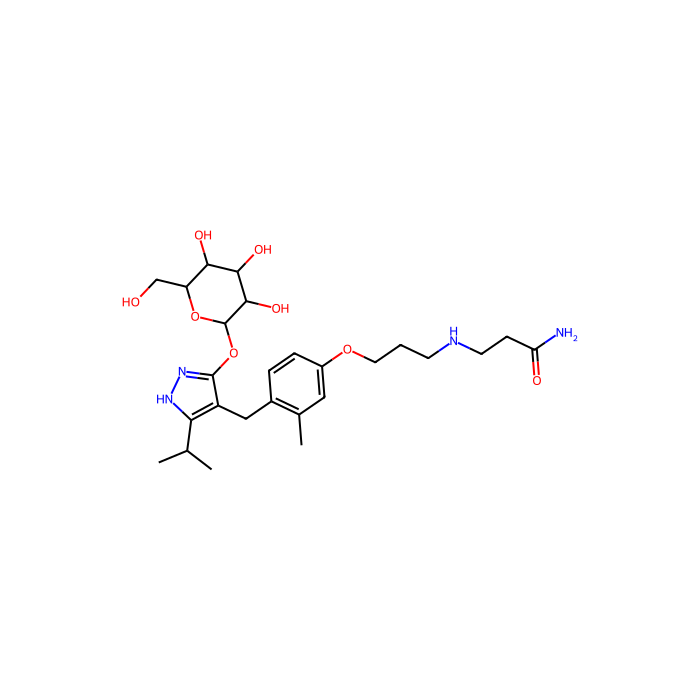
KGA-2727 KGA-2727 is a potent, selective, high-affinity inhibitor of sodium glucose cotransporter 1 (SGLT1) with Ki of 97.4 nM and 43.5 nM for human SGLT1 and rat SGLT1, respectively. The selectivity ratios (Ki for SGLT2/Ki for SGLT1) of KGA-2727 are 140 (human) and 390 (rat). KGA-2727 exhibits antidiabetic efficacy in rodent models.
Targets
rat SGLT1 (Cell-free assay); human SGLT1 (Cell-free assay) 43.5 nM(Ki); 97.4 nM(Ki)
In vitro
KGA-2727 inhibits SGLT1 potently and highly selectively in an in vitro assay using cells transiently expressing recombinant SGLTs..
In vivo
In a small intestine closed loop absorption test with normal rats, KGA-2727 inhibits the absorption of glucose but not that of fructose. In the oral glucose tolerance test with streptozotocininduced diabetic rats, KGA-2727 attenuats the elevation of plasma glucose after glucose loading, indicating that KGA-2727 improves postprandial hyperglycemia. In Zucker diabetic fatty (ZDF) rats, chronic treatments with KGA-2727 reduces the levels of plasma glucose and glycated hemoglobin. Furthermore, KGA-2727 preserves glucose-stimulated insulin secretion and reduces urinary glucose excretion with improved morphological changes of pancreatic islets and renal distal tubules in ZDF rats. In addition, the chronic treatment with KGA-2727 increases the level of Glukagon-like peptide-1 in the portal vein..
Cell Research(from reference)
Cell lines:COS-7 cells
Concentrations:0-1 μM, 0-100 μM
Comprehensive hazard, handling, storage, and regulatory compliance document.
Download SDS →Lot-specific quality data. Enter your lot number to retrieve the exact COA.
Look up COA →Full quality attributes and acceptance criteria for this grade.
View spec sheet →Taxonomy Tree
| Kingdom | Organic compounds |
|---|---|
| Superclass | Organic oxygen compounds |
| Clase | Organooxygen compounds |
| Subclass | Carbohydrates and carbohydrate conjugates |
| Intermediate Tree Nodes | Glycosyl compounds |
| Direct Parent | O-glycosyl compounds |
| Alternative Parents | Hexoses Beta amino acids and derivatives Phenoxy compounds Phenol ethers Toluenes Alkyl aryl ethers Oxanes Pyrazoles Heteroaromatic compounds Secondary alcohols Primary carboxylic acid amides Acetals Azacyclic compounds Polyols Dialkylamines Oxacyclic compounds Primary alcohols Carbonyl compounds Organopnictogen compounds Hydrocarbon derivatives Organic oxides |
| Molecular Framework | Aromatic heteromonocyclic compounds |
| Substituents | Hexose monosaccharide - Beta amino acid or derivatives - O-glycosyl compound - Phenoxy compound - Phenol ether - Alkyl aryl ether - Toluene - Monocyclic benzene moiety - Monosaccharide - Oxane - Benzenoid - Azole - Heteroaromatic compound - Pyrazole - Primary carboxylic acid amide - Secondary alcohol - Amino acid or derivatives - Carboxamide group - Secondary amine - Polyol - Organoheterocyclic compound - Oxacycle - Azacycle - Acetal - Ether - Secondary aliphatic amine - Carboxylic acid derivative - Primary alcohol - Carbonyl group - Organopnictogen compound - Organic oxide - Alcohol - Hydrocarbon derivative - Organonitrogen compound - Amine - Organic nitrogen compound - Aromatic heteromonocyclic compound |
| Descripción | This compound belongs to the class of organic compounds known as o-glycosyl compounds. These are glycoside in which a sugar group is bonded through one carbon to another group via a O-glycosidic bond. |
| External Descriptors | Not available |
| Activity Type | Relation | Activity value | Units | Action Type | Journal | PubMed Id | doi | Assay Aladdin ID |
|---|
| Activity Type | Relation | Activity value | Units | Action Type | Journal | PubMed Id | doi | Assay Aladdin ID |
|---|
Find and download the COA for your product by matching the lot number on the packaging.
| Lot Number | Certificate Type | Fecha | Articulo |
|---|---|---|---|
 H2218678 H2218678 | Certificate of Analysis | Jun 09, 2025 | K414280 |
| H2218679 | Certificate of Analysis | Jun 09, 2025 | K414280 |
| H2218680 | Certificate of Analysis | Jun 09, 2025 | K414280 |
| H2218681 | Certificate of Analysis | Jun 09, 2025 | K414280 |
| H2218682 | Certificate of Analysis | Jun 09, 2025 | K414280 |
| Solubilidad | Solubility (25°C) In vitro DMSO: 100 mg/mL (186.35 mM); Water: 100 mg/mL (186.35 mM); Ethanol: 45 mg/mL (83.85 mM); |
|---|---|
| DMSO (mg/ml) Solubilidad máxima | 100 |
| DMSO (mM) Solubilidad máxima | 186.351608214379 |
| Agua (mg/ml) Solubilidad máxima | 100 |
| Agua (mM) Solubilidad máxima | 186.351608214379 |
| Peso molecular | 536.600 g/mol |
| XLogP3 | 0.600 |
| Hydrogen Bond Donor Count | 7 |
| Hydrogen Bond Acceptor Count | 10 |
| Rotatable Bond Count | 14 |
| Exact Mass | 536.285 Da |
| Monoisotopic Mass | 536.285 Da |
| Topological Polar Surface Area | 192.000 Ų |
| Heavy Atom Count | 38 |
| Formal Charge | 0 |
| Complexity | 719.000 |
| Isotope Atom Count | 0 |
| Defined Atom Stereocenter Count | 5 |
| Undefined Atom Stereocenter Count | 0 |
| Defined Bond Stereocenter Count | 0 |
| Undefined Bond Stereocenter Count | 0 |
| The total count of all stereochemical bonds | 0 |
| Covalently-Bonded Unit Count | 1 |
No tested application protocols are provided for this item.
These are general practices; adapt to your assay and confirm compatibility experimentally.
Item-specific (Product Data):
General notes:
Good practice for biological testing (general):
Not typically applicable. KGA-2727 is not a buffering agent, and no pKa or acid/base characteristics are provided. If used in biochemical assays, it will usually be dissolved in an existing buffer system appropriate for the target (e.g., phosphate, HEPES, Tris), chosen based on the biology rather than on this compound’s properties. Consult assay-specific protocols once the compound’s solubility and ionization (if any) are known.
Because KGA-2727 is offered as a discrete small-molecule library compound (not as a solvent or common reagent), the concept of a greener substitute is generally not applicable.
Context (general):
Practical greener-lab tips (general):
Trade-offs:
No pharmacopeial status or excipient role is specified for this item. KGA-2727 is offered strictly for research use only.
General considerations (non-clinical, non-therapeutic):
Compliance note:
Because structural and analytical specifications are not provided for this listing, definitive physico-chemical properties cannot be stated.
Item-specific (Product Data):
Typical properties to consult (literature/computed, when structure is available):
Practical guidance (general):
Item-specific (Product Data):
How to interpret grade (general guidance):
Stabilizers and additives:
Recommended quality control checks (user side):
This catalog entry is positioned as a small-molecule library member rather than a general-purpose reagent; therefore, it is not typically selected as a stoichiometric reagent or catalyst in synthesis without additional context.
Item-specific (Product Data):
Typical research uses for library compounds (general):
Practical considerations:
Not applicable in a specific sense: KGA-2727 is not provided as a reagent with defined synthetic roles, and no reaction conditions are specified.
All specific conditions should be drawn from the primary literature once the identity and functional groups of KGA-2727 are known.
Safety details are limited in the Product Data. Treat KGA-2727 as a research chemical of unknown hazard profile and follow conservative laboratory safety practices. Always consult the product SDS for authoritative hazard information.
Item-specific (Product Data):
General safety guidance (good laboratory practice):
With structure and solubility not specified, start with a pragmatic solvent screen commonly used for small-molecule libraries.
Item-specific (Product Data):
General solvent strategy:
Practical tips (general):
Item-specific (Product Data):
General storage guidance (small-molecule solids/solutions):
Reconstitution (general):
Always defer to the CoA/SDS for item-specific stability and handling notes. If the lot’s CoA specifies additional constraints (e.g., protect from light), follow those instructions as primary.
Brief overview: KGA-2727 (SKU K414280) is listed in our small-molecule library category. Limited structure data are provided for this catalog entry; consult the CoA/Spec Sheet for definitive identifiers.
Item-specific (Product Data):
Structural features (general guidance):
Practical notes:
Synthetic applications cannot be detailed without a confirmed structure. As listed, KGA-2727 is a small-molecule library member rather than a general reagent.
Item-specific (Product Data):
General perspectives (once structure is known):
Recommendation:
Not applicable. This is not an antibody or targeted biologic, and the Product Data do not provide any molecular target, enzyme, receptor, or pathway specificity for KGA-2727.