CALIDAD & PUREZAMoligand™?Moligand™ — Aladdin's line of ligands and bioactive small molecules. Use for receptor, pathway, and binding studies needing defined small-molecule tools.10 mM in DMSO
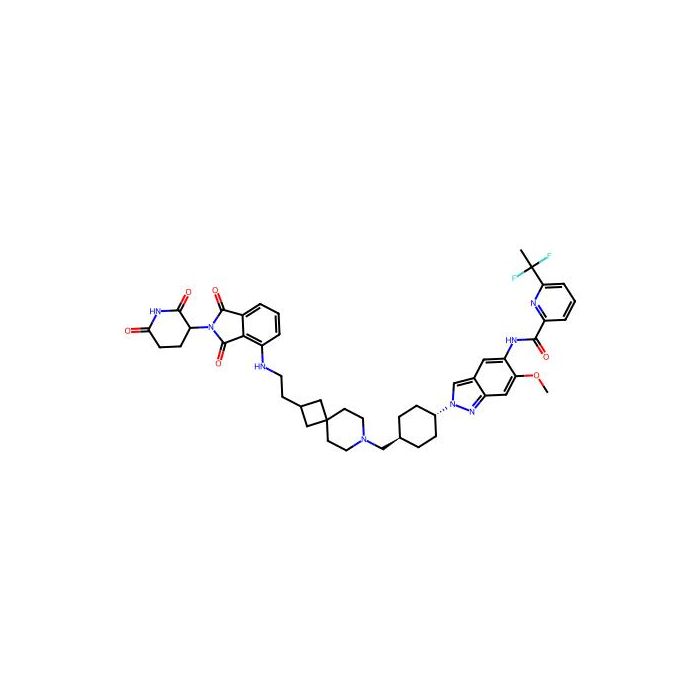
KTX-951 is an orally active IRAK4 and IMiD (Ikaros/Aiolos) substrates PROTAC degrader. KTX-951 has DC 50 of 13 nM, 14 nM and 13 nM for IRAK4 , Ikaros and Aiolos, respectively. TX-951 has antitumor activity.(Pink: IRAK4 ligand-12; Black: Linker; Blue: CRBN Ligand Pomalidomide)
Especificaciones
Especificaciones y pureza
Moligand™, 10 mM in DMSO
Condiciones de almacenamiento de almacenamiento
Store at -80°C
Enviado en
Dry ice packs + Cold packs
Este producto requiere envío en cadena de frío. Los servicios terrestres y otros servicios económicos no están disponibles.
Grado
Moligand™
Tipo de acción
DEGRADER
Nombres e identificadores
Peso molecular
850.95
Datos avanzados
Certificados (CoA, COO, BSE/TSE y tabla de análisis)
C of A & Other Certificates(BSE/TSE, COO):
Analytical Chart:
Calculadoras de soluciones
Molarity Calculator
Determine the necessary mass, volume, or concentration for preparing a solution.
Dilution Calculator
Determine the dilution needed to prepare a stock solution.
Reconstitution Calculator
Reseñas
Reseñas de cliente
Application Protocols
No tested applications, recommended dilutions, or protocol details are provided for KTX-951 in the product data. Accordingly, no validated use procedures can be supplied for this item.
Please refer to your laboratory’s standard protocols for handling small-molecule screening compounds and consult the CoA/SDS for any lot-specific instructions.
Biological Roles
Item-specific biological roles, targets, or pathways are not provided for KTX-951. Without structural or mechanistic disclosure, no definitive biological function can be ascribed to this compound.
General considerations for research small molecules (not item-specific claims)
Tool compounds may act through a variety of mechanisms (enzyme inhibition/activation, receptor modulation, pathway perturbation). Establishing a credible mode of action typically requires convergent evidence: biochemical potency, biophysical binding, cellular efficacy, and counter-screening to exclude assay artifacts.
Orthogonal validation: Utilize assays with different readouts (e.g., enzyme kinetics vs. thermal shift) to confirm true engagement. Consider target knockdown/overexpression controls in cell-based studies to link phenotype to target engagement.
Selectivity profiling: In the absence of known targets, broad-panel biochemical or cellular profiling can reveal potential off-target liabilities and help triage hits for follow-up.
ADME/physicochemical context: Basic properties (pKa, lipophilicity, polar surface area)—not specified here—strongly influence permeability, solubility, and nonspecific binding. Measure or compute these once structural data are available.
Important
No medical or clinical claims are made or implied. KTX-951 is supplied strictly for research use only. For any biological deployment, consult the CoA/SDS and validate solubility, stability, and assay compatibility empirically.
Buffer Applications
KTX-951 is not a buffering reagent, and no acid/base characteristics or pKa data are provided. Therefore, it is not typically used to prepare buffer systems.
Practical guidance for using small molecules in buffered assays (general)
Choose a buffer compatible with your assay and potential compound ionization: HEPES (pH 6.8–8.2), phosphate (pH 6.0–8.0), MOPS (pH 6.5–7.9), or acetate (pH 4–5.5). Maintain ionic strength with NaCl (e.g., 100–150 mM) if required.
Minimize solvent effects by keeping DMSO/EtOH below assay tolerance (commonly ≤0.5–1% v/v). Pre-equilibrate buffer and test precipitation upon spiking compound stocks.
To mitigate aggregation, include 0.01–0.05% nonionic surfactant (Tween-20 or Pluronic F-127) when appropriate and permitted by the assay.
For LC-MS–compatible workflows, use volatile buffers (ammonium acetate/formate) at low millimolar concentrations to avoid ion suppression.
Summary
No buffer-specific applications are defined for KTX-951. Select and optimize buffer systems around your biological or biochemical assay, confirming compound solubility and stability under those conditions.
Green Alternatives
Given that KTX-951 is supplied as a research screening compound (not a solvent or bulk reagent) and its structure is undisclosed, “green alternatives” considerations primarily relate to solvent choices for dissolution and handling in assays.
General greener-practice options (not item specifications)
Prefer aqueous delivery with minimal organic cosolvent when feasible. Aim for ≤0.5–1% v/v DMSO or ethanol in the final assay to reduce solvent burden.
When high solvency is needed during method development, consider greener or lower-toxicity co-solvents versus legacy choices:
Replace DMF/NMP (problematic) with ethanol, isopropanol, or water/PEG mixtures where solubility and assay tolerance permit.
For synthetic/analytical prep work surrounding library compounds, evaluate alternatives such as Cyrene or propylene carbonate in place of DMF/DMSO, noting viscosity and compatibility tradeoffs.
Reduce waste: Use miniaturized formats (low-volume plates, acoustic dispensing) to minimize solvent use and compound consumption.
Trade-offs
DMSO remains the most broadly effective solvent for diverse small molecules; greener substitutes may reduce solubility or introduce assay artifacts. Validate any substitution empirically.
Summary
Without structural data for KTX-951, solvent greening must be empirical and assay-driven. Start with the smallest practical DMSO fraction and migrate toward aqueous or greener cosolvents only if compound solubility and assay performance remain acceptable.
Pharmaceutical Uses
No pharmacopeial status, excipient role, or formulation use is specified for KTX-951. The product is labeled for research use only and is not intended for human or veterinary use.
General context for discovery workflows (not item-specific claims)
Research small molecules like KTX-951 may be incorporated into discovery workflows as reference standards, screening hits, or tool compounds for mechanism exploration. Any movement toward preclinical development would require extensive profiling (identity, purity, stability, solid form, impurity fate) and is outside the scope of this listing.
If you intend to use this compound as an analytical reference standard, confirm the exact salt/solvate form, assay purity, and extinction coefficients (if UV quantitation is planned) from the CoA.
No claims are made regarding compliance with pharmacopeial monographs (USP/EP/JP) or GMP suitability.
Note
KTX-951 is supplied strictly for research use only. No therapeutic, diagnostic, or clinical application is implied or supported by this product documentation.
Physical Properties
Item-specific properties
Appearance: Not specified for this item; refer to CoA/Spec Sheet.
Melting point: Not specified for this item; refer to CoA/Spec Sheet.
Boiling point: Not specified for this item; refer to CoA/Spec Sheet.
Density: Not specified for this item; refer to CoA/Spec Sheet.
Solubility: Not specified for this item; refer to CoA/Spec Sheet.
LogP/logD, pKa, refractive index: Not specified for this item; refer to CoA/Spec Sheet.
General guidance (literature/practice; not item specifications)
Library compounds are commonly formulated as concentrated DMSO stocks (e.g., 10–50 mM) due to broad solvency and assay compatibility. If aqueous delivery is needed, serial dilution into buffered media with final DMSO ≤0.5–1% v/v is typical to minimize assay interference.
If water solubility is uncertain, a minimal-solvent addition method (incremental DMSO or ethanol addition with vortex, sonication, and visual inspection) is recommended to avoid supersaturation and precipitation during assay setup.
Where ionizable groups are present (unknown for this item), solubility may be enhanced by pH adjustment within assay-compatible ranges; use volatile bases/acids (e.g., ammonium bicarbonate, formic acid) for LC-MS workflows.
For analytical characterization, standard solvent panels (ACN, MeOH, DMSO, IPA, water with 0.1% FA or NH4OAc) are typically suitable pending actual compound polarity.
Important
Do not treat the above as specifications. For exact physical constants and solubility limits of KTX-951, consult the lot-specific CoA/Spec Sheet.
Quality and Grades
Grade: Moligand™ (as listed). Moligand™ denotes small molecules intended for research screening and ligand discovery workflows. It typically emphasizes identity confirmation and purity appropriate for biochemical/biophysical assays; however, specific acceptance criteria (e.g., purity by HPLC/LC-MS, water content, residual solvents) are not provided here and should be verified on the CoA/Spec Sheet.
Purity: Not specified for this item; refer to CoA/Spec Sheet.
Stabilizers/inhibitors: Not specified for this item; refer to CoA/Spec Sheet.
UV profile/LC-MS suitability: Not specified for this item; refer to CoA/Spec Sheet.
What this means in practice
Screening-grade compounds prioritize consistent identity and usability in HTS, biochemical, and biophysical assays. They are commonly supplied in solid form or pre-dosed plates/tubes suitable for automated liquid handling.
For quantitative work (e.g., IC50/Kd determination, biophysical stoichiometry), confirm lot-specific purity and counter-ion/solvate state. If the CoA indicates salt form or solvate, adjust stock concentration calculations accordingly.
If your application requires elevated specifications (e.g., low UV background for HPLC or trace-metal control for catalytic studies), contact technical support for an enhanced grade or a custom QC package.
Documentation
CoA/Spec Sheet and SDS should be consulted for: identity confirmation method, purity method and result, residual solvent profile, water content (if applicable), and recommended handling.
Reaction and Applications
Intended use context
KTX-951 is listed under a small-molecule/compound library category (Moligand™), indicating use as a research ligand or screening compound rather than a synthetic reagent. No manufacturer application notes were supplied for this item.
Research applications (general guidance; not item-specific claims)
High-throughput screening (HTS) and primary assays: Use as a test article to probe biochemical targets, enzymatic activity, or binding in cellular/biophysical formats.
Orthogonal biophysical confirmation: Surface plasmon resonance (SPR), microscale thermophoresis (MST), thermal shift (DSF), or isothermal titration calorimetry (ITC) can be used to validate binding where solubility permits.
Structure–activity relationship (SAR) development: Pair with close analogs to build preliminary SAR in follow-up assays.
Analytical reference: May serve as a reference peak in LC/LC-MS method development for libraries, provided identity and purity are confirmed by CoA.
Practical tips (general)
Stock preparation: Prepare dry DMSO stocks at 10–50 mM when possible; aliquot to avoid freeze–thaw and water uptake.
Aggregation control: Include 0.01–0.05% nonionic detergent for aggregation-prone assays; confirm with control assays (e.g., detergent sensitivity, light scattering if available).
Interference mitigation: Assess intrinsic fluorescence/absorbance by measuring compound-only controls at assay wavelengths to flag optical interference.
Adsorption: For hydrophobic compounds, low-bind plastics or glass vials reduce adsorption losses; pre-wet tips with stock solution when dispensing nanoliter volumes.
Note: For any specific reactivity or target discussions, structural disclosure is required; consult the CoA/Spec Sheet.
Reaction Conditions
No reaction conditions are applicable or specified for KTX-951, as it is supplied as a screening/test compound rather than a reagent, and the structure is undisclosed.
General notes (if conducting any manipulation)
For solution handling (e.g., making assay stocks), prepare in an appropriate solvent such as dry DMSO, then dilute into the assay buffer while monitoring for precipitation. Keep final organic solvent within assay limits.
If any chemical modification or stability study is planned, perform a small-scale time-course under controlled temperature and light, sampling into quench solvent and analyzing by LC-MS to map degradation pathways.
Please consult the CoA/SDS for any stability caveats specific to KTX-951 when available.
Safety and Handling
Item-specific hazard data
GHS classification: Not specified for this item; refer to SDS.
Signal word: Not specified for this item; refer to SDS.
H-statements and pictograms: Not specified for this item; refer to SDS.
General laboratory precautions (for unknown small molecules; defer to SDS for authoritative guidance)
PPE: Wear lab coat, safety glasses, and suitable chemically resistant gloves. Avoid inhalation of dust/vapors and contact with skin/eyes. Use in a fume hood when handling powders or solutions that may off-gas.
Storage: Store at −80°C as specified. Keep tightly closed in the original container, desiccated and protected from light if possible. Minimize freeze–thaw cycles by aliquoting.
Incompatibilities: Unknown for this item. As general practice, avoid strong oxidizers/reductants and reactive acylating/alkylating agents unless compatibility is confirmed. Separate from foodstuffs and incompatible acids/bases.
Spill/accident response: For solids, gently cover with inert absorbent, avoid dust generation, collect mechanically, and dispose per institutional hazardous waste protocols. For solutions, absorb with appropriate material and clean the area with solvent compatible with both the compound and the surface (usually ethanol or soapy water, then rinse).
First aid (general): If on skin, wash with soap and water. If in eyes, rinse cautiously with water for several minutes and remove contact lenses if present and easy to do. If inhaled, move to fresh air. If ingested, rinse mouth; do not induce vomiting. Seek medical attention in all cases of exposure or if symptoms persist.
Always consult the product SDS for definitive hazard information and institutional procedures.
Solvent Selection
Because the structure of KTX-951 is not disclosed in the product data, solvent selection should be guided by a short solubility screen and the intended assay system.
Practical approach (general guidance)
Primary stock solvent: DMSO is the default for diverse small molecules due to broad solvency and compatibility with most biochemical/biophysical assays. Prepare a concentrated stock (e.g., 10–50 mM) if solubility allows.
Secondary options: DMF, ethanol, methanol, or acetonitrile may improve solubility for certain scaffolds. For aqueous delivery, cosolvent systems (DMSO 1–5% v/v, or EtOH/PEG400/water mixtures) can be used while monitoring assay tolerance.
Aqueous buffers: Use HEPES, phosphate, or acetate buffers at assay-appropriate pH. Include a small amount of nonionic surfactant (e.g., 0.01–0.05% Tween-20) when colloidal aggregation is a concern.
Small-molecule solubility screen: Start with 10 µL DMSO per mg as a probe; if insoluble, add stepwise with vortex and short sonication. Test dilution into buffer at multiple ratios to check for precipitation (visual/Tyndall check). Document final solvent composition tolerated by your assay.
Comparison notes (general)
DMSO vs ethanol: DMSO offers higher solvency and lower volatility; ethanol may be preferred for cell-based systems with strict DMSO limits but often has lower solubility capacity.
DMF/ACN: Useful for analytical prep and some plate-based assays; assess cytotoxicity/assay interference where relevant.
Always confirm exact solubility and compatibility for KTX-951 from the CoA when available.
Storage and Reconstitution
Item-specific conditions
Storage conditions: Store at −80°C (per product data). Keep container tightly closed, under dry and inert conditions if possible. Minimize headspace to limit moisture ingress.
Shipping: Shipped on dry ice packs + cold packs, indicating the product should remain frozen in transit.
Reconstitution and handling (general guidance; not item specifications)
Solvent: In the absence of solubility data, dry DMSO is the preferred primary solvent for small-molecule library members. Start with a conservative volume to target 10–50 mM stocks if solubility permits.
Aliquoting: Divide into single-use aliquots (low-bind tubes) to avoid repeated freeze–thaw and moisture uptake. Record exact mass/volume for accurate concentration tracking.
Thawing: Thaw aliquots quickly at room temperature, mix gently, and return unused material to −80°C promptly. Avoid frost/moisture exposure by allowing vials to equilibrate to room temperature before opening when removing from cold storage.
Stability: No stability data are provided for this item. For working solutions, limit time at ambient temperature and protect from light as a precaution. Verify integrity by LC-MS or HPLC if solutions are stored for more than 24–48 hours at 2–8°C.
Aqueous dilution: Add DMSO stock to buffer with vigorous mixing; keep final DMSO within assay tolerance and inspect for precipitation.
Always consult the lot-specific CoA/Spec Sheet and SDS for definitive solubility, stability, and handling instructions for KTX-951.
Structure and Identity
Product name: KTX-951 (SKU: K1497460)
CAS: 2573298-36-7
Category: Small molecule screening library member (Moligand™)
Item-specific identifiers
Molecular formula: Not specified for this item; refer to CoA/Spec Sheet.
Molecular weight: Not specified for this item; refer to CoA/Spec Sheet.
SMILES: Not specified for this item; refer to CoA/Spec Sheet.
InChIKey: Not specified for this item; refer to CoA/Spec Sheet.
Structural description
Structural features (rings, heteroatoms, functional groups, stereochemistry): Not disclosed in the product data. Without a structure, specific functional group analysis or stereochemical description cannot be provided.
2D depiction in words: Not available; structure not provided in the listing.
Notes
The CAS registry number uniquely identifies the substance at the registry level; however, detailed structure and exact identity parameters should be confirmed against the provided Certificate of Analysis (CoA) for the supplied lot.
If you require structural data for computational or screening workflows (e.g., docking, property prediction), please request the structure file from technical support or consult the CoA when available.
Synthetic Utility
KTX-951 is offered as a Moligand™ screening compound rather than as a synthetic reagent or building block. No structural information, functional group annotation, or reactivity profile is provided, so specific synthetic transformations cannot be recommended.
General guidance (non-item-specific)
If using this compound as a starting material or intermediate (e.g., for analog synthesis), first obtain full structural disclosure and CoA details, including salt/solvate state and impurity profile, to ensure accurate stoichiometry.
Confirm stability under planned reaction conditions (thermal, oxidative, acidic/basic) via small-scale scouting experiments and LC-MS tracking.
Where derivatization is intended (e.g., amide coupling, cross-coupling), determine the presence and accessibility of requisite functional handles by NMR/HRMS once structure is available.
Summary
No synthetic utility can be asserted for KTX-951 without structure and functional group information. It is best regarded as a screening/test article rather than a reagent.
Target Specificity
No target, pathway, or protein specificity is provided for KTX-951 in the product data. There are no disclosed epitope, binding site, or selectivity details.
Note
Any target annotations should be derived from manufacturer documentation or peer-reviewed studies specific to this compound. In the absence of such data, KTX-951 should be treated as an unannotated research ligand for exploratory use only.
Preguntas frecuentes
What is Moligand??
Moligand? is one of Aladdin Scientific's premium product lines, formulated for high-purity applications across multiple workflows. Compared to standard grades in the same workflow, Moligand? products typically offer tighter specifications, more rigorous QC, and stronger lot-to-lot consistency.
How should this product be stored?
Store at ?80 °C. Ultra-low temperature storage is required to maintain the specified shelf life.
How is this product shipped?
This product ships frozen with dry ice and cold packs. Unpack on arrival and transfer it to the storage condition stated above; handle dry ice with insulated gloves in a ventilated area.
What are the CAS number, molecular formula and molecular weight?
The CAS Number is 2573298-36-7, the molecular formula is C46H52F2N8O6, and the molecular weight is 850.95 g/mol.
What documentation is provided?
Available product documentation, including Certificates of Analysis (COA), Safety Data Sheets (SDS), and specification sheets, is shown in the product document area. Document availability and access follow the current site policy.
¿Necesita ayuda para elegir la calidad?
Nuestra guía de selección de calidades cubre la pureza, el estado del estabilizador y la idoneidad de la aplicación para todas las variantes de nuestro catálogo.
Utilizamos cookies para garantizar el correcto funcionamiento del sitio web y, cuando esté permitido, para mejorar su experiencia. Puede gestionar sus preferencias en cualquier momento en Configuración. Más información en nuestra Política de Cookies.
¿Quieres que te enviemos un mensaje cuando tengamos descuentos disponibles?
Recordármelo más tarde
¡Gracias! Por favor, revisa tu bandeja de entrada de correo electrónico para confirmar.
Products are supplied to verified businesses, institutions, and qualified professionals for research and development use only. Not for use in humans, animals, diagnosis, or therapy.