This compound belongs to the class of organic compounds known as 1,2-aminoalcohols. These are organic compounds containing an alkyl chain with an amine group bound to the C1 atom and an alcohol group bound to the C2 atom.
External Descriptors
Not available
1. Djoumbou Feunang Y, Eisner R, Knox C, Chepelev L, Hastings J, Owen G, Fahy E, Steinbeck C, Subramanian S, Bolton E, Greiner R, and Wishart DS. ClassyFire: Automated Chemical Classification With A Comprehensive, Computable Taxonomy. Journal of Cheminformatics, 2016, 8:61.
Determine the necessary mass, volume, or concentration for preparing a solution.
Dilution Calculator
Determine the dilution needed to prepare a stock solution.
Reconstitution Calculator
Reseñas
Reseñas de cliente
Application Protocols
No tested bioassay or immunoassay application protocols are provided for this item. As a small-molecule building block, procedures will be highly application-specific (e.g., coupling, protection, oxidation).
General lab readiness tips:
Verify identity and (if relevant) enantiomeric purity by NMR and chiral HPLC.
Dry material prior to moisture-sensitive steps; prepare fresh solutions in an appropriate solvent immediately before use.
For salt formation (e.g., HCl): dissolve in minimal alcohol or EtOAc and sparge with dry HCl or add standardized HCl in dioxane; isolate by crystallization where possible.
Biological Roles
This catalog item is intended for research use only; no clinical or diagnostic claims are made.
General biochemical context (literature):
Structural analogy: L-methioninol is the alcohol-reduced analogue of L-methionine, carrying an amino group and a thioether side chain. It is not a canonical metabolite but can mimic aspects of methionine’s side-chain chemistry (thioether redox/alkylation behavior) in model studies.
Functional group reactivity: the primary amine can participate in enzymatic/transaminase model studies or be derivatized for probe synthesis; the thioether can model oxidation to sulfoxide/sulfone, relevant to oxidative stress chemistry on methionine residues in proteins.
Probe/derivative utility: amino alcohols are often converted to labeled derivatives (e.g., fluorescent carbamates/urethanes) to study uptake or reactivity in biochemical assays. Any such use should be validated and is outside the scope of product specifications.
Important: Specific bioactivity, transport, or metabolic fate of this exact compound is not provided in the product data and should be established experimentally for your system.
Buffer Applications
This compound is not a dedicated buffering agent. As an amino alcohol, it can exhibit limited acid–base buffering capacity near the conjugate acid pKa of the amine (literature ~9–10 for primary aliphatic amines), but it is not commonly used as a defined buffer system.
Practical guidance:
If used in aqueous work, adjust pH with mineral acid to form a defined salt (e.g., hydrochloride) for improved solubility and stability.
For true buffering between pH 6–9, select established buffers (e.g., phosphate, HEPES, Tris) and use this product only as a reagent/building block within that medium.
Green Alternatives
Although this product is a building block rather than a solvent, greener choices can be made in its use and processing.
Greener media options (literature/principles):
Replace chlorinated solvents (DCM, CHCl3) with ethyl acetate or 2-MeTHF where solubility/selectivity allow.
Favor water/ethanol or water/i-PrOH mixtures for salt formations and simple acylations when compatible.
Use dimethyl carbonate (DMC) for O-methylation or carbonate formation as a safer reagent alternative to phosgene-derived reagents.
Illustrative comparison (general):
DCM vs EtOAc: EtOAc offers lower toxicity and better biodegradability; may require temperature control to match DCM selectivity.
DMF/DMSO vs Cyrene/PC/GBL: bio-based dipolar aprotics (e.g., Cyrene) can substitute in some coupling reactions; confirm compatibility with amine-rich substrates.
THF vs 2-MeTHF/CPME: 2-MeTHF and CPME reduce peroxide formation rates and improve LCA metrics; check solubility of amino alcohol salts.
Process considerations:
Minimize protecting-group steps and employ catalytic methods (e.g., catalytic hydrogenation for deprotection) to reduce waste.
Implement in-line scavengers for residual reagents (e.g., isocyanates, acylating agents) to simplify workup and lower solvent use.
Note: Validate alternative solvents/reagents on small scale to confirm chemoselectivity with thioether-containing substrates.
Pharmaceutical Uses
No pharmacopeial status, excipient designation, or formulation role is provided in the product data. This product is supplied for research use only.
General R&D context (literature/practice):
Synthetic intermediate: chiral amino alcohols are frequently employed as intermediates in the preparation of API candidates, peptidomimetics, and chiral auxiliaries/ligands for asymmetric catalysis used in process development.
Salt formation: conversion to hydrochloride or other pharmaceutically acceptable salts can improve handling and crystallinity during route scouting; such salts would be distinct items with their own specifications.
Compliance note:
Do not use in human or veterinary applications. For GMP or regulatory uses, source material with appropriate quality system documentation and pharmacopeial compliance if applicable.
Physical Properties
Item-specific numerical specifications are not provided in the product data and should be confirmed on the CoA/Spec Sheet for your lot.
Appearance: Not specified for this item; refer to CoA/Spec Sheet.
Melting point: Not specified for this item; refer to CoA/Spec Sheet.
Boiling point: Not specified for this item; refer to CoA/Spec Sheet.
Density: Not specified for this item; refer to CoA/Spec Sheet.
Refractive index: Not specified for this item; refer to CoA/Spec Sheet.
Solubility: Not specified for this item; refer to CoA/Spec Sheet.
General/literature expectations for an L-methionine-derived amino alcohol (informational only):
State: typically a hygroscopic solid or viscous oil depending on salt form and water content.
Polarity: polyfunctional (amine + alcohol + thioether) leading to high polarity and expected good solubility in water and polar protic solvents; limited solubility in nonpolar media.
Acid–base: primary amine pKaH typically ~9–10 (literature, amino alcohols); hydroxyl non-ionizing under neutral conditions.
Partitioning: low logP relative to methionine esters due to free OH/NH2 (literature trend).
These are general properties of amino alcohols related to L-methionine and are not product specifications. Verify exact values experimentally or from the SDS/CoA.
Quality and Grades
Grade/purity: Not specified for this item; refer to CoA/Spec Sheet.
Guidance on interpreting grades (general information):
Research grade: suitable for general laboratory synthesis and screening. Typical for building blocks where ultra-trace impurities are not critical.
High-purity or chiral-grade materials: when specified, indicate tight control of enantiomeric excess (ee) and organic/inorganic impurities—important for asymmetric catalysis or chiral ligand synthesis.
Stabilizers: This product data does not list any stabilizers. If a salt form (e.g., hydrochloride) is supplied, it often enhances stability and handling vs the free base; verify on CoA.
Documentation to consult for this item: certificate of analysis (assay method, residual solvents, water/Karl Fischer, optical rotation/ee if applicable), and specification sheet.
Practical notes:
If enantiopurity is critical, request or check optical rotation and chiral HPLC data on the CoA.
For trace-metal-sensitive applications (e.g., organometallic catalysis development), request a metals screen if not provided.
For analytical uses (HPLC/MS reference), ensure residual solvent and non-volatile residues meet your method tolerances.
Reaction and Applications
Use-cases derive from the presence of a primary amine, a primary alcohol, and a thioether in a chiral (L) framework.
Chiral building block: precursor for chiral ligands or auxiliaries; the amino alcohol motif is prevalent in asymmetric catalysis scaffolds.
Functional interconversions:
Protection: amine (Boc, Cbz, Fmoc) and alcohol (silyl, benzyl) protections to enable chemoselective transformations.
Oxidation: thioether → sulfoxide/sulfone to tune polarity or as intermediates; alcohol → aldehyde/acid derivatives under controlled conditions.
Mitsunobu inversion at C1 (alcohol), enabling access to inverted derivatives and etherification.
Reductive amination/amide coupling at the amino center to generate amides, ureas, and peptidomimetics.
Quaternization at sulfur to give sulfonium salts, useful as phase-transfer agents or for intramolecular cyclizations (literature).
Bioconjugation-adjacent chemistry: the amine can be used to attach to activated esters or isocyanates, producing carbamates/ureas in linker development.
Practical tips:
Drying: amino alcohols are often hygroscopic; dry by azeotrope with toluene or under high vacuum before moisture-sensitive steps.
Selectivity: protect one nucleophile (N or O) to avoid mixed acylation; use base and temperature control to favor N- over O-acylation.
S-chemistry: avoid strong oxidants unless sulfoxide/sulfone formation is intended; trace peroxide in solvents can slowly oxidize thioethers—use fresh, inhibitor-free solvents and add antioxidant if needed.
Reaction Conditions
General literature guidelines for transformations of amino alcohol thioethers (illustrative, not product specifications):
N-acylation/carbamate formation:
Solvent: DCM or MeCN; Base: DIPEA/TEA; Reagent: acid chloride, anhydride, or carbamoyl chloride.
Temperature: 0–25°C; Time: 1–4 h; Monitor for O-acylation—protect alcohol if needed.
Amide coupling to carboxylic acids:
Solvent: DMF/MeCN; Reagent: HATU or EDC·HCl with HOAt/HOBt; Base: DIPEA.
Temperature: 0–25°C; Time: 2–16 h; Typical isolated yields in literature for similar substrates: 70–95%.
Mitsunobu etherification/inversion (at the primary alcohol):
Solvent: THF or toluene; Reagents: DEAD/DIAD and PPh3 with pronucleophile.
Temperature: 0–25°C; Time: 2–6 h; Protect amine to suppress side reactions.
Sulfur oxidation to sulfoxide/sulfone:
Oxidants: mCPBA (≤1.1 eq for sulfoxide; ≥2.0 eq for sulfone) in DCM at −20 to 0°C (sulfoxide) or 0–25°C (sulfone).
Alternative: H2O2/AcOH or Oxone in MeOH/H2O; Control exotherm and monitor to stop at desired oxidation state.
Alcohol oxidation:
Dess–Martin periodinane in DCM for aldehyde; TEMPO/bleach (NaOCl) in biphasic system as a greener option.
Note: Conditions should be optimized for your substrate and scale. Thioethers can be over-oxidized; employ low temperatures and slow addition of oxidant.
Safety and Handling
GHS classification: Not specified for this item; refer to SDS.
Signal word, hazard statements, pictograms: Not specified for this item; refer to SDS.
General safety guidance (literature/practice for amino alcohols and thioethers):
Expected hazards: low to moderate irritation potential to skin/eyes/respiratory tract; thioethers can be malodorous. Avoid inhalation of dust or aerosols and contact with eyes/skin.
PPE: wear lab coat, safety glasses, and appropriate chemical-resistant gloves (e.g., nitrile). Handle in a chemical fume hood to control vapors/odors and avoid aerosol formation.
Incompatibilities: strong oxidizers (risk of sulfoxide/sulfone formation), strong acids/bases (may cause decomposition or salt formation), acylating/alkylating agents (react with amine/alcohol). Keep away from nitrosating agents (amines can form nitrosamines under harsh conditions).
First aid (overview; consult SDS):
Inhalation: move to fresh air; seek medical attention if symptoms persist.
Skin/eye contact: rinse with water for at least 15 minutes; remove contaminated clothing; obtain medical advice.
Ingestion: rinse mouth; do not induce vomiting; seek medical attention.
Storage note: per product data, store at 2–8°C. Keep container tightly closed, protected from light and moisture. For hygroscopic materials, purge headspace with inert gas after opening if long-term storage is needed.
Always defer to the product-specific SDS for authoritative safety information.
Solvent Selection
This product is a multifunctional polar organic (amino alcohol with thioether). Solvent choice depends on whether you need it free-based, as a salt, or protected.
General/literature solubility and miscibility trends (informational):
Water and polar protic solvents (MeOH, EtOH, i-PrOH): typically high solubility due to amino/alcohol groups; convenient for bioconjugation-like chemistry or salt formation.
Polar aprotic (DMF, DMSO, acetonitrile): good solubility for coupling reactions, carbamate/amide formation, or Mitsunobu-type transformations (if used with appropriate reagents).
Nonpolar solvents (toluene, hexanes, CPME): limited solubility unless converted to less polar derivatives (e.g., Boc-protected amine, acylated alcohol, or as a sulfate ester intermediate).
Selection guidance by use-case:
N-acylation/carbamate protection: DCM or MeCN with base; or DMF when using activated esters.
O-acylation/etherification: DCM/MeCN or THF; consider protecting the amine to enhance selectivity.
Oxidation at sulfur (to sulfoxide/sulfone): CH2Cl2/MeOH mixtures or AcOH-based systems commonly used (literature), while controlling temperature.
Environmental notes:
Prefer greener media like 2-MeTHF, EtOAc, or water/EtOH blends when feasible; DCM/DMF/DMSO carry higher EHS footprints. Validate solubility and selectivity prior to scale-up.
Storage and Reconstitution
Storage conditions (item-specific): Store at 2–8°C. Shipped on wet ice.
Container: keep tightly closed in original container; protect from moisture and air. If hygroscopic, consider storing under inert gas (N2/Ar).
Stability: Not specified for this item; refer to CoA/Spec Sheet. As a general note, amino alcohol thioethers are typically stable at 2–8°C for months when protected from light and oxidants.
Reconstitution/solution preparation:
Solubility specifics are not provided; common practice is to dissolve in water, MeOH, EtOH, or DMSO depending on application. Start with small volumes and gentle warming if needed.
For long-term stock solutions, store aliquots at 2–8°C (aqueous alcohols) or −20°C (DMSO/DMF) and avoid repeated freeze–thaw.
Disposal: follow institutional guidelines; avoid release to drains. Oxidizable sulfur content suggests using non-oxidizing waste streams unless intentionally quenched.
Always consult the product-specific CoA/SDS for definitive stability and handling instructions. For research use only.
Structure and Identity
Item-specific identifiers provided are incomplete. Where exact values are required for regulated work, use the CoA/SDS for this lot.
InChIKey: Not specified for this item; refer to CoA/Spec Sheet.
SMILES: Not specified for this item; refer to CoA/Spec Sheet.
Molecular formula: Not specified for this item; refer to CoA/Spec Sheet.
Molecular weight: Not specified for this item; refer to CoA/Spec Sheet.
General structural features (literature/general chemistry):
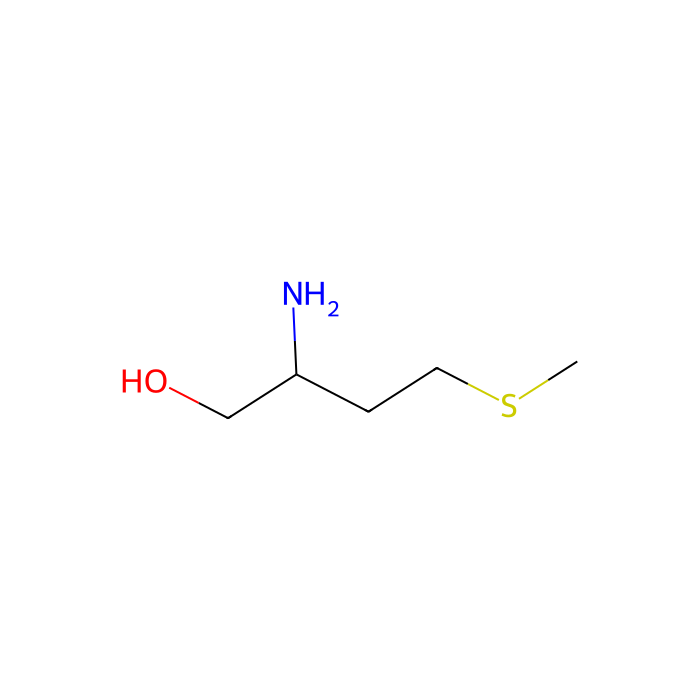
Expected functional groups for L-methioninol: a primary alcohol (–CH2OH), a primary amine (–NH2) on C2, and a thioether side chain (–S–CH3) analogous to L-methionine.
Stereochemistry: single stereocenter at the C2 (alpha) position; L configuration corresponds to (S) in the CIP system for most methionine derivatives (literature).
2D description: an amino alcohol backbone HO–CH2–CH2–CH(NH2)–CH2–S–CH3, with a single sulfur in a thioether and one chiral center bearing the amino substituent (literature).
Note: Because the supplied identifiers are partial, confirm exact structure and stereochemistry for your application from the certificate of analysis.
Synthetic Utility
Key functional handles and their synthetic value (general literature guidance):
Primary amine (on the chiral center):
Amide formation with activated carboxylic acids (EDC/HOBt, HATU) to access peptidic frameworks.
Carbamate/urea formation with chloroformates or isocyanates; useful for tagging, protecting, or modifying polarity.
Reductive amination onto carbonyls after appropriate protection of the alcohol.
Primary alcohol:
O-alkylation/etherification (via Mitsunobu or Williamson after activation), carbonate/sulfate ester formation.
Oxidation to aldehyde/acid derivatives for further elaboration; use chemoselective conditions to avoid sulfur over-oxidation.
Thioether:
Oxidation to sulfoxide/sulfone to modulate electronics and hydrogen-bonding.
Alkylation to sulfonium salts enabling intramolecular substitutions or as leaving-group strategy.
Chirality leverage:
The L-stereocenter enables enantiospecific synthesis of targets, chiral ligand development (e.g., amino alcohol ligands for enantioselective additions), and auxiliaries.
Chemoselectivity strategies:
Protect N as Boc to favor O-functionalization, or protect O as silyl ether to favor N-acylation.
Use non-nucleophilic bases (DIPEA, DBU) and low temperatures to steer selectivity; avoid strong oxidants in presence of thioether unless intended.
Target Specificity
Not applicable. This product is a small-molecule reagent/building block, not a biological targeting reagent (e.g., antibody, ligand with defined biomolecular target). No target, clone, isotype, or species reactivity information is provided or expected.
Preguntas frecuentes
What is the purity of this product?
This product is supplied at ≥98% purity (chemical assay). Lot-specific values are stated on the Certificate of Analysis.
We use cookies to ensure the website functions properly and, where permitted, to improve your experience. You can manage your preferences at any time in Settings. Learn more in our Cookie Policy.
Shall we send you a message when we have discounts available?
Remind me later
Thank you! Please check your email inbox to confirm.
Products are supplied to verified businesses, institutions, and qualified professionals for research and development use only. Not for use in humans, animals, diagnosis, or therapy.

 E1611139