This compound belongs to the class of organic compounds known as wax monoesters. These are waxes bearing an ester group at exactly one position.
External Descriptors
Wax monoesters
1. Djoumbou Feunang Y, Eisner R, Knox C, Chepelev L, Hastings J, Owen G, Fahy E, Steinbeck C, Subramanian S, Bolton E, Greiner R, and Wishart DS. ClassyFire: Automated Chemical Classification With A Comprehensive, Computable Taxonomy. Journal of Cheminformatics, 2016, 8:61.
Determine the necessary mass, volume, or concentration for preparing a solution.
Dilution Calculator
Determine the dilution needed to prepare a stock solution.
Reconstitution Calculator
Reseñas
Reseñas de cliente
Application Protocols
Not applicable. No tested bioassay protocols (e.g., WB, IHC, IF, FC) are associated with this small-molecule ester. For practical use, refer to Reaction & Applications and Reaction Conditions for general laboratory handling and transformation guidance.
Biological Roles
This product is intended for research use only. The following information is general biochemical context (literature) and not a statement of use in humans or animals.
Metabolic context: As a fatty acid ester, lauryl laurate can be hydrolyzed enzymatically by lipases/esterases to yield lauric acid (dodecanoic acid) and lauryl alcohol (dodecanol). Both products are known intermediates in lipid metabolism—lauric acid enters β-oxidation; dodecanol can be oxidized to the corresponding acid.
Membrane interactions: Highly hydrophobic; partitions strongly into lipid phases or micelles. Useful as a model hydrophobe to study interfacial catalysis and enzyme activity at oil–water interfaces.
Enzymology studies: Serves as a convenient substrate for evaluating selectivity and kinetics of lipases from various sources (e.g., Candida, Rhizomucor), particularly in nonaqueous media or emulsions, due to its simple, saturated structure and low volatility.
Toxicology/ecology (general): Long-chain saturated esters exhibit low acute toxicity and are readily biodegradable; however, their strong hydrophobicity can cause surface fouling—avoid uncontrolled environmental release.
Note: No medical, diagnostic, or therapeutic claims are made for this item. Any biological testing protocols should be validated independently for the intended system.
Buffer Applications
This compound is a highly hydrophobic, water-immiscible ester and is not used to prepare aqueous buffer systems. For experiments requiring this material alongside buffers (e.g., biphasic or emulsion systems), prepare the buffer independently (e.g., phosphate, Tris) and combine under controlled emulsification or with surfactants as needed. Refer instead to Reaction & Applications and Solvent Selection for relevant usage guidance.
Green Alternatives
Lauryl laurate itself can be a comparatively “green” medium when sourced from renewables, as it derives from saturated fatty acid and fatty alcohol feedstocks (e.g., coconut/palm fractions). Considerations and comparisons (literature):
Positive attributes:
Renewable sourcing potential: produced by esterification of biogenic dodecanoic acid and dodecanol.
Low volatility: reduces worker VOC exposure and photochemical smog formation relative to many petro-solvents.
Biodegradability: long-chain fatty esters are readily biodegradable in the environment under aerobic conditions.
High viscosity and hydrophobicity may impede mass transfer vs. lighter ethers/esters (e.g., EtOAc, 2-MeTHF).
Low polarity limits solvency for polar reagents/catalysts.
Comparison (literature, general):
Lauryl laurate vs. mineral oil: similar nonvolatility; lauryl laurate is renewable/biodegradable; mineral oil is fossil-derived but often cheaper.
Lauryl laurate vs. isopropyl myristate (IPM): both renewable; IPM is typically lower viscosity and more common as excipient/solvent; lauryl laurate offers higher thermal stability.
Lauryl laurate vs. 2-MeTHF/CPME: those are greener volatile ethers for synthetic steps; lauryl laurate suits roles requiring nonvolatility or as a reaction medium for lipases.
Guidance: Choose lauryl laurate when a nonvolatile, renewable, hydrophobic medium is advantageous; use lighter green solvents for steps demanding distillability and polarity.
Pharmaceutical Uses
Research use only. The following are general excipient/manufacturing roles from literature for long-chain fatty esters; they are not product-specific claims.
Potential roles: hydrophobic vehicle, nonaqueous diluent, emollient, and lubricant in topical or transdermal formulations; processing aid for granulation or film-coating where a low-volatility, inert lipid is desired.
Comparators: isopropyl myristate and ethyl oleate are more commonly cited; lauryl laurate exhibits similar physicochemical behavior (low volatility, good spreadability, strong solvency for lipophilic actives) and improved oxidative stability due to saturation.
Process considerations: viscosity and solid fat content at storage temperature determine flow and spray characteristics; compatibility with polymers (e.g., cellulose derivatives, acrylics) and surfactants should be screened.
Quality attributes to control (if used as an excipient): peroxide value, acid value, residual solvents, identity/purity by GC, color (APHA), and potential antioxidants.
No therapeutic or clinical performance claims are made. Conformance to pharmacopoeial monographs is not implied; consult CoA/Spec Sheet for this item if excipient use is contemplated in research settings.
Physical Properties
Item-specific specifications are not provided in the Product Data. Values below are literature/general references for dodecyl dodecanoate (lauryl laurate) and are not certificate specifications for this SKU.
Physical state/appearance (literature): clear, colorless to pale yellow, oily liquid; very low volatility.
Density (literature): ~0.84–0.86 g/mL at 25 °C (long-chain fatty esters)
Refractive index nD20 (literature): ~1.440–1.447
Boiling behavior (literature): very high normal-boiling; typically distilled only under high vacuum to avoid thermal decomposition.
Melting/pour point (literature): below ambient; remains liquid at room temperature.
Solubility (literature):
Water: practically insoluble
Organic: miscible with nonpolar/aprotic solvents (hexanes, heptane, toluene); soluble in chlorinated solvents; limited solubility in alcohols depending on chain length/temperature.
LogP (literature estimate): very high (>>6), reflecting strong hydrophobicity.
Dielectric constant (literature): low, comparable to other long-chain esters (~2–3 at 20–25 °C).
For item-specific parameters (e.g., exact density, refractive index, UV cutoff, residuals), Not specified for this item; refer to CoA/Spec Sheet.
Quality and Grades
Item-specific grade/purity: Not specified for this item; refer to CoA/Spec Sheet.
Appearance specification: Not specified for this item; refer to CoA/Spec Sheet.
Interpretation and guidance (general, literature-based):
For long-chain ester materials, “technical” vs “high-purity” grades can differ in acid value, hydroxyl value, peroxide value, color (APHA), water content (Karl Fischer), and residual alcohol/acid content. Chromatographic purity (GC area %) is often used to quantify the main ester vs. homologs.
UV/LC use: If intended as an HPLC additive or matrix, low UV absorbance and low impurity background are desirable; a dedicated “HPLC grade” would typically indicate controlled UV cutoffs and trace impurities.
Stabilizers: Such esters generally do not require inhibitors; specifications may include peroxide value limits to ensure oxidative stability. If a stabilizer/antioxidant is present, it should be disclosed on CoA/label.
Trace metals/ions: Typically not critical for this class unless used in catalysis or electronic applications; if relevant, request a certificate stating metal limits.
Recommendation: Verify the CoA for this specific lot to confirm assay (e.g., GC %), acid value, water, color, and any stabilizer information to ensure suitability for your intended application.
Reaction and Applications
Relevant uses for lauryl laurate (literature/practice) derive from its stability as a saturated fatty ester and its utility as a hydrophobic medium or model substrate:
Biocatalysis models: Common as a substrate in lipase-catalyzed hydrolysis and transesterification studies. Its symmetrical, long-chain nature makes it useful for assessing enzyme activity, selectivity, and solvent effects in nonaqueous media.
Transesterification donor/acceptor: Under acid (e.g., p-TsOH) or base (e.g., alkoxide) catalysis, it can undergo exchange with alcohols to generate other esters (equilibrium controlled). Useful for method development in ester exchange.
Hydrophobic reaction medium: Serves as a nonvolatile, inert-like solvent for high-temperature or moisture-sensitive processes, dispersing lipophilic substrates/catalysts while minimizing evaporation losses.
Extraction/partitioning: Its strong hydrophobicity and low miscibility with polar phases allow use as an organic phase for partitioning very nonpolar analytes or for liquid–liquid extraction systems where volatility must be minimized.
Thermal/oxidative stability: Saturated ester resists autoxidation better than unsaturated analogs; appropriate for prolonged warming under inert atmosphere.
Practical notes:
Limit acid/base exposure to avoid unwanted hydrolysis during synthetic steps.
For enzymatic work, control water activity and consider adding molecular sieves or buffer-salt hydrates to tune equilibrium.
For vacuum operations, expect very low vapor pressure; plan for high-vacuum or short-path setups if purification by distillation is attempted.
Reaction Conditions
General literature guidance for transformations involving lauryl laurate (not product-specific; optimize for your system):
Base-catalyzed transesterification:
Catalyst: NaOMe (0.5–2 mol%) or K2CO3 (5–10 mol%) in neat ester or in toluene/hexanes.
Conditions: 40–90 °C; drive equilibrium by excess incoming alcohol and removal of lauryl alcohol (vacuum or N2 sweep). Times: 2–24 h depending on nucleophile.
Acid-catalyzed transesterification/hydrolysis:
Catalyst: p-TsOH (1–5 mol%) or H2SO4 (0.5–2 wt%) with azeotropic water/alcohol removal (Dean–Stark) in toluene or xylene.
Conditions: 60–120 °C; monitor by GC for exchange extent. Neutralize and wash to remove acid.
Enzymatic reactions (lipases):
Catalyst: immobilized Candida antarctica lipase B (CALB) or similar.
Solvent: neat lauryl laurate or organic phase (heptane, isooctane); control water activity (molecular sieves, salt hydrates).
Conditions: 25–60 °C; gentle agitation to enhance interfacial area; conversions in hours to days depending on substrate.
Saponification (for analytical prep of acid/alcohol):
Reagents: KOH/EtOH or NaOH/MeOH (0.5–2 M).
Conditions: Reflux 1–4 h; quench and extract liberated lauric acid/dodecanol.
Notes:
Due to very low volatility, purification often favors liquid–liquid extraction, adsorption (silica plug), or high-vacuum/short-path distillation if needed.
For thermal operations, employ inert atmosphere to minimize color formation.
Safety and Handling
GHS/CLP classification: Not specified for this item; refer to SDS.
Signal word / H-statements / pictograms: Not specified for this item; refer to SDS.
General safety guidance for long-chain aliphatic esters (literature, not product-specific):
Hazards: Generally low acute toxicity; may cause mild skin/eye irritation. Combustible as an organic liquid; can form slippery films on surfaces. Very low vapor pressure reduces inhalation exposure under ambient conditions.
Incompatibilities: Strong oxidizers; strong acids/bases can catalyze hydrolysis/transesterification. Avoid excessive heat that can cause thermal decomposition.
Handling/PPE: Use standard lab PPE (lab coat, safety glasses, nitrile gloves). Work with adequate ventilation. Prevent spills—wipe up promptly with absorbent to avoid slip hazard.
First aid (overview—consult SDS):
Skin: Wash with soap and water if prolonged contact occurs.
Eyes: Rinse cautiously with water for several minutes; remove contact lenses if present and easy to do.
Ingestion: Rinse mouth; seek medical advice if large amounts swallowed.
Inhalation: Unlikely significant exposure; move to fresh air if aerosol/mist inhaled.
Fire safety: Use CO2, dry chemical, or foam. Cool containers with water spray. Combustion can produce CO, CO2, and hydrocarbons.
Waste: Dispose according to local regulations for non-halogenated organic waste. Avoid release to drains.
Always defer to the product’s SDS for authoritative safety information.
Solvent Selection
Although not a routine chromatography solvent, lauryl laurate functions as a highly hydrophobic, low-volatility medium.
Polarity and miscibility (literature):
Polarity: very low; behaves like a nonpolar/aprotic solvent with slight polarizability from the ester.
Dielectric constant: low (~2–3 at 20–25 °C).
Miscibility: immiscible with water; miscible with hydrocarbon solvents (hexanes, heptane, toluene) and many chlorinated solvents; partially miscible with short alcohols at elevated temperatures.
Use scenarios (literature/practice):
Hydrophobic carrier or diluent where minimal volatility/odor is desired (e.g., phase medium for extractions, dispersions, or enzymatic catalysis in organic phase).
Alternative to mineral oils for high-boiling bath media or for creating hydrophobic matrices.
Solvent/vehicle for lipase-catalyzed transformations, where low water activity and a nonpolar environment are beneficial.
Selection versus alternatives:
Compared to n-alkanes/mineral oil: slightly higher polarity and solvency for lipophiles; remains nonvolatile and low-odor.
Compared to isopropyl myristate or ethyl oleate: similar solvency and viscosity; choose based on substrate compatibility, regulatory/excipient preferences, and viscosity requirements.
Practical tips: Drying is typically unnecessary; however, trace moisture can influence biocatalysis and hydrolysis equilibria—control water activity when reactions are moisture-sensitive.
Storage and Reconstitution
Storage (from Product Data): Room temperature.
Shipping (from Product Data): Shipped under normal conditions.
Practical guidance (general):
Keep container tightly closed in a cool, dry, well-ventilated place. Protect from strong oxidizers and from prolonged exposure to light/air to minimize any oxidative discoloration.
No reconstitution required: supplied as a neat liquid ester. If solidification occurs at low temperatures, warm gently (e.g., 30–40 °C water bath) and mix to homogeneity before use.
Moisture sensitivity: low; however, presence of water promotes hydrolysis under acid/base catalysis and can affect biocatalytic equilibria—control water content when relevant.
Long-term stability: saturated long-chain esters are generally stable at ambient conditions. For sensitive analytical applications, monitor acid value/peroxide value periodically.
Always consult the product label and CoA/SDS for any lot-specific storage instructions or stabilizer information.
Structure and Identity
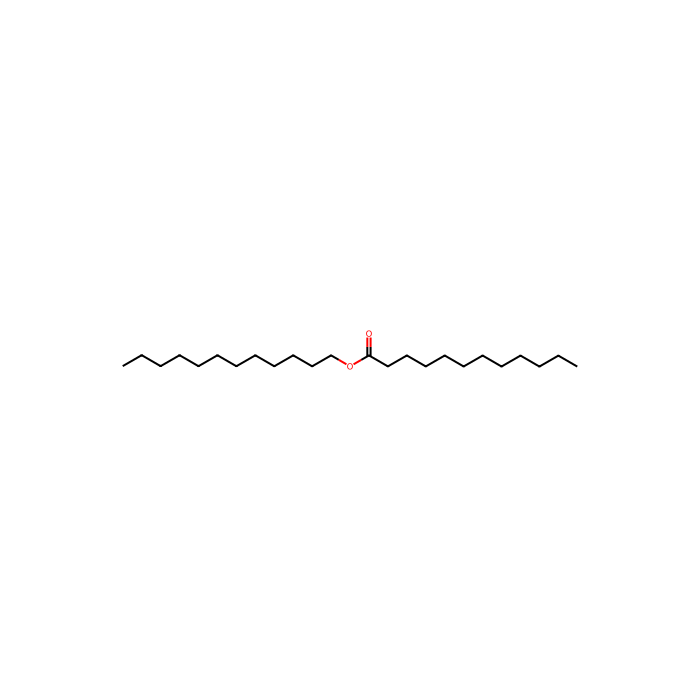
Lauric acid lauryl ester is the symmetrical long-chain fatty ester dodecyl dodecanoate (lauryl laurate), formed from lauric acid (dodecanoic acid) and lauryl alcohol (dodecanol). It is a highly hydrophobic, neutral ester with no stereocenters and two linear C12 chains flanking an ester linkage.
Item-specific identifiers from Product Data:
CAS: 13945-76-1
InChIKey: Not specified for this item; refer to CoA/Spec Sheet. (catalog lists: 57181)
SMILES: Not specified for this item; refer to CoA/Spec Sheet.
Structural features (general chemistry description):
Functional group: one aliphatic carboxylic ester (R–C(=O)–O–R′)
Hydrocarbon content: two saturated C12 n-alkyl chains (highly lipophilic)
2D description: a central ester carbonyl connected to a linear dodecyl chain (acyl side) and an alkoxy dodecyl chain (alkyl side); no rings or heteroatoms beyond the ester oxygens.
Stereochemistry: none (achiral).
Synthetic Utility
From a synthetic perspective, lauryl laurate functions primarily as:
Stable model ester: Useful in method development for ester hydrolysis, transesterification, and interesterification—especially in nonaqueous or biphasic systems.
Hydrophobic reaction medium: Acts as an inert-like, nonvolatile carrier for lipophilic substrates/catalysts at elevated temperatures where solvent loss is undesirable. Saturation confers oxidative robustness compared with unsaturated lipids.
Precursor via exchange: Under acid or base catalysis, it can be converted to other laurate esters (R–OH + lauryl laurate ⇌ R–O–C(O)–C11H23 + lauryl alcohol), providing a convenient lauroyl source without handling lauroyl chloride.
Enzymatic selectivity probe: Long-chain symmetrical ester helps profile lipase preferences (chain length effects, solvent effects, water activity) with simple analytics (GC/FID for alcohol/acid release).
Constraints and tips:
Reactivity is that of a regular saturated aliphatic ester: resistant to nucleophiles without catalysis; undergoes saponification (NaOH, KOH), acid-catalyzed hydrolysis, and transesterification (alkoxides, acids, enzymes).
For acyl-transfer chemistry where leaving group ability matters, alcoholates derived from long-chain alcohols are relatively poor; drive equilibrium by excess reagent, removal of coproduct (e.g., distill lauryl alcohol under vacuum), or use molecular sieves.
Avoid strong oxidants; if heating for extended periods, use inert gas blanketing to minimize any oxidative discoloration.
Target Specificity
Not applicable. This product is a small-molecule fatty ester, not an antibody, probe, or affinity reagent. No antigen/epitope, species reactivity, clone, or isotype information applies.
We use cookies to ensure the website functions properly and, where permitted, to improve your experience. You can manage your preferences at any time in Settings. Learn more in our Cookie Policy.
Shall we send you a message when we have discounts available?
Remind me later
Thank you! Please check your email inbox to confirm.
Products are supplied to verified businesses, institutions, and qualified professionals for research and development use only. Not for use in humans, animals, diagnosis, or therapy.

 G2214023