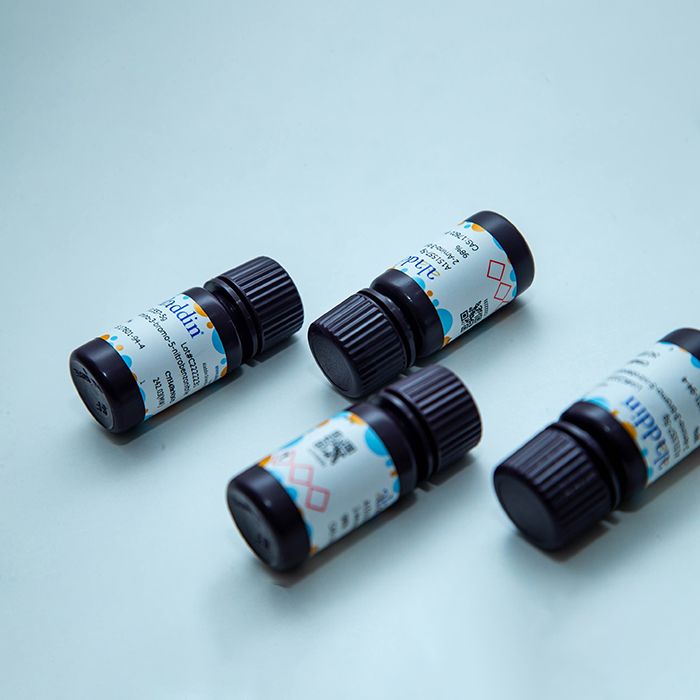
LCMV GP (61-80) is a peptide fragment derived from lymphocytic choriomeningitis virus (LCMV) glycoprotein (GP), and corresponds to amino acids 61-80. LCMV GP (61-80) is a specific epitope which can induce CD4 + T-cell response .
Form:Solid
Especificaciones
Especificaciones y pureza
≥98%
Mecanismos bioquímicos y fisiológicos
LCMV GP (61-80) is a peptide fragment derived from lymphocytic choriomeningitis virus (LCMV) glycoprotein (GP), and corresponds to amino acids 61-80. LCMV GP (61-80) is a specific epitope which can induce CD4 + T-cell response.
Condiciones de almacenamiento de almacenamiento
Protected from light,Argon charged,Desiccated,Store at -80°C
Enviado en
Dry ice packs + Cold packs
Este producto requiere envío en cadena de frío. Los servicios terrestres y otros servicios económicos no están disponibles.
Pureza
≥98%
Nombres e identificadores
Peso molecular
2290.60
Datos avanzados
Certificados (CoA, COO, BSE/TSE y tabla de análisis)
C of A & Other Certificates(BSE/TSE, COO):
Analytical Chart:
Propiedades químicas y físicas
Solubilidad
H2O Peptide Solubility and Storage Guidelines: 1. Calculate the length of the peptide. 2. Calculate the overall charge of the entire peptide according to the following table: Contents Assign value Acidic amino acid Asp (D), Glu (E), a
Calculadoras de soluciones
Molarity Calculator
Determine the necessary mass, volume, or concentration for preparing a solution.
Dilution Calculator
Determine the dilution needed to prepare a stock solution.
Reconstitution Calculator
Reseñas
Reseñas de cliente
Application Protocols
Only application details provided in Product Data may be reported here.
Item-specific (Product Data)
Tested applications, recommended concentrations/dilutions, positive controls: Not specified for this item; refer to CoA/Spec Sheet.
Please consult the CoA/Spec Sheet and SDS for any validated protocols associated with this lot. General protocol suggestions are intentionally omitted from this section to comply with item-specific reporting.
Biological Roles
Item-specific (Product Data)
No biological role statements are specified for this item.
Literature/general context (not item-specific)
Origin: Lymphocytic choriomeningitis virus (LCMV) encodes a surface glycoprotein (GP) that mediates viral entry via receptor binding and membrane fusion.
Epitope relevance: The GP 61–80 region has been widely studied as a helper T-cell (CD4+) epitope in murine systems, facilitating investigations of antigen processing/presentation and memory T-cell dynamics in basic immunology research.
Mechanistic insights: Defined peptides allow dissection of MHC class II binding preferences, TCR repertoire selection, and cytokine polarization under controlled conditions.
Research scope only: Any biological activity ascribed to this peptide pertains to in vitro/in vivo laboratory models and is not indicative of clinical or therapeutic use.
Buffer Applications
This item is a peptide, not a buffering agent. It does not form classical buffer systems with defined pKa/pH ranges. For experimental use, dissolve in an appropriate assay buffer (e.g., PBS, HBSS, cell culture media) chosen for biological compatibility rather than buffering capacity contributed by the peptide itself.
Item-specific buffer data: Not specified for this item; refer to CoA/Spec Sheet.
See also: Solvent Selection and Storage & Reconstitution for dissolution and handling guidance.
Green Alternatives
Peptides are not solvents or commodity reagents where greener substitutes are typically evaluated; thus, "green alternative" selection is not directly applicable to this item. Nevertheless, greener handling strategies can be applied:
General guidance (not item-specific)
Solvent minimization: Prefer aqueous buffers for final formulations; limit DMSO/DMF volumes and capture for proper waste disposal.
Energy efficiency: Thaw on ice and work rapidly to reduce time at ambient conditions; avoid unnecessary lyophilizations by preparing appropriately sized aliquots.
Packaging/waste: Use amber vials and inert-atmosphere storage to extend shelf life and reduce waste from degraded material.
Process choices: If disaggregation is needed, choose lower-toxicity aids first (e.g., ethanol/water mixtures) before resorting to HFIP/TFA, compatibility permitting.
Pharmaceutical Uses
No pharmacopeial status or excipient role is specified for this item. This product is supplied strictly for research use only, not for human or veterinary use.
General context (not item-specific)
Synthetic peptides can serve as analytical reference materials, process controls, or components in research-scale formulation studies (e.g., stability, adsorption, impurity profiling).
Any GMP applicability, residual solvent limits, or compendial testing requirements would need explicit specification and are not provided for this item.
Item-specific statement
Pharmaceutical/clinical applications: Not specified for this item; refer to CoA/Spec Sheet.
Physical Properties
Item-specific (Product Data)
Appearance: Not specified for this item; refer to CoA/Spec Sheet.
Molecular Weight: Not specified for this item; refer to CoA/Spec Sheet.
Other specifications (mp, solubility, optical rotation, water content): Not specified for this item; refer to CoA/Spec Sheet.
Literature/general (not item-specific; peptides of length ~20)
Physical state: Typically white to off-white lyophilized solid or film when supplied dry.
Solubility behavior: Sequence-dependent. Hydrophilic/basic peptides often dissolve in water or aqueous buffers (pH 6–8). Hydrophobic/acidic peptides may require organic cosolvents (e.g., DMSO, DMF) or pH adjustment (brief exposure to dilute NH4OH for acidic, dilute acetic acid for basic) followed by dilution into buffer.
pI/pKa: Determined by residue composition; values vary with Lys/Arg/His/Asp/Glu content (not specified for this item).
Optical properties: Peptides lack a sharp UV cutoff; aromatic residues (Trp/Tyr/Phe) contribute to absorption near 257–280 nm (literature generality).
Stability: Solid-state peptides are generally stable at −20 to −80 °C under dry, inert, light-protected conditions; aqueous solutions are less stable and benefit from aliquoting and freezing (literature practice).
Practical guidance (general)
Start with a small-volume pre-dissolution in sterile water, buffer, or minimal DMSO, then bring to final volume.
Avoid vigorous vortexing if gelation/aggregation occurs; gentle warming (≤37 °C) and sonication can help, if compatible with the peptide.
Quality and Grades
Item-specific (Product Data)
Grade/Purity: Not specified for this item; refer to CoA/Spec Sheet.
Interpretation and guidance (general; not item-specific)
Common peptide grades:
Crude: Minimal purification; appropriate for screening where sequence confirmation is primary.
Desalted: Salts removed; still contains closely related impurities.
70–80%: Suitable for some biochemical screening where minor impurities are tolerable.
90% / >95% / >98% (HPLC grade): Increasing stringency for binding assays, immunology, biophysics, and quantitation.
Typical QC data: Analytical RP-HPLC chromatogram (multi-wavelength), ESI/ MALDI-MS for MW confirmation, sometimes HRMS and amino acid analysis. Endotoxin/bioburden are not standard unless specified.
Modifications: Terminal capping (Ac-/NH2-) can improve stability/solubility; presence/absence of such modifications, counterions (e.g., TFA vs acetate), and salt form materially impact performance—verify on the CoA for this item.
Recommendation: Match grade to application sensitivity (e.g., T-cell assays typically require ≥95% purity). Since the grade is not provided here, consult the CoA/Spec Sheet to select appropriate use conditions.
Reaction and Applications
Item-specific (Product Data)
Manufacturer Applications: Not specified for this item.
Literature/general applications of LCMV GP (61–80) peptide (not item-specific)
Immunology: Commonly used as a CD4+ T-cell epitope from LCMV GP in mouse models to study antigen presentation (MHC class II) and T-cell receptor specificity, as well as to benchmark vaccine or adjuvant responses in basic research.
Assays: Employed in ELISPOT, intracellular cytokine staining (ICS), peptide–MHC binding assays, and T-cell proliferation assays as a defined antigenic stimulus (research use only).
Controls/standards: Serves as a positive control peptide in adoptive transfer or ex vivo restimulation protocols; used to calibrate assay sensitivity and functional avidity measurements.
Biophysics: Utilized in binding/thermodynamic studies with MHC-II or antibodies via ITC, SPR, or fluorescence anisotropy; sequence-dependent labeling strategies enable mechanistic studies.
Practical notes (general)
Use freshly prepared aliquots; avoid repeated freeze–thaw of peptide stocks.
Filter sterilize (0.22 µm) after dissolution when used in cell-based assays, conditions permitting.
When comparing responses across experiments, use the same counterion and lot-matched material to minimize variability.
Reaction Conditions
Conventional organic reaction conditions are generally not applicable to a finished peptide reagent. If chemical modification is intended, adopt bioconjugation conditions that preserve peptide integrity.
General conditions for common peptide modifications (not item-specific)
NHS-ester labeling (amines): pH 7.5–8.5 in phosphate/borate buffer, 0–25 °C, 0.5–2 h; avoid primary amine buffers (e.g., Tris) during coupling.
Maleimide–thiol coupling (Cys): pH 6.5–7.2, degassed buffer, 0–25 °C, 0.5–2 h; include EDTA to chelate metals that catalyze oxidation; exclude competing thiols.
Click chemistry (CuAAC): Azide/alkyne-functionalized peptides in tert-butanol/water or DMSO/water with Cu(I) catalyst and ligand; protect sensitive residues; remove copper post-reaction.
Stability considerations
Avoid prolonged exposure to strong acids/bases or elevated temperatures; many side chains (Trp, Met, Cys) are oxidation/acid-labile.
Item-specific reaction conditions: Not specified for this item; refer to CoA/Spec Sheet.
Safety and Handling
Item-specific (Product Data)
GHS Classification: Not specified for this item; refer to SDS.
Signal Word: Not specified for this item; refer to SDS.
H-Statements: Not specified for this item; refer to SDS.
Pictograms: Not specified for this item; refer to SDS.
General laboratory safety for peptides (not item-specific)
Expected hazards: Synthetic research peptides are typically of low volatility and present low acute hazard via inhalation; avoid generating dust/aerosols. Sensitization is possible upon repeated exposure.
PPE: Lab coat, safety glasses, and appropriate gloves (e.g., nitrile). Use a certified chemical fume hood when weighing, dissolving, or aliquoting powders.
Handling: Minimize exposure to moisture and light; keep containers closed under inert atmosphere as provided. Avoid repeated freeze–thaw cycles.
Incompatibilities: Strong oxidizers may degrade sensitive residues (e.g., Met, Cys, Trp). Avoid high pH at elevated temperature to limit backbone hydrolysis and racemization.
First aid (overview): If inhaled, move to fresh air; if on skin/eyes, rinse with water for ≥15 min; if ingested, rinse mouth. Seek medical attention as per institutional SOPs. Always defer to the SDS for authoritative guidance.
Waste: Dispose according to institutional and local regulations for organic laboratory chemicals/biologicals.
Solvent Selection
Item-specific (Product Data)
No solvent recommendations are specified for this item; refer to CoA/Spec Sheet.
General guidance for peptides (not item-specific)
Primary choices: Water, PBS, or suitable assay buffer when the peptide is polar; DMSO or DMF for hydrophobic sequences, followed by dilution into aqueous media.
pH strategies: Briefly adjust pH to favor ionization—acidify (0.1% acetic acid) for basic peptides or basify (≤0.1 N NH4OH) for acidic peptides—then neutralize upon dilution.
Cosolvent ceilings: Keep organic cosolvents (e.g., DMSO) ≤1–2% v/v in biological assays to avoid interference.
Additives: 0.01–0.1% TFA or HCl can suppress aggregation during stock preparation; non-ionic detergents (e.g., 0.01% Tween-20) can help with highly hydrophobic peptides if compatible with downstream assays.
Comparison (general)
Water/PBS: Best biocompatibility; limited for hydrophobic sequences.
DMSO: Strong solvency; potential assay interference at higher %.
DMF: Good solvency; less biocompatible; use for stock then dilute.
HFIP: Effective for disaggregating β-structured peptides prior to final dissolution; evaporate thoroughly before biological use.
Storage and Reconstitution
Item-specific (Product Data)
Storage conditions: Protected from light, Argon charged, Desiccated, Store at −80 °C.
Shipped in: Dry ice packs + Cold packs.
Research use note: For research use only.
General reconstitution guidance for peptides (not item-specific)
Allow vial to equilibrate to room temperature in a desiccator before opening to prevent moisture condensation.
Reconstitute using sterile, oxygen-reduced solvent when possible (degassed water/buffer). Start with minimal volume (e.g., 1–5 mg/mL) to create a concentrated stock.
If insoluble, trial sequence-compatible solvents: water or buffer first; if needed, small volumes of DMSO/DMF, then dilute with buffer. Gentle warming (≤37 °C) and brief sonication can assist.
Aliquot immediately into single-use portions; store aliquots at −80 °C, protected from light, preferably under inert gas. Avoid repeated freeze–thaw cycles.
For long-term storage, keep as a dry solid under inert atmosphere at −80 °C. Monitor integrity by analytical HPLC/MS at defined intervals for critical applications.
Item-specific notes on concentration, pH, and excipients: Not specified for this item; refer to CoA/Spec Sheet.
Structure and Identity
Brief description: LCMV GP (61-80) denotes a synthetic peptide fragment corresponding to residues 61–80 of the Lymphocytic choriomeningitis virus (LCMV) glycoprotein (GP).
Item-specific (Product Data)
CAS: 232598-19-5
Molecular Formula: Not specified for this item; refer to CoA/Spec Sheet.
Molecular Weight: Not specified for this item; refer to CoA/Spec Sheet.
InChIKey: Not specified for this item; refer to CoA/Spec Sheet.
SMILES: Not specified for this item; refer to CoA/Spec Sheet.
Compound type: Synthetic peptide (20-mer) derived from a viral class I/II glycoprotein ectodomain region.
Structural features: Linear polypeptide chain composed of 20 L-α-amino acids with backbone amide bonds, side-chain functional diversity (acidic, basic, polar, hydrophobic residues) depending on exact sequence (sequence not provided for this item).
2D structural depiction (verbal): A repeating –NH–CHR–CO– backbone with side chains (R) varying per residue; N-terminus (free amine or protected/capped) and C-terminus (free acid or amide-capped) determine net charge; termini status not specified for this item.
Notes
Exact sequence, terminal modifications, disulfides, unusual residues, or post-translational modifications are not specified for this item; consult the CoA/Spec Sheet.
Synthetic Utility
As a defined peptide, this item is not primarily a synthetic building block for organic synthesis workflows. However, it can participate in conjugation and derivatization relevant to biochemical method development.
General utilities (not item-specific)
Bioconjugation: N-terminus, C-terminus, and side chains (e.g., Lys ε-amine, Cys thiol if present) can be leveraged for labeling with fluorophores, biotin, or haptens via NHS-ester, maleimide, click chemistry (azide/alkyne), or enzymatic ligation.
Carrier coupling: Conjugation to KLH, BSA, or other carriers using heterobifunctional linkers (e.g., SMCC) to generate immunogens or assay capture reagents (sequence/functional group dependent; sequence not specified for this item).
Surface immobilization: Attachment to SPR/ELISA surfaces through amine coupling (EDC/NHS) for affinity measurements.
Retrosynthetic perspective
The peptide can serve as a standards/calibrant for LC–MS method development, digestion mapping, or as a comparator for epitope mapping experiments.
Target Specificity
Only target specificity provided in Product Data may be reported here.
Item-specific (Product Data)
Target/epitope, species reactivity, clone/isotype: Not specified for this item; refer to CoA/Spec Sheet.
Note: While the peptide name implies correspondence to LCMV glycoprotein residues 61–80, no validated target-binding, MHC restriction, or assay-verified specificity is provided in the Product Data for this specific SKU.
Preguntas frecuentes
What is the purity of this product?
This product is supplied at ≥98% purity (chemical assay). Lot-specific values are stated on the Certificate of Analysis.
How should this product be stored?
Store at ?80 °C, protected from light, desiccated, under argon. It is supplied under an argon blanket; reseal under inert gas after each use.
How is this product shipped?
This product ships frozen with dry ice and cold packs. Unpack on arrival and transfer it to the storage condition stated above; handle dry ice with insulated gloves in a ventilated area.
What are the CAS number, molecular formula and molecular weight?
The CAS Number is 232598-19-5, the molecular formula is C108H160N24O31, and the molecular weight is 2290.60 g/mol.
What documentation is provided?
Available product documentation, including Certificates of Analysis (COA), Safety Data Sheets (SDS), and specification sheets, is shown in the product document area. Document availability and access follow the current site policy.
Utilizamos cookies para garantizar el correcto funcionamiento del sitio web y, cuando esté permitido, para mejorar su experiencia. Puede gestionar sus preferencias en cualquier momento en Configuración. Más información en nuestra Política de Cookies.
¿Quieres que te enviemos un mensaje cuando tengamos descuentos disponibles?
Recordármelo más tarde
¡Gracias! Por favor, revisa tu bandeja de entrada de correo electrónico para confirmar.
Products are supplied to verified businesses, institutions, and qualified professionals for research and development use only. Not for use in humans, animals, diagnosis, or therapy.