Post-transition metal sulfate - Inorganic lead salt - Inorganic post-transition metal salt - Inorganic oxide - Inorganic salt
Descripción
This compound belongs to the class of inorganic compounds known as post-transition metal sulfates. These are inorganic compounds in which the largest oxoanion is sulfate, and in which the heaviest atom not in an oxoanion is a post-transition metal.
External Descriptors
Not available
1. Djoumbou Feunang Y, Eisner R, Knox C, Chepelev L, Hastings J, Owen G, Fahy E, Steinbeck C, Subramanian S, Bolton E, Greiner R, and Wishart DS. ClassyFire: Automated Chemical Classification With A Comprehensive, Computable Taxonomy. Journal of Cheminformatics, 2016, 8:61.
Partially soluble in water, dilute HCl and HNO{3}. Soluble in sodium hydroxide, ammonium acetate or tartrate, concentrated hydriodic acid. Insoluble in alcohol
Determine the necessary mass, volume, or concentration for preparing a solution.
Dilution Calculator
Determine the dilution needed to prepare a stock solution.
Reconstitution Calculator
Reseñas
Reseñas de cliente
Application Protocols
No item-specific, tested application protocols are provided for this inorganic salt.
General laboratory examples (literature; adapt to your SOPs)
Preparation of saturated PbSO4 for Ksp: Add excess PbSO4 to CO2-free water, stir at 25 °C for 48 h, allow settling, then sample supernatant through a 0.02 µm filter for Pb2+/SO4 2− analysis.
Conversion to Pb(NO3)2: To a stirred slurry of PbSO4, add hot concentrated HNO3 until dissolution is complete; cool, filter if needed, and standardize concentration by gravimetry/ICP. Neutralize residual acidity as required for downstream use.
Crystal growth: Dissolve Pb2+ and SO4 2− precursors in hot acid; allow slow cooling/evaporation to crystallize PbSO4 in presence/absence of habit modifiers. Handle all solutions in a hood and collect all waste as hazardous heavy-metal waste.
Note: These are general research-use examples. Validate at small scale and follow institutional safety policies.
Biological Roles
Lead sulfate has no known beneficial biological role.
Literature/General information
Toxicology: Lead is a non-essential, cumulative toxic metal. In biological systems, Pb2+ can substitute for Ca2+ and Zn2+ in proteins and signaling pathways, disrupting enzymatic activity and neurotransmission. Sulfate acts mainly as a counterion; the toxicological profile is dominated by Pb2+.
Bioavailability: The low solubility of PbSO4 limits dissolution in neutral aqueous media, but acidic environments (e.g., stomach, lysosomes) can increase Pb2+ release. Particle size and complexing ligands modulate absorption.
Environmental fate: PbSO4 is a common weathering product of lead-containing materials and can persist in soils/sediments; transformations to anglesite/cerussite and other lead minerals occur depending on pH and anions.
Notes for researchers
Use appropriate biosafety procedures when handling lead salts around biological materials. Prevent contamination of cell culture or animal facilities. This product is for research use only and not for use in diagnostic or therapeutic applications.
Buffer Applications
Not typically applicable. Lead sulfate is not a buffering agent and does not participate in defined acid–base buffer systems.
Literature/General note
If Pb2+ is required in a buffered medium (e.g., controlled free-ion activity studies), complexation with acetate, citrate, or EDTA in a suitable buffer may be employed. Carefully calculate speciation and maintain pH to avoid precipitation of Pb(OH)2, PbCO3, or PbSO4 depending on counterions present.
Green Alternatives
Context
Lead compounds are intrinsically hazardous (toxic and environmentally persistent). Where possible, consider less hazardous surrogates that fulfill the same experimental role.
Potential alternatives (literature/general)
For sulfate precipitation studies: Barium sulfate (BaSO4) or strontium sulfate (SrSO4) provide similar sparingly soluble sulfate equilibria without lead toxicity; note that Ba2+ is also toxic but generally less regulated than Pb2+.
For Pb2+ source in materials chemistry: Explore tin(II) or bismuth(III) systems when the chemistry allows, recognizing changes in valence and structure.
For electrochemistry teaching: Zinc or iron sulfate systems can demonstrate charge–discharge and precipitation phenomena with reduced hazard.
Solubility of sulfate salts at 25 °C: PbSO4 (Ksp ~1.6×10^−8), BaSO4 (Ksp ~1.1×10^−10), SrSO4 (Ksp ~3.2×10^−7), ZnSO4 (highly soluble; not a precipitation analog).
Trade-offs
Substituting Pb may alter redox potentials, crystal structure, and function; not all lead-dependent phenomena have true green substitutes. If PbSO4 is essential, mitigate risk via microscale experiments, closed systems, rigorous waste handling, and exposure controls.
Pharmaceutical Uses
Not applicable. Lead sulfate is not used as a pharmaceutical excipient or processing aid due to toxicity and regulatory restrictions on lead-containing substances.
General context
Pharmaceutical manufacturing strictly limits lead content as an impurity (per pharmacopeial heavy-metal and elemental impurity guidelines). Lead salts are excluded from formulation use. For any process-related research where metal sulfates are needed, consider benign alternatives (e.g., MgSO4, Na2SO4) unless the study specifically concerns lead toxicology under controlled conditions.
Physical Properties
Item-specific facts (from Product Data)
Appearance: Not specified for this item; refer to CoA/Spec Sheet.
Literature/General values (for reference; not item specifications)
Typical appearance (literature): white, crystalline or powdery solid.
Melting/decomposition: decomposes on strong heating; converts to PbO with SO3/SO2 loss.
Density (literature): ~6.2 g/cm3 at 20–25 °C.
Solubility (literature): Very low solubility in water (Ksp ~1.6×10^−8 to 1.7×10^−8 at 25 °C). Insoluble in ethanol/organic solvents. Solubility increases in concentrated acids (e.g., hot HNO3, HCl) due to complexation and/or formation of other lead salts; soluble in concentrated alkali with complexing agents (e.g., acetate/citrate) to limited extents.
Partitioning: Not applicable (ionic solid, not meaningfully described by logP).
Refractive index: Not typically reported for powders; consult crystallographic data if required.
Practical implications
The exceedingly low water solubility makes PbSO4 useful as a sparingly soluble Pb2+ source and for Ksp demonstrations. To prepare clear Pb2+ solutions, dissolve in hot concentrated acids (controlled conditions) or perform metathesis to more soluble lead(II) salts.
Quality and Grades
Item-specific facts (from Product Data)
Grade/Purity: Not specified for this item; refer to CoA/Spec Sheet.
Guidance on grades (general)
Inorganic salt grades often include: technical, laboratory, analytical (AR), and higher-purity trace-metal grades. For AR/trace-metal grades, limits on alkali/alkaline earths, transition metals, and anions are typically controlled and verified by ICP-OES/ICP-MS/ion chromatography.
For lead sulfate specifically, key impurities may include other lead phases (PbO, PbCO3), residual sulfate precursors, chloride/nitrate (from synthesis), and trace metals (Cu, Fe, Zn). If your application is sensitive (e.g., reference material preparation, electrochemical benchmarking), consult the CoA for impurity profiles and moisture content.
UV/LC considerations: PbSO4 is not used as a chromatographic solvent or UV reference. Low-UV or HPLC-grade designations are not applicable.
Stabilizers: PbSO4 generally requires no stabilizer; it is air-stable. If anti-caking agents or drying histories matter to your workflow, verify on the CoA.
Recommendation
Align grade selection with application criticality: electrochemistry and analytical method development may require AR/trace-metal–controlled lots; routine precipitation/teaching labs often tolerate laboratory grade. Always verify lot-specific data on the CoA.
Reaction and Applications
Item-specific facts (from Product Data)
Manufacturer applications: Not specified in the catalog entry beyond research use.
Literature/General applications (for reference)
Electrochemical systems: PbSO4 is the discharge product and an active-phase component in lead–acid battery research. In laboratory studies, it serves in phase-equilibrium, morphology, and conversion-kinetics experiments under controlled conditions.
Precursor chemistry: Functions as a stable Pb2+ source for preparing other lead(II) salts (e.g., metathesis to Pb(NO3)2, Pb(CH3COO)2) or lead oxides/sulfides upon thermal treatment or anion exchange.
Analytical/teaching: Classical demonstration of solubility product, common-ion effects, and sulfate precipitation equilibria.
Materials synthesis: Acts as a lead source in hydrothermal/solvothermal routes to lead-containing oxysalts or perovskite-related phases where slow release of Pb2+ is advantageous.
Practical tips
For metathesis, use a slight excess of the incoming anion in aqueous or acidic medium; remove byproducts (e.g., sulfate) by filtration or precipitation with Ba2+ if appropriate.
Control particle size by adjusting supersaturation, temperature, and seed loading; morphology impacts reaction rates in electrochemical studies.
Avoid sulfide contamination unless PbS formation is desired; even trace sulfide rapidly converts Pb2+ to PbS.
Dissolution to Pb2+ stock: Suspend PbSO4 and add hot concentrated HNO3 with stirring until solids dissolve; cool and dilute cautiously. Typical concentrations: 0.1–1.0 M Pb(NO3)2 stocks prepared from stoichiometric conversion. Always use a fume hood and secondary containment.
Metathesis to acetates/citrates: React with glacial acetic acid/aqueous acetate buffer at elevated temperature; removal of sulfate by Ba2+ precipitation can drive completion. Filter off BaSO4 and polish-filter before use.
Ksp studies: Prepare saturated suspensions in deionized CO2-free water at 25 °C, equilibrate for 24–72 h with agitation, then filter through 0.02–0.1 µm membranes to remove colloids before ICP/OES or ion chromatography.
Thermal conversion: Calcine under air/inert atmosphere (e.g., 400–700 °C) to form PbO; monitor off-gases (SO2/SO3) using appropriate scrubbing/controls. Do not combine with organics at elevated temperatures.
Data points (literature)
Ksp(PbSO4, 25 °C): ~1.6×10^−8 to 1.7×10^−8.
Acid effects: Solubility increases notably with [H+] and complexing anions (NO3−, Cl−) due to complex formation.
Always tailor conditions to scale, containment, and local regulations; consult primary literature and your risk assessment.
Safety and Handling
Item-specific facts (from Product Data)
Signal word: Not specified for this item; refer to SDS.
H-statements: Not specified for this item; refer to SDS.
GHS classification/pictograms: Not specified for this item; refer to SDS.
Storage conditions: Room temperature.
Shipped in: FedEx DG Service.
Literature/General safety guidance for lead sulfate (for reference; defer to SDS)
Hazard overview: Lead compounds are toxic; chronic exposure can affect hematopoietic, neurological, and renal systems. Environmental hazard to aquatic life. Avoid inhalation of dust and ingestion; minimize skin contact.
PPE: Use lab coat, chemical-resistant gloves (e.g., nitrile), splash goggles; handle powders in a fume hood or ventilated enclosure to control dust.
Incompatibilities: Strong bases can form plumbites; strong oxidizers in presence of organics may pose additional risk; avoid contact with sulfides (formation of PbS) if purity is critical. Avoid ammonium salts with strong bases in confined spaces (ammonia evolution) during dissolution protocols.
First aid (general): If inhaled—move to fresh air, seek medical attention. Skin/eye contact—rinse with water for ≥15 min, remove contaminated clothing, obtain medical advice. If swallowed—rinse mouth, do not induce vomiting, seek immediate medical attention.
Waste: Collect lead-containing waste in labeled heavy-metal waste streams per institutional and regulatory requirements. Prevent environmental release.
Special notes: Do not heat with organic materials. Use dedicated tools/areas to prevent cross-contamination with non-lead work.
Solvent Selection
Not a solvent; lead sulfate is an inorganic salt. Selection considerations focus on media for dispersion or dissolution.
Literature/General guidance
Water: Sparingly soluble; expect heterogeneous suspensions. Useful for Ksp studies but not for preparing concentrated Pb2+ solutions.
Mineral acids: Increased solubility in hot concentrated nitric or hydrochloric acid (formation of Pb(NO3)2 or PbCl2/complexes). Use controlled additions with cooling and in a fume hood.
Complexing media: Acetate, citrate, and EDTA can increase apparent solubility by complexation with Pb2+; useful for preparing buffered Pb2+ solutions at defined free-ion activities.
Non-aqueous solvents: Essentially insoluble in common organics; suspension only.
Comparison (literature)
PbSO4 vs Pb(NO3)2: Nitrate is readily water-soluble, convenient for aqueous Pb2+ stock solutions; sulfate offers low solubility, useful where solid/liquid equilibria are desired.
PbSO4 vs PbO: Oxide is basic and reacts with acids/bases differently; choose based on pH and counterion requirements.
Practical tip
To avoid co-precipitation artifacts, pre-condition suspensions and allow sufficient equilibration time when studying solubility or adsorption phenomena.
Storage and Reconstitution
Item-specific facts (from Product Data)
Storage conditions: Room temperature.
Shipped in: FedEx DG Service.
General storage guidance
Keep container tightly closed, dry, and clearly labeled in a dedicated area for toxic heavy-metal salts. Avoid generating or dispersing dust; store away from food-contact areas and biological workspaces.
Segregate from strong bases and sulfide sources if phase purity is important. Secondary containment is recommended.
Reconstitution/Preparation notes (literature; not item specifications)
Aqueous suspensions: Disperse into deionized, CO2-free water using gentle stirring; expect a heterogeneous suspension due to low solubility.
Solution preparation: For clear Pb2+ solutions, dissolve via hot concentrated mineral acid to form more soluble lead salts (e.g., nitrate), or use complexing ligands (acetate/citrate/EDTA) under controlled pH. Filter fine particulates through 0.2 µm PTFE membranes.
Stability: Solid is air-stable. In solution, speciation depends on pH and counterions; avoid prolonged storage of lead solutions—prepare fresh when possible and store in plastic or glass that is compatible and clearly labeled.
Always consult the lot-specific CoA and SDS for definitive handling and storage instructions. For research use only.
Structure and Identity
Item-specific facts (from Product Data)
Product name: Lead sulfate
SKU: L121691
CAS: 7446-14-2
CID: 24008
InChIKey: 178138 (as provided)
SMILES: Not specified for this item; refer to CoA/Spec Sheet.
Molecular formula: Not specified for this item; refer to CoA/Spec Sheet.
Molecular weight: Not specified for this item; refer to CoA/Spec Sheet.
Literature/General structure information
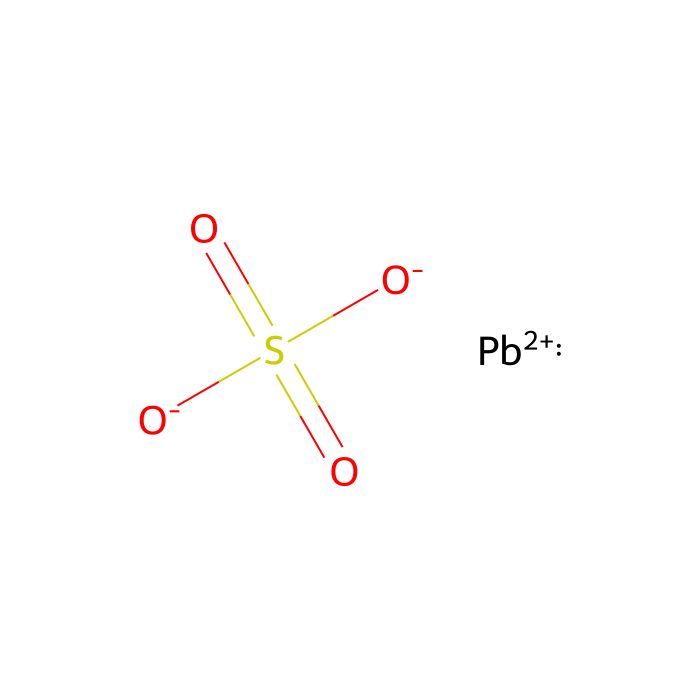
Common formula (literature): PbSO4, an inorganic salt composed of divalent lead cations (Pb2+) and sulfate anions (SO4 2−).
Structure description: The sulfate anion is a tetrahedral XO4 unit with S at the center and four equivalent S–O bonds; Pb2+ coordinates to oxygen atoms, giving an extended ionic lattice. No stereochemistry applies.
Representative identifiers (literature): InChIKey commonly reported for PbSO4 differs by database; consult primary databases for a canonical key if needed.
Notes
Lead sulfate forms a crystalline ionic solid; the extended lattice features Pb–O interactions around the sulfate tetrahedra. Because this is an inorganic salt, 2D line structures are less informative than the ionic formulation and lattice description.
Synthetic Utility
Literature/General synthetic roles of PbSO4 (for reference)
Controlled Pb2+ source: The sparing solubility provides a slow-release reservoir of Pb2+ in heterogeneous systems, aiding hydrothermal growth of lead-containing oxysalts or framework materials.
Metathesis platform: Converts to other lead(II) salts upon treatment with corresponding acids/ligands (e.g., HNO3 → Pb(NO3)2; HOAc → Pb(OAc)2 with appropriate conditions). Sulfate can be removed as insoluble BaSO4 using Ba2+ to drive equilibria.
Thermal transformations: Heating yields PbO while evolving SOx; subsequent reactions furnish mixed oxides or lead-based ceramics under solid-state conditions.
Precipitation control: Seeding and controlled supersaturation growth of PbSO4 crystals supports studies in crystallization kinetics and morphology modifiers (e.g., citrate, tartrate).
Practical considerations
Manage carbonate in water/air; PbCO3 may form on prolonged standing in alkaline, carbonate-bearing media.
For clean metathesis, filter thoroughly to remove entrained sulfate solids and wash with minimal volumes to limit loss of soluble lead salts.
Target Specificity
Not applicable. This product is an inorganic salt and not a biological targeting reagent. No antigen, epitope, or species specificity applies.
Preguntas frecuentes
What does the trace-metals specification mean?
This product is specified at ≥99.99% on a trace-metals basis. That figure describes metallic impurity content rather than overall chemical assay, so it is the relevant specification for ICP-MS, semiconductor and battery applications. Lot-specific values are stated on the Certificate of Analysis.
How should this product be stored?
Store at room temperature.
How is this product shipped?
This product is classified as dangerous goods and ships via FedEx DG Service. Ground and other economy services are not available, and delivery to some destinations or address types may be restricted.
What are the CAS number, molecular formula and molecular weight?
The CAS Number is 7446-14-2, the molecular formula is O4PbS, and the molecular weight is 303.26 g/mol. InChIKey KEQXNNJHMWSZHK-UHFFFAOYSA-L.
What documentation is provided?
Available product documentation, including Certificates of Analysis (COA), Safety Data Sheets (SDS), and specification sheets, is shown in the product document area. Document availability and access follow the current site policy.
Utilizamos cookies para garantizar el correcto funcionamiento del sitio web y, cuando esté permitido, para mejorar su experiencia. Puede gestionar sus preferencias en cualquier momento en Configuración. Más información en nuestra Política de Cookies.
¿Quieres que te enviemos un mensaje cuando tengamos descuentos disponibles?
Recordármelo más tarde
¡Gracias! Por favor, revisa tu bandeja de entrada de correo electrónico para confirmar.
Products are supplied to verified businesses, institutions, and qualified professionals for research and development use only. Not for use in humans, animals, diagnosis, or therapy.

 L2504154