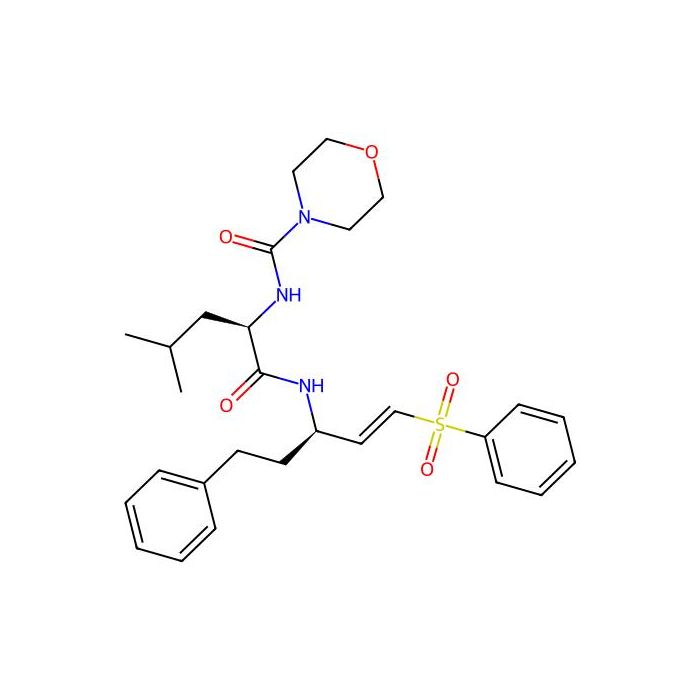
LHVS - ≥99% , CAS No.170111-28-1

CAS: 170111-28-1 Cat. No.: L647702 Fórmula: C28H37N3O5S Peso molecular: 527.68 PubChem CID: 23648296
Disponible para pedir
CALIDAD & PUREZA ≥99%
Storage
Store at -20°C
Shipped In
Ice chest + Ice pads
★
Talla
Alemania (EU)
USA*
Precio
Cantidad
5mg
L647702-5mg
Fabricado bajo pedido · 8–12 semanas
504,07€
10mg
L647702-10mg
Fabricado bajo pedido · 8–12 semanas
799,10€
Enter a quantity for the sizes you want to add.

Descripción general

LHVS is a potent, non-selective, irreversible, cell-permeable cysteine protease and cathepsin inhibitor. LHVS decreases actin ring formation. LHVS inhibits T. gondii invasion with an IC 50 of 10 μM

In Vitro

LHVS (5 μM, 2 h) results in a 50% reduction of actin ring formation in wild-type osteoclasts when compared with untreated osteoclasts. LHVS acts in a dose-dependent manner on osteoclasts and at 5 μM, LHVS inhibits cathepsins K, L, S, and B. LHVS (1-5 nM) can inhibit specifically cathepsin S in HOM2 cells, leaving other cysteine proteases functionally active. LHVS impairs tachyzoite attachment by blocking the release of at least two key invasion proteins, MIC2 and M2AP, from the micronemes. LHVS (50 μM) selectively impairs microneme protein secretion. MCE has not independently confirmed the accuracy of these methods. They are for reference only.

In Vivo

LHVS (3-30 mg/kg, SC, once) shows anti-hyperalgesic effect in neuropathic rats. LHVS (30 nmol per rat, spinal delivery, daily) is antinociceptive in neuropathic rats. LHVS (1-50 nmol per rat, Intrathecal injection, daily) reverses established neuropathic mechanical hyperalgesia in 14-day neuropathic rats. MCE has not independently confirmed the accuracy of these methods. They are for reference only. Animal Model: Male Wistar rats (180-220 g)Dosage: 3-30 mg/kg Administration: SC, once Result: Produced a dose-dependent reversal of the mechanical hyperalgesia which lasted up to 3 h in neuropathic rats. In contrast, a single systemic administration of LHVS did not reverse mechanical allodynia in neuropathic rats. Animal Model: Male Wistar rats received a partial ligation of the left sciatic nerve (PNL)Dosage: 30 nmol per rat Administration: Spinal delivery, Daily Result: Failed to prevent the development of allodynia when continuous delivery from day 0 to day 7 post-PNL, but significantly reversed allodynia on day 7 post-PNL. In addition, the delivery of LHVS from day 7 to day 14 post-PNL significantly reversed established mechanical allodynia from day 8. Animal Model: Male Wistar rats received a partial ligation of the left sciatic nerve (PNL)Dosage: 1, 10 or 50 nmol per rat Administration: Intrathecal injection, Daily Result: Reduced established mechanical hyperalgesia. This effect was dose-dependent and remained significant until 3 h after administration of the highest dose.

Form:Solid

IC50& Target:cathepsin S cathepsin K cathepsin L Cathepsin B

Especificaciones

Especificaciones y pureza
≥99%
Mecanismos bioquímicos y fisiológicos
LHVS is a potent, non-selective, irreversible, cell-permeable cysteine protease and cathepsin inhibitor. LHVS decreases actin ring formation. LHVS inhibits T. gondii invasion with an IC 50 of 10 μM.
Condiciones de almacenamiento de almacenamiento
Store at -20°C
Enviado en
Ice chest + Ice pads
Este producto requiere envío en cadena de frío. Los servicios terrestres y otros servicios económicos no están disponibles.
Tipo de acción
INHIBITOR
Pureza
≥99%
Nombres e identificadores
SMILES
CC(C)CC(C(=O)NC(CCC1=CC=CC=C1)C=CS(=O)(=O)C2=CC=CC=C2)NC(=O)N3CCOCC3
IUPAC Name
N-[(2R)-1-[[(E,3R)-1-(benzenesulfonyl)-5-phenylpent-1-en-3-yl]amino]-4-methyl-1-oxopentan-2-yl]morpholine-4-carboxamide
InChIKey
YUMYYTORLYHUFW-ZUDLOMHPSA-N
InChI
1S/C28H37N3O5S/c1-22(2)21-26(30-28(33)31-16-18-36-19-17-31)27(32)29-24(14-13-23-9-5-3-6-10-23)15-20-37(34,35)25-11-7-4-8-12-25/h3-12,15,20,22,24,26H,13-14,16-19,21H2,1-2H3,(H,29,32)(H,30,33)/b20-15+/t24-,26-/m1/s1
Isómeros SMILES
CC(C)C[C@H](C(=O)N[C@H](CCC1=CC=CC=C1)/C=C/S(=O)(=O)C2=CC=CC=C2)NC(=O)N3CCOCC3
PubChem CID
23648296
Peso molecular
527.68

Datos avanzados

Estructura 3D
Modelo de Estructura Química Interactiva


Objetivos asociados (humanos)
CTSL Tclin Cathepsin L1 (3 Activities)
Activity TypeActivity Value -log(M)Mechanism of ActionActivity ReferencePublications (PubMed IDs)
CTSS Tchem Cathepsin S (3 Activities)
Activity TypeActivity Value -log(M)Mechanism of ActionActivity ReferencePublications (PubMed IDs)
CTSK Tchem Cathepsin K (2 Activities)
Activity TypeActivity Value -log(M)Mechanism of ActionActivity ReferencePublications (PubMed IDs)
CTSB Tchem Cathepsin B (1 Activities)
Activity TypeActivity Value -log(M)Mechanism of ActionActivity ReferencePublications (PubMed IDs)
CTSB Tchem Cathepsin B (3822 Activities)
Activity TypeRelationActivity valueUnitsAction TypeJournalPubMed IddoiAssay Aladdin ID
CTSG Tchem Cathepsin G (2304 Activities)
Activity TypeRelationActivity valueUnitsAction TypeJournalPubMed IddoiAssay Aladdin ID
CTSK Tchem Cathepsin K (3011 Activities)
Activity TypeRelationActivity valueUnitsAction TypeJournalPubMed IddoiAssay Aladdin ID
CTSS Tchem Cathepsin S (3285 Activities)
Activity TypeRelationActivity valueUnitsAction TypeJournalPubMed IddoiAssay Aladdin ID
CTSH Tchem Cathepsin H (179 Activities)
Activity TypeRelationActivity valueUnitsAction TypeJournalPubMed IddoiAssay Aladdin ID
CTSC Tchem Dipeptidyl peptidase I (1385 Activities)
Activity TypeRelationActivity valueUnitsAction TypeJournalPubMed IddoiAssay Aladdin ID
Objetivos asociados (no humanos)
CTSL Cathepsin L (58 Activities)
Activity TypeRelationActivity valueUnitsAction TypeJournalPubMed IddoiAssay Aladdin ID
Toxoplasma gondii (4585 Activities)
Activity TypeRelationActivity valueUnitsAction TypeJournalPubMed IddoiAssay Aladdin ID
Rattus norvegicus (775804 Activities)
Activity TypeRelationActivity valueUnitsAction TypeJournalPubMed IddoiAssay Aladdin ID
Ctsl Cathepsin L1 (28 Activities)
Activity TypeRelationActivity valueUnitsAction TypeJournalPubMed IddoiAssay Aladdin ID
Prtn3 Myeloblastin (11 Activities)
Activity TypeRelationActivity valueUnitsAction TypeJournalPubMed IddoiAssay Aladdin ID
Mecanismos de acción
Certificados (CoA, COO, BSE/TSE y tabla de análisis)
C of A & Other Certificates(BSE/TSE, COO):
Analytical Chart:
Propiedades químicas y físicas
SolubilidadDMSO : 100 mg/mL (189.51 mM; Need ultrasonic)
Preguntas frecuentes y artículos
Calculadoras de soluciones
Reseñas

Reseñas de cliente

Application Protocols

No vendor-validated application protocols are specified for this item. For research planning, consider the following general, literature-style procedure outlines (not product specifications):

  • Enzyme inhibition IC50/kinact–Ki determination:
    • Prepare a 10 mM DMSO stock; make a 10-point half-log dilution series (constant DMSO across wells).
    • Pre-incubate inhibitor with enzyme in appropriate buffer and reducing conditions for 30 min at 25–37°C.
    • Initiate with fluorogenic substrate; record progress curves; fit to time-dependent inhibition models.
  • Cell-based target engagement (ABPP competition):
    • Treat cells with LHVS or vehicle for 1–2 h.
    • Label lysates with a cysteine-protease-directed activity-based probe.
    • Analyze by SDS-PAGE/fluorescence or MS; reduced probe labeling indicates engagement.

Researchers should tailor parameters to their enzyme/cell system and consult primary literature. This information is provided solely as general guidance.

Biological Roles

Note: The following describes research biology context; this product is for laboratory use only and not for any clinical or diagnostic application.

  • Mechanistic role (literature): LHVS is widely used as an irreversible inhibitor of cysteine cathepsins, especially cathepsin S, by covalent modification of the catalytic cysteine. By acutely blocking proteolysis, it enables dissection of cathepsin-dependent pathways.
  • Pathways studied:
    • Antigen processing and presentation: cathepsins regulate peptide generation within endo/lysosomal compartments; LHVS treatment helps delineate cathepsin contributions.
    • Proteostasis and lysosomal turnover: used to probe lysosomal degradation of proteins and receptors.
    • Extracellular matrix remodeling: cathepsins participate in ECM turnover; LHVS can be used to study these dynamics in cell culture.
  • Selectivity considerations (literature): While LHVS is often described as cathepsin S–selective at certain concentrations and conditions, off-target inhibition of other cysteine cathepsins (e.g., B, L, K) can occur depending on dose, time, and species. Empirical profiling (enzymatic panels or ABPP) is recommended for each system.
  • Cellular uptake: The peptidomimetic and morpholine features tend to promote lysosomal accumulation via weak-base trapping; this can enrich inhibitor in acidic organelles, enhancing apparent potency against lysosomal proteases.

Practical note: Include vehicle-only controls and concentration–response designs to separate on-target biological effects from solvent or off-target impacts.

Buffer Applications

This product is not a buffering agent and is not used to control pH. However, buffer composition strongly influences its biochemical performance.

  • Practical guidance (literature):
    • Use neutral to mildly acidic buffers (e.g., citrate-phosphate, MES, or acetate) compatible with cathepsin activity assays.
    • Maintain consistent ionic strength, detergent (if any), and reducing agent levels (e.g., DTT or cysteine) across treatments; reducing agents activate cysteine proteases but may also influence inhibitor kinetics.
    • Keep final DMSO constant in all wells or tubes to avoid solvent-induced rate changes.

For standard buffer recipes, consult enzyme assay references specific to your target cathepsin.

Green Alternatives

As LHVS is a bioactive research tool (not a process solvent or commodity reagent), green chemistry considerations primarily concern solvent choice and waste minimization rather than replacing the molecule itself.

  • Solvent selection (greener practices):
    • Prefer water-based buffers with minimal DMSO (≤0.1–0.5% v/v when assay permits).
    • When organic mobile phases are needed (e.g., HPLC), favor ethanol or water-rich gradients where feasible over acetonitrile. However, method performance may dictate ACN or MeOH.
  • Scale minimization:
    • Design experiments at the smallest scale that yields statistically robust data; use microplate formats to reduce solvent and plastic waste.
  • Waste handling:
    • Segregate DMSO-containing organic waste; avoid chlorinated solvents unless analytically justified.
  • Alternative tool compounds (functional alternatives; literature):
    • Different cysteine protease inhibitors (e.g., E-64 derivatives, epoxysuccinates, nitriles) may offer comparable mechanistic insights with different hazard/solubility profiles. Selection should be driven by target selectivity, mechanism, and assay tolerability.

Trade-offs: Greener co-solvents or lower DMSO content can reduce solubility and apparent potency due to precipitation or binding artifacts. Validate solubility/assay performance during method development.

Pharmaceutical Uses

No pharmaceutical or therapeutic use is claimed or supported for this catalog item. It is offered strictly for research use only.

Context for formulation scientists (general information):

  • LHVS and related peptidomimetic inhibitors are occasionally used as internal standards or positive controls in discovery-stage enzyme assays. They are not formulated as drug products.
  • Excipient status: no pharmacopeial excipient designation.
  • If formulating lab test articles (e.g., for in vivo research), researchers typically use DMSO-based vehicles with co-solvents/surfactants (PEG400, Tween 80, Captisol) as appropriate for their institutional approvals; such practices are outside the scope of this product listing.
Physical Properties

Item-specific specifications

  • Appearance: Not specified for this item; refer to CoA/Spec Sheet.
  • Grade/Purity: Not specified for this item; refer to CoA/Spec Sheet.
  • Molecular Formula: Not specified for this item; refer to CoA/Spec Sheet.
  • Molecular Weight: Not specified for this item; refer to CoA/Spec Sheet.

Literature or general reference values for LHVS-type cathepsin inhibitors (informational only; not product specification):

  • Physical state: typically isolated as an off-white to white solid for research use; exact appearance can vary by batch and salt form.
  • Solubility profile: commonly soluble in DMSO and DMF at millimolar concentrations; sparingly soluble in aqueous buffers without co-solvent; aqueous working solutions are generally prepared by serial dilution from a DMSO stock (≤1% v/v DMSO final recommended for many cell assays).
  • LogP/cLogP: peptidomimetic vinyl sulfones are moderately lipophilic; reported cLogP values vary by analog and salt form.
  • pKa: no strongly ionizable groups beyond the tertiary amine (morpholine) and amide/urea moieties; operational pKa values depend on microenvironment and are seldom used for buffer design.
  • Melting point, boiling point, density, refractive index, UV cutoff: Not typically reported for this class; consult primary literature for a specific LHVS form.

Always rely on the item’s CoA/SDS for definitive physical data relevant to your lot.

Quality and Grades

Item-specific grade/purity: Not specified for this item; refer to CoA/Spec Sheet.

Context for researchers:

  • For small-molecule screening tools like LHVS, suppliers commonly offer research-grade material characterized by NMR/HPLC-MS. If HPLC purity (e.g., >95%) is critical to your application (biochemical kinetics, cellular assays), verify the exact specification on the CoA.
  • Analytical expectations by grade (general):
    • Research grade: identity confirmed by MS/NMR; purity by HPLC/UPLC; residual solvents/stoichiometry may vary.
    • Screening library grade: adequate for HTS; may emphasize throughput; confirm impurity thresholds prior to SAR decisions.
    • Custom/high-purity grades: low residual solvent/water, tighter isomeric purity control; available on request from many vendors.
  • Stabilizers: None specified for this item. For electrophilic inhibitors, stabilizers are usually unnecessary, but dryness and low-temperature storage improve shelf life.
  • What to check on receipt:
    • Batch-specific HPLC chromatogram and purity.
    • Identity confirmation (MS, 1H NMR) and, if stereochemistry matters to your work, chiral purity data.
    • Water content (if hygroscopic behavior is suspected) and salt form.

Conclusion: Consult the item’s CoA/SDS for definitive grade, purity, and characterization techniques used for your lot.

Reaction and Applications

This product is primarily used as a biochemical tool compound rather than a synthetic reagent. Typical research applications (literature) include:

  • Enzyme inhibition studies:
    • Irreversible inhibition of cysteine cathepsins (e.g., Cat S, Cat L) via vinyl sulfone Michael addition to the active-site Cys thiolate. Used to dissect protease function in antigen processing and proteostasis pathways.
  • Activity profiling:
    • Pairing with activity-based probes (ABPs) to validate target engagement; pre-incubation with LHVS should reduce probe labeling of sensitive cathepsins.
  • Cell biology:
    • Evaluate protease-dependent trafficking or antigen presentation by treating cells with sub-cytotoxic concentrations; ensure DMSO vehicle controls (same % v/v) and time-matched treatments.
  • Biochemical assay setup (general guidance):
    • Prepare 10 mM DMSO stock; make serial dilutions in assay buffer to obtain a dose-response curve (e.g., 0.1–10,000 nM). Maintain constant DMSO across wells.
    • Pre-incubate enzyme with inhibitor (e.g., 15–60 min at 25–37°C) before adding substrate to assess kobs/[I] and estimate kinact/Ki where applicable.
  • Controls and orthogonality:
    • Include a non-electrophilic negative control or an unrelated protease inhibitor to test specificity.
    • Confirm covalency by dialysis, jump-dilution, or MS of the enzyme.

Note: Exact potencies vary by enzyme source, buffer, and temperature; consult primary literature for your target isoform.

Reaction Conditions

Because LHVS is used as a biochemical inhibitor, the most relevant “conditions” are those for enzyme or cell-based assays rather than classical organic reactions. The following are literature-style general guidelines; optimize for your target system.

  • Stock preparation: dissolve in anhydrous DMSO to 10–50 mM. Store aliquots at −20°C. Thaw only what is needed.
  • Enzyme assays:
    • Buffer: choose one compatible with the target cathepsin (e.g., citrate-phosphate pH 5–6 for many lysosomal cathepsins; consult enzyme supplier data).
    • Reducing environment: include low millimolar DTT or L-cysteine when required to maintain the catalytic Cys in the thiolate state.
    • Pre-incubation: 15–60 min at 25–37°C with enzyme prior to substrate addition to capture time-dependent irreversible inhibition; monitor progress curves to estimate kinact/Ki.
    • Concentration range: typically 0.1 nM to 10 μM for titration; span above and below expected potency.
  • Cell-based assays:
    • Vehicle control: match final DMSO content (often ≤0.1–0.5% v/v).
    • Exposure: 1–24 h at 37°C depending on readout; shorter exposures help attribute primary target engagement vs secondary effects.
    • Washout/jump-dilution studies can confirm covalency and residence time in cells.
  • Stability:
    • Avoid prolonged incubation in strong base or nucleophile-rich media, which may degrade the vinyl sulfone.

These parameters are starting points; validate with pilot studies and controls.

Safety and Handling

Authoritative safety information resides in the product SDS. The following guidance is general and for research laboratory risk assessment.

  • GHS classification, signal word, pictograms, H-statements: Not specified for this item; refer to SDS.
  • Likely hazards (general for peptidomimetic electrophiles): may cause irritation to skin, eyes, and respiratory tract. Electrophilic vinyl sulfones can alkylate biological nucleophiles; avoid exposure.
  • Recommended PPE: lab coat, safety glasses/goggles, nitrile gloves (change frequently), and use within a certified fume hood or ventilated enclosure.
  • Handling practices:
    • Avoid dust/aerosol generation; weigh in a balance enclosure when possible.
    • Prepare concentrated stocks in anhydrous DMSO; cap immediately to limit moisture uptake.
    • Prevent contamination of shared equipment; dedicate pipette tips and solvent-resistant containers.
  • Incompatibilities: strong bases/nucleophiles may react with the vinyl sulfone; store away from amines, thiols, and reducing agents. Avoid prolonged exposure to aqueous buffers at elevated pH.
  • First aid (general):
    • Skin/eye contact: rinse with water for ≥15 minutes; remove contaminated clothing; seek medical attention if irritation persists.
    • Inhalation: move to fresh air; seek medical advice if symptoms develop.
    • Ingestion: rinse mouth; do not induce vomiting; seek medical attention.
  • Spill/accidental release: avoid dust; absorb DMSO solutions with inert material; dispose in accordance with institutional and regulatory requirements.
  • Waste: treat as hazardous organic waste containing electrophiles; segregate halogen-free organics where applicable.
Solvent Selection

For peptidomimetic small molecules like LHVS, solvent choice is driven by solubility and assay compatibility.

  • Primary stock solvent (common practice, literature):
    • DMSO: excellent solvating power; typical 10–50 mM stocks. Compatible with most biochemical and cell-based assays at ≤0.1–1% v/v in final media.
  • Alternative organic solvents (literature):
    • DMF: similar solvency to DMSO; less favored for biological assays due to toxicity and volatility concerns.
    • Acetonitrile: moderate solubility possible; often used as a co-solvent in HPLC or for rapid dilutions.
    • Ethanol: limited solubility expected; may be used as a minor co-solvent.
  • Aqueous systems:
    • Direct dissolution in water/buffer is typically poor; use serial dilution from DMSO stocks into buffer with vigorous mixing. Maintain final DMSO ≤ assay tolerance.
  • Practical guidance:
    • Filter sterilization of working solutions is generally unnecessary if prepared aseptically and used promptly; if needed, filter using low-binding PTFE or PVDF after dilution (avoid extracting plasticizers from filters with neat DMSO).
    • Pre-warm buffers and add DMSO stock slowly to minimize precipitation; sonication can aid clarity.

Small comparison (general):

  • DMSO: maximum solvency, assay-friendly up to moderate %.
  • DMF: strong solvent but less bio-compatible.
  • ACN: miscible with water, easier to remove, but often lower solubility for peptidomimetics.
Storage and Reconstitution

Item-specific storage and shipping:

  • Storage Conditions: Store at −20°C (as provided in Product Data).
  • Shipped In: Ice chest + ice pads (as provided in Product Data).

General reconstitution guidance for small-molecule inhibitors (literature; not a specification):

  • Solvent: dissolve in anhydrous DMSO to prepare a concentrated stock (e.g., 10–50 mM). Vortex and, if needed, briefly sonicate to ensure complete dissolution.
  • Aliquoting: dispense single-use aliquots (e.g., 10–50 μL) in inert, tightly sealed tubes to minimize freeze–thaw cycles and moisture ingress.
  • Handling: allow vials to equilibrate to room temperature in a desiccated environment before opening to prevent condensation. Reseal promptly.
  • Working solutions: prepare by serial dilution from the DMSO stock into pre-warmed assay buffer or media with vigorous mixing; keep final DMSO consistent across samples.
  • Stability: avoid repeated freeze–thaw of stock solutions; protect from light and moisture. For long experiments, keep working solutions on ice and use within the same day unless stability has been verified.

Always refer to the lot-specific CoA and SDS for definitive instructions, and validate solution stability under your exact assay conditions.

Structure and Identity

Brief overview: LHVS is a research-grade small molecule widely cited as an irreversible cysteine protease (cathepsin) inhibitor. Identity details from our listing and literature are summarized below.

  • Item-specific identifiers (Product Data):

    • SKU: L647702
    • Product Name: LHVS
    • CAS: 170111-28-1
    • PubChem CID: 23648296
    • InChIKey: 447284 (as provided)
    • SMILES: Not specified for this item; refer to CoA/Spec Sheet.
  • Structural features (literature, for reference only; not product specification):

    • Commonly described as a peptide-mimetic vinyl sulfone bearing a leucyl/homophenylalanine motif and a morpholinyl urea cap; functions as an electrophilic warhead targeting active-site cysteine residues of cathepsins via Michael addition.
    • Functional groups typically reported: vinyl sulfone (electrophile), amide/urea linkages, aromatic rings, and tertiary amine heterocycle (morpholine).
    • Stereochemistry: contains L-configured amino acid residues (e.g., L-Leu) in most literature preparations; exact stereochemical configuration for this catalog item is Not specified for this item; refer to CoA/Spec Sheet.
  • Molecular formula and molecular weight: Not specified for this item; refer to CoA/Spec Sheet. (Literature values exist for specific LHVS stereochemical variants; consult primary references or PubChem CID 23648296 for a specific structure record.)

2D structure in words (literature): a linear peptidomimetic backbone terminating in a vinyl-sulfone electrophile, capped on the N-terminus by a morpholine-urea moiety and incorporating hydrophobic/aromatic side chains reminiscent of Leu and homophenylalanine.

Synthetic Utility

This compound is intended as a biological tool, not as a general synthetic building block. Consequently, it is not typically employed as a reagent or intermediate in organic synthesis workflows.

General synthetic context (literature, for background only):

  • Vinyl sulfones are electrophiles that can undergo Michael additions with thiols; however, in LHVS this functionality is purpose-built for covalent enzyme inhibition rather than for preparative transformations.
  • Peptidomimetic assembly usually involves peptide coupling steps (amide formation), urea formation, vinyl sulfone installation, and side-chain protection strategies. These steps pertain to the synthesis of LHVS itself rather than its use as a reagent.

Recommendation: If your aim is to generate analogs or SAR series, consider custom synthesis or modular routes starting from amino acid derivatives and vinyl sulfone building blocks. LHVS as supplied is not designed for derivatization or further chemical transformation in standard synthetic schemes.

Target Specificity

No target specificity data are provided for this catalog item. The following general note is for context only and is not a specification of this product:

  • Literature commonly describes LHVS as an irreversible inhibitor preferentially affecting certain cysteine cathepsins (notably cathepsin S under specific assay conditions). However, actual selectivity is assay- and condition-dependent. For this item, no selectivity panel or potency values are specified; refer to your own validation or published references.

Preguntas frecuentes

What is the purity of this product?
This product is supplied at ≥99% purity (chemical assay). Lot-specific values are stated on the Certificate of Analysis.
How should this product be stored?
Store at ?20 °C. Freezer storage is required to maintain the specified shelf life.
How is this product shipped?
This product ships in an insulated container with ice pads. Unpack on arrival and transfer it to the storage condition stated above.
What are the CAS number, molecular formula and molecular weight?
The CAS Number is 170111-28-1, the molecular formula is C28H37N3O5S, and the molecular weight is 527.68 g/mol. InChIKey YUMYYTORLYHUFW-ZUDLOMHPSA-N.
What documentation is provided?
Available product documentation, including Certificates of Analysis (COA), Safety Data Sheets (SDS), and specification sheets, is shown in the product document area. Document availability and access follow the current site policy.

¿Quieres que te enviemos un mensaje cuando tengamos descuentos disponibles?

Recordármelo más tarde

¡Gracias! Por favor, revisa tu bandeja de entrada de correo electrónico para confirmar.

¡Vaya! Las notificaciones están desactivadas.